Global stability in a negative chemotaxis system with chemically induced lethality
Pith reviewed 2026-05-10 08:15 UTC · model grok-4.3
The pith
Repellent supply strength determines whether cell populations go extinct or equilibrate to a uniform positive density in a negative chemotaxis model with lethality.
A machine-rendered reading of the paper's core claim, the machinery that carries it, and where it could break.
Core claim
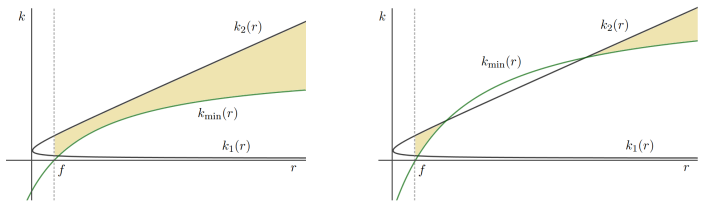
In the negative chemotaxis Keller-Segel system with logistic growth and chemically induced lethality, constant external chemorepellent supplies cause solutions to converge in the L^∞ norm to extinction when the supply is large relative to the logistic growth rate, or to a positive spatially homogeneous steady state when the supply is small.
What carries the argument
The threshold comparison between the magnitude of the constant external chemorepellent supply and the logistic growth rate, which determines the sign that controls long-time attraction to the zero state or the positive constant.
If this is right
- When the constant supply lies below the critical value, every solution approaches the same positive uniform density regardless of initial data.
- When the supply lies above the critical value, the population density converges uniformly to zero everywhere.
- The repulsive chemotactic flux does not produce lasting spatial inhomogeneities under constant supply.
- Boundedness of solutions holds globally in time, with the long-term behavior fully classified by the parameter comparison.
Where Pith is reading between the lines
- The stabilizing role of a constant supply suggests that time-varying supplies could allow transient patterns before eventual homogenization or extinction.
- In applications, maintaining an external chemical level above threshold could achieve spatially uniform eradication of a cell population.
- Related models with nonlinear death rates or additional advection terms might admit analogous thresholds that can be tested numerically.
Load-bearing premise
The external supply of the chemorepellent is constant in both time and space.
What would settle it
An explicit solution or numerical trajectory that develops persistent spatial patterns or fails to reach extinction when the supply exceeds the logistic threshold.
Figures
read the original abstract
In this paper, we investigate the long-time dynamics of a repulsive Keller-Segel chemotaxis system. The model features negative chemotaxis, logistic growth and a cell death term, accounting for a lethal chemorepellent that is self-produced by the cells and externally supplied. We prove that, for constant chemorepellent supplies, depending on their magnitude with respect to the logistic growth rate, solutions converge in $L^\infty$ norm toward extinction of the population, or equilibrate toward a nontrivial spatially homogeneous steady state.
Editorial analysis
A structured set of objections, weighed in public.
Referee Report
Summary. The paper investigates the long-time dynamics of a repulsive Keller-Segel chemotaxis system with negative chemotaxis, logistic growth, and a cell death term induced by a self-produced and externally supplied lethal chemorepellent. The central result establishes that, for constant-in-time-and-space chemorepellent supplies, solutions converge in the L^∞ norm either to extinction or to a unique nontrivial spatially homogeneous steady state, with the outcome determined by comparing the supply magnitude to the logistic growth rate.
Significance. If the proofs hold, the result gives a clean, parameter-driven dichotomy for global stability in this class of models, exploiting the time-independence of the supply to reduce the asymptotics to a scalar comparison. This is a useful contribution to the analysis of repulsive chemotaxis systems with lethality, as it identifies explicit thresholds separating extinction from survival at a homogeneous equilibrium. The approach appears to rely on comparison principles or energy methods that become tractable precisely because the supply is constant, which is a genuine technical advantage.
minor comments (2)
- The abstract states L^∞ convergence but does not indicate whether the proof first obtains L^1 or L^2 bounds before upgrading; a brief outline of the bootstrap or comparison argument in the introduction would improve readability.
- Notation for the death term and chemotactic sensitivity function should be fixed consistently between the model statement and the steady-state analysis to avoid any ambiguity in the parameter threshold.
Simulated Author's Rebuttal
We thank the referee for the careful reading and positive evaluation of our manuscript. The referee's summary accurately captures the main contribution: the L^∞ convergence dichotomy for solutions of the repulsive chemotaxis system with constant chemorepellent supply, determined by comparison with the logistic growth rate. We are pleased that the technical advantage of time-independent supply is recognized. No major comments were listed in the report, so we have no specific points requiring response or revision at this stage. We remain available to address any minor suggestions should they be provided.
Circularity Check
No significant circularity; derivation is self-contained
full rationale
The paper establishes global stability for the repulsive Keller-Segel system with logistic growth and lethal death term by applying standard parabolic comparison principles and energy dissipation estimates to the given PDEs under the assumption of constant-in-time-and-space chemorepellent supply. The long-time behavior is controlled by a direct scalar comparison between supply magnitude and logistic growth rate, which follows from the model equations without any fitted parameters, self-referential definitions, or load-bearing self-citations. No step reduces a claimed result to an input quantity by construction, and the proof chain remains independent of the target stability statement.
Axiom & Free-Parameter Ledger
axioms (1)
- domain assumption The system is governed by the standard parabolic chemotaxis equations augmented with logistic growth and a lethality term proportional to the chemorepellent density.
Reference graph
Works this paper leans on
-
[1]
X. Bai, M. Winkler.Equilibration in a fully parabolic two-species chemotaxis system with competitive kinetics.Indiana Univ. Math. J., 65(2), (2016)
work page 2016
-
[2]
N. Bellomo, A. Bellouquid, Y. Tao, M. Winkler.Toward a mathematical theory of Keller-Segel models of pattern formation in biological tissues.Math. Model. Methods Appl. Sci., 25, 1663–1763, (2015)
work page 2015
-
[3]
T. Cieślak, M. Fuest, K. Hajduk, M. Sierżęga.On the existence of global solutions for the 3D chemore- pulsion system.Z. Anal. Anwend., 43 (2024)
work page 2024
-
[4]
X. Deng, Q. Huang, Z.-A. Wang.Global dynamics and pattern formation in a diffusive population- toxicant model with negative toxicant-taxis.SIAM J. Appl. Math., 83 (6), (2023)
work page 2023
- [5]
-
[6]
F. Herrero-Hervás, M. NegreanuAsymptotics and periodic dynamics in a negative chemotaxis system with cell lethality. Preprint (2025)
work page 2025
-
[7]
F. Herrero-Hervás, M. Negreanu.On a negative chemotaxis system with lethal interaction.Commun. Nonlinear Sci. Numer. Simul., 156, (2026)
work page 2026
-
[8]
D. Horstmann.From 1970 until present: the Keller-Segel model in chemotaxis and its consequences, Jahresbericht der Deutschen Mathematiker-Vereinigung. 105(3), 103-165, (2003)
work page 1970
-
[9]
E. F. Keller, L. A. SegelInitiation of slime mold aggregation viewed as an instability. J. Theoret. Biol,. 26, (1970)
work page 1970
-
[10]
E. F. Keller, L. A. SegelA model for chemotaxis.J. Theoret. Biol., 30, (1971)
work page 1971
-
[11]
O. A. Ladyzhenskaya, V. A. Solonnikov, N. N. Ural’tseva.Linear and Quasi-Linear Equations of Parabolic Type.Amer. Math. Soc., Providence, RI, (1968)
work page 1968
-
[12]
M. Mizukami.Boundedness and asymptotic stability in a two-species chemotaxis-competition model with signal-dependent sensitivity.Discrete Contin. Dyn. Syst. Ser. B, 22(6), (2017)
work page 2017
-
[13]
G. Ren, B. Liu.Global dynamics for an attraction–repulsion chemotaxis model with logistic source.J. Differ. Equ., 268 (8), (2020)
work page 2020
- [14]
-
[15]
G. H. Wadhams, J. P Armitage.Making sense of it all: bacterial chemotaxisNat Rev Mol Cell Biol, 5(12), (2004)
work page 2004
- [16]
discussion (0)
Sign in with ORCID, Apple, or X to comment. Anyone can read and Pith papers without signing in.