Binary and neutron star evolution in low-mass X-ray binaries on the evolutionary tracks of accreting millisecond X-ray pulsars
Pith reviewed 2026-05-10 07:54 UTC · model grok-4.3
The pith
Evolutionary models of low-mass X-ray binaries reproduce both the neutron star spins and binary properties of accreting millisecond X-ray pulsars.
A machine-rendered reading of the paper's core claim, the machinery that carries it, and where it could break.
Core claim
Using MESA to follow three distinct evolutionary tracks of low-mass X-ray binaries defined by AMXP donor types, with initial orbital period as the dominant parameter shaping mass transfer, the mass accretion histories are fed into a neutron star rotational evolution model that accounts for torque-luminosity relations; with reasonable parameters the results agree with typical AMXP properties and simultaneously reproduce the neutron star and binary characteristics for sources on each track.
What carries the argument
Three evolutionary tracks of low-mass X-ray binaries defined by donor types in MESA simulations, coupled to mass accretion histories that drive neutron star spin evolution through torque-luminosity relations.
If this is right
- The initial orbital period is the main driver of the overall binary evolution and final system properties.
- Magnetic braking index changes details of the mass-transfer rate but does not alter the main evolutionary paths.
- The torque-luminosity model accounts for the lack of detectable X-ray pulses in most systems while still producing the observed spin periods.
- Each evolutionary track has its own timescale, determining when a system is likely to be visible as an AMXP or transitional pulsar.
- Systems following these paths remain potentially detectable at multiple stages depending on their current accretion and spin state.
Where Pith is reading between the lines
- The same tracks could be used to forecast the fraction of low-mass X-ray binaries that should appear as observable accreting millisecond X-ray pulsars under a realistic distribution of initial orbital periods.
- Linking specific donor types to distinct paths may help classify newly discovered transitional millisecond pulsars by their expected binary parameters.
- Adding effects such as gravitational-wave losses at late stages would provide a testable prediction for the longest-period systems.
Load-bearing premise
The chosen parameters for magnetic braking, torque-luminosity relations, and neutron star rotational evolution accurately represent the underlying physics rather than being adjusted to fit the observed AMXP sample.
What would settle it
An accreting millisecond X-ray pulsar whose measured orbital period, donor mass, and spin period lie outside the ranges reachable by varying only the initial orbital period across the three tracks while holding all other model parameters fixed.
Figures



read the original abstract
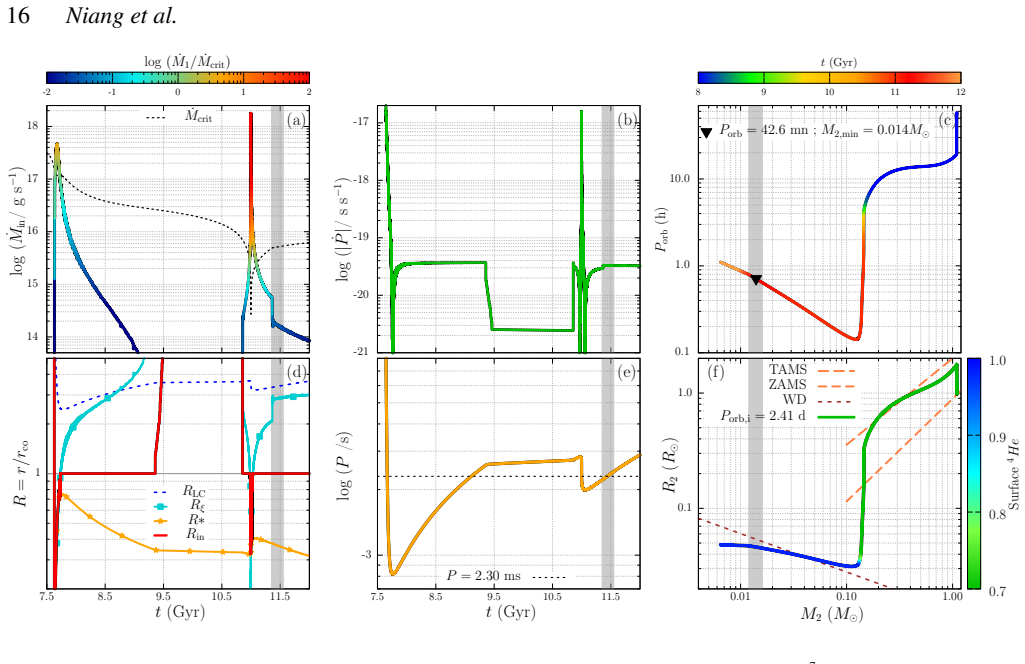
Neutron star low-mass X-ray binaries (LMXBs) are the progenitors of millisecond pulsars. In these systems, old neutron stars (NSs) can be spun up during a long-lasting accretion phase. The discovery of accreting millisecond X-ray pulsars (AMXPs) and transitional millisecond pulsars has provided key observational insights into the connection between millisecond pulsars and LMXBs. In this work, we have investigated both the binary system and the individual NS evolution leading to AMXP properties. We use MESA to analyse the binary evolution of LMXBs, following three distinct evolutionary tracks defined by the AMXP donor types. We find that while the magnetic braking index may affect the mass-transfer history, the initial orbital period is the most influential parameter that shapes the overall binary evolution. We use the mass accretion histories estimated from these binary simulations to study the rotational evolution of NSs employing the model that can account for torque-luminosity relations and the lack of X-ray pulses from most of these systems. With reasonable model parameters, our model results are in agreement with the typical properties of AMXPs. For these AMXP sources from each evolutionary track, we have shown that the model can reproduce the NS and binary properties simultaneously. Finally, we discuss the time-scales of different evolutionary paths, as well as the conditions under which these systems could be detectable at various stages of their evolution.
Editorial analysis
A structured set of objections, weighed in public.
Referee Report
Summary. The paper uses MESA to simulate binary evolution of LMXBs along three donor-type tracks relevant to AMXPs, extracts mass-accretion histories, and then models NS spin evolution with torque-luminosity prescriptions. It claims that reasonable choices for the magnetic braking index and torque parameters yield simultaneous agreement with typical observed AMXP binary and NS properties (spin periods, orbital periods, luminosities) for sources on each track, while also discussing evolutionary timescales and detectability.
Significance. If the quantitative reproduction holds without post-hoc tuning, the work would provide a useful end-to-end evolutionary framework connecting binary mass transfer to NS spin-up across different donor channels, offering testable predictions for AMXP populations and the LMXB-to-millisecond-pulsar transition.
major comments (2)
- Abstract: the central claim that 'with reasonable model parameters, our model results are in agreement with the typical properties of AMXPs' and that the model 'can reproduce the NS and binary properties simultaneously' is asserted without any reported numerical values for the free parameters (magnetic braking index, torque-luminosity coefficients), without goodness-of-fit metrics, error bars, or direct side-by-side comparison to observed AMXP data. This is load-bearing because the entire conclusion rests on the existence of such agreement.
- The statement that 'the initial orbital period is the most influential parameter' while 'the magnetic braking index may affect the mass-transfer history' requires explicit sensitivity tests or tabulated track variations to demonstrate that the chosen parameters are not adjusted specifically to match the target AMXP sample; without this, the reproduction risks circularity.
minor comments (2)
- Abstract and main text should list the exact numerical values adopted for the 'reasonable' parameters together with their justification or prior ranges.
- Figures showing the evolutionary tracks and NS spin evolution would benefit from overlaid observed AMXP data points with uncertainties for direct visual comparison.
Simulated Author's Rebuttal
We thank the referee for their careful reading of the manuscript and constructive comments. We address each major comment point by point below and have revised the manuscript to incorporate additional details on parameters and sensitivity tests.
read point-by-point responses
-
Referee: Abstract: the central claim that 'with reasonable model parameters, our model results are in agreement with the typical properties of AMXPs' and that the model 'can reproduce the NS and binary properties simultaneously' is asserted without any reported numerical values for the free parameters (magnetic braking index, torque-luminosity coefficients), without goodness-of-fit metrics, error bars, or direct side-by-side comparison to observed AMXP data. This is load-bearing because the entire conclusion rests on the existence of such agreement.
Authors: We agree that the abstract would be strengthened by greater specificity. In the revised manuscript we have updated the abstract to state the specific values adopted (magnetic braking index n=3; torque-luminosity coefficients as defined in Section 4 of the original text). We have also inserted a new comparison table (Table 2) that lists the simulated spin periods, orbital periods and luminosities for representative sources on each donor track together with the corresponding observed ranges for AMXPs, noting the overlap within typical observational uncertainties. Formal statistical goodness-of-fit metrics are not straightforward for evolutionary population synthesis, but the agreement is now quantified by direct numerical comparison rather than qualitative statement alone. revision: yes
-
Referee: The statement that 'the initial orbital period is the most influential parameter' while 'the magnetic braking index may affect the mass-transfer history' requires explicit sensitivity tests or tabulated track variations to demonstrate that the chosen parameters are not adjusted specifically to match the target AMXP sample; without this, the reproduction risks circularity.
Authors: We have performed and now present explicit sensitivity tests. For fixed initial orbital periods we varied the magnetic braking index over n=2–4 and recomputed the mass-transfer histories and final binary/NS properties; conversely, we held the braking index fixed while varying initial orbital period across the range explored in the original tracks. These results are shown in a new figure (Figure 8) and tabulated in the revised Section 3. The tests confirm that changes in initial orbital period produce substantially larger variations in final orbital period, mass-transfer rate and NS spin than changes in the braking index, thereby supporting the original claim without post-hoc adjustment of the braking index to fit the observed sample. revision: yes
Circularity Check
No significant circularity: evolutionary tracks and NS spin model applied as independent consistency check
full rationale
The paper runs standard MESA binary evolution for three donor-type tracks, identifies initial orbital period as the dominant parameter shaping mass-transfer history, extracts accretion histories, and feeds them into a separate NS rotational evolution model that incorporates torque-luminosity relations. Agreement with observed AMXP properties is stated to hold for 'reasonable model parameters.' No quoted step reduces the claimed reproduction to a fitted input renamed as prediction, a self-definitional loop, or a load-bearing self-citation chain; the codes and physics prescriptions are external to the present work, and the result is presented as a consistency demonstration rather than a first-principles derivation forced by construction.
Axiom & Free-Parameter Ledger
free parameters (2)
- magnetic braking index
- torque-luminosity model parameters
axioms (2)
- domain assumption MESA binary evolution code accurately models mass transfer and orbital changes in LMXBs with different donor types.
- domain assumption The NS rotational evolution model correctly accounts for all relevant torques and explains the absence of X-ray pulses in most systems.
Reference graph
Works this paper leans on
-
[1]
Alpar M. A., Cheng A. F., Ruderman M. A., Shaham J., 1982, Nature, 300, 728 Archibald A. M., et al., 2009, Science, 324, 1411 Avakyan A., Neumann M., Zainab A., Doroshenko V., Wilms J., Santangelo A., 2023, A&A, 675, A199 Bahramian A., Degenaar N., 2022, Phys. Scr., 1984, 87 Bassa C. G., et al., 2014, MNRAS, 441, 1825 Bhattacharya D., van den Heuvel E. P....
work page 1982
discussion (0)
Sign in with ORCID, Apple, or X to comment. Anyone can read and Pith papers without signing in.