Two-Tier High Altitude Platform Stations (HAPS) for Exploring Wireless Energy Harvesting
Pith reviewed 2026-05-10 05:55 UTC · model grok-4.3
The pith
A two-tier HAPS architecture lets regular platforms harvest wireless energy from a mother platform to reach higher data rates than conventional setups.
A machine-rendered reading of the paper's core claim, the machinery that carries it, and where it could break.
Core claim
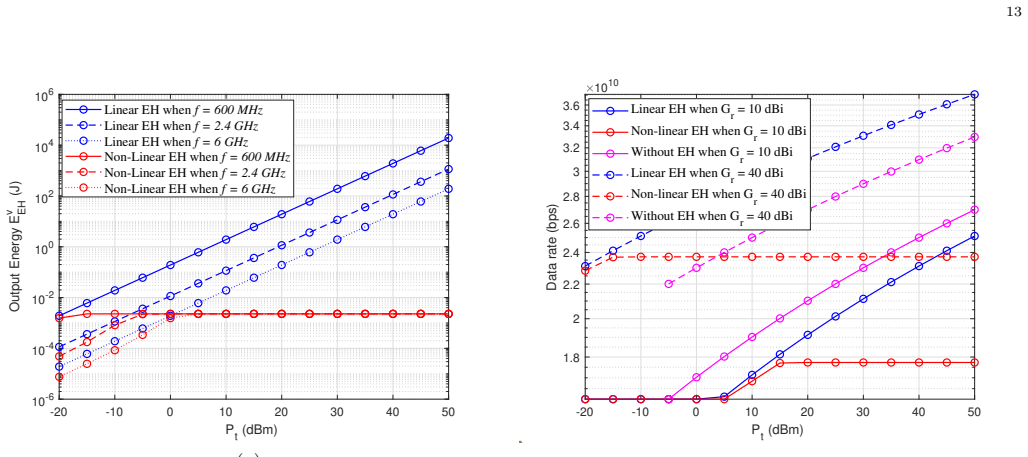
In the two-tier HAPS-SMBS architecture, regular nodes harvest energy from the mother node's signals while the mother coordinates with the ground station. Optimal positioning of regular nodes is derived to reduce attenuation and power loss. The joint optimization of positioning and harvesting factor is solved by the iterative distance and EH factor algorithm, whose performance is checked with Q-learning. The EH-enabled system produces higher data rates than conventional approaches, with maximum transmit power delivering the largest improvement.
What carries the argument
The two-tier HAPS-SMBS architecture, where a mother node manages coordination and energy transfer while regular nodes harvest from its signals, together with the iterative distance and EH factor algorithm that jointly tunes node location and harvesting ratio.
If this is right
- Optimal regular HAPS-SMBS placement reduces signal attenuation and power loss in the two-tier setup.
- Maximizing transmit power produces larger data-rate gains than operating without energy harvesting.
- Q-learning approximates optimal values more closely than the iterative algorithm after sufficient training in linear models.
- EH-enabled HAPS-SMBS nodes deliver measurably higher data rates than conventional systems without harvesting.
Where Pith is reading between the lines
- Persistent aerial coverage could become feasible in remote regions if energy sharing between platforms proves reliable.
- The coordination role of the mother HAPS might scale to dynamic UAV swarms that share energy on demand.
- Ground-station integration could let the system adapt harvesting factors in real time based on traffic load.
- Atmospheric and mobility effects omitted in the model would need separate validation before deployment.
Load-bearing premise
Wireless energy can be harvested from nearby HAPS signals with enough efficiency to produce real performance gains, without accounting for atmospheric losses or platform motion.
What would settle it
A side-by-side field measurement of harvested energy and achieved data rate on moving HAPS platforms under real atmospheric conditions versus the paper's simulated non-EH baseline.
Figures




read the original abstract
In sixth-generation (6G) cellular networks and beyond, aerial platforms, such as uncrewed aerial vehicles (UAVs) and high-altitude platform stations (HAPS), are anticipated to play a crucial role in enhancing connectivity, expanding network coverage, and supporting advanced communication services. However, the deployment of energy-efficient onboard communication systems is essential for their widespread adoption and effectiveness. The integration of energy harvesting (EH) into aerial platforms is envisioned to be pivotal in promoting both energy and cost efficiency. In this paper, we propose a new paradigm for aerial platforms in which they can collect energy from the transmitted signals of nearby aerial platforms. The paper employs a two-tier architecture with HAPS super-macro base stations (HAPS-SMBS) system: regular HAPS-SMBS nodes serve as base stations, while a "mother" HAPS-SMBS node acts as a manager to coordinate communications between regular HAPS-SMBS and the ground station, thus enabling wireless energy transfer. Specifically, we analyze the characteristics of EH-enabled HAPS-SMBS and compare their performance with those without EH. Additionally, we derive the optimal regular HAPS-SMBS positioning to mitigate signal attenuation and power loss. Subsequently, we formulate a joint optimization problem for regular HAPS-SMBS positioning and the EH factor. We solve the problem using the iterative distance and EH factor algorithm (IDFA); however, we employ $Q$-learning to verify its effectiveness. Our findings indicate that, compared to conventional EH systems, IDFA and $Q$-learning exhibit higher data rate performance. In contrast, $Q$-learning outperforms IDFA systems in linear modelswith intensive training in approximating optimal values. Furthermore, maximizing transmit power achieves higher gains than systems without EH.
Editorial analysis
A structured set of objections, weighed in public.
Referee Report
Summary. The paper proposes a two-tier HAPS architecture for 6G networks in which a coordinating 'mother' HAPS-SMBS node enables wireless energy transfer to regular HAPS-SMBS nodes that serve as base stations. It analyzes EH-enabled HAPS-SMBS performance versus non-EH systems, derives optimal regular HAPS-SMBS positioning to reduce attenuation, formulates a joint optimization of positioning and EH factor, solves it via the proposed Iterative Distance and EH Factor Algorithm (IDFA), and employs Q-learning for verification. The central claims are that IDFA and Q-learning yield higher data rates than conventional EH baselines, that Q-learning outperforms IDFA under intensive training in linear models, and that maximizing transmit power produces higher gains than non-EH systems.
Significance. If the optimization procedure and reported gains can be placed on a rigorous footing with convergence guarantees and reproducible simulations, the work would offer a concrete contribution to energy-efficient aerial platform design by showing how inter-platform wireless power transfer and positioning can be jointly managed. The two-tier coordination idea and the explicit comparison of an iterative heuristic against reinforcement learning are potentially useful for the community, but the absence of supporting analysis currently prevents the claims from being actionable.
major comments (3)
- [Abstract / IDFA section] Abstract and IDFA description: the paper asserts that IDFA solves the joint positioning-plus-EH-factor problem and delivers higher data rates than conventional EH, yet supplies neither a convergence analysis, iteration bound, nor optimality gap for IDFA. Because the headline performance superiority rests on IDFA reaching the claimed operating points, the lack of these guarantees is load-bearing.
- [Abstract] Abstract: the statement that 'Q-learning outperforms IDFA systems in linear models with intensive training' directly indicates that IDFA returns only locally good solutions. Without a quantitative comparison of the IDFA–Q-learning gap or a benchmark against global search / convex relaxation, the claim that IDFA itself improves upon conventional EH cannot be secured.
- [EH analysis and positioning section] EH modeling and positioning derivation: the feasibility of meaningful energy harvesting from nearby HAPS signals is asserted without accounting for atmospheric attenuation, Doppler due to platform motion, or realistic EH circuit efficiency curves. These factors directly affect whether the derived optimal positioning and EH factor produce the claimed rate gains.
minor comments (2)
- [Abstract] Abstract contains a typographical error: 'linear modelswith' should be 'linear models with'.
- [System model] Notation for the EH factor and the 'mother HAPS-SMBS' entity is introduced without a clear symbol table or consistent definition across the optimization formulation.
Simulated Author's Rebuttal
We thank the referee for the constructive and detailed comments, which help improve the rigor of our work. We address each major comment point by point below, outlining the specific revisions planned for the next manuscript version.
read point-by-point responses
-
Referee: [Abstract / IDFA section] Abstract and IDFA description: the paper asserts that IDFA solves the joint positioning-plus-EH-factor problem and delivers higher data rates than conventional EH, yet supplies neither a convergence analysis, iteration bound, nor optimality gap for IDFA. Because the headline performance superiority rests on IDFA reaching the claimed operating points, the lack of these guarantees is load-bearing.
Authors: We agree that the absence of a formal convergence analysis for IDFA weakens the claims. IDFA is an alternating iterative procedure that successively optimizes positioning and the EH factor. In the revised manuscript we will add a dedicated subsection proving convergence to a stationary point (under the Lipschitz continuity of the rate function and bounded step sizes) and reporting empirical iteration counts from the simulations. We will also quantify the optimality gap by comparing IDFA solutions against exhaustive search on reduced-scale instances. revision: yes
-
Referee: [Abstract] Abstract: the statement that 'Q-learning outperforms IDFA systems in linear models with intensive training' directly indicates that IDFA returns only locally good solutions. Without a quantitative comparison of the IDFA–Q-learning gap or a benchmark against global search / convex relaxation, the claim that IDFA itself improves upon conventional EH cannot be secured.
Authors: The referee is correct that the statement implies IDFA may reach only local solutions. To secure the improvement claim, we will revise the abstract and add a new results subsection that reports the numerical gap (in bps/Hz) between IDFA and Q-learning across all simulated scenarios. We will further benchmark IDFA against a convex relaxation obtained by successive convex approximation and, where tractable, against global search, thereby placing the gains over non-EH baselines on firmer ground. revision: yes
-
Referee: [EH analysis and positioning section] EH modeling and positioning derivation: the feasibility of meaningful energy harvesting from nearby HAPS signals is asserted without accounting for atmospheric attenuation, Doppler due to platform motion, or realistic EH circuit efficiency curves. These factors directly affect whether the derived optimal positioning and EH factor produce the claimed rate gains.
Authors: We acknowledge that the present model uses ideal free-space propagation. In the revision we will replace the EH link model with one that includes atmospheric attenuation (via ITU-R recommendations for HAPS altitudes), Doppler shift arising from platform velocity, and a realistic RF-to-DC efficiency curve drawn from measured rectenna data. The optimal positioning derivation and all rate comparisons will be recomputed under the updated model, with the changes clearly highlighted. revision: yes
Circularity Check
No significant circularity; optimization and verification steps remain independent of fitted inputs
full rationale
The paper derives optimal HAPS-SMBS positioning from path-loss considerations, formulates a joint optimization over positioning and EH factor, introduces IDFA as an iterative solver, and invokes Q-learning solely for verification against conventional EH baselines. No equations or steps reduce by construction to the same data or parameters used for evaluation; IDFA is presented as a new algorithm without self-referential fitting, and performance claims rest on explicit comparisons rather than tautological renaming or self-citation chains. The derivation chain is self-contained against external benchmarks.
Axiom & Free-Parameter Ledger
free parameters (2)
- EH factor
- regular HAPS positioning
axioms (1)
- domain assumption Wireless energy can be harvested from RF signals transmitted by nearby HAPS platforms
invented entities (1)
-
mother HAPS-SMBS node
no independent evidence
Reference graph
Works this paper leans on
-
[1]
B. Karaman, I. Basturk, S. Taskin, E. Zeydan, F. Kara, E. A. Beyazıt, M. Camelo, E. Björnson, and H. Yanikomeroglu, “Solu- tions for sustainable and resilient communication infrastructure in disaster relief and management scenarios,” IEEE Commun. Surv. Tutor. (Early Access), 2025
work page 2025
-
[2]
Empowering non-terrestrial networks with artificial intelligence: A survey,
A. Iqbal, M.-L. Tham, Y. J. Wong, G. Wainer, Y. X. Zhu, T. Dagiuklas et al., “Empowering non-terrestrial networks with artificial intelligence: A survey,” IEEE Access, vol. 11, pp. 100 986–101 006, 2023
work page 2023
-
[3]
The bridge toward 6G: 5G-Advanced evolution in 3GPP Release I9,
X. Lin, “The bridge toward 6G: 5G-Advanced evolution in 3GPP Release I9,” IEEE Commun. Stand. Mag., vol. 9, no. 1, pp. 28–35, 2025
work page 2025
-
[4]
G. T. 38.863, “Solutions for NR to support non-terrestrial networks (NTN): Non-terrestrial networks (NTN) related RF and co-existence aspects,” 2023
work page 2023
-
[5]
Enhanced sensing in 6G NTN: Imaging with LEO satellite and UA V communication network,
X. Lv, R. Liu, R. Hou, Q. Liu, Q. Zhu, Y. Zang, and J. S. Thompson, “Enhanced sensing in 6G NTN: Imaging with LEO satellite and UA V communication network,” IEEE Sens. J., vol. 25, no. 17, pp. 33 005–33 021, 2025. 15
work page 2025
-
[6]
Non-terrestrial networks in the 6G era: Challenges and opportunities,
M. Giordani and M. Zorzi, “Non-terrestrial networks in the 6G era: Challenges and opportunities,” IEEE Net., vol. 35, no. 2, pp. 244–251, 2020
work page 2020
-
[7]
Sustaining dynamic traffic in dense urban areas with high altitude platform stations (HAPS),
C. E. Kement, F. Kara, W. Jaafar, H. Yanikomeroglu, G. Senarath, N. D. Dao, and P. Zhu, “Sustaining dynamic traffic in dense urban areas with high altitude platform stations (HAPS),” IEEE Commun. Mag., vol. 61, no. 7, pp. 150–156, 2023
work page 2023
-
[8]
HAPS for 6G networks: Potential use cases, open challenges, and possible solutions,
O. Abbasi, A. Yadav, H. Yanikomeroglu, N.-D. Dao, G. Senarath, and P. Zhu, “HAPS for 6G networks: Potential use cases, open challenges, and possible solutions,” IEEE Wirel. Commun., vol. 31, no. 3, pp. 324–331, 2024
work page 2024
-
[9]
Link budget analysis for reconfigurable smart surfaces in aerial platforms,
S. Alfattani, W. Jaafar, Y. Hmamouche, H. Yanikomeroglu, and A. Yongaçoglu, “Link budget analysis for reconfigurable smart surfaces in aerial platforms,” IEEE Open J. Commun. Soc., vol. 2, pp. 1980–1995, 2021
work page 1980
-
[10]
Energy harvesting enabled-UA V relay assisted NOMA network under finite block- length,
S. Thapliyal, R. Pandey, and C. Charan, “Energy harvesting enabled-UA V relay assisted NOMA network under finite block- length,” IEEE Int. Things J., vol. 11, no. 13, pp. 23 255–23 267, 2024
work page 2024
-
[11]
RF-based energy harvesting: Nonlinear models, applications and challenges,
R. Jiang, “RF-based energy harvesting: Nonlinear models, applications and challenges,” arXiv preprint arXiv:2405.04976, 2024
-
[12]
Error performance analysis of UA V-mounted RIS for NOMA systems with practical constraints,
F. Khennoufa, K. Abdellatif, F. Kara, H. Yanikomeroglu, K. Rabie, T. Y. Elganimi, and S. Beddiaf, “Error performance analysis of UA V-mounted RIS for NOMA systems with practical constraints,” IEEE Commun. Lett., vol. 28, no. 4, pp. 887–891, 2024
work page 2024
-
[13]
Resource-efficient HAPS-RIS enabled beyond-cell communica- tions,
S. Alfattani, A. Yadav, H. Yanikomeroglu, and A. Yongacoglu, “Resource-efficient HAPS-RIS enabled beyond-cell communica- tions,” IEEE Wirel. Commun. Lett., vol. 12, no. 4, pp. 679–683, 2023
work page 2023
-
[14]
F. Khennoufa, K. Abdellatif, H. Yanikomeroglu, M. Ozturk, T. Elganimi, F. Kara, and K. Rabie, “A multi-layer non- terrestrial networks architecture for 6G and beyond under realistic conditions and with practical limitations,” IEEE IoTs. Mag., vol. 8, no. 5, pp. 136–143, 2025
work page 2025
-
[15]
Multi-layer network formation through HAPS base sta- tion and transmissive RIS-equipped UA V,
——, “Multi-layer network formation through HAPS base sta- tion and transmissive RIS-equipped UA V,” in IEEE Wirel. Commun. Net. Conf. (WCNC), 2025, pp. 1–6
work page 2025
-
[16]
UA V-based wide-area internet of things: an integrated deployment architecture,
Z. Na, B. Li, X. Liu, J. Wang, M. Zhang, Y. Liu, and B. Mao, “UA V-based wide-area internet of things: an integrated deployment architecture,” IEEE Net., vol. 35, no. 5, pp. 122– 128, 2021
work page 2021
-
[17]
RF energy harvesting using multidirectional rectennas: A review,
W. A. Khan, R. Raad, F. Tubbal, P. I. Theoharis, and S. Iranmanesh, “RF energy harvesting using multidirectional rectennas: A review,” IEEE Sens. J., vol. 24, no. 12, pp. 18 762– 18 790, 2024
work page 2024
-
[18]
Energy storage design for energy harvesting sensors,
D. Monagle, T. C. Krause, A. W. Langham, and S. B. Leeb, “Energy storage design for energy harvesting sensors,” IEEE Sens. J., 2025
work page 2025
-
[19]
S. Enayati, H. Saeedi, H. Pishro-Nik, and H. Yanikomeroglu, “Optimal altitude selection of aerial base stations to maximize coverage and energy harvesting probabilities: a stochastic ge- ometry Analysis,” IEEE Trans. Veh. Technol, vol. 69, no. 1, pp. 1096–1100, 2020
work page 2020
-
[20]
Distributed deployment of aerial base stations with RF energy harvesting,
S. Kida, T. Kimura, and T. Takine, “Distributed deployment of aerial base stations with RF energy harvesting,” in 2022 IEEE 95th Veh. Tech. Conf (VTC2022-Spring), 2022, pp. 1–5
work page 2022
-
[21]
T. M. Hoang, L. T. T. Huyen, X. N. Tran, and P. T. Hiep, “Outage probability of aerial base station NOMA MIMO wire- less communication with RF energy harvesting,” IEEE Internet Things J, vol. 9, no. 22, pp. 22 874–22 886, 2022
work page 2022
-
[22]
User scheduling and trajectory optimization for energy-efficient IRS- UA V networks with SWIPT,
S. Zargari, A. Hakimi, C. Tellambura, and S. Herath, “User scheduling and trajectory optimization for energy-efficient IRS- UA V networks with SWIPT,” IEEE Trans. Veh. Tech., vol. 72, no. 2, pp. 1815–1830, 2022
work page 2022
-
[23]
M. A. Ouamri, Y. Machter, D. Singh, D. Alkama, and X. Li, “Joint energy efficiency and throughput optimization for UA V- WPT integrated ground network using DDPG,” IEEE Com- mun. Lett., vol. 27, no. 12, pp. 3295 – 3299, 2023
work page 2023
-
[24]
H. Peng and L.-C. Wang, “Energy harvesting reconfigurable intelligent surface for UA V based on robust deep reinforcement learning,” IEEE Tran. Wirel. Commun., vol. 22, no. 10, pp. 6826–6838, 2023
work page 2023
-
[25]
Secure swarm UA V-assisted communications with cooperative friendly jam- ming,
H. Dang-Ngoc, D. N. Nguyen, K. Ho-Van, D. T. Hoang, E. Dutkiewicz, Q.-V. Pham, and W.-J. Hwang, “Secure swarm UA V-assisted communications with cooperative friendly jam- ming,” IEEE Int. Things J., vol. 9, no. 24, pp. 25 596–25 611, 2022
work page 2022
-
[26]
X. Ma, Z. Na, B. Lin, and L. Liu, “Energy efficiency optimiza- tion of UA V-assisted wireless powered systems for dependable data collections in internet of things,” IEEE Trans. Reliab., vol. 72, no. 2, pp. 472–482, 2022
work page 2022
-
[27]
SHARP (stationary high altitude relay plat- form),
“SHARP (stationary high altitude relay plat- form),” The Friends of CRC Association, Ac- cessed: Nov. 26, 2025. [Online]. A vailable: http://www.friendsofcrc.ca/Projects/SHARP/sharp.html
work page 2025
-
[28]
A microwaver powered, long duration, high altitude platform,
W. C. Brown, “A microwaver powered, long duration, high altitude platform,” in IEEE MTT-S Int. Microw. Symp. Dig., 1986, pp. 507–510
work page 1986
-
[29]
A microwave powered high altitude platform,
J. J. Schlesak, A. Alden, and T. Ohno, “A microwave powered high altitude platform,” in IEEE MTT-S Int. Microw. Symp. Dig., 1988, pp. 283–286
work page 1988
-
[30]
RF power: How RF energy harvesting works,
“RF power: How RF energy harvesting works,” MyArrow, Accessed: Nov. 26, 2025. [Online]. A vailable: https://www.arrow.com/en/research-and-events/articles/the- realities-of-rf-power-harvesting
work page 2025
-
[31]
W. C. Brown, “Design definition of a microwave power reception and conversion system for use on a high altitude powered platform,” NASA Contractor Report, vol. 15866, 1981
work page 1981
-
[32]
——, “Design study for a gound microwave power transmission system for use with a high-altitude powered platform,” NASA Contractor Report, vol. 168344, 1983
work page 1983
-
[33]
Performance of a high-power, 2.388-GHz receiving array in wireless power transmission over 1.54 km,
R. M. Dickinson, “Performance of a high-power, 2.388-GHz receiving array in wireless power transmission over 1.54 km,” in IEEE-MTT-S Int. Micr. Symp., 1976, pp. 139–141
work page 1976
-
[34]
Multi-layer transmitting RIS-aided receiver for collaborative jamming and anti-jamming networks,
J. Li, L. Yang, W. Hao, I. Ahmad, H. Liu, F. Shu, and D. Niyato, “Multi-layer transmitting RIS-aided receiver for collaborative jamming and anti-jamming networks,” IEEE Trans. Wireless Commun., vol. 24, no. 8, pp. 6518–6534, 2025
work page 2025
-
[35]
Absorptive RIS-assisted near-field covert com- munication with fluid antenna systems,
J. Li, L. Yang, C. You, I. Ahmad, P. S. Bithas, M. D. Renzo, and D. Niyato, “Absorptive RIS-assisted near-field covert com- munication with fluid antenna systems,” IEEE J. Sel. Areas Commun. (Early Access), 2025
work page 2025
-
[36]
H. T. Le, T. V. Nguyen, H. T. T. Pham, and N. T. Dang, “Harvested energy evaluation of free-space optics RIS-assisted ground-HAP-UA V system over composite channels,” in IEEE 99th Veh. Technol. Conf. (VTC2024-Spring), 2024, pp. 1–5
work page 2024
-
[37]
Exploiting multi-layer refracting RIS-assisted receiver for HAP-SWIPT networks,
K. An, Y. Sun, Z. Lin, Y. Zhu, W. Ni, N. Al-Dhahir, K.- K. Wong, and D. Niyato, “Exploiting multi-layer refracting RIS-assisted receiver for HAP-SWIPT networks,” IEEE Trans. Wirel. Commun, vol. 23, no. 10, pp. 12 638–12 657, 2024
work page 2024
-
[38]
Scalable robust beamforming for multi-layer refracting RIS-assisted HAP-SWIPT networks,
Y. Sun, K. An, Z. Lin, Y. Zhu, N. Al-Dhahir, and K.-K. Wong, “Scalable robust beamforming for multi-layer refracting RIS-assisted HAP-SWIPT networks,” in IEEE Glob. Commun. Conf., 2023, pp. 1656–1662
work page 2023
-
[39]
Q. Zhai, M. Bolić, Y. Li, W. Cheng, and C. Liu, “A Q-learning- based resource allocation for downlink non-orthogonal multiple access systems considering QoS,” IEEE Access, vol. 9, pp. 72 702–72 711, 2021
work page 2021
-
[40]
Nonlinear energy-harvesting for D2D networks un- derlaying UA V with SWIPT using MADQN,
M. A. Ouamri, G. Barb, D. Singh, A. B. Adam, M. Muthanna, and X. Li, “Nonlinear energy-harvesting for D2D networks un- derlaying UA V with SWIPT using MADQN,” IEEE Commun. Lett., vol. 27, no. 7, pp. 1804–1808, 2023
work page 2023
-
[41]
H. Yang, K. Lin, L. Xiao, Y. Zhao, Z. Xiong, and Z. Han, “En- ergy harvesting UA V-RIS-assisted maritime communications based on deep reinforcement learning against jamming,” IEEE Trans. Wirel. Commun., vol. 23, no. 8, pp. 9854–9868, 2024
work page 2024
-
[42]
J. Liu, Z. Xu, and Z. Wen, “Joint data transmission and tra- jectory optimization in UA V-enabled wireless powered mobile edge learning systems,” IEEE Trans. Veh. Tech., vol. 72, no. 9, pp. 11 617–11 630, 2023
work page 2023
-
[43]
A. Jabbari, H. Khan, S. Duraibi, I. Budhiraja, S. Gupta, and M. Omar, “Energy maximization for wireless powered communication enabled IoT devices With NOMA underlaying solar powered UA V using federated reinforcement learning for 6G networks,” IEEE Trans. Cons. Elect., vol. 70, no. 1, pp. 3926–3939, 2024
work page 2024
-
[44]
Framework and overall objectives of the future development of IMT for 2030 and beyond,
“Framework and overall objectives of the future development of IMT for 2030 and beyond,” ITU, 2023
work page 2030
-
[45]
ITU-R future report: high altitude platform stations as IMT base stations (HIBS),
A. Weissberger, “ITU-R future report: high altitude platform stations as IMT base stations (HIBS),” 2021. 16
work page 2021
-
[46]
User grouping and energy harvesting in UA V-NOMA system with AF/DF relaying,
D.-T. Do, A.-T. Le, Y. Liu, and A. Jamalipour, “User grouping and energy harvesting in UA V-NOMA system with AF/DF relaying,” IEEE Trans. Veh. Tech., vol. 70, no. 11, pp. 11 855– 11 868, 2021
work page 2021
-
[47]
S. Alfattani, W. Jaafar, H. Yanikomeroglu, and A. Yongaçoglu, “Multimode high-altitude platform stations for next-generation wireless networks: Selection mechanism, benefits, and potential challenges,” IEEE Veh. Tech. Mag., vol. 18, no. 3, pp. 20–28, 2023
work page 2023
-
[48]
High altitude platform station based super macro base station constellations,
M. S. Alam, G. K. Kurt, H. Yanikomeroglu, P. Zhu, and N. D. Dào, “High altitude platform station based super macro base station constellations,” IEEE Commun. Mag., vol. 59, no. 1, pp. 103–109, 2021
work page 2021
-
[49]
FSO-based vertical backhaul/fronthaul framework for 5G+ wireless networks,
M. Alzenad, M. Z. Shakir, H. Yanikomeroglu, and M. S. Alouini, “FSO-based vertical backhaul/fronthaul framework for 5G+ wireless networks,” IEEE Commun. Mag., vol. 56, no. 1, pp. 218–224, 2018
work page 2018
-
[50]
A vision and framework for the high altitude platform station (HAPS) networks of the future,
G. K. Kurt, M. G. Khoshkholgh, S. Alfattani, A. Ibrahim, T. S. Darwish, M. S. Alam, H. Yanikomeroglu, and A. Yongacoglu, “A vision and framework for the high altitude platform station (HAPS) networks of the future,” IEEE Commun. Sur. Tutor., vol. 23, no. 2, pp. 729–779, 2021
work page 2021
-
[51]
Deep reinforcement learning-based optimization for IRS-assisted cognitive radio systems,
C. Zhong, M. Cui, G. Zhang, Q. Wu, X. Guan, X. Chu, and H. V. Poor, “Deep reinforcement learning-based optimization for IRS-assisted cognitive radio systems,” IEEE Trans. Com- mun., vol. 70, no. 6, pp. 3849–3864, 2022
work page 2022
-
[52]
F. Khennoufa, A. Khelil, S. Beddiaf, F. Kara, K. Rabie, H. Kaya, A. Emir, S. Ikki, and H. Yanikomeroglu, “Wireless powered cooperative communication network for dual-hop uplink NOMA with IQI and SIC imperfections,” IEEE Access, vol. 11, pp. 76 506–76 523, 2023
work page 2023
-
[53]
Maximizing harvested energy in natural energy powered RF WPT with nonlinear EH model,
X. Zhang, K. Xiong, W. Chen, P. Fan, B. Gao, and K. Ben Letaief, “Maximizing harvested energy in natural energy powered RF WPT with nonlinear EH model,” IEEE Trans. Wirel. Commun., vol. 24, no. 7, pp. 5432–5445, 2025
work page 2025
-
[54]
Outage and throughput of WPCN-SWIPT networks with nonlinear EH model in Nakagami-m fading,
R. Jiang, K. Xiong, Y. Zhang, L. Zhou, T. Liu, and Z. Zhong, “Outage and throughput of WPCN-SWIPT networks with nonlinear EH model in Nakagami-m fading,” Elect., vol. 8, no. 2, p. 138, 2019
work page 2019
-
[55]
N. Saeed, H. Almorad, H. Dahrouj, T. Y. Al-Naffouri, J. S. Shamma, and M.-S. Alouini, “Point-to-point communication in integrated satellite-aerial 6G networks: State-of-the-art and future challenges,” IEEE Open J. Commun. Soc., vol. 2, pp. 1505–1525, 2021
work page 2021
-
[56]
The cubic formula-solve any 3rd degree poly- nomial equation,
E. Schechter, “The cubic formula-solve any 3rd degree poly- nomial equation,” Accessed: Oct. 15, 2025. [Online]. A vailable: https://math.vanderbilt.edu/schectex/courses/cubic/
work page 2025
-
[57]
M. Razaviyayn, M. Hong, and Z.-Q. Luo, “A unified conver- gence analysis of block successive minimization methods for nonsmooth optimization,” SIAM J. Optim, vol. 23, no. 2, pp. 1126–1153, 2013
work page 2013
-
[58]
Q- learning assisted energy-aware traffic offloading and cell switch- ing in heterogeneous networks,
A. I. Abubakar, M. Ozturk, S. Hussain, and M. A. Imran, “Q- learning assisted energy-aware traffic offloading and cell switch- ing in heterogeneous networks,” in IEEE 24th Int. Workshop Comput. Aided Model. Des. Commun. Links Netw., 2019, pp. 1–6
work page 2019
-
[59]
A landing spot approach for enhancing the performance of UA V-aided wireless networks,
R. Gangula, D. Gesbert, D. F. Külzer, and J. M. Franceschi, “A landing spot approach for enhancing the performance of UA V-aided wireless networks,” in IEEE Int. Conf. Commun. Workshops, 2018, pp. 1–6
work page 2018
-
[60]
Error performance of cooperative relaying systems empowered by SWIPT and NOMA,
F. Kara, “Error performance of cooperative relaying systems empowered by SWIPT and NOMA,” Phy. Commun., vol. 49, p. 101450, 2021
work page 2021
discussion (0)
Sign in with ORCID, Apple, or X to comment. Anyone can read and Pith papers without signing in.