On Drift Induced by Local Transition Asymmetry in Combinatorial State Spaces
Pith reviewed 2026-05-10 05:44 UTC · model grok-4.3
The pith
Asymmetry in local transitions induces a systematic drift in the distance process relative to a reference configuration.
A machine-rendered reading of the paper's core claim, the machinery that carries it, and where it could break.
Core claim
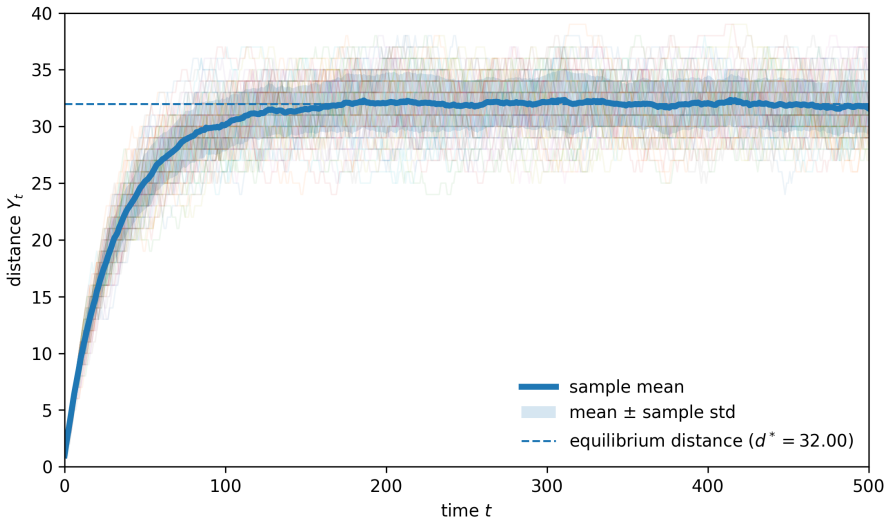
Asymmetry in local transitions induces a systematic drift in a distance process relative to a reference configuration. This drift results from the imbalance between inward and outward transitions, translating combinatorial multiplicities into directional bias. Analyzing the random walk on the Johnson graph, we derive explicit expressions for the drift and expected hitting times. We also show that locality constraints lead to trajectory-level differences that can hinder search trajectories from reaching the target, even under identical stationary distributions.
What carries the argument
The Johnson graph whose vertices are configurations grouped by distance to the reference and whose edges encode the allowed local transitions, from which net drift is computed as the difference in expected inward versus outward steps.
If this is right
- Explicit closed-form expressions exist for both the drift coefficient and the expected time to hit the reference configuration.
- Trajectory statistics deviate from those predicted by the stationary distribution alone.
- Local-search algorithms can be impeded by this drift even when the target configuration has positive stationary probability.
- The effect scales with the combinatorial layer sizes rather than with any external potential.
Where Pith is reading between the lines
- Algorithms that modify transition probabilities to balance inward and outward moves could reduce the unwanted drift without changing the target stationary measure.
- The same mechanism may appear in other distance-based combinatorial graphs whenever layer sizes are unequal.
- Hitting-time calculations that ignore the drift term will systematically underestimate or overestimate search effort depending on the sign of the bias.
Load-bearing premise
The combinatorial state space has local transitions whose multiplicities differ enough to produce a measurable imbalance between moves that decrease distance and moves that increase it.
What would settle it
A direct simulation of the random walk on the Johnson graph that measures zero net drift in the distance process despite unequal numbers of inward and outward transitions at each layer.
Figures


read the original abstract
We study stochastic processes on combinatorial state spaces with local transition constraints, as arise in local search algorithms. We show that asymmetry in local transitions induces a systematic drift in a distance process relative to a reference configuration. This drift results from the imbalance between inward and outward transitions, translating combinatorial multiplicities into directional bias. Analyzing the random walk on the Johnson graph, we derive explicit expressions for the drift and expected hitting times. We also show that locality constraints lead to trajectory-level differences that can hinder search trajectories from reaching the target, even under identical stationary distributions.
Editorial analysis
A structured set of objections, weighed in public.
Referee Report
Summary. The manuscript studies stochastic processes on combinatorial state spaces subject to local transition constraints, as encountered in local search. It shows that asymmetry in local transitions produces a systematic drift in the distance process to a reference configuration, arising from imbalances between inward and outward transition multiplicities that convert combinatorial counts into directional bias. Explicit expressions for the drift and expected hitting times are derived by treating the distance process as a Markov chain on the Johnson graph. The work further establishes that locality constraints induce trajectory-level differences capable of impeding target reachability even when the stationary distribution is identical to that of a symmetrized counterpart.
Significance. If the derivations hold, the paper supplies a precise, parameter-free account of how local asymmetry generates bias in combinatorial search, together with closed-form hitting-time expressions and a controlled trajectory comparison. These elements are directly usable for diagnosing performance gaps in local-search algorithms and for designing symmetry-preserving variants. The internal consistency of the Markov-chain analysis on the Johnson graph and the absence of fitted parameters or circular definitions constitute clear strengths.
minor comments (4)
- Abstract: the clause 'translating combinatorial multiplicities into directional bias' is clear in intent but would benefit from an immediate parenthetical reference to the specific multiplicity ratio that produces the drift (e.g., the ratio of outward to inward edges at distance k).
- Section on hitting-time derivation: the linear system is stated to follow from the distance-process transition matrix; an explicit display of that matrix (or at least its general entry) would improve reproducibility and allow readers to verify the closed-form solution.
- Trajectory comparison: the symmetrized counterpart is invoked to hold the stationary distribution fixed; a brief statement of how the symmetrization is constructed (e.g., averaging forward and reverse transition probabilities) should appear in the main text rather than only in a supplement.
- Notation: the distance process is denoted variously as a random walk on the Johnson graph and as a one-dimensional Markov chain; a single consistent symbol (e.g., D_t) and a short table of transition probabilities would reduce ambiguity.
Simulated Author's Rebuttal
We thank the referee for the careful reading and the positive assessment of the manuscript. The report correctly identifies the core contribution: the derivation of systematic drift in distance processes on the Johnson graph arising from local transition asymmetry, together with explicit hitting-time formulas and the trajectory-level comparison under identical stationary distributions. We are pleased that the parameter-free nature of the analysis and its direct applicability to local-search diagnostics were noted as strengths. Since the report contains no specific major comments, we interpret the minor_revision recommendation as a request for minor clarifications or polishing, which we will incorporate in the revised version.
Circularity Check
No significant circularity; derivation is self-contained Markov analysis
full rationale
The manuscript derives explicit drift and hitting-time expressions by treating the distance process as a Markov chain on the Johnson graph and computing transition probabilities directly from combinatorial multiplicities of inward versus outward edges. These steps rely on standard linear-system solutions for expected hitting times and do not reduce to fitted parameters, self-definitions, or load-bearing self-citations. The argument remains internally consistent and independent of the target result.
Axiom & Free-Parameter Ledger
axioms (2)
- standard math Properties of Markov chains and random walks on undirected graphs
- domain assumption Local transition constraints exist in the combinatorial state space
Reference graph
Works this paper leans on
-
[1]
Anne Auger and Benjamin Doerr.Theory of Randomized Search Heuristics. World Scien- tific, 2011
work page 2011
-
[2]
Konstantinos Benidis, Yiyong Feng, and Daniel P. Palomar. Sparse portfolios for high- dimensional financial index tracking.IEEE Transactions on Signal Processing, 66(1):155– 170, 2018
work page 2018
-
[3]
Avrim L. Blum and Pat Langley. Selection of relevant features and examples in machine learning.Artificial Intelligence, 97(1):245–271, 1997
work page 1997
-
[4]
Thomas M. Cover and Joy A. Thomas.Elements of Information Theory. Wiley, 2006. 21
work page 2006
-
[5]
Benjamin Doerr and Frank Neumann, editors.Theory of Evolutionary Computation: Re- cent Developments in Discrete Optimization. Springer, 2020
work page 2020
-
[6]
Local op- tima networks for constrained search spaces
Jonathan Fieldsend, Arnaud Liefooghe, Katherine Malan, and S´ ebastien Verel. Local op- tima networks for constrained search spaces. InProceedings of the Genetic and Evolu- tionary Computation Conference, GECCO ’25, pages 204–212, New York, NY, USA, 2025. Association for Computing Machinery
work page 2025
- [7]
-
[8]
An introduction to variable and feature selection
Isabelle Guyon and Andr´ e Elisseeff. An introduction to variable and feature selection. Journal of Machine Learning Research, 3:1157–1182, 2003
work page 2003
-
[9]
Drift analysis and average time complexity of evolutionary algorithms
Jun He and Xin Yao. Drift analysis and average time complexity of evolutionary algorithms. Artificial Intelligence, 127(1):57–85, 2001
work page 2001
-
[10]
Hoos and Thomas St¨ utzle.Stochastic Local Search: Foundations and Applica- tions
Holger H. Hoos and Thomas St¨ utzle.Stochastic Local Search: Foundations and Applica- tions. Elsevier / Morgan Kaufmann, 2004
work page 2004
-
[11]
PhD thesis, Uni- versity of New Mexico, Albuquerque, NM, 1995
Terry Jones.Evolutionary Algorithms, Fitness Landscapes and Search. PhD thesis, Uni- versity of New Mexico, Albuquerque, NM, 1995
work page 1995
-
[12]
John G. Kemeny and J. Laurie Snell.Finite Markov Chains. Springer-Verlag, 1976
work page 1976
-
[13]
Johannes Lengler. Drift analysis. InTheory of Evolutionary Computation: Recent Devel- opments in Discrete Optimization, pages 89–131. Springer, 2020
work page 2020
-
[14]
Levin, Yuval Peres, and Elizabeth L
David A. Levin, Yuval Peres, and Elizabeth L. Wilmer.Markov Chains and Mixing Times. American Mathematical Society, 2009
work page 2009
-
[15]
Katherine M. Malan and Andries P. Engelbrecht. A survey of techniques for characterising fitness landscapes and some possible ways forward.Information Sciences, 241:148–163, 2013
work page 2013
-
[16]
Marc M´ ezard and Andrea Montanari.Information, Physics, and Computation. Oxford University Press, 2009
work page 2009
-
[17]
Frank Neumann and Carsten Witt.Bioinspired Computation in Combinatorial Opti- mization: Algorithms and Their Computational Complexity. Natural Computing Series. Springer, 2010
work page 2010
-
[18]
Hidetoshi Nishimori.Statistical Physics of Spin Glasses and Information Processing: An Introduction. Oxford University Press, 2001
work page 2001
-
[19]
Gabriela Ochoa, Katherine M. Malan, and Christian Blum. Search trajectory networks: A tool for analysing and visualising the behaviour of metaheuristics.Applied Soft Computing, 109:107492, 2021
work page 2021
-
[20]
A study of NK landscapes’ basins and local optima networks
Gabriela Ochoa, Marco Tomassini, Seb´ astien V´ erel, and Christian Darabos. A study of NK landscapes’ basins and local optima networks. InProceedings of the 10th Annual Conference on Genetic and Evolutionary Computation, GECCO ’08, pages 555–562, New York, NY, USA, 2008. Association for Computing Machinery
work page 2008
-
[21]
Springer Berlin Heidelberg, Berlin, Heidelberg, 2014
Gabriela Ochoa, S´ ebastien Verel, Fabio Daolio, and Marco Tomassini.Local Optima Net- works: A New Model of Combinatorial Fitness Landscapes, pages 233–262. Springer Berlin Heidelberg, Berlin, Heidelberg, 2014. 22
work page 2014
-
[22]
Bernt Øksendal.Stochastic Differential Equations: An Introduction with Applications. Universitext. Springer, Berlin, Heidelberg, 6 edition, 2003
work page 2003
-
[23]
Princeton University Press, 2024
Luca Peliti.Statistical Mechanics in a Nutshell, Second Edition. Princeton University Press, 2024
work page 2024
-
[24]
Robert and George Casella.Monte Carlo Statistical Methods
Christian P. Robert and George Casella.Monte Carlo Statistical Methods. Springer, 2004
work page 2004
-
[25]
Yutaka Sakurai, Daiki Wakabayashi, and Fumio Ishizaki. Formulations to select assets for constructing sparse index tracking portfolios.Journal of Investment Strategies, 13(2):1–15, 2024
work page 2024
-
[26]
Thomson, Gabriela Ochoa, Daan van den Berg, Tianyu Liang, and Thomas Weise
Sarah L. Thomson, Gabriela Ochoa, Daan van den Berg, Tianyu Liang, and Thomas Weise. Entropy, search trajectories, and explainability for frequency fitness assignment. In Michael Affenzeller, Stephan M. Winkler, Anna V. Kononova, Heike Trautmann, Tea Tuˇ sar, Penousal Machado, and Thomas B¨ ack, editors,Parallel Problem Solving from Nature – PPSN XVIII, p...
work page 2024
discussion (0)
Sign in with ORCID, Apple, or X to comment. Anyone can read and Pith papers without signing in.