Universal compression of wave fields in weakly scattering media
Pith reviewed 2026-05-10 05:04 UTC · model grok-4.3
The pith
Wave fields in weakly scattering media compress by hundreds of times by confining their Fourier content to a thin dispersion shell, allowing accurate second-order calculations directly on the reduced data.
A machine-rendered reading of the paper's core claim, the machinery that carries it, and where it could break.
Core claim
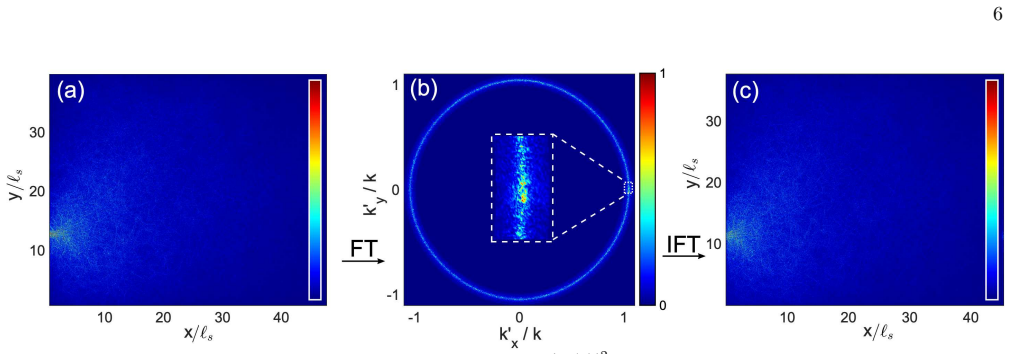
OSCAR exploits the universal confinement of the Fourier representation of wave fields to a thin dispersion shell, a direct consequence of wave propagation when the scattering mean free path significantly exceeds the wavelength. The resulting compression ratio reflects on-shell confinement and excess Fourier volume from sub-wavelength discretization. Second-order quantities such as intensity, correlations, and optical sensitivity remain accurate when computed via convolution entirely in compressed space because coherent interference between independently compressed fields is preserved.
What carries the argument
On-shell confinement of the wave-field Fourier representation to a thin dispersion shell, which encodes the propagation physics of weak scattering and permits both data reduction and direct operations on the compressed representation.
If this is right
- Compression ratios reach approximately 380 times with sub-percent field reconstruction error in 2D and 3D electromagnetic simulations.
- Intensity, field correlations, and optical sensitivity can be obtained by direct convolution in compressed space without reconstructing the full fields.
- The method supports routine ensemble averaging at system sizes relevant to biomedical optics, seismology, and underwater acoustics.
- The approach is universal for any weakly scattering medium and independent of specific scatterer realizations.
Where Pith is reading between the lines
- The same shell confinement should apply to acoustic or elastic waves in weakly scattering solids or fluids, suggesting direct transfer of the compression scheme.
- Time-dependent or pulsed fields could be handled by stacking thin shells at different frequencies, provided the mean-free-path condition holds across the bandwidth.
- Integration with existing mesh or wavelet compressors could further reduce storage for problems that combine sub-wavelength features with large overall scale.
Load-bearing premise
The scattering mean free path is much longer than the wavelength, which forces the Fourier content of the wave field onto a narrow shell.
What would settle it
A numerical simulation in a medium with mean free path comparable to wavelength that shows the Fourier spectrum of the field spreading well beyond the expected thin shell and producing large errors in reconstructed intensity would falsify the claimed compression accuracy.
Figures



read the original abstract
Advances in computational methods have made full-wave simulations in large disordered media increasingly feasible, but the resulting field data, scaling with the cube of the ratio of system size to wavelength, creates a severe storage and post-processing bottleneck. Generic compression methods are sample-specific and preclude operations on compressed data. We introduce OSCAR (On-Shell Compression And Reconstruction), a physics-based lossy compression scheme for weakly scattering media. OSCAR exploits the universal confinement of the Fourier representation of wave fields to a thin dispersion shell, a direct consequence of wave propagation when the scattering mean free path significantly exceeds the wavelength. The resulting compression ratio reflects two distinct scale separations: on-shell confinement due to weak scattering, and the excess Fourier-space volume introduced by sub-wavelength discretization of the scatterers. Crucially, second-order quantities such as intensity, correlations, and (optical) sensitivity can be computed via convolution entirely in compressed space and remain accurate even when individual field reconstruction incurs appreciable error, because coherent interference between independently compressed fields is preserved. Numerical simulations of electromagnetic waves in 2D and 3D confirm compression ratios up to ${\sim}380\times$ with sub-percent field error, enabling routine ensemble studies at scales relevant to biomedical optics, seismology, and underwater acoustics.
Editorial analysis
A structured set of objections, weighed in public.
Referee Report
Summary. The manuscript introduces OSCAR, a physics-based lossy compression scheme for wave fields in weakly scattering media. It exploits the confinement of the Fourier representation to a thin dispersion shell around |k|=k0, a direct consequence of the wave equation under the condition that the scattering mean free path greatly exceeds the wavelength. This yields compression ratios up to ~380x, with the key feature that second-order quantities (intensity, correlations, optical sensitivity) can be obtained via convolutions performed entirely in the compressed representation, remaining accurate even when individual field reconstructions have appreciable error. The approach is validated through 2D and 3D electromagnetic simulations.
Significance. If the accuracy claims for second-order observables hold, the method would provide a substantial practical advance for large-scale wave simulations by reducing storage demands while preserving the ability to compute ensemble statistics without full decompression. The parameter-free, derivation-based nature (no fitting or self-referential definitions) and explicit preservation of coherent interference are notable strengths that distinguish it from generic compressors.
major comments (1)
- Abstract: the claim that second-order quantities remain accurate via convolution in compressed space, even with appreciable field reconstruction error, lacks an explicit bound or scaling analysis for off-shell Fourier components. The Helmholtz equation implies that the field transform has non-zero support outside the dispersion shell whose amplitude scales with the scattering source strength; without a derivation showing when the resulting cross terms in quadratic forms fall below the reported sub-percent threshold, the central accuracy assertion is incompletely supported.
minor comments (3)
- The reported compression ratios and sub-percent errors would be strengthened by explicit details on how shell thickness and discretization parameters were selected, together with direct comparisons against standard compressors (e.g., wavelet or DCT-based) on identical wave-field datasets.
- Clarify the precise error metric used for the 'sub-percent field error' (L2 norm, maximum absolute error, or ensemble-averaged) and whether it is reported for the reconstructed fields or for the second-order quantities themselves.
- The abstract would benefit from a brief statement of the achieved compression ratios separately for the 2D and 3D cases to illustrate scaling with dimensionality.
Simulated Author's Rebuttal
We thank the referee for their positive evaluation of the significance of OSCAR and for the constructive comment on the abstract. We address the concern below and have revised the manuscript to strengthen the theoretical support for the accuracy of second-order observables.
read point-by-point responses
-
Referee: Abstract: the claim that second-order quantities remain accurate via convolution in compressed space, even with appreciable field reconstruction error, lacks an explicit bound or scaling analysis for off-shell Fourier components. The Helmholtz equation implies that the field transform has non-zero support outside the dispersion shell whose amplitude scales with the scattering source strength; without a derivation showing when the resulting cross terms in quadratic forms fall below the reported sub-percent threshold, the central accuracy assertion is incompletely supported.
Authors: We agree that the abstract claim would benefit from an explicit scaling argument. In the revised manuscript we have added a short derivation in Section II (Theory) showing that, under the weak-scattering condition ℓ_s ≫ λ, the off-shell Fourier amplitude is bounded by O((k_0 ℓ_s)^{-1}) relative to the on-shell component. Consequently, the cross terms that appear in quadratic forms (intensity, correlations, sensitivity) are suppressed by O((k_0 ℓ_s)^{-2}). For the regime explored in our simulations (k_0 ℓ_s ≳ 30), this places the relative error comfortably below the reported sub-percent level. We have also inserted a concise reference to this bound in the abstract and updated the caption of Figure 3 to note the scaling. The numerical results already demonstrate that the convolution-based observables remain accurate even when individual-field reconstruction error is several percent; the added analysis now supplies the missing analytic justification. revision: yes
Circularity Check
No significant circularity; derivation self-contained from wave equation
full rationale
The paper's core mechanism—on-shell confinement of the Fourier representation of wave fields—follows directly from the Helmholtz/wave equation under the weak-scattering condition (mean free path significantly exceeds wavelength), as stated in the abstract. OSCAR compression and the claim that second-order quantities (intensity, correlations, sensitivity) remain accurate via convolution in compressed space are presented as consequences of this physics-based scale separation and preservation of coherent interference, without any fitted parameters, self-referential definitions, or load-bearing self-citations. No step reduces by construction to its own inputs; the derivation chain is independent and externally grounded in standard wave propagation principles.
Axiom & Free-Parameter Ledger
axioms (1)
- domain assumption Wave propagation in media where the scattering mean free path significantly exceeds the wavelength confines the Fourier representation of the field to a thin dispersion shell.
Reference graph
Works this paper leans on
-
[1]
(5): P P∞ = 2 π tan−1(α) +O (kℓs)−1 ,(7) whereα= ∆k ℓ s
Power normalization Retaining spatial Fourier components within a shell of width ∆kcentered at|k ′|=kcaptures only a part of the total spectral weight in Eq. (5): P P∞ = 2 π tan−1(α) +O (kℓs)−1 ,(7) whereα= ∆k ℓ s. Forα= 1, 50% of the spectral weight is retained;α= 3 recovers≈80%. Reconstructed fields must be rescaled by p P∞/Pto preserve total energy. Fo...
-
[2]
Discrete dispersion relation Finite-difference discretization modifies the dispersion re- lation. For a uniform grid with spacing ∆x, the continu- ous relationk 2 =P i k′2 i becomes [17] ω c 2 ¯ε∆x2 = 4 dX i=1 sin2 k′ i∆x 2 ,(8) which reduces to the continuum limit as ∆x→0. At finite resolution, the iso-surface deviates from a sphere (circle in 2D) toward...
-
[3]
A Gaussian beam impinging on a semi-infinite scattering medium is an example of such a situation
Boundary/source-induced anisotropy In finite systems with directional and/or spatially con- fined sources, the azimuthal distribution of spectral weight along the shell might become nonuniform. A Gaussian beam impinging on a semi-infinite scattering medium is an example of such a situation. In this case, fields near the injection boundary and/or in the do...
-
[4]
Intensity as convolution As an example, we consider intensity of a scalar fieldE(r) found in a specific realization of disorder (no ensemble averaging) I(r) =E(r)E ∗(r).(10) In Fourier space, this product becomes a convolution: ˜I(q) = Z ddk′ (2π)d ˜E(k′) ˜E∗(k′ −q),(11) whereqis the spatial frequency of the intensity pattern andd=2,3 is the dimensionalit...
-
[5]
Optical sensitivity Optical sensitivityS(r 0) quantifies the response of de- tected flux to a localized absorptive perturbation at po- sitionr 0 inside the medium [39–41]. For a point pertur- bationδε(r) =i δϵ δV δ(r−r 0), it takes the form S(r0) =−k 2δVRe [E out(r0)E0(r0)],(12) whereE 0(r0) is the field atr 0 due to illumination from the source andE out(...
-
[6]
Ensemble averaging without decompression For disorder-averaged quantities I(r) or correlation func- tions E(r)E ∗(r′), the sample-independence of shell ge- ometry becomes essential. Because all compressed quan- tities in all disorder realizations share the same shell structure, ensemble operations can be performed on com- pressed data by averaging the con...
-
[7]
B. M. Notaroˇ s, F. P. Andriulli, and H. Bagci, Guest edi- torial frontiers in computational electromagnetics, IEEE Transactions on Antennas and Propagation71, 9175 (2023)
work page 2023
-
[8]
A. P. Mosk, A. Lagendijk, G. Lerosey, and M. Fink, Con- trolling waves in space and time for imaging and focusing in complex media, Nature Photonics6, 283 (2012)
work page 2012
-
[9]
J.-H. Park, Z. Yu, K. Lee, P. Lai, and Y. Park, Perspec- tive: Wavefront shaping techniques for controlling multi- ple light scattering in biological tissues: Toward in vivo applications, APL Photonics3, 100901 (2018)
work page 2018
-
[10]
S. Gigan, O. Katz, H. B. de Aguiar, E. R. Andresen, A. Aubry, J. Bertolotti, E. Bossy, D. Bouchet, J. Brake, S. Brasselet, Y. Bromberg, H. Cao, T. Chaigne, Z. Cheng, W. Choi, T. ˇCiˇ zm´ ar, M. Cui, V. R. Curtis, H. De- fienne, M. Hofer, R. Horisaki, R. Horstmeyer, N. Ji, A. K. LaViolette, J. Mertz, C. Moser, A. P. Mosk, N. C. P´ egard, R. Piestun, S. Pop...
work page 2022
-
[11]
H. Cao, A. P. Mosk, and S. Rotter, Shaping the propa- gation of light in complex media, Nature Physics18, 994 (2022)
work page 2022
-
[12]
A. F. Fercher, W. Drexler, C. K. Hitzenberger, and T. Lasser, Optical coherence tomography—principles and applications, Reports on Progress in Physics66, 239 (2003)
work page 2003
-
[13]
M. K. Kim, Principles and techniques of digital holo- graphic microscopy, SPIE Reviews1, 018005 (2010)
work page 2010
-
[14]
M. Kraszewski and J. Pluci´ nski, Coherent-wave monte carlo method for simulating light propagation in tissue, inProceedings of SPIE, Vol. 10063 (2016) p. 100631T
work page 2016
-
[15]
J. P. McCoy, L. E. Matloff, P. J. Vorster, D. X. Hammer, and R. D. Ferguson, Finite-difference time- domain (FDTD) optical simulations: A primer for life sciences and biophotonics practitioners, Micron142, 102989 (2021)
work page 2021
-
[16]
J. Virieux and S. Operto, An overview of full-waveform inversion in exploration geophysics, Geophysics74, WCC1 (2009)
work page 2009
- [17]
-
[18]
F. B. Jensen, W. A. Kuperman, M. B. Porter, and H. Schmidt,Computational Ocean Acoustics, 2nd ed. (Springer, 2011)
work page 2011
-
[19]
Y.-T. Lin, J. M. Collis, and T. F. Duda, A three- dimensional parabolic equation model of sound propaga- tion using higher-order operator splitting and Pad´ e ap- proximants, Journal of the Acoustical Society of America 132, EL364 (2012)
work page 2012
- [20]
-
[21]
S. Mache and I. M. Vellekoop, Domain decomposition of the modified Born series approach for large-scale wave propagation simulations, Journal of Computational Physics550, 114619 (2026)
work page 2026
-
[22]
K. S. Yee, Numerical solution of initial boundary value problems involving Maxwell’s equations in isotropic me- dia, IEEE Transactions on Antennas and Propagation 14, 302 (1966)
work page 1966
-
[23]
A. Taflove and S. C. Hagness,Computational Electro- dynamics: The Finite-Difference Time-Domain Method, 3rd ed. (Artech House, Boston, MA, 2005)
work page 2005
-
[24]
J. M. Ball and W. Li, Using high-resolution microscopy data to generate realistic structures for electromagnetic FDTD simulations from complex biological models, Na- ture Protocols19, 1348 (2024)
work page 2024
-
[25]
L. Krischer, A. Fichtner, S. Zukauskaite, and H. Igel, Large-scale seismic inversion framework, Seismological Research Letters86, 1198 (2015)
work page 2015
-
[26]
X. Zhao, A. Curtis, and X. Zhang, Physically structured variational inference for Bayesian full waveform inver- sion, Journal of Geophysical Research: Solid Earth129, e2024JB029557 (2024)
work page 2024
-
[27]
T. C. A. Oliveira, Y.-T. Lin, and M. B. Porter, Under- water sound propagation modeling in a complex shallow water environment, Frontiers in Marine Science8, 751327 (2021)
work page 2021
- [28]
-
[29]
E. Akkermans and G. Montambaux,Mesoscopic Physics of Electrons and Photons(Cambridge University Press, 2007)
work page 2007
-
[30]
W. Wang, W. Zhang, and T. Lei, Compression of seismic forward modeling wavefield using tuckermpi, Computers & Geosciences172, 105298 (2023)
work page 2023
-
[31]
Y. Ni, M. A. Denolle, Q. Shi, B. P. Lipovsky, S. Pan, and J. N. Kutz, Wavefield reconstruction of distributed acous- tic sensing: Lossy compression, wavefield separation, and edge computing, Journal of Geophysical Research: Machine Learning and Computation1, e2024JH000247 (2024)
work page 2024
-
[32]
J. B. Muir and Z. Zhan, Seismic wavefield reconstruc- tion using a pre-conditioned wavelet–curvelet compres- sive sensing approach, Geophysical Journal International 227, 303 (2021)
work page 2021
- [33]
-
[34]
N. Kukreja, J. H¨ uckelheim, M. Louboutin, J. Wash- bourne, P. H. J. Kelly, and G. J. Gorman, Lossy check- point compression in full waveform inversion: a case study with ZFPv0.5.5 and the overthrust model, Geo- scientific Model Development15, 3815 (2022)
work page 2022
-
[35]
Ishimaru,Wave Propagation and Scattering in Ran- dom Media(Academic Press, New York, 1978)
A. Ishimaru,Wave Propagation and Scattering in Ran- dom Media(Academic Press, New York, 1978)
work page 1978
-
[36]
P. Sheng,Introduction to Wave Scattering, Localization and Mesoscopic Phenomena, 2nd ed., Springer Series in Materials Science, Vol. 88 (Springer, 2006)
work page 2006
-
[37]
A. Lagendijk and B. A. van Tiggelen, Resonant multiple scattering of light, Physics Reports270, 143 (1996)
work page 1996
-
[38]
S. L. Jacques, Optical properties of biological tissues: a review, Physics in Medicine and Biology58, R37 (2013)
work page 2013
-
[39]
M. C. W. van Rossum and T. M. Nieuwenhuizen, Multi- ple scattering of classical waves: microscopy, mesoscopy, and diffusion, Reviews of Modern Physics71, 313 (1999). 13
work page 1999
-
[40]
J. W. Goodman,Speckle Phenomena in Optics: Theory and Applications(Roberts and Company, Englewood, CO, 2007)
work page 2007
-
[41]
J. W. Goodman,Introduction to Fourier Optics, 3rd ed. (Roberts and Company, Englewood, CO, 2005)
work page 2005
-
[42]
P. Jara, H. C. Lin, C. W. Hsu, H. Cao, and A. Yamilov, Simulation of coherent remission in planar disordered medium, 2023 International Applied Computational Electromagnetics Society Symposium (ACES) , 1 (2023)
work page 2023
- [43]
-
[44]
P. Jara, A. Goetschy, H. Cao, and A. Yamilov, Harnessing coherent-wave control for sensing applications, Physical Review Applied24, 054027 (2025)
work page 2025
-
[45]
S. R. Arridge, Optical tomography in medical imaging, Inverse Problems15, R41 (1999)
work page 1999
-
[46]
S. R. Arridge and J. C. Schotland, Optical tomogra- phy: forward and inverse problems, Inverse Problems25, 123010 (2009)
work page 2009
-
[47]
T. Durduran, R. Choe, W. B. Baker, and A. G. Yodh, Diffuse optics for tissue monitoring and tomography, Re- ports on Progress in Physics73, 076701 (2010)
work page 2010
- [48]
- [49]
-
[50]
H.-C. Lin, Z. Wang, and C. W. Hsu, Fast multi-source nanophotonic simulations using augmented partial fac- torization, Nature Computational Science2, 815 (2022)
work page 2022
-
[51]
The Mill HPC Cluster, Missouri Univer- sity of Science and Technology (2024), https://scholarsmine.mst.edu/the-mill/1/
work page 2024
-
[52]
G. Osnabrugge, S. Leedumrongwatthanakun, and I. M. Vellekoop, A convergent Born series for solving the inho- mogeneous Helmholtz equation in arbitrarily large media, Journal of Computational Physics322, 113 (2016)
work page 2016
-
[53]
A. Lagendijk, B. van Tiggelen, and D. S. Wiersma, Fifty years of Anderson localization, Physics Today62, 24 (2009)
work page 2009
-
[54]
A. Yamilov, S. E. Skipetrov, T. W. Hughes, M. Minkov, Z. Yu, and H. Cao, Anderson localization of electromag- netic waves in three dimensions, Nature Physics , 1308– (2023)
work page 2023
discussion (0)
Sign in with ORCID, Apple, or X to comment. Anyone can read and Pith papers without signing in.