The effect of interstellar scattering on coherent radio emission from stars: the case of CU Vir
Pith reviewed 2026-05-10 04:25 UTC · model grok-4.3
The pith
Interstellar scintillation can reproduce the unexplained spectral features in CU Vir's 400 MHz radio emission for a compact source.
A machine-rendered reading of the paper's core claim, the machinery that carries it, and where it could break.
Core claim
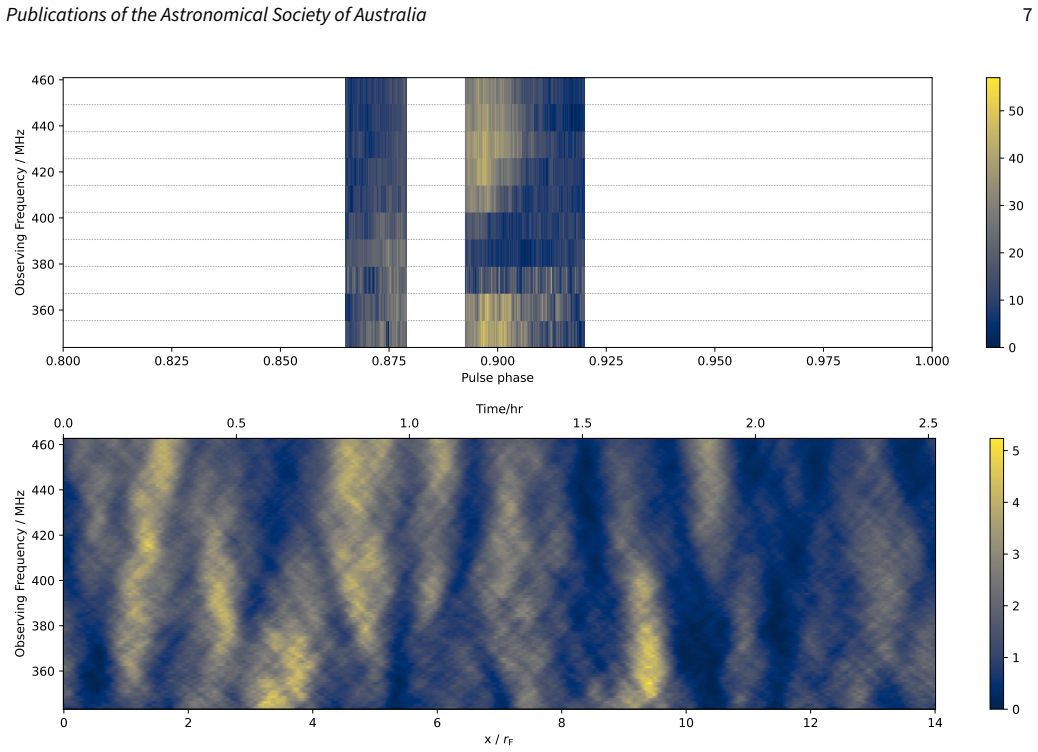
Diffractive interstellar scintillation can have a strong effect on the observed dynamic spectrum of radio emission from stars, for an assumed size of the emitting region of 0.01 solar radii. A plausible level of turbulence along the line of sight to CU Vir produces the observed spectral features at 400 MHz that had been attributed to the stellar magnetosphere.
What carries the argument
Diffractive interstellar scintillation, which causes intensity modulations in radio waves passing through turbulent interstellar plasma, applied to a compact emitting region of 0.01 solar radii.
If this is right
- Caution is required when attributing spectral and temporal variations in stellar coherent radio emission solely to magnetospheric processes, particularly at low frequencies.
- Accurate modeling of ECME from stars must incorporate the frequency-dependent location of the emitting region to predict scintillation effects correctly.
- Further observations at different frequencies and resolutions can distinguish interstellar scintillation from intrinsic stellar variability.
- The dynamic spectrum of coherent radio pulses from other magnetic stars may also be shaped by interstellar propagation when sources are compact.
Where Pith is reading between the lines
- If the scintillation hypothesis holds, past and future low-frequency radio observations of magnetic stars will need explicit correction for interstellar effects before being used as magnetospheric diagnostics.
- Stellar radio pulses could serve as additional probes of interstellar turbulence if their intrinsic emission properties can be isolated.
- The same compact-source scintillation physics may affect radio observations of other coherent emitters, such as exoplanet aurorae, at meter wavelengths.
Load-bearing premise
The radio-emitting region is as small as 0.01 solar radii and the turbulence along the line of sight to CU Vir is strong enough for the modeled scintillation to match the observed spectral features.
What would settle it
Multi-frequency monitoring that shows the spectral features do not weaken or change scale as expected for interstellar scintillation, or VLBI imaging that resolves a source larger than 0.01 solar radii, would rule out the scintillation explanation.
Figures


read the original abstract
A subset of magnetic stars exhibit periodic radio pulses produced by the coherent electron cyclotron maser mechanism. These pulses are known to exhibit both temporal and spectral variations, which have been attributed to phenomena intrinsic to the stellar magnetosphere. However, in order to fully characterise the radio pulses and use them as magnetospheric probes (as suggested by past studies), it is also important to consider the effects of phenomena extrinsic to the magnetosphere. In this paper, we investigate whether interstellar scintillation could be a relevant mechanism for explaining spectral and temporal variations observed for coherent stellar radio emission. For that, we consider the case of the well-characterised magnetic hot star CU Vir. At 400 MHz, coherent radio emission from the star was reported to exhibit a peculiar spectral evolution that remains unexplained. We show that a plausible level of turbulence along the line of sight can produce the observed phenomenon of spectral features. Our analysis shows that diffractive interstellar scintillation can have a strong effect on the observed dynamic spectrum of radio emission from stars, for an assumed size of the emitting region of $0.01r_\odot$, and that caution should therefore be taken in separating intrinsic and extrinsic features, particularly at low frequencies. These results are preliminary and further work is required to fully model the scintillation of ECME from stars (in particular the change in source location with frequency), and to explore the full range of plausible scintillation parameters. We suggest how further observations may be used to test the interstellar scintillation hypothesis.
Editorial analysis
A structured set of objections, weighed in public.
Referee Report
Summary. The paper examines whether interstellar scintillation can explain observed spectral and temporal variations in coherent electron cyclotron maser emission (ECME) from the magnetic star CU Vir. Using a model of diffractive interstellar scintillation, it argues that a plausible level of turbulence along the line of sight, combined with an assumed emitting region size of 0.01 solar radii, can reproduce the peculiar spectral evolution reported at 400 MHz, and concludes that extrinsic effects must be considered when interpreting such stellar radio pulses as magnetospheric probes.
Significance. If the modeling holds after addressing the noted limitations, the result would highlight the importance of accounting for interstellar medium effects in low-frequency stellar radio observations, potentially refining how ECME pulses are used to probe stellar magnetospheres. The work explicitly acknowledges its preliminary nature and the need for further modeling of frequency-dependent source properties.
major comments (2)
- [Abstract; modeling section] The central claim that plausible turbulence reproduces the observed spectral features rests on an assumed emitting region size of 0.01 r_⊙ (stated in the abstract and used throughout the modeling); no quantitative justification, sensitivity tests, or comparison to independent constraints on source size appear in the manuscript, and the abstract provides no fit statistics, residuals, or direct overlay of model versus data.
- [Discussion; conclusions] The scintillation model assumes a fixed source location and size, yet ECME emission frequency is tied to local magnetic field strength via the resonance condition, implying that different frequencies within the 400 MHz band originate at different altitudes and longitudes; this alters the effective distance to the scattering screen, Fresnel scale, and modulation index. The manuscript notes this frequency dependence as requiring future work, but the current reproduction of features may not survive that extension.
minor comments (2)
- [Abstract] The abstract could specify the exact observed spectral phenomenon (e.g., the particular frequency drift or modulation pattern) being modeled rather than referring to it generically as 'peculiar spectral evolution'.
- [Abstract] Notation for the source size (0.01r_⊙) should be written consistently with a space or multiplication symbol for clarity.
Simulated Author's Rebuttal
We thank the referee for their constructive and detailed comments, which have helped us identify areas where the manuscript can be strengthened. We respond to each major comment below, indicating the changes we will make in the revised version.
read point-by-point responses
-
Referee: [Abstract; modeling section] The central claim that plausible turbulence reproduces the observed spectral features rests on an assumed emitting region size of 0.01 r_⊙ (stated in the abstract and used throughout the modeling); no quantitative justification, sensitivity tests, or comparison to independent constraints on source size appear in the manuscript, and the abstract provides no fit statistics, residuals, or direct overlay of model versus data.
Authors: We agree that the source size of 0.01 solar radii is presented as an assumption without detailed justification or sensitivity analysis in the current manuscript. This value was selected because it allows diffractive scintillation to produce spectral features matching the reported observations for plausible turbulence levels along the line of sight. In the revised manuscript we will add a dedicated paragraph in the modeling section providing quantitative justification drawn from typical ECME source scales reported in the literature for magnetic stars, together with sensitivity tests that vary the source size over a plausible range and show which values reproduce the observed dynamic spectrum. We will also include a direct visual and quantitative comparison of the model output to the observed data (including residuals or a simple goodness-of-fit metric) both in the main text and in the abstract where space permits. revision: yes
-
Referee: [Discussion; conclusions] The scintillation model assumes a fixed source location and size, yet ECME emission frequency is tied to local magnetic field strength via the resonance condition, implying that different frequencies within the 400 MHz band originate at different altitudes and longitudes; this alters the effective distance to the scattering screen, Fresnel scale, and modulation index. The manuscript notes this frequency dependence as requiring future work, but the current reproduction of features may not survive that extension.
Authors: We acknowledge that the fixed-source approximation is a simplification whose validity must be tested once frequency-dependent source properties are included. The manuscript already states that the results are preliminary and explicitly flags the need for future modeling of the change in source location with frequency. The present calculation demonstrates that interstellar scintillation can generate spectral structure comparable to the observations under this approximation; it is offered as a proof-of-concept rather than a definitive reproduction. In the revision we will expand the discussion and conclusions to (i) restate the limitation more prominently, (ii) outline the specific modifications required to incorporate altitude- and longitude-dependent source positions, and (iii) clarify that the broader conclusion—namely that extrinsic scintillation effects should be considered when interpreting low-frequency stellar pulses—remains a useful caution even if the detailed spectral match evolves with a more complete model. revision: partial
Circularity Check
No significant circularity; external model applied to data with acknowledged limitations
full rationale
The paper applies a standard diffractive scintillation model (with externally motivated parameters for turbulence level and an assumed emitting region size of 0.01 r_⊙) to demonstrate that it can reproduce the observed spectral evolution at 400 MHz for CU Vir. No step reduces a claimed prediction or result to its own fitted inputs by construction, nor does any load-bearing premise rely on a self-citation chain that is itself unverified. The authors explicitly flag the fixed-source-location simplification as requiring future work due to ECME frequency-height dependence, confirming the current analysis is a plausibility demonstration rather than a self-referential derivation. This is self-contained against external benchmarks and receives the default low score.
Axiom & Free-Parameter Ledger
free parameters (1)
- emitting region size
axioms (1)
- domain assumption Standard diffractive interstellar scintillation theory governs the propagation of radio waves from a compact source through turbulent plasma.
Reference graph
Works this paper leans on
-
[1]
Berry, I. D., Owocki, S. P., Shultz, M. E., & ud-Doula, A. 2022, MNRAS, 511, 4815
work page 2022
-
[2]
Brisken, W. F., Macquart, J. P., Gao, J. J., et al. 2010, ApJ, 708, 232
work page 2010
-
[3]
Coles, W. A., Rickett, B. J., Gao, J. J., Hobbs, G., & Verbiest, J. P. W. 2010, ApJ, 717, 1206
work page 2010
-
[4]
Cordes, J. M. 1986, ApJ, 311, 183
work page 1986
-
[5]
Cordes, J. M. & Lazio, T. J. W. 2002, arXiv e-prints, astro
work page 2002
-
[6]
Cordes, J. M., Rickett, B. J., Stinebring, D. R., & Coles, W. A. 2006, ApJ, 637, 346
work page 2006
- [7]
- [8]
-
[9]
N., Pritchard, J., Murphy, T., et al
Driessen, L. N., Pritchard, J., Murphy, T., et al. 2024, PASA, 41, e084
work page 2024
-
[10]
Dulk, G. A. 1985, ARA&A, 23, 169 Gaia Collaboration, Prusti, T., de Bruijne, J. H. J., et al. 2016, A&A, 595, A1 Gaia Collaboration, Vallenari, A., Brown, A. G. A., et al. 2023, A&A, 674, A1
work page 1985
- [11]
-
[12]
Gwinn, C. R., Johnson, M. D., Reynolds, J. E., et al. 2012, ApJ, 758, 7
work page 2012
-
[13]
Jauncey, D. L., Kedziora-Chudczer, L. L., Lovell, J. E. J., et al. 2000, in Astrophysical Phenomena Revealed by Space VLBI, ed. H. Hirabayashi, P. G. Edwards, & D. W. Murphy, 147
work page 2000
-
[14]
Kochukhov, O., Lüftinger, T., Neiner, C., Alecian, E., & MiMeS Collabora- tion. 2014, A&A, 565, A83
work page 2014
-
[15]
A., Mitra, D., Naidu, A., Joshi, B
Krishnakumar, M. A., Mitra, D., Naidu, A., Joshi, B. C., & Manoharan, P. K. 2015, ApJ, 804, 23
work page 2015
-
[16]
Leto, P., Trigilio, C., Buemi, C. S., Umana, G., & Leone, F. 2006, A&A, 458, 831
work page 2006
-
[17]
Leto, P., Trigilio, C., Krtička, J., et al. 2021, MNRAS, 507, 1979
work page 2021
-
[18]
Lovell, J. E. J., Rickett, B. J., Macquart, J. P., et al. 2008, ApJ, 689, 108
work page 2008
-
[19]
Macquart, J. P. & de Bruyn, A. G. 2006, A&A, 446, 185
work page 2006
-
[20]
Macquart, J.-P., Kedziora-Chudczer, L., Jauncey, D., & Rayner, D. 2001, Ap&SS, 278, 135
work page 2001
-
[21]
McKee, J. W., Zhu, H., Stinebring, D. R., & Cordes, J. M. 2022, ApJ, 927, 99
work page 2022
-
[22]
Melrose, D. B. 2017, Reviews of Modern Plasma Physics, 1, 5
work page 2017
-
[23]
1992, Philosophical Transactions of the Royal Society of London Series A, 341, 151
Narayan, R. 1992, Philosophical Transactions of the Royal Society of London Series A, 341, 151
work page 1992
-
[24]
Oosterloo, T. A., Vedantham, H. K., Kutkin, A. M., et al. 2020, A&A, 641, L4
work page 2020
- [25]
-
[26]
Reardon, D. J., Main, R., Ocker, S. K., et al. 2025, Nature Astronomy, 9, 1053
work page 2025
-
[27]
Rickett, B., Johnston, S., Tomlinson, T., & Reynolds, J. 2009, MNRAS, 395, 1391
work page 2009
-
[28]
Rickett, B. J. 1986, ApJ, 307, 564
work page 1986
- [29]
- [30]
- [31]
-
[32]
Shultz, M. E., Owocki, S. P., ud-Doula, A., et al. 2022, MNRAS, 513, 1429
work page 2022
-
[33]
Spangler, S. R. 2009, Space Sci. Rev., 143, 277
work page 2009
-
[34]
Spangler, S. R. & Gwinn, C. R. 1990, ApJ, 353, L29
work page 1990
-
[35]
Stinebring, D. R., McLaughlin, M. A., Cordes, J. M., et al. 2001, ApJ, 549, L97
work page 2001
-
[36]
Stinebring, D. R., Rickett, B. J., Minter, A. H., et al. 2022, ApJ, 941, 34
work page 2022
-
[37]
Townsend, R. H. D. & Owocki, S. P. 2005, MNRAS, 357, 251
work page 2005
-
[38]
Treumann, R. A. 2006, A&A Rev., 13, 229
work page 2006
-
[39]
Trigilio, C., Leto, P., Leone, F., Umana, G., & Buemi, C. 2000, A&A, 362, 281
work page 2000
-
[40]
Trigilio, C., Leto, P., Umana, G., Buemi, C. S., & Leone, F. 2008, MNRAS, 384, 1437 Publications of the Astronomical Society of Australia9
work page 2008
-
[41]
Trigilio, C., Leto, P., Umana, G., Buemi, C. S., & Leone, F. 2011, ApJ, 739, L10
work page 2011
-
[42]
Vlemmings, W. H. T., Bignall, H. E., & Diamond, P. J. 2007, ApJ, 656, 198
work page 2007
-
[43]
Walker, M. A. 1998, MNRAS, 294, 307
work page 1998
-
[44]
Wang, Y., Tuntsov, A., Murphy, T., et al. 2021, MNRAS, 502, 3294
work page 2021
- [45]
discussion (0)
Sign in with ORCID, Apple, or X to comment. Anyone can read and Pith papers without signing in.