Dynamics of one-dimensional Bose-Josephson Junction in a Box Trap: From Coherent Oscillations to Many-Body Dephasing and Dynamical Freezing
Pith reviewed 2026-05-10 03:21 UTC · model grok-4.3
The pith
In a one-dimensional Bose-Josephson junction, interactions and initial imbalance drive transitions from coherent oscillations to many-body dephasing, equilibration, and dynamical freezing.
A machine-rendered reading of the paper's core claim, the machinery that carries it, and where it could break.
Core claim
Using the MCTDHB method, the study shows that in the weakly interacting regime the system exhibits coherent Josephson oscillations, at intermediate strengths a crossover occurs with small imbalances giving pure oscillations, moderate ones many-body dephasing with collapse-and-revival, and large ones equilibration with fragmentation; in the strongly interacting regime dynamical freezing sets in with pronounced fragmentation, particle-resolved density peaks, and suppressed tunneling.
What carries the argument
The multiconfigurational time-dependent Hartree method for bosons (MCTDHB) which incorporates multiple orbitals to capture correlation-induced fragmentation and many-body effects beyond mean-field.
If this is right
- Coherent oscillations occur only in the weakly interacting regime or for very small initial imbalances.
- Many-body dephasing leads to collapse-and-revival behavior at intermediate imbalances.
- Large imbalances at intermediate interactions cause saturation of observables like orbital entropy and participation ratio due to equilibration.
- Dynamical freezing in strong interactions features well-separated density peaks and strongly suppressed tunneling.
Where Pith is reading between the lines
- These regimes suggest that similar transitions could appear in other low-dimensional interacting quantum systems under controlled imbalances.
- Experimental probes of density distributions and entanglement measures in ultracold atom setups could map these dynamical crossovers.
- The competition between coherence and fragmentation may inform designs for quantum simulators using Josephson junctions.
Load-bearing premise
The MCTDHB method with a finite number of orbitals accurately captures the relevant many-body correlations and fragmentation without truncation errors that would alter the identified dynamical regimes.
What would settle it
An experimental measurement showing the emergence of particle-resolved density peaks and saturation of fragmentation measures in the strongly interacting limit with large initial imbalance would support the dynamical freezing regime.
Figures




read the original abstract
Understanding how coherent quantum dynamics give way to correlation-dominated behavior in low-dimensional systems remains a central challenge in quantum many-body physics. Here, we address this problem by investigating the interplay of interactions and initial population imbalance in a one-dimensional Bose-Josephson junction confined in a box trap. Using the multiconfigurational time-dependent Hartree method for bosons (MCTDHB), we identify distinct dynamical regimes governed by the interplay between coherence and correlation-induced fragmentation. In the weakly interacting regime, the system exhibits coherent Josephson oscillations, while strong initial imbalance leads to damping. At intermediate interaction strength, fixing the interaction and varying only the initial imbalance, we uncover a crossover in the dynamics: very small imbalances yield nearly pure, non-fragmented oscillations; moderate imbalances induce many-body dephasing with collapse-and-revival behavior; and large imbalances drive equilibration accompanied by strong fragmentation and saturation of many-body observables, including orbital entropy and participation ratio. In the strongly interacting regime, the system enters a dynamical freezing regime characterized by pronounced fragmentation, where the density develops well-separated, particle-resolved peaks and tunneling is strongly suppressed. These results establish a unified picture of how coherence, dephasing, equilibration, and dynamical freezing emerge and compete in one-dimensional Josephson dynamics.
Editorial analysis
A structured set of objections, weighed in public.
Referee Report
Summary. The manuscript investigates the dynamics of a one-dimensional Bose-Josephson junction in a box trap using the multiconfigurational time-dependent Hartree method for bosons (MCTDHB). It identifies distinct regimes—coherent Josephson oscillations for weak interactions, many-body dephasing with collapse-and-revival for moderate imbalances at intermediate interactions, equilibration with strong fragmentation for large imbalances, and dynamical freezing with suppressed tunneling and particle-resolved density peaks in the strongly interacting limit—governed by the interplay of interaction strength and initial population imbalance, as diagnosed via fragmentation measures, orbital entropy, participation ratio, and density profiles.
Significance. If the MCTDHB results prove robust, the work offers a unified numerical picture of the competition between coherence and correlation-induced fragmentation in low-dimensional Josephson systems. This could be relevant for experiments with ultracold bosons in box traps, highlighting how initial imbalance can drive crossovers from oscillatory to frozen dynamics without changing the Hamiltonian parameters.
major comments (2)
- [Numerical method and results sections] The central claims rest on MCTDHB distinguishing regimes via fragmentation (participation ratio, orbital entropy) and observables such as density peaks and tunneling suppression. However, the manuscript provides no information on the number of time-dependent orbitals M employed, nor any convergence tests with increasing M. For strong interactions and large initial imbalances, where dynamical freezing and saturation of many-body observables are reported, an insufficient M can truncate correlations and produce artificial saturation or freezing; this directly undermines the identification of the regimes.
- [Results on dynamical regimes] No quantitative error bars, statistical uncertainties, or comparisons to exact diagonalization (for small particle numbers) or other methods are supplied to support the reported crossovers, saturation values, or thresholds for 'strong fragmentation.' This makes it impossible to verify whether the claimed distinctions between dephasing, equilibration, and freezing are numerically stable.
minor comments (2)
- [Abstract] The abstract states that 'fixing the interaction and varying only the initial imbalance' reveals a crossover, but does not specify the fixed interaction value or the precise range of imbalances studied; adding this would improve clarity.
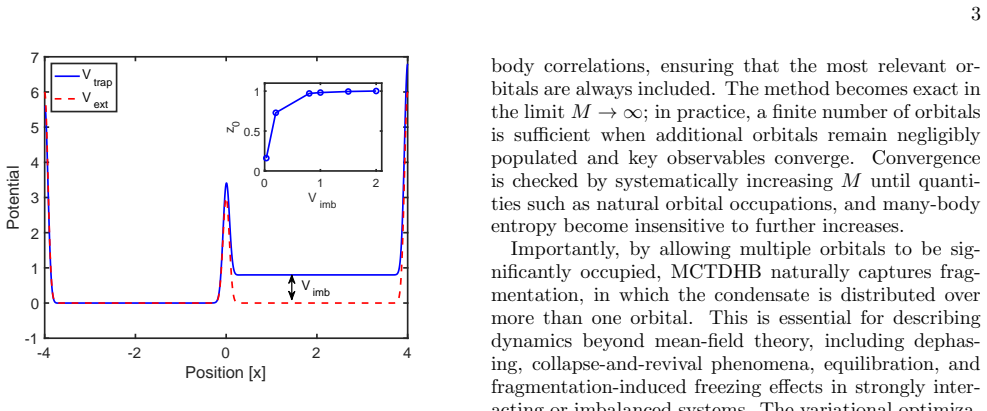
- Figure captions and text should explicitly state the particle number N and box length used in all simulations to allow reproducibility.
Simulated Author's Rebuttal
We thank the referee for the careful reading of our manuscript and the constructive comments. We address the major comments point by point below, and we will revise the manuscript accordingly to strengthen the numerical validation.
read point-by-point responses
-
Referee: [Numerical method and results sections] The central claims rest on MCTDHB distinguishing regimes via fragmentation (participation ratio, orbital entropy) and observables such as density peaks and tunneling suppression. However, the manuscript provides no information on the number of time-dependent orbitals M employed, nor any convergence tests with increasing M. For strong interactions and large initial imbalances, where dynamical freezing and saturation of many-body observables are reported, an insufficient M can truncate correlations and produce artificial saturation or freezing; this directly undermines the identification of the regimes.
Authors: We agree that providing details on the number of time-dependent orbitals M and performing convergence tests is necessary to substantiate the MCTDHB results, particularly to rule out artificial effects in the dynamical freezing regime. This information was inadvertently omitted from the original manuscript. In the revised version, we will include a description of the M values employed across different regimes and add explicit convergence tests (e.g., plots of fragmentation and density observables versus M). These will show that the reported features, including the saturation of many-body observables and suppression of tunneling, converge for the M used and do not change qualitatively with larger M. revision: yes
-
Referee: [Results on dynamical regimes] No quantitative error bars, statistical uncertainties, or comparisons to exact diagonalization (for small particle numbers) or other methods are supplied to support the reported crossovers, saturation values, or thresholds for 'strong fragmentation.' This makes it impossible to verify whether the claimed distinctions between dephasing, equilibration, and freezing are numerically stable.
Authors: We note that MCTDHB, being a variational method without stochastic elements, does not have statistical error bars; the primary control parameter is M, which we will document and test for convergence as described in response to the first comment. To address the request for comparisons, we will add benchmarks against exact diagonalization for small particle numbers (N=2,3,4) in the supplementary material or a new section, focusing on the coherent oscillation and dephasing regimes where such comparisons are feasible. This will confirm the accuracy of the method for the observables of interest. For the larger N and strong interaction cases, the M-convergence provides the necessary validation of the regime distinctions. We will also quantify the fragmentation thresholds more explicitly in the text. revision: partial
- Exact diagonalization comparisons for the largest particle numbers and strongest interactions studied, due to the exponential growth of the Hilbert space dimension making such calculations intractable.
Circularity Check
No circularity: results from direct numerical MCTDHB evolution
full rationale
The paper reports outcomes of time-dependent many-body simulations via the MCTDHB method applied to the Bose-Josephson junction Hamiltonian. Distinct regimes (coherent oscillations, dephasing, equilibration, dynamical freezing) are identified by inspecting computed observables such as participation ratio, orbital entropy, density profiles, and tunneling currents. No analytical derivation chain exists that reduces a claimed prediction to a fitted parameter or self-referential definition. No load-bearing self-citations or uniqueness theorems are invoked; the central claims rest on the numerical trajectories themselves. This is the expected non-finding for a purely computational study whose inputs are the Hamiltonian, initial state, and orbital basis size.
Axiom & Free-Parameter Ledger
free parameters (2)
- interaction strength
- initial population imbalance
axioms (1)
- domain assumption MCTDHB with a finite orbital basis sufficiently approximates the full many-body wavefunction for the observed dynamics.
Reference graph
Works this paper leans on
-
[1]
The initial state exhibits ten well-separated lobes cor- responding to the particles, indicating strong spatial localiza- tion near the fermionization limit. The structure remains es- sentially unchanged over time, demonstrating frozen dynam- ics and suppressed tunneling, consistent with the nearly con- stant population imbalance. The one-body density mat...
work page 2023
-
[2]
A.G. acknowledges support from Funda¸ c˜ ao de Am- paro ` a Pesquisa do Estado de S˜ ao Paulo (FAPESP) [Grant 2024/01533-7], and Conselho Nacional de De- senvolvimento Cient´ ıfico e Tecnol´ ogico (CNPq) [Grant 306219/2022-0]. R.D. acknowledges support from the French government under the France 2030 investment plan, as part of the Initiative d’Excellence...
work page 2024
-
[3]
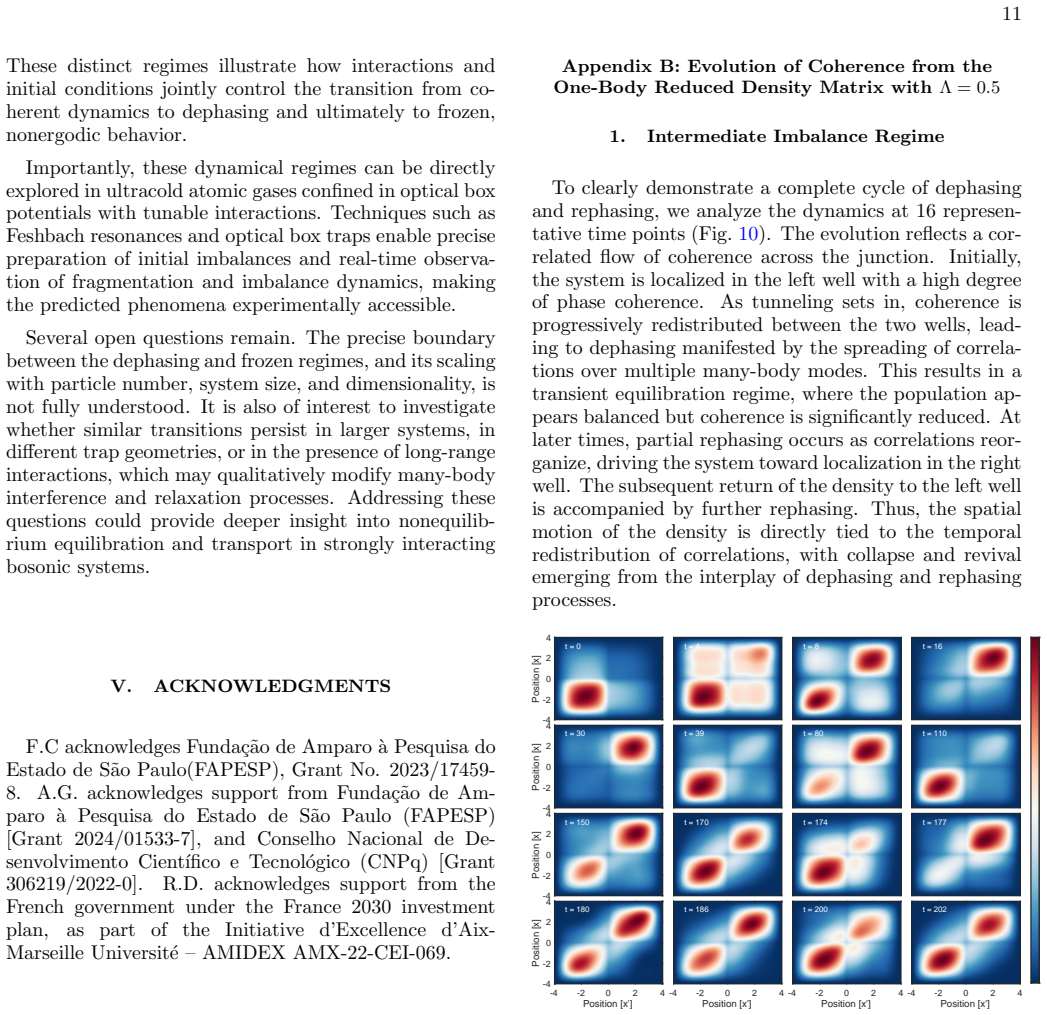
Intermediate Imbalance Regime To clearly demonstrate a complete cycle of dephasing and rephasing, we analyze the dynamics at 16 represen- tative time points (Fig. 10). The evolution reflects a cor- related flow of coherence across the junction. Initially, the system is localized in the left well with a high degree of phase coherence. As tunneling sets in,...
-
[4]
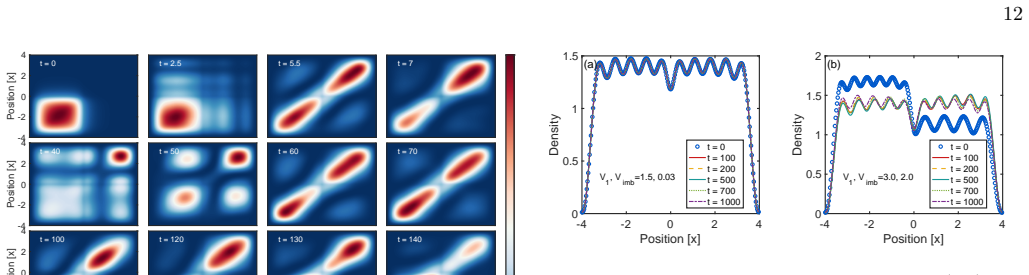
Strong Imbalance Regime To capture the evolution of coherence across differ- ent timescales, we analyze the one-body reduced den- sity matrix at 16 representative time points, spanning from early-time dynamics to the long-time limit (Fig. 11). 12 -4 -2 0 2 4Position [x] t = 0 t = 2.5 t = 5.5 t = 7 -4 -2 0 2 4Position [x] t = 40 t = 50 t = 60 t = 70 -4 -2 ...
- [5]
-
[6]
M. Lewenstein, A. Sanpera, V. Ahufinger, B. Damski, A. Sen(De), and U. Sen, Ultracold atomic gases in op- tical lattices: mimicking condensed matter physics and beyond, Advances in Physics56, 243 (2007)
work page 2007
-
[7]
C. Chin, R. Grimm, P. Julienne, and E. Tiesinga, Fesh- bach resonances in ultracold gases, Rev. Mod. Phys.82, 1225 (2010)
work page 2010
-
[8]
F. H. Mies, E. Tiesinga, and P. S. Julienne, Manipulation of feshbach resonances in ultracold atomic collisions using time-dependent magnetic fields, Phys. Rev. A61, 022721 (2000)
work page 2000
-
[9]
R. Dubessy and H. Perrin, Quantum gases in bubble traps, AVS Quantum Science7, 010501 (2025)
work page 2025
-
[10]
S. Levy, E. Lahoud, I. Shomroni, and J. Steinhauer, The a.c. and d.c. Josephson effects in a Bose–Einstein con- densate, Nature449, 579 (2007)
work page 2007
-
[11]
R. Gati and M. K. Oberthaler, A bosonic Josephson junc- tion, J. Phys. B40, R61 (2007)
work page 2007
-
[12]
T. Betz, S. Manz, R. B¨ ucker, T. Berrada, C. Koller, G. Kazakov, I. E. Mazets, H.-P. Stimming, A. Perrin, T. Schumm, and J. Schmiedmayer, Two-point phase cor- relations of a one-dimensional bosonic Josephson junc- tion, Phys. Rev. Lett.106, 020407 (2011)
work page 2011
-
[13]
M. Pigneur, T. Berrada, M. Bonneau, T. Schumm, E. Demler, and J. Schmiedmayer, Relaxation to a phase- locked equilibrium state in a one-dimensional bosonic Josephson junction, Phys. Rev. Lett.120, 173601 (2018)
work page 2018
-
[14]
S. Hofferberth, I. Lesanovsky, T. Schumm, A. Imam- bekov, V. Gritsev, E. Demler, and J. Schmiedmayer, 14 Non-equilibrium coherence dynamics in one-dimensional Bose gases, Nature449, 324 (2007)
work page 2007
-
[15]
Y. Qiao and F. Grossmann, Revealing quantum effects in bosonic Josephson junctions beyond mean-field dynam- ics, Frontiers in Physics11, 1221614 (2023)
work page 2023
-
[16]
K. Sakmann, A. I. Streltsov, O. E. Alon, and L. S. Ceder- baum, Exact quantum dynamics of a bosonic Josephson junction, Phys. Rev. Lett.103, 220601 (2009)
work page 2009
- [17]
-
[18]
D. Stefanatos and E. Paspalakis, Relaxation dynamics in a stochastic bosonic Josephson junction, Physics Letters A383, 2370 (2019)
work page 2019
-
[19]
F. Meinert, M. J. Mark, E. Kirilov, K. Lauber, P. Wein- mann, M. Gr¨ obner, A. J. Daley, and H.-C. N¨ agerl, Ob- servation of many-body dynamics in long-range tunneling after a quantum quench, Science344, 1259–1262 (2014)
work page 2014
-
[20]
S. Raghavan, A. Smerzi, S. Fantoni, and S. R. Shenoy, Coherent oscillations between two weakly coupled Bose- Einstein condensates: Josephson effects,πoscillations, and macroscopic quantum self-trapping, Phys. Rev. A 59, 620 (1999)
work page 1999
-
[21]
G. Spagnolli, G. Semeghini, L. Masi, G. Ferioli, A. Trenkwalder, S. Coop, M. Landini, L. Pezz` e, G. Mod- ugno, M. Inguscio, A. Smerzi, and M. Fattori, Crossing over from attractive to repulsive interactions in a tunnel- ing bosonic Josephson junction, Phys. Rev. Lett.118, 230403 (2017)
work page 2017
- [22]
-
[24]
F. S. Cataliotti, S. Burger, C. Fort, P. Maddaloni, F. Mi- nardi, A. Trombettoni, A. Smerzi, and M. Inguscio, Josephson junction arrays with Bose-Einstein conden- sates, Science293, 843 (2001)
work page 2001
-
[25]
L. J. LeBlanc, A. B. Bardon, J. McKeever, M. H. T. Extavour, D. Jervis, J. H. Thywissen, F. Piazza, and A. Smerzi, Dynamics of a tunable superfluid junction, Phys. Rev. Lett.106, 025302 (2011)
work page 2011
-
[26]
G. J. Milburn, J. Corney, E. M. Wright, and D. F. Walls, Quantum dynamics of an atomic Bose-Einstein conden- sate in a double-well potential, Phys. Rev. A55, 4318 (1997)
work page 1997
- [27]
-
[28]
S. Raghavan, A. Smerzi, and V. M. Kenkre, Transi- tions in coherent oscillations between two trapped Bose- Einstein condensates, Phys. Rev. A60, R1787 (1999)
work page 1999
-
[29]
M. Abad, M. Guilleumas, R. Mayol, F. Piazza, D. M. Jezek, and A. Smerzi, Phase slips and vortex dynamics in Josephson oscillations between Bose-Einstein conden- sates, EPL (Europhysics Letters)109, 40005 (2015)
work page 2015
- [30]
-
[31]
J. M. Schurer, R. Gerritsma, P. Schmelcher, and A. Ne- gretti, Impact of many-body correlations on the dynam- ics of an ion-controlled bosonic Josephson junction, Phys. Rev. A93, 063602 (2016)
work page 2016
-
[32]
S. K. Haldar and O. E. Alon, Many-body quantum dy- namics of an asymmetric bosonic Josephson junction, New Journal of Physics21, 103037 (2019)
work page 2019
-
[33]
A. K. Saha, D. S. Ray, and B. Deb, Parametric oscilla- tions in a dissipative bosonic Josephson junction, J. Phys. B53, 135301 (2020)
work page 2020
-
[34]
A. K. Saha, D. S. Ray, and B. Deb, Phase diffusion and fluctuations in a dissipative Bose-Josephson junc- tion, Phys. Rev. E107, 034141 (2023)
work page 2023
-
[35]
A. Bhowmik, S. K. Haldar, and O. E. Alon, Impact of the transverse direction on the many-body tunneling dy- namics in a two-dimensional bosonic Josephson junction, Scientific Reports10, 21476 (2020)
work page 2020
-
[36]
E. Boukobza, M. G. Moore, D. Cohen, and A. Vardi, Nonlinear phase dynamics in a driven bosonic Josephson junction, Phys. Rev. Lett.104, 240402 (2010)
work page 2010
-
[37]
B. D. Josephson, Possible new effects in superconductive tunnelling, Physics Letters1, 251 (1962)
work page 1962
-
[38]
P. W. Anderson and J. M. Rowell, Probable observation of the Josephson superconducting tunneling effect, Phys. Rev. Lett.10, 230 (1963)
work page 1963
-
[39]
K. K. Likharev, Superconducting weak links, Rev. Mod. Phys.51, 101 (1979)
work page 1979
-
[40]
G. Valtolina, A. Burchianti, A. Amico, E. Neri, K. Xhani, J. A. Seman, A. Trombettoni, A. Smerzi, M. Zaccanti, M. Inguscio, and G. Roati, Josephson effect in fermionic superfluids across the BEC-BCS crossover, Science350, 1505 (2015)
work page 2015
- [41]
-
[42]
M. Zaccanti and W. Zwerger, Critical Josephson cur- rent in bcs-bec–crossover superfluids, Phys. Rev. A100, 063601 (2019)
work page 2019
-
[43]
A. Burchianti, F. Scazza, A. Amico, G. Valtolina, J. A. Seman, C. Fort, M. Zaccanti, M. Inguscio, and G. Roati, Connecting dissipation and phase slips in a Josephson junction between fermionic superfluids, Phys. Rev. Lett. 120, 025302 (2018)
work page 2018
- [44]
-
[45]
W. J. Kwon, G. Del Pace, R. Panza, M. Inguscio, W. Zw- erger, M. Zaccanti, F. Scazza, and G. Roati, Strongly correlated superfluid order parameters from dc Joseph- son supercurrents, Science369, 84–88 (2020)
work page 2020
-
[46]
A. K. Saha, K. Adhikary, S. Mal, K. R. Dastidar, and B. Deb, The effects of trap-confinement and inter- atomic interactions on Josephson effects and macroscopic quantum self-trapping for a Bose-Einstein condensate, J. Phys. B52, 155301 (2019)
work page 2019
- [47]
-
[48]
A. K. Saha and R. Dubessy, Dynamical phase diagram of a one-dimensional bose gas in a box with a tunable weak link: From Bose-Josephson oscillations to shock waves, 15 Phys. Rev. A104, 023316 (2021)
work page 2021
-
[49]
V. P. Singh, N. Luick, L. Sobirey, and L. Mathey, Joseph- son junction dynamics in a two-dimensional ultracold bose gas, Phys. Rev. Res.2, 033298 (2020)
work page 2020
-
[50]
J. Polo, R. Dubessy, P. Pedri, H. Perrin, and A. Minguzzi, Oscillations and decay of superfluid currents in a one- dimensional bose gas on a ring, Phys. Rev. Lett.123, 195301 (2019)
work page 2019
-
[51]
J.-F. Mennemann, I. E. Mazets, M. Pigneur, H. P. Stim- ming, N. J. Mauser, J. Schmiedmayer, and S. Erne, Relaxation in an extended bosonic Josephson junction, Phys. Rev. Res.3, 023197 (2021)
work page 2021
-
[52]
Y. D. van Nieuwkerk, J. Schmiedmayer, and F. H. Essler, Josephson oscillations in split one-dimensional Bose gases, SciPost Phys.10, 090 (2021)
work page 2021
-
[53]
K. Xhani and N. P. Proukakis, Dissipation in a finite- temperature atomic Josephson junction, Phys. Rev. Res. 4, 033205 (2022)
work page 2022
-
[54]
S.-C. Ji, T. Schweigler, M. Tajik, F. Cataldini, J. a. Sabino, F. S. Møller, S. Erne, and J. Schmiedmayer, Floquet engineering a bosonic Josephson junction, Phys. Rev. Lett.129, 080402 (2022)
work page 2022
-
[55]
A. Burchianti, C. Fort, and M. Modugno, Josephson plasma oscillations and the gross-pitaevskii equation: Bo- goliubov approach versus two-mode model, Phys. Rev. A 95, 023627 (2017)
work page 2017
-
[56]
Y. M. Bidasyuk, O. O. Prikhodko, and M. Weyrauch, Phonon-Josephson resonances in atomtronic circuits, Phys. Rev. A94, 033603 (2016)
work page 2016
-
[57]
Y. Shin, M. Saba, T. A. Pasquini, W. Ketterle, D. E. Pritchard, and A. E. Leanhardt, Atom interferometry with Bose-Einstein condensates in a double-well poten- tial, Phys. Rev. Lett.92, 050405 (2004)
work page 2004
- [58]
- [59]
-
[60]
K. S. Gan, V. P. Singh, L. Amico, and R. Dumke, Joseph- son dynamics in 2d ring-shaped condensates (2025), arXiv:2509.00533 [cond-mat.quant-gas]
work page internal anchor Pith review Pith/arXiv arXiv 2025
-
[61]
R. Gati, B. Hemmerling, J. F¨ olling, M. Albiez, and M. K. Oberthaler, Noise thermometry with two weakly coupled Bose-Einstein condensates, Phys. Rev. Lett.96, 130404 (2006)
work page 2006
- [62]
-
[63]
C. Ryu, E. C. Samson, and M. G. Boshier, Quantum interference of currents in an atomtronic squid, Nature Communications11, 3338 (2020)
work page 2020
-
[64]
Edwards, Atom SQUID, Nature Physics9, 68 (2013)
M. Edwards, Atom SQUID, Nature Physics9, 68 (2013)
work page 2013
-
[65]
T. Murtadho, F. Cataldini, S. Erne, M. Gluza, M. Tajik, J. Schmiedmayer, and N. H. Y. Ng, Measurement of to- tal phase fluctuation in cold-atomic quantum simulators, Phys. Rev. Res.7, L022031 (2025)
work page 2025
- [66]
-
[67]
J. J. P. van Es, P. Wicke, A. H. van Amerongen, C. R´ etif, S. Whitlock, and N. J. van Druten, Box traps on an atom chip for one-dimensional quantum gases, J. Phys. B43, 155002 (2010)
work page 2010
- [68]
-
[69]
M. Girardeau, Relationship between systems of impene- trable bosons and fermions in one dimension, Journal of Mathematical Physics1, 516 (1960)
work page 1960
-
[70]
T. Kinoshita, T. Wenger, and D. S. Weiss, Observation of a one-dimensional tonks-girardeau gas, Science305, 1125 (2004)
work page 2004
-
[71]
O. E. Alon, A. I. Streltsov, and L. S. Cederbaum, Multiconfigurational time-dependent Hartree method for bosons: Many-body dynamics of bosonic systems, Phys. Rev. A77, 033613 (2008)
work page 2008
-
[72]
A. I. Streltsov, O. E. Alon, and L. S. Cederbaum, Role of excited states in the splitting of a trapped interacting Bose-Einstein condensate by a time-dependent barrier, Phys. Rev. Lett.99, 030402 (2007)
work page 2007
-
[73]
O. E. Alon, A. I. Streltsov, and L. S. Cederbaum, Multi- configurational time-dependent Hartree method for mix- tures consisting of two types of identical particles, Phys. Rev. A76, 062501 (2007)
work page 2007
-
[74]
A. I. Streltsov, O. E. Alon, and L. S. Cederbaum, Gen- eral variational many-body theory with complete self- consistency for trapped bosonic systems, Phys. Rev. A 73, 063626 (2006)
work page 2006
-
[75]
A. U. J. Lode, Multiconfigurational time-dependent Hartree method for bosons with internal degrees of free- dom: Theory and composite fragmentation of multi- component Bose-Einstein condensates, Phys. Rev. A93, 063601 (2016)
work page 2016
-
[76]
R. Lin, P. Molignini, L. Papariello, M. C. Tsatsos, C. L´ evˆ eque, S. E. Weiner, E. Fasshauer, R. Chitra, and A. U. J. Lode, MCTDH-X: The multiconfigura- tional time-dependent Hartree method for indistinguish- able particles software, Quantum Science and Technology 5, 024004 (2020)
work page 2020
-
[77]
A. U. J. Lode, M. C. Tsatsos, E. Fasshauer, S. E. Weiner, R. Lin, L. Papariello, P. Molignini, C. L´ evˆ eque, M. B¨ uttner, J. Xiang, S. Dutta, and Y. Bilinskaya, Mctdh-x: The multiconfigurational time-dependent Hartree method for indistinguishable particles software (2024)
work page 2024
-
[78]
E. Fasshauer and A. U. J. Lode, Multiconfigurational time-dependent Hartree method for fermions: Imple- mentation, exactness, and few-fermion tunneling to open space, Phys. Rev. A93, 033635 (2016)
work page 2016
-
[79]
A. U. J. Lode, C. L´ evˆ eque, L. B. Madsen, A. I. Streltsov, and O. E. Alon, Colloquium: Multiconfigurational time- dependent Hartree approaches for indistinguishable par- ticles, Rev. Mod. Phys.92, 011001 (2020)
work page 2020
-
[80]
U. R. Fischer, A. U. J. Lode, and B. Chatterjee, Conden- sate fragmentation as a sensitive measure of the quantum many-body behavior of bosons with long-range interac- tions, Phys. Rev. A91, 063621 (2015)
work page 2015
-
[81]
S. Bera, B. Chakrabarti, A. Gammal, M. C. Tsatsos, M. Lekala, B. Chatterjee, C. L´ evˆ eque, and A. U. Lode, Sorting fermionization from crystallization in many- boson wavefunctions, Scientific Reports9, 17873 (2019)
work page 2019
discussion (0)
Sign in with ORCID, Apple, or X to comment. Anyone can read and Pith papers without signing in.