Spectrum Configuration Framework for Throughput Maximization in Open Systems with Roll-Off-Based QoT Optimization
Pith reviewed 2026-05-10 03:23 UTC · model grok-4.3
The pith
A knapsack-based optimizer tunes transceiver roll-off and other parameters to raise aggregate throughput under fixed spectrum and QoT constraints in open optical systems.
A machine-rendered reading of the paper's core claim, the machinery that carries it, and where it could break.
Core claim
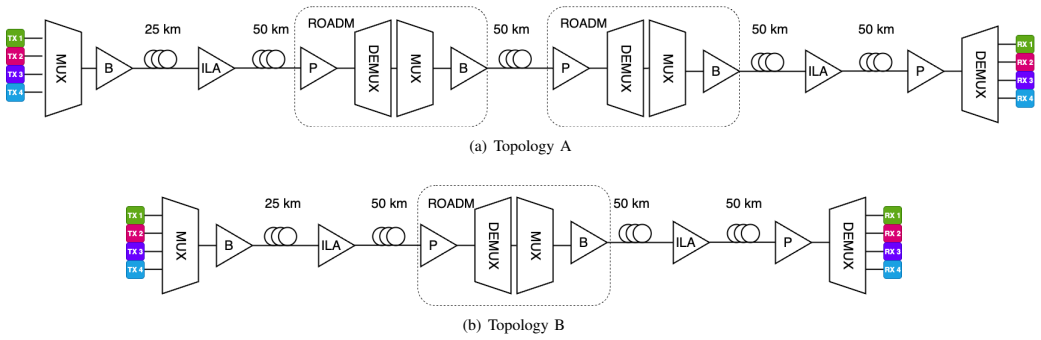
Experimental validation on a metro-scale open testbed confirms the effectiveness of the proposed approach in achieving efficient spectrum utilization and adaptive throughput-margin trade-offs.
Load-bearing premise
That the measured QoT gains from roll-off optimization in the presence of cascaded WSS filtering remain valid and additive when the knapsack optimizer selects multi-channel configurations under real traffic and hardware constraints.
Figures
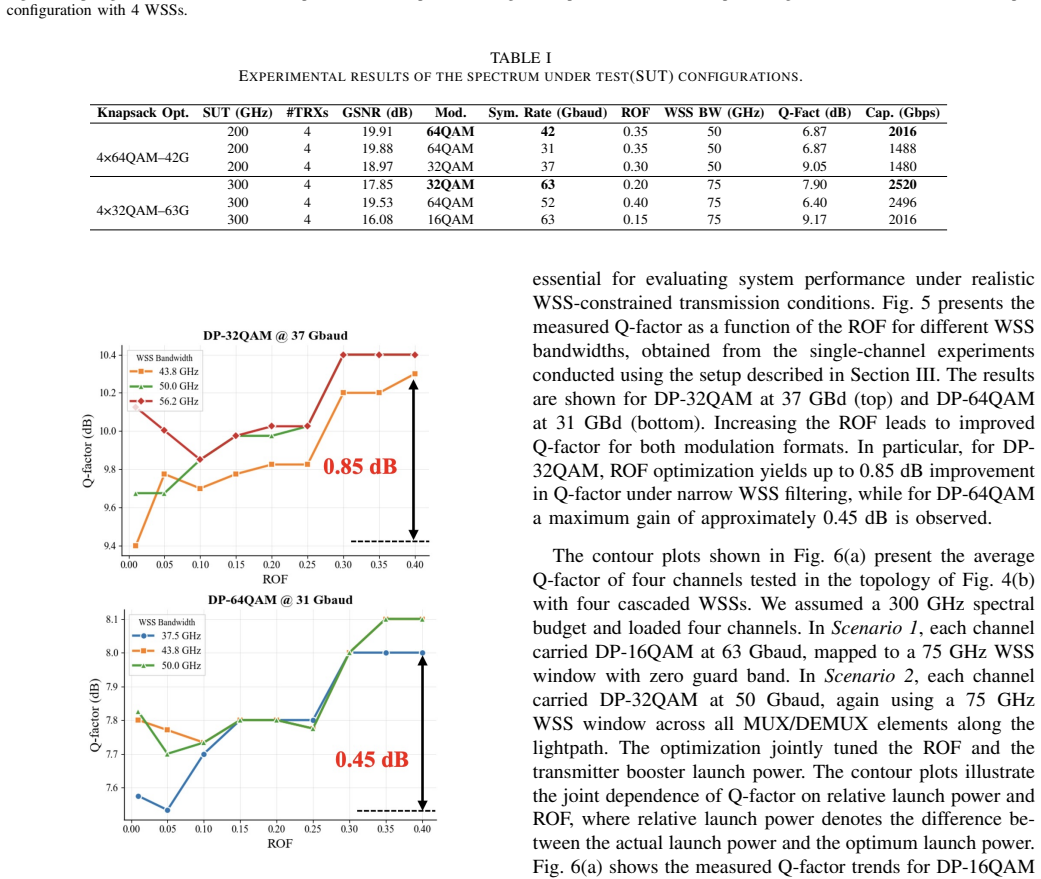
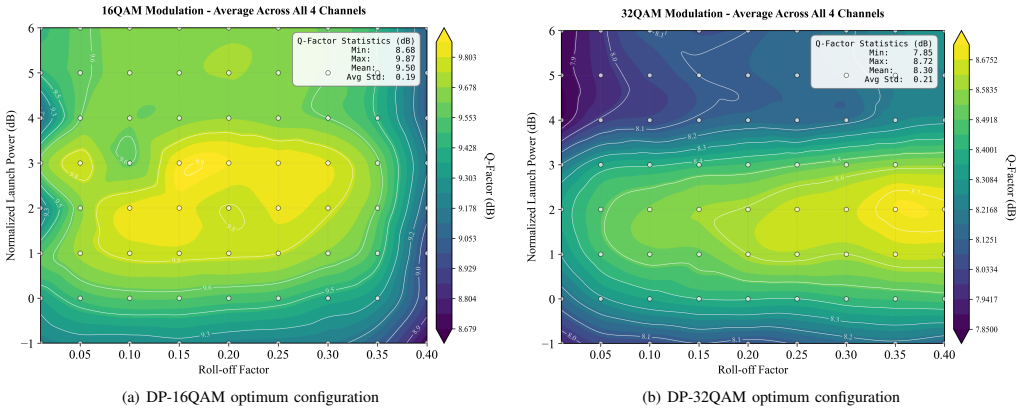
read the original abstract
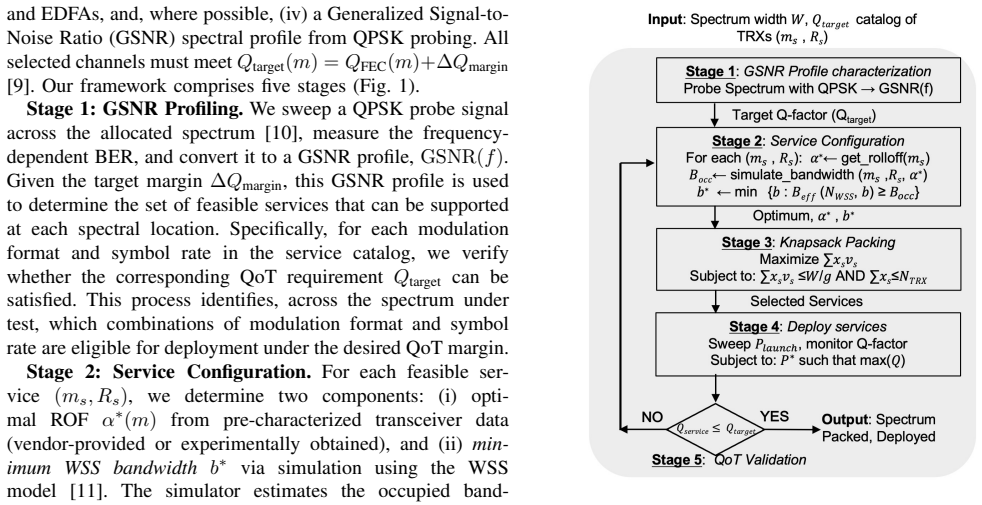
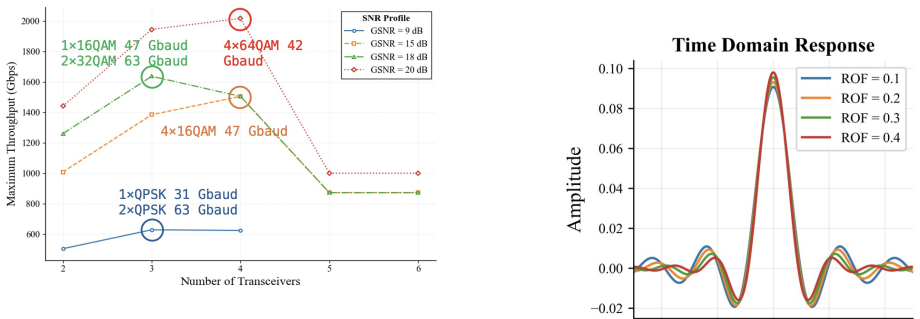
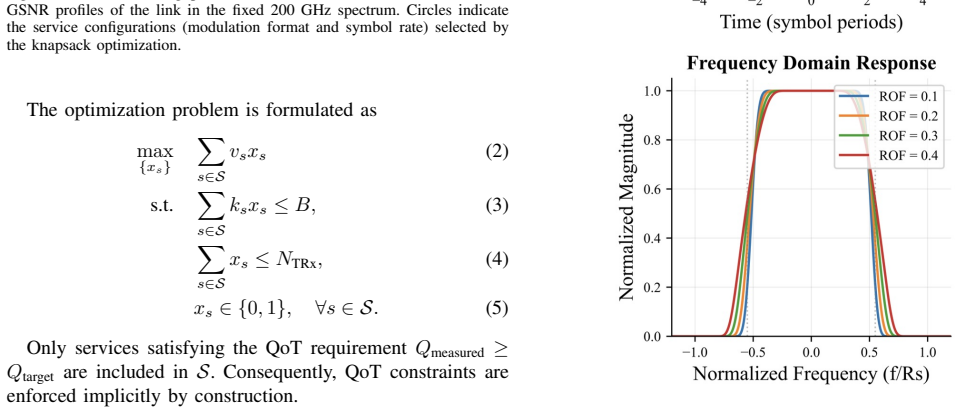
We propose a spectrum-configuration framework for open and disaggregated optical systems that maximizes throughput while guaranteeing the quality of transmission (QoT) margins. The framework jointly optimizes transceiver parameters, including modulation format, symbol rate, pulse-shaping roll-off factor, and wavelength-selective switch (WSS) bandwidth, under fixed spectral allocation constraints. The impact of roll-off factor optimization is first experimentally evaluated in the presence of cascaded WSS filtering, demonstrating measurable QoT gains for both single- and multi-channel transmission. Building on these observations, a knapsack-based optimization is applied in the context of Optical Spectrum as a Service (OSaaS) to select service configurations that maximize aggregate throughput within a fixed spectrum width and limited transceiver resources. Experimental validation on a metro-scale open testbed confirms the effectiveness of the proposed approach in achieving efficient spectrum utilization and adaptive throughput-margin trade-offs.
Editorial analysis
A structured set of objections, weighed in public.
Axiom & Free-Parameter Ledger
axioms (2)
- standard math Knapsack optimization can be applied to select discrete service configurations under linear capacity and margin constraints
- domain assumption Roll-off factor changes produce measurable QoT gains that remain additive across channels under fixed spectral allocation
Reference graph
Works this paper leans on
-
[1]
Effect of Channel Launch Power on Fill Margin in C+L Band Elastic Optical Networks , year=
Mitra, Abhijit and Semrau, Daniel and Gahlawat, Nishant and Srivastava, Anand and Bayvel, Polina and Lord, Andrew , journal=. Effect of Channel Launch Power on Fill Margin in C+L Band Elastic Optical Networks , year=
-
[2]
Borraccini, Giacomo and D'Amico, Andrea and Straullu, Stefano and Usmani, Fehmida and Ahmad, Arsalan and Curri, Vittorio , journal=. Iterative supervised learning approach using transceiver bit-error-rate measurements for optical line system optimization , year=
-
[3]
Yang Yue and Qiang Wang and Jon Anderson , journal =. Transmitter skew tolerance and spectral efficiency tradeoff in high baud-rate QAM optical communication systems , volume =. 2018 , url =. doi:10.1364/OE.26.015045 , abstract =
-
[4]
Design of Low-Margin Optical Networks , year =
Yvan Pointurier , journal =. Design of Low-Margin Optical Networks , year =. doi:10.1364/JOCN.9.0000A9 , abstract =
-
[5]
Design of low-margin optical networks , year=
Pointurier, Yvan , journal=. Design of low-margin optical networks , year=
-
[6]
GNPy model of the physical layer for open and disaggregated optical networking [Invited] , year=
Curri, Vittorio , journal=. GNPy model of the physical layer for open and disaggregated optical networking [Invited] , year=
- [7]
-
[8]
Cibby Pulikkaseril and others , title =. Opt. Express , year =
-
[9]
Fabrega, J. M. and Moreolo, M. Svaluto and Martín, L. and Piat, A. Chiadò and Riccardi, E. and Roccato, D. and Sambo, N. and Cugini, F. and Potì, L. and Yan, S. and Hugues-Salas, E. and Simeonidou, D. and Gunkel, M. and Palmer, R. and Fedderwitz, S. and Rafique, D. and Rahman, T. and de Waardt, Huug and Napoli, A. , journal=. On the filter narrowing issue...
-
[10]
Kaeval, Kaida and Grobe, Klaus and Elbers, Jorg-Peter , journal=. Operation of optical spectrum as a service in disaggregated and multi-operator environments [Invited] , year=
-
[11]
Roll-off factor dependence of Nyquist pulse transmission , volume =
Koudai Harako and Daiki Suzuki and Toshihiko Hirooka and Masataka Nakazawa , journal =. Roll-off factor dependence of Nyquist pulse transmission , volume =. 2016 , url =. doi:10.1364/OE.24.021986 , abstract =
-
[12]
and Ruffini, Marco and Pedreno-Manresa, Jose-Juan and Patri, Sai Kireet and Jervan, Gert , journal=
Kaeval, Kaida and Slyne, Frank and Troia, Sebastian and Kenny, Eoin and Grobe, Klaus and Griesser, Helmut and Kilper, Daniel C. and Ruffini, Marco and Pedreno-Manresa, Jose-Juan and Patri, Sai Kireet and Jervan, Gert , journal=. Employing channel probing to derive end-of-life service margins for optical spectrum services , year=
discussion (0)
Sign in with ORCID, Apple, or X to comment. Anyone can read and Pith papers without signing in.