Rather than drafting, vortex capture dictates efficiency in three-hydrofoil schools
Pith reviewed 2026-05-10 02:32 UTC · model grok-4.3
The pith
Vortex capture in leader wakes, not low-flow drafting, produces 58% thrust and 24% efficiency gains in three-hydrofoil schools.
A machine-rendered reading of the paper's core claim, the machinery that carries it, and where it could break.
Core claim
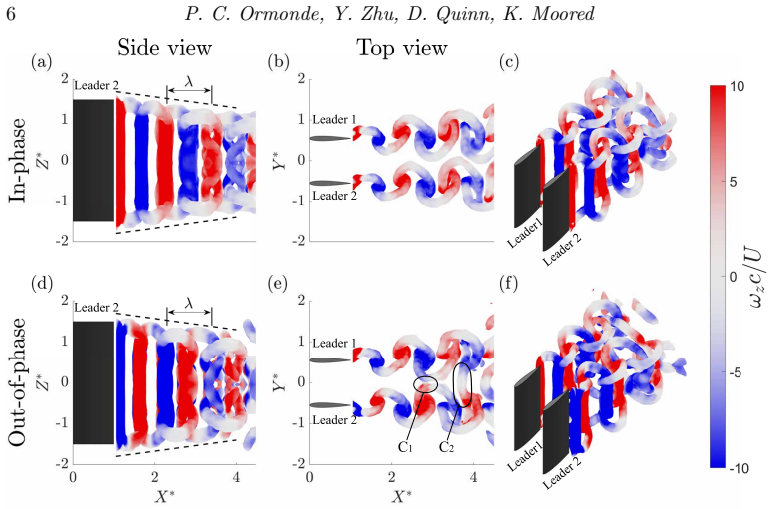
In three-dimensional experiments, a school of three pitching hydrofoils achieves collective thrust 58% higher and efficiency 24% higher than isolated foils when the follower is placed in the vortex wake of a leader. Traditional drafting in momentum-deficit wakes does not improve performance; instead, the oscillatory wakes produce momentum surplus yet still yield benefits through direct vortex-body interactions on the follower and upstream interactions that reduce leader power. An optimal spatial phase exists that depends on the measured wake wavelength, wake breakdown is not observed within three chord lengths, and the downstream foil shows cross-stream instability that would demand active控制
What carries the argument
Vortex-body interactions in the oscillatory wake that increase follower thrust and efficiency, combined with upstream body-to-body interactions that reduce leader power consumption.
If this is right
- Compact formations with the follower in the vortex wake outperform spread-out formations that rely on reduced mean flow.
- Thrust and efficiency peak at a specific spatial phase determined by the actual wake wavelength rather than prior estimates.
- Performance benefits persist at least three chord lengths downstream because wake breakdown does not occur in that range.
- Cross-stream instability of the follower means sustained high performance requires active control strategies.
Where Pith is reading between the lines
- Natural fish schools may achieve energy savings by maintaining precise vortex-capture spacing rather than simple drafting.
- Underwater vehicle or drone formations could improve range by adopting similar compact vortex-aligned arrangements.
- Varying foil flexibility or oscillation frequency would likely shift the optimal phase and the distance at which wake breakdown appears.
Load-bearing premise
Rigid pitching hydrofoils in controlled laboratory flows accurately represent the hydrodynamic interactions that occur in real fish schools or more flexible multi-body systems.
What would settle it
Position the follower hydrofoil in a region of reduced mean flow without vortex interaction and measure whether thrust and efficiency still rise by amounts comparable to the vortex-wake cases.
Figures




read the original abstract
Three-dimensional experiments are presented on a school of three pitching hydrofoils. Two side-by-side leader foils maintain the same relative positions while the location of a third follower foil is varied. Force and flow measurements detail the mechanisms that drive the school to achieve collective thrust and efficiency that are 58% and 24% higher than isolated foils, respectively. Traditional drafting involves positioning yourself in the wake of an upstream object. In wakes with a net momentum deficit, drafting reduces drag by lowering oncoming flow speed. By contrast, wakes from oscillatory swimmers feature strong momentum surplus regions, which increases drag by increasing the oncoming flow. Despite that, our results show that the best performance benefits occur for compact schools where the follower is directly in the vortex wake of a leader, whereas regions of reduced mean flow do not improve performance. The thrust and efficiency benefits are shown to be driven by vortex-body interactions that increase the thrust and efficiency of the follower and by body-to-body upstream interactions that reduce the power of the leaders. There is an optimal spatial phase to maximize the thrust and efficiency of the follower that depends upon the actual wake wavelength rather than the estimated wavelength used in previous literature. Moreover, wake breakdown, and its associated elimination of vortex-body performance benefits, is not observed within at least three chord lengths downstream of the leaders. Lastly, measurements of the cross-stream stability of the downstream foil indicate that compact, high-performance formations may require active control strategies in order to maintain their organization and maximise the hydrodynamic benefits of schooling.
Editorial analysis
A structured set of objections, weighed in public.
Referee Report
Summary. The manuscript reports three-dimensional experiments on a school of three rigid pitching hydrofoils, with two side-by-side leaders fixed and the follower position varied systematically. Force and flow measurements show collective thrust and efficiency 58% and 24% higher than isolated foils, respectively. The central claim is that performance maxima occur when the follower is positioned in the vortex wake of a leader (vortex capture), not in regions of reduced mean flow (traditional drafting); benefits arise from vortex-body interactions that augment follower thrust/efficiency and upstream body-to-body interactions that reduce leader power. Additional results include an optimal spatial phase tied to the measured wake wavelength, absence of wake breakdown within at least three chord lengths, and indications that compact high-performance formations require active control for cross-stream stability.
Significance. If the position-dependent force and flow data hold, the work supplies direct experimental evidence that vortex-mediated interactions, rather than mean-flow drafting, govern efficiency gains in oscillatory multi-body propulsion. This challenges prevailing models of fish schooling hydrodynamics and offers a mechanistic basis for collective performance that could guide bio-inspired vehicle design. The controlled laboratory setup with quantified positions and visualized wakes isolates the proposed mechanisms more cleanly than field observations of live fish.
major comments (2)
- [Results] Results section (force and efficiency data): The reported 58% thrust and 24% efficiency gains are load-bearing for the central claim, yet the manuscript provides no error bars, replicate statistics, or uncertainty quantification on these percentages. Without these, it is impossible to determine whether the gains exceed measurement variability or post-hoc selection effects.
- [Flow measurements] Flow visualization and wake analysis: The claim that 'wake breakdown... is not observed within at least three chord lengths' and that optimal phase depends on the 'actual wake wavelength' rather than estimated values rests on qualitative interpretation of visualized structures. Quantitative metrics (e.g., circulation decay, vortex trajectory tracking, or wavelength spectra) are needed to make this distinction falsifiable and to rule out subjective assessment of breakdown.
minor comments (2)
- The abstract and title use 'three-hydrofoil schools' while the text refers to 'school of three pitching hydrofoils'; standardize terminology for clarity.
- Figure captions for flow fields should explicitly label the positions corresponding to the reported performance maxima and the reduced-mean-flow regions to allow direct visual comparison with the force data.
Simulated Author's Rebuttal
We thank the referee for their thoughtful and constructive review. The comments highlight important areas for strengthening the presentation of our experimental results and flow analysis. We address each major comment below and have revised the manuscript to incorporate the requested clarifications and additional data.
read point-by-point responses
-
Referee: [Results] Results section (force and efficiency data): The reported 58% thrust and 24% efficiency gains are load-bearing for the central claim, yet the manuscript provides no error bars, replicate statistics, or uncertainty quantification on these percentages. Without these, it is impossible to determine whether the gains exceed measurement variability or post-hoc selection effects.
Authors: We agree that explicit uncertainty quantification is necessary to support the reported gains. In the revised manuscript we have added error bars (standard deviation across N=5 independent runs per position) to all thrust, power, and efficiency data in the results figures. We also report the number of replicates, the measurement uncertainty from the force sensors, and a brief statistical note confirming that the peak gains exceed variability at the 95% confidence level. These additions directly address the concern about post-hoc selection and allow readers to evaluate the robustness of the 58% thrust and 24% efficiency improvements. revision: yes
-
Referee: [Flow measurements] Flow visualization and wake analysis: The claim that 'wake breakdown... is not observed within at least three chord lengths' and that optimal phase depends on the 'actual wake wavelength' rather than estimated values rests on qualitative interpretation of visualized structures. Quantitative metrics (e.g., circulation decay, vortex trajectory tracking, or wavelength spectra) are needed to make this distinction falsifiable and to rule out subjective assessment of breakdown.
Authors: The referee correctly notes that the original claims relied primarily on visual inspection. We have revised the flow-analysis section to include quantitative metrics extracted from the PIV data: (i) circulation decay curves for the leading-edge and trailing-edge vortices as a function of downstream distance, (ii) tracked vortex-core trajectories showing persistence of coherent structures beyond three chord lengths, and (iii) spatial Fourier spectra of the streamwise velocity field that confirm the measured wake wavelength matches the observed optimal follower phase. These additions make the statements about wake integrity and phase dependence falsifiable and remove reliance on subjective interpretation. revision: yes
Circularity Check
No significant circularity
full rationale
The paper is a purely experimental study reporting direct force and flow measurements on three pitching hydrofoils with controlled variation of follower position. Central claims (thrust/efficiency gains from vortex capture rather than drafting, upstream power reduction on leaders, optimal spatial phase tied to wake wavelength) are grounded in position-dependent data without any derivations, model equations, fitted parameters renamed as predictions, or self-citation chains. No load-bearing step reduces to its own inputs by construction.
Axiom & Free-Parameter Ledger
axioms (1)
- domain assumption The flow around rigid pitching hydrofoils in a uniform stream is governed by incompressible Navier-Stokes equations with no-slip boundary conditions.
Reference graph
Works this paper leans on
-
[1]
Journal of Fluids Engineering , volume =
Kinsey, Thomas and Dumas, Guy , title =. Journal of Fluids Engineering , volume =. 2012 , month =. doi:10.1115/1.4005423 , url =
-
[2]
and Zhu, Yuanhang and Breuer, Kenneth S
Handy-Cardenas, Eric E. and Zhu, Yuanhang and Breuer, Kenneth S. , year=. Optimal kinematics for energy harvesting using favourable wake–foil interactions in tandem oscillating hydrofoils , volume=. doi:10.1017/jfm.2025.10198 , journal=
-
[3]
Ponta, Fernando L. , title =. Physics of Fluids , volume =. 2010 , month =. doi:10.1063/1.3481383 , url =
-
[4]
Nature communications , volume=
Flow interactions lead to self-organized flight formations disrupted by self-amplifying waves , author=. Nature communications , volume=. 2024 , publisher=
work page 2024
-
[5]
Journal of Fluids and Structures , volume=
Propulsive performance and vortex wakes of multiple tandem foils pitching in-line , author=. Journal of Fluids and Structures , volume=. 2022 , publisher=
work page 2022
-
[6]
Efficient foil propulsion through vortex control , author=. Aiaa journal , volume=
-
[7]
Journal of fluid mechanics , volume=
Passive propulsion in vortex wakes , author=. Journal of fluid mechanics , volume=. 2006 , publisher=
work page 2006
-
[8]
Journal of Experimental Biology , volume=
Neuromuscular control of trout swimming in a vortex street: implications for energy economy during the Karman gait , author=. Journal of Experimental Biology , volume=. 2004 , publisher=
work page 2004
-
[9]
Journal of Fluid Mechanics , volume=
Collective locomotion of two closely spaced self-propelled flapping plates , author=. Journal of Fluid Mechanics , volume=. 2018 , publisher=
work page 2018
-
[10]
Collective locomotion of two-dimensional lattices of flapping plates. Part 2. Lattice flows and propulsive efficiency , author=. Journal of Fluid Mechanics , volume=. 2021 , publisher=
work page 2021
-
[11]
Journal of Fluid Mechanics , volume=
Two-dimensional hydrodynamic schooling of two flapping swimmers initially in tandem formation , author=. Journal of Fluid Mechanics , volume=. 2022 , publisher=
work page 2022
-
[12]
Journal of Fluid Mechanics , volume=
Flow-mediated organization of two freely flapping swimmers , author=. Journal of Fluid Mechanics , volume=. 2021 , publisher=
work page 2021
-
[13]
Effects of body shape on hydrodynamic interactions in a dense diamond fish school , author=. Physics of Fluids , volume=. 2024 , publisher=
work page 2024
-
[14]
Effects of phase difference on hydrodynamic interactions and wake patterns in high-density fish schools , author=. Physics of Fluids , volume=. 2022 , publisher=
work page 2022
-
[15]
Philosophical Transactions of the Royal Society B: Biological Sciences , volume=
A review of fish swimming mechanics and behaviour in altered flows , author=. Philosophical Transactions of the Royal Society B: Biological Sciences , volume=. 2007 , publisher=
work page 2007
-
[16]
Swimming and Flying in Nature: Volume 2 , pages=
Some hydrodynamical aspects of fish schooling , author=. Swimming and Flying in Nature: Volume 2 , pages=. 1975 , publisher=
work page 1975
-
[17]
Energy conservation by collective movement in schooling fish , author=. Elife , volume=. 2024 , publisher=
work page 2024
-
[18]
High-efficiency can be achieved for non-uniformly flexible pitching hydrofoils via tailored collective interactions , author=. Fluids , volume=. 2021 , publisher=
work page 2021
-
[19]
Bioinspiration & Biomimetics , volume=
Tunabot Flex: A tuna-inspired robot with body flexibility improves high-performance swimming , author=. Bioinspiration & Biomimetics , volume=. 2021 , publisher=
work page 2021
-
[20]
Form, function, and locomotory habits in fish , author=. Fish physiology , pages=. 1978 , publisher=
work page 1978
- [21]
- [22]
-
[23]
Kuhn, H. W. and Tucker, A. W. , title =. Proceedings of the Second Berkeley Symposium on Mathematical Statistics and Probability , editor =
-
[24]
The Quarterly review of biology , volume=
Schooling behavior in fishes , author=. The Quarterly review of biology , volume=. 1948 , publisher=
work page 1948
-
[25]
Ecological modelling , volume=
Evolutionary trends in fish schools in heterogeneous environments , author=. Ecological modelling , volume=. 2016 , publisher=
work page 2016
-
[26]
The structure and function of fish schools , author=. Scientific american , volume=
-
[27]
Behavioral ecology and sociobiology , volume=
Fish swimming in schools save energy regardless of their spatial position , author=. Behavioral ecology and sociobiology , volume=. 2015 , publisher=
work page 2015
-
[28]
Journal of Fish Biology , volume=
Energy savings in sea bass swimming in a school: measurements of tail beat frequency and oxygen consumption at different swimming speeds , author=. Journal of Fish Biology , volume=. 1998 , publisher=
work page 1998
- [29]
-
[30]
Proceedings of the national academy of sciences , volume=
Interaction ruling animal collective behavior depends on topological rather than metric distance: Evidence from a field study , author=. Proceedings of the national academy of sciences , volume=. 2008 , publisher=
work page 2008
-
[31]
Journal of Fluid Mechanics , volume=
Passive propulsion in vortex wakes , author=. Journal of Fluid Mechanics , volume=. 2006 , publisher=
work page 2006
-
[32]
Journal of Fluid Mechanics , volume=
Active vorticity control in a shear flow using a flapping foil , author=. Journal of Fluid Mechanics , volume=. 1994 , publisher=
work page 1994
-
[33]
Proceedings of the National Academy of Sciences , volume=
Efficient collective swimming by harnessing vortices through deep reinforcement learning , author=. Proceedings of the National Academy of Sciences , volume=. 2018 , publisher=
work page 2018
-
[34]
Physical review letters , volume=
Flow-mediated interactions between two self-propelled flapping filaments in tandem configuration , author=. Physical review letters , volume=. 2014 , publisher=
work page 2014
-
[35]
Journal of Fluid Mechanics , volume=
Performance augmentation mechanism of in-line tandem flapping foils , author=. Journal of Fluid Mechanics , volume=. 2017 , publisher=
work page 2017
-
[36]
Experimental study on mean thrust of two plunging wings in tandem , author=. AIAA Journal , volume=. 2015 , publisher=
work page 2015
-
[37]
Physical review letters , volume=
Model of collective fish behavior with hydrodynamic interactions , author=. Physical review letters , volume=. 2018 , publisher=
work page 2018
-
[38]
On the energetics and stability of a minimal fish school , author=. BioRxiv , pages=. 2019 , publisher=
work page 2019
-
[39]
Proceedings of the National Academy of Sciences , volume=
Flow interactions between uncoordinated flapping swimmers give rise to group cohesion , author=. Proceedings of the National Academy of Sciences , volume=. 2019 , publisher=
work page 2019
-
[40]
Bioinspiration & biomimetics , volume=
Synchronisation through learning for two self-propelled swimmers , author=. Bioinspiration & biomimetics , volume=. 2017 , publisher=
work page 2017
-
[41]
arXiv preprint arXiv:1904.13045 , year=
Lattices of hydrodynamically interacting flapping swimmers , author=. arXiv preprint arXiv:1904.13045 , year=
-
[42]
Journal of Fluid Mechanics , volume=
Swimming freely near the ground leads to flow-mediated equilibrium altitudes , author=. Journal of Fluid Mechanics , volume=. 2019 , publisher=
work page 2019
-
[43]
Bioinspiration & biomimetics , volume=
Flow interactions of two-and three-dimensional networked bio-inspired control elements in an in-line arrangement , author=. Bioinspiration & biomimetics , volume=. 2018 , publisher=
work page 2018
-
[44]
Theoretical and Computational Fluid Dynamics , volume=
Hydrodynamics of a biologically inspired tandem flapping foil configuration , author=. Theoretical and Computational Fluid Dynamics , volume=. 2007 , publisher=
work page 2007
-
[45]
Flying and swimming animals cruise at a Strouhal number tuned for high power efficiency , author=. Nature , volume=. 2003 , publisher=
work page 2003
-
[46]
Journal of Fluid Mechanics , volume=
Oscillating foils of high propulsive efficiency , author=. Journal of Fluid Mechanics , volume=. 1998 , publisher=
work page 1998
-
[47]
Journal of Fluid Mechanics , volume=
Unsteady propulsion near a solid boundary , author=. Journal of Fluid Mechanics , volume=. 2014 , publisher=
work page 2014
-
[48]
Propulsion of a flapping and oscillating airfoil , author=. NACA Report , year=
- [49]
-
[50]
General Theory of Aerodynamic Instability and the Mechanism of Flutter, NACA , author=. 1935 , institution=
work page 1935
-
[51]
Upwash exploitation and downwash avoidance by flap phasing in ibis formation flight , author=. Nature , volume=. 2014 , publisher=
work page 2014
-
[52]
Journal of Fluids and Structures , volume=
Optimal Strouhal number for swimming animals , author=. Journal of Fluids and Structures , volume=. 2012 , publisher=
work page 2012
-
[53]
Journal of experimental biology , volume=
The speed of swimming of fish as related to size and to the frequency and amplitude of the tail beat , author=. Journal of experimental biology , volume=. 1958 , publisher=
work page 1958
- [54]
-
[55]
Linear instability mechanisms leading to optimally efficient locomotion with flexible propulsors , author=. Physics of Fluids , volume=. 2014 , publisher=
work page 2014
-
[56]
Journal of Fluid Mechanics , volume=
Hydrodynamic propulsion by large amplitude oscillation of an airfoil with chordwise flexibility , author=. Journal of Fluid Mechanics , volume=. 1978 , publisher=
work page 1978
-
[57]
Hydrodynamics of undulatory propulsion , author=. Fish physiology , volume=. 2005 , publisher=
work page 2005
-
[58]
Journal of Fluid Mechanics , volume=
Swimming of a waving plate , author=. Journal of Fluid Mechanics , volume=. 1961 , publisher=
work page 1961
-
[59]
Aerodynamics of a NACA4412 airfoil in ground effect , author=. AIAA journal , volume=
-
[60]
Journal of Fluid Mechanics , volume=
An analytic solution for two-and three-dimensional wings in ground effect , author=. Journal of Fluid Mechanics , volume=. 1970 , publisher=
work page 1970
-
[61]
Aerodynamics of a heaving airfoil in ground effect , author=. AIAA journal , volume=
-
[62]
Journal of Fluid Mechanics , volume=
Wake structure and thrust generation of a flapping foil in two-dimensional flow , author=. Journal of Fluid Mechanics , volume=. 2017 , publisher=
work page 2017
-
[63]
Journal of The Royal Society Interface , volume=
Stable formations of self-propelled fish-like swimmers induced by hydrodynamic interactions , author=. Journal of The Royal Society Interface , volume=. 2018 , publisher=
work page 2018
-
[64]
Bioinspiration & biomimetics , volume=
The hydrodynamic advantages of synchronized swimming in a rectangular pattern , author=. Bioinspiration & biomimetics , volume=. 2015 , publisher=
work page 2015
-
[65]
Journal of Fluid Mechanics , volume=
Optimal undulatory swimming for a single fish-like body and for a pair of interacting swimmers , author=. Journal of Fluid Mechanics , volume=. 2017 , publisher=
work page 2017
-
[66]
Journal of Fluid Mechanics , volume=
Vortex wakes of a flapping foil , author=. Journal of Fluid Mechanics , volume=. 2009 , publisher=
work page 2009
-
[67]
Swimming and flying in nature , pages=
Extraction of flow energy by fish and birds in a wavy stream , author=. Swimming and flying in nature , pages=. 1975 , publisher=
work page 1975
-
[68]
Self-organized shape and frontal density of fish schools , author=. Ethology , volume=. 2008 , publisher=
work page 2008
-
[69]
From behavioural analyses to models of collective motion in fish schools , author=. Interface focus , volume=. 2012 , publisher=
work page 2012
-
[70]
Revealing the mechanism and scaling laws behind equilibrium altitudes of near-ground pitching hydrofoils , author=. 2023 , eprint=
work page 2023
-
[71]
Journal of Fluid Mechanics , keywords =
Peng, Ze-Rui and Huang, Haibo and Lu, Xi-Yun , doi =. Journal of Fluid Mechanics , keywords =
-
[72]
Journal of Fluid Mechanics , keywords =
Floryan, Daniel and. Journal of Fluid Mechanics , keywords =. doi:10.1017/jfm.2017.302 , eprint =
-
[73]
Dong, Gen Jin and Lu, Xi Yun , doi =. Physics of Fluids , number =
-
[74]
Wagenhoffer, Nathan and Moored, Keith W. and Jaworski, Justin W. , doi =. Physical Review Fluids , keywords =
-
[75]
Unsteady Ground Effect of Undulatory Swimmers , author=. 2021 , school=
work page 2021
-
[76]
Bao, Y. and Zhou, D. and Tao, J. J. and Peng, Z. and Zhu, H. B. and Sun, Z. L. and Tong, H. L. , doi =. Physics of Fluids , number =
-
[77]
Buren, Tyler Van and Floryan, Daniel and Smits, Alexander J , doi =. AIAA Journal , number =
-
[78]
Huera-Huarte, F. J. , doi =. Journal of Fluids and Structures , keywords =
-
[79]
Ayancik, Fatma and Fish, Frank E. and Moored, Keith W. , doi =. Journal of the Royal Society Interface , keywords =
-
[80]
Mivehchi, Amin and Zhong, Qiang and Kurt, Melike and Quinn, Daniel B. and Moored, Keith W. , doi =. Journal of Fluid Mechanics , keywords =. arXiv , arxivId =:2011.11792 , file =
discussion (0)
Sign in with ORCID, Apple, or X to comment. Anyone can read and Pith papers without signing in.