Tonnetz Theory, Classical Harmony, and the Combinatorial Geometry of Abstract Musical Resources
Pith reviewed 2026-05-10 01:39 UTC · model grok-4.3
The pith
Diatonic triads map to a {7_3} bipartite graph and seventh chords to the Fano configuration in tonnetz theory.
A machine-rendered reading of the paper's core claim, the machinery that carries it, and where it could break.
Core claim
In the case of diatonic triads, the well-known relations between the seven diatonic degrees and their pitch classes are represented by a bipartite graph of type {7_3} and girth four. In the case of diatonic seventh chords, the voice-leading relations are given a complete characterization by a Fano configuration {7_3}. A tonnetz for pentatonic music is constructed on the Desargues configuration {10_3}, and a tonnetz for the twelve-tone system is constructed on the Cremona-Richmond configuration {15_3}. The chromatic pitch-class set and the major-triad set are related by a D222 configuration whose Levi graph places the minor triads in one-to-one correspondence with a class of hexacycles, so as
What carries the argument
Levi graphs of specific combinatorial configurations ({7_3} bipartite graphs, Fano {7_3}, Desargues {10_3}, Cremona-Richmond {15_3}, D222) that encode the adjacency and incidence structure of pitch classes and harmonies in each tonnetz.
If this is right
- Voice-leading relations among diatonic seventh chords receive an exhaustive combinatorial description via the Fano plane.
- Pentatonic and twelve-tone materials become available for composition through the incidence structure of the Desargues and Cremona-Richmond configurations.
- The characteristic major-minor duality in the classical tonnetz is expressed by the placement of minor triads on specific hexacycles of the D222 Levi graph.
- These configurations supply abstract combinatorial resources that can be used to generate or analyze harmonic progressions beyond traditional interval-based models.
Where Pith is reading between the lines
- If the mappings are faithful, then other scale systems might be classified by matching them to known configurations in finite geometry.
- Algorithms that enumerate cycles or automorphisms in these graphs could be tested as generators of new harmonic sequences.
- The approach may link to existing group-theoretic treatments of transposition and inversion by identifying the symmetry groups of the chosen configurations with musical operations.
Load-bearing premise
The selected graph configurations accurately encode the musically relevant relations such as voice leading and harmonic function without omitting important features or introducing arbitrary choices.
What would settle it
A concrete voice-leading move between two diatonic seventh chords that is absent from the edges of the Fano {7_3} graph, or an edge present in the graph that does not correspond to any standard voice-leading relation, would refute the claimed complete characterization.
Figures





read the original abstract
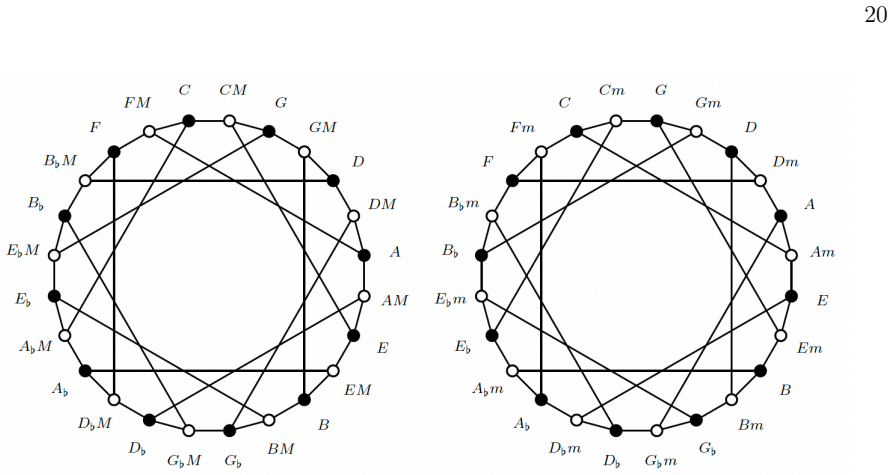
In a previous submission, we established a fundamental relation between tone networks and configurations. It was shown that the Eulerian tonnetz can be represented by a $\{12_3\}$ of Daublebsky von Sterneck type D222. We also constructed a tonnetz for Tristan-genus chords (dominant sevenths and half-diminished sevenths) and we showed that this tonnetz can be represented by a $\{12_3\}$ of type D228. In both of these constructions the associated Levi graphs play an important role. Here we look at the tonnetze associated with some other musical systems, thereby offering several concrete examples of an abstract view of music as combinatorial geometry. First, we look at the tonal harmonies typical of the classical period. In the case of diatonic triads, we show the existence of a bipartite graph of type $\{7_3\}$ and girth four that represents the well-known relations between the seven diatonic degrees and their pitch classes. In the case of diatonic seventh chords, we obtain a Fano configuration $\{7_3\}$ which gives a complete characterization of the voice-leading relations that hold between such chords. Next, we construct a tonnetz for pentatonic music based on the Desargues configuration $\{10_3\}$ and we construct a tonnetz for the 12-tone system based on the Cremona-Richmond configuration $\{15_3\}$. Both can be used as a resource for musical compositions. Finally, we show that the relation between the chromatic pitch class set and the major triad set is also represented by a D222. The minor triads are in one-to-one correspondence with the members of a certain class of hexacycles in the Levi graph of this configuration. In this way, the characteristic duality between major and minor triads in the tonnetz can be broken.
Editorial analysis
A structured set of objections, weighed in public.
Referee Report
Summary. The paper extends prior work on tonnetz representations via combinatorial configurations by constructing geometric models for classical diatonic harmony, pentatonic scales, and 12-tone systems. It claims existence of a {7_3} bipartite graph of girth four for relations among the seven diatonic triads and pitch classes, a Fano plane {7_3} that completely characterizes voice-leading relations among diatonic seventh chords, a Desargues {10_3} tonnetz for pentatonic music, a Cremona-Richmond {15_3} tonnetz for the 12-tone system, and a D222 configuration linking chromatic pitch classes to major triads (with minor triads corresponding to hexacycles in the associated Levi graph).
Significance. If the claimed incidences are shown to arise directly from exhaustive enumeration of musically admissible voice-leading relations rather than selective encoding, the work supplies explicit, reusable combinatorial resources (Fano plane, Desargues configuration, Levi graphs) for analyzing harmonic function and voice leading. The approach strengthens the link between music theory and finite geometry by exhibiting known configurations as tonnetze, potentially enabling systematic composition tools and falsifiable predictions about admissible progressions.
major comments (3)
- [Abstract] Abstract: the claim that the Fano {7_3} 'gives a complete characterization of the voice-leading relations' between diatonic seventh chords is load-bearing for the central thesis yet unsupported by any enumeration of admissible leadings, incidence matrix, or verification that every musically allowed pair corresponds to a line and no disallowed pair does; without this explicit matching the characterization cannot be assessed as non-circular.
- [Abstract] Abstract: the asserted existence of a {7_3} girth-four bipartite graph for diatonic triads and pitch classes likewise requires a concrete construction (point-line incidence table or diagram) showing how the seven degrees and their pitch classes realize the incidences and why the girth is exactly four; the abstract states existence without derivation details.
- [Introduction] The manuscript refers to 'a previous submission' establishing the {12_3} D222 and D228 cases but provides no self-contained recap of the Levi-graph construction or the definition of admissible voice-leading moves used there; this definition is prerequisite for verifying that the new {7_3} and {10_3} incidences are not fitted post hoc.
minor comments (2)
- [Abstract] The notation '{n_k}' for configurations should be defined or referenced to standard combinatorial literature (e.g., incidence structures or block designs) on first use.
- Diagrams or explicit Levi-graph drawings for the Fano, Desargues, and D222 cases would make the claimed correspondences verifiable at a glance.
Simulated Author's Rebuttal
We thank the referee for the careful reading and constructive suggestions. The comments highlight areas where the presentation of our combinatorial constructions can be made more explicit and self-contained. We address each major comment below and commit to revisions that strengthen the manuscript without altering its core claims.
read point-by-point responses
-
Referee: [Abstract] Abstract: the claim that the Fano {7_3} 'gives a complete characterization of the voice-leading relations' between diatonic seventh chords is load-bearing for the central thesis yet unsupported by any enumeration of admissible leadings, incidence matrix, or verification that every musically allowed pair corresponds to a line and no disallowed pair does; without this explicit matching the characterization cannot be assessed as non-circular.
Authors: We agree that an explicit incidence matrix and verification are necessary to substantiate the claim of complete characterization. The manuscript derives the Fano plane directly from the admissible voice-leading relations among the seven diatonic seventh chords (using the same combinatorial rules as in our prior work on D222/D228 configurations). To eliminate any ambiguity, we will add a dedicated subsection with the full incidence table, an enumeration of all admissible leadings, and a proof that the lines match exactly these relations while excluding disallowed pairs. This will be included in the revised version. revision: yes
-
Referee: [Abstract] Abstract: the asserted existence of a {7_3} girth-four bipartite graph for diatonic triads and pitch classes likewise requires a concrete construction (point-line incidence table or diagram) showing how the seven degrees and their pitch classes realize the incidences and why the girth is exactly four; the abstract states existence without derivation details.
Authors: The bipartite {7_3} graph is constructed in the body by taking the seven diatonic degrees as one partite set and the corresponding pitch classes as the other, with incidences given by triad membership. The girth is four because the structure contains no 3-cycles (no three elements are mutually incident). We will add an explicit incidence table and a diagram in the revised manuscript to provide the requested concrete construction and derivation details. revision: yes
-
Referee: [Introduction] The manuscript refers to 'a previous submission' establishing the {12_3} D222 and D228 cases but provides no self-contained recap of the Levi-graph construction or the definition of admissible voice-leading moves used there; this definition is prerequisite for verifying that the new {7_3} and {10_3} incidences are not fitted post hoc.
Authors: We accept that a self-contained recap is needed for independent verification. The revised introduction will include a brief subsection summarizing the Levi-graph construction from the prior work and the precise definition of admissible voice-leading moves (minimal voice motion preserving harmonic function under the combinatorial incidence rules). This will allow readers to confirm that the new {7_3} and {10_3} incidences arise directly from the same rules rather than being fitted post hoc. revision: yes
Circularity Check
No significant circularity; mappings to external configurations are independent
full rationale
The paper references prior work on the general tonnetz-configuration relation but presents the specific claims for diatonic triads (bipartite {7_3} graph of girth four) and seventh chords (Fano {7_3}) as direct constructions that exhibit the incidence structures matching voice-leading relations. These are shown by explicit correspondence rather than by redefining the musical relations to force the geometry or by fitting parameters whose output is then relabeled as a prediction. No equation or definition in the abstract or described chain reduces the claimed complete characterization to the input data by construction; the combinatorial objects are external and the musical relations are treated as given data to be matched. The derivation chain therefore remains self-contained against external benchmarks.
Axiom & Free-Parameter Ledger
axioms (1)
- standard math Incidence structures satisfy the standard axioms of a linear space or configuration where each point lies on a fixed number of lines and each line contains a fixed number of points.
Reference graph
Works this paper leans on
-
[1]
Baker, H. F. (1925) Principles of Geometry , Vol. IV: Higher Geometry. Cambridge University Press
work page 1925
-
[2]
Boland, J. R. & Hughston, L. P. (2025) Configurations, Tessellations and Tone Net- works. ArXiv: 2505.08752
work page internal anchor Pith review Pith/arXiv arXiv 2025
-
[3]
Brier, R. & Bryant, T. (2021) On the Steiner Quadruple System with Ten Points v3. Bulletin of the Institute of Combinatorics and its Applications 92, 115-127
work page 2021
-
[4]
(1846) Sur quelques theor` ems de la g´ eom´ etrie de position
Cayley, A. (1846) Sur quelques theor` ems de la g´ eom´ etrie de position. Collected Math- ematical Papers, Vol. 1, 1889, 317-328
-
[5]
(2012) Audacious Euphony: Chromaticism and the Triad’s Second Nature
Cohn, R. (2012) Audacious Euphony: Chromaticism and the Triad’s Second Nature . Oxford University Press
work page 2012
-
[6]
Coxeter, H. S. M. (1950) Self-Dual Configurations and Regular Graphs. Bull. Amer. Math. Soc. 56, 413-455
work page 1950
-
[7]
Coxeter, H. S. M. (1958) Twelve Points in P G(5, 3) with 95040 Self-Transformations. Proc. Roy. Soc. A 247, 279-293
work page 1958
-
[8]
Coxeter, H. S. M. (1974) Projective Geometry. Second edition. Toronto and Buffalo: University of Toronto Press
work page 1974
-
[9]
(2024) An Algebra of Chords for a Non-degenerate Tonnetz
Cubarsi, R. (2024) An Algebra of Chords for a Non-degenerate Tonnetz. J. Math. Mu- sic 18 (3), 259-295
work page 2024
-
[10]
(1895) Die Configurationen 12 3
Daublebsky von Sterneck, R. (1895) Die Configurationen 12 3. Monatshefte Math. Physik 6, 223-260
-
[11]
Douthett, J. & Steinbach, P. (1998) Parsimonious Graphs: A Study in Parsimony, Contextual Transformations, and Modes of Limited Transposition. J. Music Theory 42 (2), 241-263. 24
work page 1998
-
[12]
(1979) Tonal Harmony in Concept and Practice , third edition
Forte, A. (1979) Tonal Harmony in Concept and Practice , third edition. New York: Holt, Rinehart and Winston
work page 1979
-
[13]
(2009)Configurations of Points and Lines
Gr¨ unbaum, B. (2009)Configurations of Points and Lines . Graduate Studies in Math- ematics 103. Providence, Rhode Island: American Mathematical Society
work page 2009
-
[14]
Levi, F. W. (1929) Geometrische Konfigurationen. Leipzig: S. Hirzel
work page 1929
-
[15]
Levi, F. W. (1942) Finite Geometrical Systems. Six public lectures delivered in Febru- ary, 1940, at the University of Calcutta. Calcutta, India: University of Calcutta
work page 1942
-
[16]
(1967) A Study of Hexachord Levels in Schoenberg’s Violin Fantasy
Lewin, D. (1967) A Study of Hexachord Levels in Schoenberg’s Violin Fantasy. Per- spectives of New Music 6 (1), 18-32. Reprinted in: B. Boretz & E. T. Cone, eds. (1968) Perspectives on Schoenberg and Stravinsky. Princeton University Press
work page 1967
-
[17]
Mason, J. H. (1977) Matroids as the Study of Geometrical Configurations. In: Higher Combinatorics, Ainger, M., ed., 133-176. Dordrecht: D. Reidel
work page 1977
-
[18]
(1985) Harmony, revised edition
Piston, W. (1985) Harmony, revised edition. Revised and expanded by M. DeVoto. London: Victor Gollancz
work page 1985
-
[19]
Richmond, H. W. (1900) On the Figure of Six Points in Space of Four Dimen- sions. Quart. J. Math. 31 (3), 125-160
work page 1900
-
[20]
(1954)Structural Functions of Harmony
Sch¨ onberg, A. (1954)Structural Functions of Harmony . Revised edition with correc- tions, edited by L. Stein. London: Ernest Benn
work page 1954
-
[21]
(1997) Errata: An Examined Life
Steiner, G. (1997) Errata: An Examined Life . London: Weidenfeld & Nicolson
work page 1997
-
[22]
Sylvester, J. J. (1844) Elementary Researches in the Analysis of Combinatorial Ag- gregation. Philosophical Magazine XXIV (1844), 285-296
-
[23]
Sylvester, J. J. (1861) Note on the Origin of the Unsymmetrical Six-Valued Function of Six Letters. Philosophical Magazine XXI (1861), 369-377
-
[24]
(2011) A Geometry of Music: Harmony and Counterpoint in the Ex- tended Common Practice
Tymoczko, D. (2011) A Geometry of Music: Harmony and Counterpoint in the Ex- tended Common Practice. New York: Oxford University Press
work page 2011
-
[25]
Tutte, W. T. (1947) A Family of Cubical Graphs. Cambridge Philos. Soc. 43, 459-474
work page 1947
-
[26]
Waller, D. A. (1978) Some Combinatorial Aspects of the Musical Chords.Mathematical Gazette 62 (419), 12-15. 25 APPENDIX A: T ables of Duads and Synthemes Letters as totals of number-synthemes a 12, 34, 56 13, 25, 46 14, 26, 35 15, 24, 36 16, 23, 45 b 12, 34, 56 16, 24, 35 15, 23, 46 13, 26, 45 14, 25, 36 c 13, 25, 46 16, 24, 35 12, 36, 45 14, 23, 56 15, 2...
work page 1978
discussion (0)
Sign in with ORCID, Apple, or X to comment. Anyone can read and Pith papers without signing in.