The physics of ELM-free regimes in EUROfusion tokamaks
Pith reviewed 2026-05-09 23:28 UTC · model grok-4.3
The pith
QCE and negative triangularity regimes reach normalized pedestal performance comparable to ELMy H-modes while avoiding large Type-I ELMs.
A machine-rendered reading of the paper's core claim, the machinery that carries it, and where it could break.
Core claim
Access to the NT and QCE regimes is controlled by ideal-MHD ballooning modes, with QCE entry occurring above a minimum separatrix density that matches experimental observations. When pedestal top values are appropriately normalized, QCE achieves performance levels that do not differ significantly from ELMy H-mode plasmas. This similarity, together with the model's application to the ITER 15 MA baseline, establishes the QCE regime as a viable ELM-free operational scenario for both ITER and future reactors.
What carries the argument
Ideal-MHD access models based on ballooning modes, which govern entry into NT and QCE regimes and can be expressed as a minimum separatrix density criterion for QCE.
If this is right
- QCE plasmas can maintain high pedestal performance without large Type-I ELMs.
- The minimum separatrix density provides a practical predictor for accessing the QCE regime in experiments.
- Both NT and QCE rely on ballooning-mode transport to remain ELM-free.
- These regimes become relevant operational scenarios for the 15 MA ITER baseline and future reactors.
- Progress in ideal-MHD models improves understanding of multiple ELM-free regimes across EUROfusion devices.
Where Pith is reading between the lines
- The separatrix density threshold could be tested as a control knob in other tokamaks to trigger QCE-like behavior.
- If the normalized performance holds, reactor designs might adopt QCE without major trade-offs in fusion power density.
- Ballooning-mode physics might link QCE and NT to other ELM-free regimes such as QH or I-mode, suggesting shared access criteria.
- Nonlinear simulations could check whether kinetic effects alter the ideal-MHD density threshold at ITER scales.
Load-bearing premise
That ideal-MHD ballooning-mode models fully capture the physics of entry into the NT and QCE regimes without requiring kinetic, nonlinear, or resistive effects, and that the normalization procedure allows fair comparison of pedestal values across regimes.
What would settle it
A measurement of separatrix density at QCE onset in a high-current plasma that falls substantially below the predicted minimum, or normalized pedestal top values in QCE that differ markedly from ELMy H-mode levels, would falsify the access models and performance claims.
Figures


read the original abstract
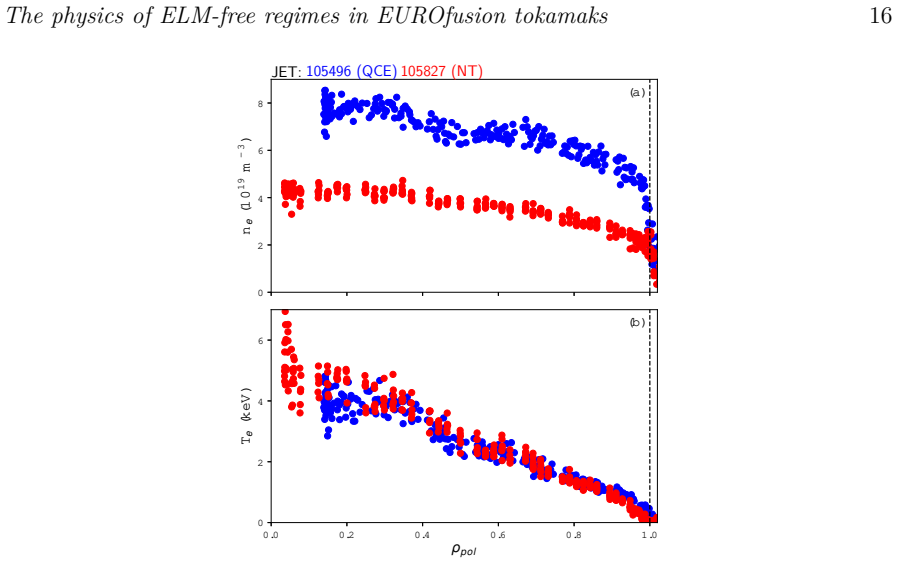
The development of operational scenarios without large Type-I ELMs is of utmost importance for the stable operation and longevity of future tokamaks. The EUROfusion tokamak exploitation program has therefore made the understanding of ELM-free regimes a major topic of exploration across all its contributing devices (ASDEX Upgrade, JET, MAST-Upgrade, TCV, and WEST). An integrated program to investigate a range of Type-I ELM-free regimes has been developed covering the enhanced D-alpha (EDA), magnetic perturbations (MP), negative triangularity (NT), quasi-continuous exhaust (QCE), quiescent H-mode (QH), the baseline small ELMs (SE), I-mode, and X-point radiator (XPR) regimes. This contribution focuses on the development and understanding of the NT and QCE regimes on ASDEX Upgrade, JET, and TCV. The importance of transport via ballooning modes in both regimes is highlighted, as well as the progress in developing access models based on ideal-MHD. In the case of the QCE, this can also be expressed as a minimum separatrix density, which corresponds well to experimentally measured separatrix densities. Particular focus is paid to the performance of the QCE in terms of the achieved pedestal top values, which, when appropriately normalised, do not differ significantly from ELMy H-mode plasmas. This, combined with the predicted minimum separatrix density for the 15 MA ITER baseline plasma, highlight the relevance of the QCE as a potential operational scenario for both ITER and future reactors.
Editorial analysis
A structured set of objections, weighed in public.
Referee Report
Summary. The manuscript reviews the EUROfusion tokamak program on Type-I ELM-free regimes across ASDEX Upgrade, JET, MAST-Upgrade, TCV, and WEST, with primary focus on negative triangularity (NT) and quasi-continuous exhaust (QCE) regimes. It highlights the role of ballooning-mode transport, presents ideal-MHD-based access models (including a minimum separatrix density criterion for QCE that is stated to match experimental measurements), reports that appropriately normalized QCE pedestal-top values are statistically comparable to those in ELMy H-mode, and extrapolates the QCE minimum-density criterion to the 15 MA ITER baseline scenario to argue for its reactor relevance.
Significance. If the ideal-MHD access models are shown to be robust and the normalized pedestal comparisons hold under detailed scrutiny, the work would strengthen the case for QCE as an ELM-free operational scenario for ITER and future devices by linking experimental observations to a predictive density threshold. The integrated multi-device approach and emphasis on ballooning physics provide a useful framework for scenario development, though the absence of quantified kinetic/resistive corrections limits immediate applicability.
major comments (2)
- [Abstract / QCE access model section] The central claim that the ideal-MHD ballooning-mode access model yields a minimum separatrix density 'which corresponds well to experimentally measured separatrix densities' and can be extrapolated to ITER requires explicit derivation steps, error bars, and sensitivity analysis to finite-Larmor-radius or resistive effects at the separatrix; without these, the ITER 15 MA prediction rests on an untested assumption of model completeness.
- [QCE performance comparison] The statement that QCE pedestal-top values 'when appropriately normalised, do not differ significantly from ELMy H-mode plasmas' is load-bearing for the performance claim, yet the normalization procedure, choice of reference quantities, and statistical test for 'no significant difference' are unspecified; alternative normalizations could alter the conclusion and affect the reactor-relevance argument.
minor comments (2)
- [Abstract] The abstract lists multiple regimes (EDA, MP, NT, QCE, QH, SE, I-mode, XPR) but provides quantitative details only for NT and QCE; a brief summary table of key parameters across all regimes would improve clarity.
- [Results sections on QCE and NT] No mention of dataset size, discharge statistics, or uncertainty quantification for the separatrix-density comparison or pedestal-top values; adding these would strengthen the experimental support.
Circularity Check
No significant circularity; claims anchored in experimental correspondence and independent modeling.
full rationale
The abstract and described content present the minimum separatrix density as corresponding to measured experimental values rather than defined by the model, and the pedestal normalization is presented as a comparison tool without evidence of it being a fitted input renamed as prediction. Access models are described as progress in ideal-MHD development, with no quoted self-definitional loops, self-citation load-bearing for uniqueness, or ansatz smuggling. The ITER extrapolation is framed as a prediction based on the model, not a tautology. This is the common honest non-finding for papers that validate against data.
Axiom & Free-Parameter Ledger
axioms (1)
- domain assumption Ideal MHD provides a sufficient description for predicting access to ballooning-dominated ELM-free regimes
Reference graph
Works this paper leans on
-
[1]
M. G. Dunne, et al. The role of the density profile in the ASDEX-Upgrade pedestal structure. Plasma Physics and Controlled Fusion , 59, 2017
2017
-
[2]
Frassinetti, et al
L. Frassinetti, et al. Pedestal structure, stability and scalings in JET-IL W: The EUROfusion JET-IL W pedestal database. Nuclear Fusion, 61, 2021
2021
-
[3]
U. A. Sheikh, et al. Pedestal structure and energy confinement studies on TCV. Plasma Physics and Controlled Fusion , 61(1), nov 2018. The physics of ELM-free regimes in EUROfusion tokamaks 19
2018
-
[4]
Greenwald, et al
M. Greenwald, et al. Characterization of enhanced D α high-confinement modes in Alcator C- Mod. Physics of Plasmas , 6(5), May 1999. _eprint: https://pubs.aip.org/aip/pop/article- pdf/6/5/1943/19073048/1943_1_online.pdf
1999
-
[5]
Gil, et al
L. Gil, et al. EDA H-mode in ASDEX Upgrade: scans of heating power, fueling, and plasma current. Nuclear Fusion, 65(4), mar 2025
2025
-
[6]
T. E. Evans, et al. Suppression of Large Edge-Localized Modes in High-Confinement. Physical Review Letters, 92, 2004. NULL
2004
-
[7]
Nazikian, et al
R. Nazikian, et al. Pedestal Bifurcation and Resonant Field Penetration at the Threshold of Edge-Localized Mode Suppression in the DIII-D Tokamak. Phys. Rev. Lett. , 114, Mar 2015
2015
-
[8]
Suttrop, et al
W. Suttrop, et al. Experimental studies of high-confinement mode plasma response to non- axisymmetric magnetic perturbations in ASDEX Upgrade. Plasma Physics and Controlled Fusion, 59, 2017
2017
-
[9]
A. E. Hubbard, et al. Multi-device studies of pedestal physics and confinement in the I-mode regime. Nuclear Fusion, 56(8), jul 2016
2016
-
[10]
Happel, et al
T. Happel, et al. The I-mode confinement regime at ASDEX Upgrade: global properties and characterization of strongly intermittent density fluctuations. Plasma Physics and Controlled Fusion, 59, 2017
2017
-
[11]
Marinoni, et al
A. Marinoni, et al. A brief history of negative triangularity tokamak plasmas. Reviews of Modern Plasma Physics , 5(1), October 2021
2021
-
[12]
A. O. Nelson, et al. Prospects for H-mode inhibition in negative triangularity tokamak reactor plasmas. Nuclear Fusion, 62, 2022
2022
-
[13]
Coda, et al
S. Coda, et al. Enhanced confinement in diverted negative-triangularity L-mode plasmas in TCV. Plasma Physics and Controlled Fusion , 64, 2021
2021
-
[14]
Happel, et al
T. Happel, et al. Overview of initial negative triangularity plasma studies on the ASDEX Upgrade tokamak. Nuclear Fusion, 63(1), nov 2022
2022
-
[15]
G. F. Harrer, et al. Parameter dependences of small edge localized modes ( ELMs ). Nuclear Fusion, 58, 2018
2018
-
[16]
Labit, et al
B. Labit, et al. Dependence on plasma shape and plasma fueling for small edge-localized mode regimes in TCV and ASDEX Upgrade. Nuclear Fusion, 59, 8 2019
2019
-
[17]
Faitsch, et al
M. Faitsch, et al. Analysis and expansion of the quasi-continuous exhaust (QCE) regime in ASDEX Upgrade. Nuclear Fusion, 63(7), may 2023
2023
-
[18]
Faitsch, et al
M. Faitsch, et al. The quasi-continuous exhaust regime in JET. Nuclear Fusion, 65, 2025
2025
-
[19]
K. H. Burrell, et al. Quiescent H-mode plasmas in the DIII-D tokamak. Plasma Physics and Controlled Fusion, 44(5A), apr 2002
2002
-
[20]
Suttrop, et al
W. Suttrop, et al. Study of quiescent H-mode plasmas in ASDEX Upgrade. Plasma Physics and Controlled Fusion, 46(5A), apr 2004
2004
-
[21]
Suttrop, et al
W. Suttrop, et al. Studies of the ‘Quiescent H-mode’ regime in ASDEX Upgrade and JET. Nuclear Fusion, 45(7), jul 2005
2005
-
[22]
E. R. Solano, et al. Observation of Confined Current Ribbon in JET Plasmas. Phys. Rev. Lett. , 104, May 2010
2010
-
[23]
Chen, et al
X. Chen, et al. Expanding the parameter space of the wide-pedestal QH-mode towards ITER conditions. Nuclear Fusion, 60(9), aug 2020
2020
-
[24]
Garcia, et al
J. Garcia, et al. New H-mode regimes with small ELMs and high thermal confinement in the Joint European Torus. Physics of Plasmas , 29(3), 03 2022
2022
-
[25]
de la Luna, et al
E. de la Luna, et al. Exploring the physics of a high-performance H-mode scenario with small ELMs at low collisionality in JET with Be/W wall. Nuclear Fusion, 64(9), jul 2024
2024
-
[26]
Bernert, et al
M. Bernert, et al. X-point radiation: From discovery to potential application in a future reactor. Nuclear Materials and Energy , 43, 2025
2025
-
[27]
P. B. Snyder, et al. Development and validation of a predictive model for the pedestal height. Physics of Plasmas , 16, 2009
2009
-
[28]
Snyder, et al
P.B. Snyder, et al. A first-principles predictive model of the pedestal height and width: The physics of ELM-free regimes in EUROfusion tokamaks 20 development, testing and ITER optimization with the EPED model. Nuclear Fusion, 51, 2011
2011
-
[29]
Dickinson, et al
D. Dickinson, et al. Towards the construction of a model to describe the inter-ELM evolution of the pedestal on MAST. Plasma Physics and Controlled Fusion , 53, 2011
2011
-
[30]
Wolfrum, et al
E. Wolfrum, et al. Overview of recent pedestal studies at ASDEX Upgrade. Nuclear Fusion, 55, 2015
2015
-
[31]
Kalis, et al
J. Kalis, et al. Experimental characterization of the quasi-coherent mode in EDA H-Mode and QCE scenarios at ASDEX Upgrade. Nuclear Fusion, 64(1), dec 2023
2023
-
[32]
M. G. Dunne, et al. Quasi-continuous exhaust operational space. Nuclear Fusion, 64, 2024
2024
-
[33]
M. G. Dunne. Impact of impurity seeding and divertor conditions on transitions, pedestal structure and ELMs. Nuclear Fusion, 57, 2017
2017
-
[34]
Snyder, et al
P.B. Snyder, et al. High fusion performance in Super H-mode experiments on Alcator C-Mod and DIII-D. Nuclear Fusion, 59(8), jun 2019
2019
-
[35]
Leppin, et al
L.A. Leppin, et al. Complex structure of turbulence across the ASDEX Upgrade pedestal. Journal of Plasma Physics , 89(6), 2023
2023
-
[36]
Meier, et al
L. Meier, et al. MHD simulations of formation, sustainment and loss of quiescent H-mode in the all-tungsten ASDEX Upgrade. Nuclear Fusion, 63(8), jul 2023
2023
-
[37]
P. B. Snyder, et al. The EPED pedestal model and edge localized mode-suppressed regimes: Studies of quiescent H-mode and development of a model for edge localized mode suppression via resonant magnetic perturbations. Physics of Plasmas , 19, 2012
2012
-
[38]
Willensdorfer, et al
M. Willensdorfer, et al. Observation of magnetic islands in tokamak plasmas during the suppression of edge-localized modes. Nature Physics , 20(12), Dec 2024
2024
-
[39]
A. O. Nelson, et al. Robust A voidance of Edge-Localized Modes alongside Gradient Formation in the Negative Triangularity Tokamak Edge. Phys. Rev. Lett. , 131, Nov 2023
2023
-
[40]
Radovanovic, et al
L. Radovanovic, et al. Developing a physics understanding of the quasi-continuous exhaust regime: Pedestal profile and ballooning stability analysis. Nuclear Fusion, 62, 8 2022
2022
-
[41]
Griener, et al
M. Griener, et al. Continuous observation of filaments from the confined region to the far scrape-off layer. Nuclear Materials and Energy , 25, 2020
2020
-
[42]
Vanovac, et al
B. Vanovac, et al. Pedestal properties of negative triangularity discharges in ASDEX Upgrade. Plasma Physics and Controlled Fusion , 66(11), sep 2024
2024
-
[43]
Sauter et al
O. Sauter et al. Negative triangularity tokamak operation in TCV, IAEA FEC 2023. 2023
2023
-
[44]
Vanovac et al
B. Vanovac et al. NT on AUG. Nuclear Fusion, submitted
-
[45]
Sauter, et al
O. Sauter, et al. Improved Confinement with Negative Triangularity in L-mode Plasmas in JET, 2024
2024
-
[46]
Sauter et al
O. Sauter et al. Negative triangularity experiments in JET. Plasma Physics and Controlled Fusion, to be submitted, 2026
2026
-
[47]
E. R. Solano, et al. L-H transition studies in tritium and deuterium–tritium campaigns at JET with Be wall and W divertor. Nuclear Fusion, 63(11), oct 2023
2023
-
[48]
Faitsch, et al
M. Faitsch, et al. The quasi-continuous exhaust regime in ASDEX Upgrade and JET. Nuclear Materials and Energy , 42, 2025
2025
-
[49]
G. T. A. Huysmans, et al. Isoparametric Bicubic Hermit Elements for Solution of the Grad- Shafranov Equation. Conference on computational plasma physics (CP90) , 1991
1991
-
[50]
Eich, et al
T. Eich, et al. Turbulence driven widening of the near-SOL power width in ASDEX Upgrade H-Mode discharges. Nuclear Fusion, 60, 2020
2020
-
[51]
R. L. Miller, et al. Noncircular, finite aspect ratio, local equilibrium model. Physics of Plasmas , 5, 1998
1998
-
[52]
A. A. Pshenov, et al. SOLPS-ITER simulations of the ITER divertor with improved plasma-facing component geometry. Nuclear Materials and Energy , 42, 2025
2025
-
[53]
Maget, et al
P. Maget, et al. MHD stability of the pedestal in ITER scenarios. Nuclear Fusion, 53, 2013
2013
-
[54]
Luda, et al
T. Luda, et al. Effect of the plasma size on pedestal and global confinement and prediction for ITER with IMEP. Nuclear Fusion, 65(7), jun 2025
2025
-
[55]
Kappatou, et al
A. Kappatou, et al. Overview of the third JET deuterium-tritium campaign. Plasma Physics and The physics of ELM-free regimes in EUROfusion tokamaks 21 Controlled Fusion, 67(4), apr 2025
2025
-
[56]
Redl, et al
A. Redl, et al. An extensive analysis of SOL properties in high-d plasmas in ASDEX Upgrade. Nuclear Fusion, 64(8), jul 2024
2024
-
[57]
H. J. Sun, et al. Impact of the plasma boundary on machine operation and the risk mitigation strategy on JET. Nuclear Fusion, 65(7), jun 2025
2025
discussion (0)
Sign in with ORCID, Apple, or X to comment. Anyone can read and Pith papers without signing in.