Recognition: unknown
Accurate Frequency Response Modeling in Integrated T&D Co-Simulation via EWMA-RTTA-Based Quadratic Extrapolation
Pith reviewed 2026-05-09 23:37 UTC · model grok-4.3
The pith
Quadratic extrapolation with adaptive averaging accurately models frequency response across mismatched T&D simulation timesteps.
A machine-rendered reading of the paper's core claim, the machinery that carries it, and where it could break.
Core claim
The EWMA-RTTA-Based Quadratic Extrapolation method predicts voltage magnitude and phase angle variations inside each 10 ms transmission interval rather than holding them constant, thereby supplying accurate inputs to PLL frequency estimation in the electromagnetic transient distribution model and improving overall frequency response modeling for IBRs.
What carries the argument
EWMA-RTTA-Based Quadratic Extrapolation, which adapts real-time thresholds via exponentially weighted moving averages and fits quadratic curves to forecast voltage trends over asynchronous simulation steps.
If this is right
- IBRs can supply primary and secondary frequency response in co-simulations without timestep-induced errors in PLL estimates.
- Co-simulation of IEEE-scale T&D systems becomes practical for studying high distributed PV penetration.
- Frequency response services from distribution resources can be evaluated more accurately in real-time simulators.
- The approach removes a key barrier to scalable modeling of inverter-dominated grids.
Where Pith is reading between the lines
- The same extrapolation logic may apply to other multi-timescale simulations that couple electromagnetic transients with phasor-domain models.
- Adoption would support operational planning tools that need fast yet accurate frequency dynamics with high renewable shares.
- Testing under fault conditions or rapid solar irradiance changes would reveal the method's limits for contingency studies.
Load-bearing premise
That quadratic extrapolation of voltage magnitude and phase angle within each 10 ms transmission interval will remain accurate enough for PLL frequency estimation under varying IBR operating conditions and network dynamics.
What would settle it
Running a reference co-simulation in which the transmission model also uses the 100 microsecond timestep and checking whether the reported 25.7-fold nMAE reduction persists across multiple IBR penetration levels and load profiles.
Figures


read the original abstract
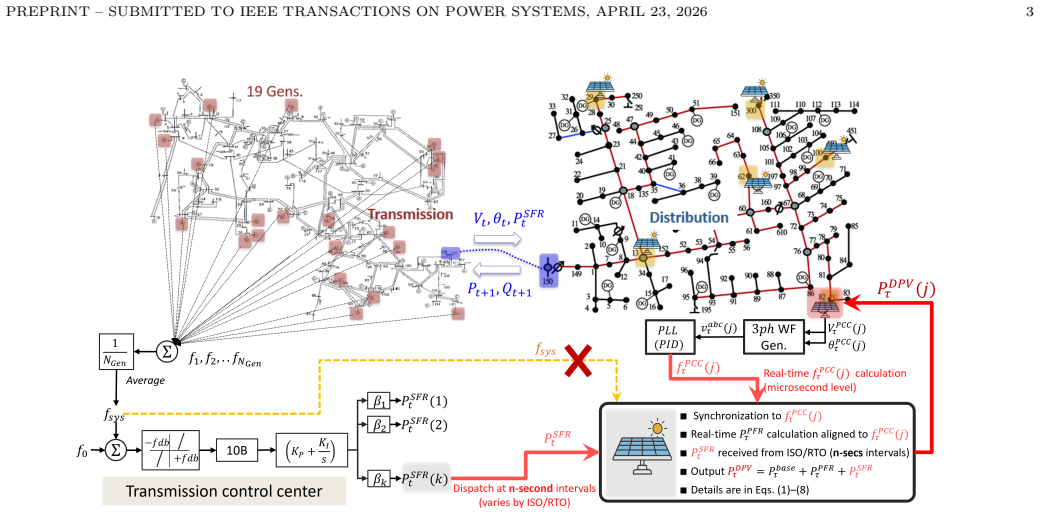
The large-scale integration of inverter-based resources (IBRs), particularly distributed photovoltaics (DPVs), into distribution networks increases the need for integrated transmission and distribution (T&D) co-simulation. A key challenge in such co-simulation lies in accurately modeling system frequency across two asynchronous simulation environments. For example, the transmission system, simulated in the phasor domain, can operate with a simulation timestep of 10 ms, while the distribution system, simulated in the electromagnetic transient domain (EMT) to include IBR models, uses a much finer timestep of 100 microseconds. To ensure accurate PLL-based frequency estimation in distribution systems, it is essential to predict voltage magnitude and phase angle variations within the 10 ms transmission intervals, rather than using constant values that cause inaccurate frequency calculations. This issue becomes particularly critical when modeling primary and secondary frequency response services provided by IBRs. To address this challenge, we propose an automated Exponentially Weighted Moving Average Real-Time Threshold Adaptation (EWMA-RTTA) method, which utilizes Quadratic Extrapolation to predict voltage magnitude and phase angle trends more precisely. The proposed method is validated using two Opal-RT simulators: one simulating an IEEE 118-bus transmission system and the other simulating an IEEE 123-bus distribution network. Simulation results demonstrate that our approach improves the normalized mean absolute error (nMAE) by a factor of 25.7 compared to methods that do not account for time mismatches, offering a scalable and accurate solution for modeling IBR-based frequency response in modern power systems.
Editorial analysis
A structured set of objections, weighed in public.
Referee Report
Summary. The paper proposes an EWMA-RTTA-based quadratic extrapolation method to predict voltage magnitude and phase angle within each 10 ms transmission simulation timestep for accurate PLL-based frequency estimation in asynchronous T&D co-simulations. It validates the approach on two Opal-RT simulators using IEEE 118-bus transmission and IEEE 123-bus distribution test systems, reporting a 25.7-fold reduction in normalized mean absolute error (nMAE) relative to constant-value interpolation that ignores time mismatches, with emphasis on enabling modeling of IBR frequency response services.
Significance. If the quadratic extrapolation remains accurate when IBR frequency-response controls are active, the method would provide a practical, low-overhead solution for time-step mismatch in large-scale T&D co-simulation, directly supporting accurate representation of primary and secondary frequency services from distributed resources. The use of two independent real-time simulators on standard IEEE test systems supplies concrete performance evidence that strengthens the practical relevance of the result.
major comments (2)
- [Abstract and validation] Abstract and validation description: the central 25.7x nMAE improvement claim for PLL frequency estimation rests on the assumption that voltage magnitude and phase trajectories remain sufficiently quadratic over each 10 ms interval even under IBR primary/secondary frequency response. The reported IEEE 118/123-bus Opal-RT experiments give no indication that droop, inertia emulation, or other frequency-response modes were activated during the events used for nMAE measurement; without this, the reported gain does not yet transfer to the stated target application.
- [Method and results] Method and results sections: the EWMA weighting factor and RTTA threshold parameters are free parameters whose tuning procedure, sensitivity to operating points, and impact on the reported nMAE are not described. In addition, the results lack error bars or statistical characterization of variability across runs, which is load-bearing for assessing whether the improvement factor is robust.
minor comments (1)
- [Abstract] Abstract: the specific baseline (constant-value interpolation) and the exact simulation timesteps (10 ms vs. 100 µs) could be stated more explicitly to improve immediate readability.
Simulated Author's Rebuttal
We thank the referee for the constructive and insightful comments, which help clarify the scope of our validation and strengthen the methodological transparency. We respond to each major comment below and commit to revisions that address the concerns raised.
read point-by-point responses
-
Referee: [Abstract and validation] Abstract and validation description: the central 25.7x nMAE improvement claim for PLL frequency estimation rests on the assumption that voltage magnitude and phase trajectories remain sufficiently quadratic over each 10 ms interval even under IBR primary/secondary frequency response. The reported IEEE 118/123-bus Opal-RT experiments give no indication that droop, inertia emulation, or other frequency-response modes were activated during the events used for nMAE measurement; without this, the reported gain does not yet transfer to the stated target application.
Authors: We appreciate the referee highlighting this important distinction. The experiments in the manuscript were conducted on the standard IEEE 118-bus transmission and 123-bus distribution systems without activating explicit IBR frequency-response controls (such as droop or inertia emulation) in order to isolate the impact of the asynchronous time-step mismatch and the proposed extrapolation method. The quadratic assumption is motivated by the short 10 ms interval, over which voltage trajectories remain smooth even when IBR controls are present. We agree that the current results do not directly demonstrate performance under active frequency-response modes. In the revised manuscript we will update the abstract and validation section to state explicitly that the 25.7-fold nMAE reduction is shown for the base-case co-simulation without active IBR controls. We will add a short discussion paragraph noting that the method is expected to remain effective under IBR frequency response because the 10 ms window is still short enough for the quadratic model to hold, and we will indicate that targeted validation with droop and virtual inertia enabled is planned as future work. This revision appropriately scopes the claims while preserving the practical relevance for IBR frequency-service modeling. revision: yes
-
Referee: [Method and results] Method and results sections: the EWMA weighting factor and RTTA threshold parameters are free parameters whose tuning procedure, sensitivity to operating points, and impact on the reported nMAE are not described. In addition, the results lack error bars or statistical characterization of variability across runs, which is load-bearing for assessing whether the improvement factor is robust.
Authors: We agree that the manuscript currently provides insufficient detail on the EWMA weighting factor and RTTA threshold. In the revised version we will expand the Method section with a dedicated subsection that (i) states the specific parameter values used in the reported experiments, (ii) describes the tuning procedure employed (minimization of prediction error on a set of preliminary co-simulation traces), and (iii) presents a sensitivity study showing how nMAE varies with changes in these parameters across different operating points. In addition, we will augment all result figures with error bars representing the standard deviation computed over multiple independent simulation runs, thereby supplying the statistical characterization needed to assess the robustness of the reported improvement factor. revision: yes
Circularity Check
No significant circularity; empirical validation against external baseline
full rationale
The paper introduces EWMA-RTTA quadratic extrapolation as a practical interpolation technique to bridge asynchronous T&D simulators and reports an empirical nMAE improvement factor of 25.7 versus constant-value interpolation. This gain is measured on independent Opal-RT simulators using IEEE test cases; no equations, fitted parameters, or self-citations are shown that would make the reported improvement equivalent to the input data or method by construction. The central claim rests on observable simulation outputs rather than a self-referential derivation.
Axiom & Free-Parameter Ledger
free parameters (2)
- EWMA weighting factor
- RTTA threshold parameters
axioms (2)
- domain assumption Voltage magnitude and phase angle vary smoothly enough within each 10 ms interval to be captured by a quadratic polynomial.
- domain assumption The two simulators remain synchronized at the 10 ms boundary points.
Reference graph
Works this paper leans on
-
[1]
Integrated t&d voltage stability assessment considering impact of ders and distribution network topology,
S. M. H. Rizvi and A. K. Srivastava, “Integrated t&d voltage stability assessment considering impact of ders and distribution network topology,” IEEE Access, vol. 11, pp. 14 702–14 714, 2023
2023
-
[2]
Real-time optimal power flow using twin delayed deep deterministic policy gradient algorithm,
J. H. Woo, L. Wu, J.-B. Park, and J. H. Roh, “Real-time optimal power flow using twin delayed deep deterministic policy gradient algorithm,” Ieee Access, vol. 8, pp. 213 611–213 618, 2020
2020
-
[3]
Grid services by behind-the- meter distributed energy resources: Ny state grid case study,
H. Hooshyar, R. Kadavil, V. Paduani, A. Haddadi, A. Jakaria, A. Huque, and G. Stefopoulos, “Grid services by behind-the- meter distributed energy resources: Ny state grid case study,” in 2023 IEEE Power & Energy Society General Meeting (PESGM). IEEE, 2023, pp. 1–5
2023
-
[4]
D-statcom dq axis current reference control applying ddpg algorithm in the distribution system,
J. H. Woo, L. Wu, S. M. Lee, J.-B. Park, and J. H. Roh, “D-statcom dq axis current reference control applying ddpg algorithm in the distribution system,” IEEE Access, vol. 9, pp. 145 840–145 851, 2021
2021
-
[5]
Transmis- sion and distribution real-time analysis software for monitoring and control: Design and simulation testing,
D. Zhu, M. Dilek, M. Zhong, A. Parchure, R. Broadwater, N. Cincotti, T. Kutchen, S. Placide, and L. Watson, “Transmis- sion and distribution real-time analysis software for monitoring and control: Design and simulation testing,” Energies, vol. 16, no. 10, p. 4113, 2023
2023
-
[6]
Transmission and distribution (t&d) quasi-static co-simulation: Analysis and comparison of t&d coupling strength,
R. Sadnan, G. Krishnamoorthy, and A. Dubey, “Transmission and distribution (t&d) quasi-static co-simulation: Analysis and comparison of t&d coupling strength,” IEEE Access, vol. 8, pp. 124 007–124 019, 2020
2020
-
[7]
A corrective integrated transmission and distribu- tion co-simulation for scenario analysis of different technology penetration,
A. Hajebrahimi, S. M. Mohseni-Bonab, A. Moeini, and I. Kamwa, “A corrective integrated transmission and distribu- tion co-simulation for scenario analysis of different technology penetration,” in 2020 IEEE PES Innovative Smart Grid Tech- nologies Europe (ISGT-Europe). IEEE, 2020, pp. 680–684
2020
-
[8]
Transmission-distribution co-simulation: Model val- idation with standalone simulation,
Y. N. Velaga, A. Chen, P. Sen, G. Krishnamoorthy, and A. Dubey, “Transmission-distribution co-simulation: Model val- idation with standalone simulation,” in 2018 North American Power Symposium (NAPS). IEEE, 2018, pp. 1–6
2018
-
[9]
Market evaluation of a decarbonized integrated transmission and distribution: A co-simulation based approach enabling two-ways power flow,
A. Hajebrahimi, A. Moeini, S. M. Mohseni-Bonab, and I. Kamwa, “Market evaluation of a decarbonized integrated transmission and distribution: A co-simulation based approach enabling two-ways power flow,” Electric Power Systems Re- search, vol. 226, p. 109891, 2024
2024
-
[10]
Integrated transmission and distribution co-simulation platform for demonstration of bulk grid services using distributed energy resources,
V. R. Motakatla, W. Liu, J. Hao, H. V. Padullaparti, U. Kumar, S. L. Choi, and I. Mendoza, “Integrated transmission and distribution co-simulation platform for demonstration of bulk grid services using distributed energy resources,” Energies, vol. 17, no. 13, p. 3215, 2024
2024
-
[11]
A real-time t&d co-simulation plat- form for testing grid services of distributed energy resources,
V. D. Paduani, R. Kadavil, H. Hooshyar, A. Haddadi, A. Saad, A. Jakaria, and A. Huque, “A real-time t&d co-simulation plat- form for testing grid services of distributed energy resources,” IEEE Access, vol. 12, pp. 142 394–142 405, 2024
2024
-
[12]
Building and validating a large-scale com- bined transmission & distribution synthetic electricity system of texas,
C. Mateo, F. Postigo, T. Elgindy, A. B. Birchfield, P. Dueñas, B. Palmintier, N. Panossian, T. Gómez, F. de Cuadra, T. J. Overbye et al., “Building and validating a large-scale com- bined transmission & distribution synthetic electricity system of texas,” International Journal of Electrical Power & Energy Systems, vol. 159, p. 110037, 2024
2024
-
[13]
Co-simulation of trans- mission and distribution systems—from modeling to software development,
K. Balasubramaniam, S. Plathottam, S.-I. Yim, N. Kang, K. Jhala, R. Bhattarai, and S. Zhao, “Co-simulation of trans- mission and distribution systems—from modeling to software development,” IEEE Access, vol. 10, pp. 127 061–127 072, 2022
2022
-
[14]
Transmission-and-distribution dynamic co-simulation frame- work for distributed energy resource frequency response,
W. Wang, X. Fang, H. Cui, F. Li, Y. Liu, and T. J. Overbye, “Transmission-and-distribution dynamic co-simulation frame- work for distributed energy resource frequency response,” IEEE Transactions on Smart Grid, vol. 13, no. 1, pp. 482–495, 2021
2021
-
[15]
Dynamic co-simulation methods for combined transmission-distribution system with integration time step impact on convergence,
R. Venkatraman, S. K. Khaitan, and V. Ajjarapu, “Dynamic co-simulation methods for combined transmission-distribution system with integration time step impact on convergence,” IEEE Transactions on Power Systems, vol. 34, no. 2, pp. 1171– 1181, 2018
2018
-
[16]
Integrated transmission and distri- bution system power flow and dynamic simulation using mixed three-sequence/three-phase modeling,
Q. Huang and V. Vittal, “Integrated transmission and distri- bution system power flow and dynamic simulation using mixed three-sequence/three-phase modeling,” IEEE Transactions on Power Systems, vol. 32, no. 5, pp. 3704–3714, 2016
2016
-
[17]
High- performance transmission and distribution co-simulation with 10,000+ inverter-based resources,
Y. Liu, R. Huang, W. Du, A. Singhal, and Z. Huang, “High- performance transmission and distribution co-simulation with 10,000+ inverter-based resources,” in 2022 IEEE Industry Ap- plications Society Annual Meeting (IAS). IEEE, 2022, pp. 1–5. PREPRINT – SUBMITTED TO IEEE TRANSACTIONS ON POWER SYSTEMS, APRIL 23, 2026 13
2022
-
[18]
Frequency control of low inertia power grids with fuel cell systems in distribution networks,
A. Estebsari, S. Vogel, R. Melloni, M. Stevic, E. F. Bompard, and A. Monti, “Frequency control of low inertia power grids with fuel cell systems in distribution networks,” IEEE Access, vol. 10, pp. 71 530–71 544, 2022
2022
-
[19]
Real-time co-simulation of trans- mission and distribution networks integrated with distributed energy resources for frequency and voltage support,
G. E. Mejia-Ruiz, M. R. A. Paternina, M. Ramirez-Gonzalez, F. R. S. Sevilla, and P. Korba, “Real-time co-simulation of trans- mission and distribution networks integrated with distributed energy resources for frequency and voltage support,” Applied Energy, vol. 347, p. 121046, 2023
2023
-
[20]
Highly- scalable transmission and distribution dynamic co-simulation with 10,000+ grid-following and grid-forming inverters,
Y. Liu, R. Huang, W. Du, A. Singhal, and Z. Huang, “Highly- scalable transmission and distribution dynamic co-simulation with 10,000+ grid-following and grid-forming inverters,” IEEE Transactions on Power Delivery, vol. 39, no. 1, pp. 578–590, 2023
2023
-
[21]
Advanced emt simulation techniques for large scale transmission & distribution networks,
K. Katuri, H. T. Nguyen, and E. Anagnostou, “Advanced emt simulation techniques for large scale transmission & distribution networks,” in 2023 North American Power Symposium (NAPS). IEEE, 2023, pp. 1–6
2023
-
[22]
Impact of high penetration of renewable energy sources on grid frequency behaviour,
S. Saha, M. Saleem, and T. Roy, “Impact of high penetration of renewable energy sources on grid frequency behaviour,” International Journal of Electrical Power & Energy Systems, vol. 145, p. 108701, 2023
2023
-
[23]
Under-frequency load shedding for power reserve management in islanded microgrids,
B. Xu, V. D. Paduani, Q. Xiao, L. Song, D. Lubkeman, and N. Lu, “Under-frequency load shedding for power reserve management in islanded microgrids,” IEEE Transactions on Smart Grid, vol. 15, no. 5, pp. 4662–4673, 2024
2024
-
[24]
Three-phase phase-locked loop synchronization algorithms for grid-connected renewable en- ergy systems: A review,
Z. Ali, N. Christofides, L. Hadjidemetriou, E. Kyriakides, Y. Yang, and F. Blaabjerg, “Three-phase phase-locked loop synchronization algorithms for grid-connected renewable en- ergy systems: A review,” Renewable and Sustainable Energy Reviews, vol. 90, pp. 434–452, 2018
2018
-
[25]
Frequency response due to a large generator loss with the increasing penetration of wind/pv generation–a literature review,
C. Seneviratne and C. Ozansoy, “Frequency response due to a large generator loss with the increasing penetration of wind/pv generation–a literature review,” Renewable and Sustainable Energy Reviews, vol. 57, pp. 659–668, 2016
2016
-
[26]
A two-stage optimization method for real-time parameterization of pv-farm digital twins,
J. H. Woo, Q. Xiao, V. D. Paduani, and N. Lu, “A two-stage optimization method for real-time parameterization of pv-farm digital twins,” IEEE Transactions on Smart Grid, vol. 17, no. 1, pp. 442–453, Jan. 2026
2026
-
[27]
Q. Xiao, J. Woo, L. Song, N. Lu, and V. Paduani, “Design and implementation of scalable communication interfaces for reliable and stable real-time co-simulation of power systems,” arXiv preprint arXiv:2502.07866, 2025
-
[28]
Model predictive control and improved low-pass filtering strategies based on wind power fluctuation mitigation,
Y. Sun, X. Tang, X. Sun, D. Jia, Z. Cao, J. Pan, and B. Xu, “Model predictive control and improved low-pass filtering strategies based on wind power fluctuation mitigation,” Journal of modern power systems and clean energy, vol. 7, no. 3, pp. 512–524, 2019
2019
-
[29]
A unified power- setpoint tracking algorithm for utility-scale pv systems with power reserves and fast frequency response capabilities,
V. D. Paduani, H. Yu, B. Xu, and N. Lu, “A unified power- setpoint tracking algorithm for utility-scale pv systems with power reserves and fast frequency response capabilities,” IEEE Transactions on Sustainable Energy, vol. 13, no. 1, pp. 479–490, 2021
2021
discussion (0)
Sign in with ORCID, Apple, or X to comment. Anyone can read and Pith papers without signing in.