Bulk-Surface Coupled PDE with an Open Boundary
Pith reviewed 2026-05-09 23:21 UTC · model grok-4.3
The pith
A bulk-surface Laplace system with an open boundary has a unique solution obtained by boundary-integral reformulation and analyzed for edge singularity via the Wiener-Hopf method.
A machine-rendered reading of the paper's core claim, the machinery that carries it, and where it could break.
Core claim
The bulk-surface coupled Laplace system with an open boundary can be recast as an integro-differential equation using boundary integral representations. For this equation existence and uniqueness of the solution are proved. The Wiener-Hopf technique supplies the asymptotic expansion of the solution near the edge, revealing its singular character. These results support a finite element method that incorporates the known singularity structure, for which rigorous error estimates are derived and verified numerically.
What carries the argument
The integro-differential equation obtained from boundary integral representations of the coupled system, analyzed by Wiener-Hopf factorization to produce explicit asymptotic expansions of the edge singularity that are then built into the finite element space.
If this is right
- Existence and uniqueness hold for the integro-differential formulation of the coupled system.
- Explicit asymptotic expressions describe the leading singular behavior at the open-boundary edge.
- The singularity-adapted finite element method satisfies rigorous a priori error estimates.
- Numerical experiments reproduce the theoretically predicted convergence rates.
Where Pith is reading between the lines
- The same boundary-integral and Wiener-Hopf steps may apply to other elliptic bulk-surface problems that possess an edge.
- The derived singularity asymptotics can guide mesh grading or enrichment strategies in practical discretizations.
- The overall approach supplies a template for proving well-posedness and designing convergent schemes for related interface problems with free edges.
Load-bearing premise
The open boundary edge possesses sufficient local smoothness and geometric regularity for the Wiener-Hopf factorization to deliver explicit asymptotic expansions of the singularity.
What would settle it
Numerical computation of the solution near the edge yielding a leading singularity exponent different from the one predicted by the Wiener-Hopf analysis, or finite-element errors failing to attain the rates stated in the error analysis when the singularity structure is incorporated.
Figures


read the original abstract
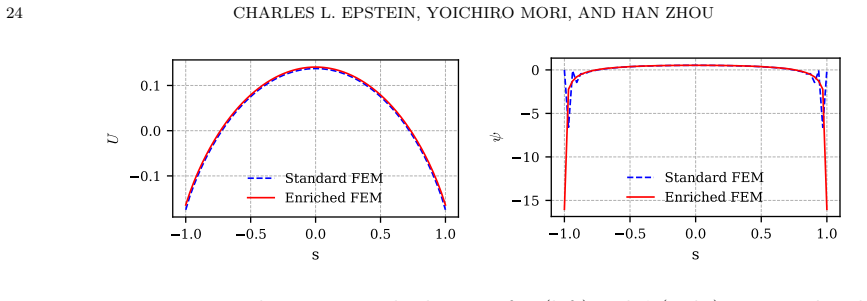
We study a bulk-surface coupled Laplace system involving an embedded open boundary. The problem is reformulated as an integro-differential equation using boundary integral representations, for which we establish existence and uniqueness of the solution. A Wiener-Hopf technique is employed to study the solution regularity and derive asymptotic expressions for the edge singularity. Building on these results, we develop a finite element method that incorporates the singularity structure and provide a rigorous error analysis. Numerical experiments confirm the theoretical convergence rates.
Editorial analysis
A structured set of objections, weighed in public.
Referee Report
Summary. The paper claims to study a bulk-surface coupled Laplace system with an embedded open boundary. It reformulates the problem as an integro-differential equation via boundary integral representations and proves existence and uniqueness. A Wiener-Hopf technique is used to analyze solution regularity and derive explicit asymptotic expressions for the edge singularity. These results inform a finite element method incorporating the singularity structure, for which a rigorous error analysis is provided. Numerical experiments are said to confirm the theoretical convergence rates.
Significance. If the central claims hold under appropriate geometric assumptions, the work is significant for providing a rigorous analytical-numerical pipeline for coupled PDEs with open boundaries and edge singularities. Strengths include the combination of boundary integral reformulation, Wiener-Hopf factorization for explicit asymptotics, and a singularity-aware FEM with error estimates backed by numerical validation. This offers a parameter-free approach grounded in classical techniques, which could advance modeling in applications with free edges or interfaces.
major comments (1)
- [Wiener-Hopf regularity analysis] In the section on the Wiener-Hopf technique for regularity and edge singularity asymptotics: the factorization is performed after local coordinate flattening to reduce to a half-line problem with constant-coefficient principal symbol. For a general curved embedded open boundary, surface curvature introduces variable coefficients and lower-order terms that are not automatically removable. The manuscript must explicitly state the geometric hypotheses (e.g., local flatness or analyticity in a neighborhood of the edge) under which the derived singularity exponents remain valid, as these are load-bearing for the subsequent a-priori error estimates of the FEM.
Simulated Author's Rebuttal
We thank the referee for the careful reading and constructive comments. We address the major comment below and agree to revise the manuscript for greater clarity on the geometric assumptions.
read point-by-point responses
-
Referee: In the section on the Wiener-Hopf technique for regularity and edge singularity asymptotics: the factorization is performed after local coordinate flattening to reduce to a half-line problem with constant-coefficient principal symbol. For a general curved embedded open boundary, surface curvature introduces variable coefficients and lower-order terms that are not automatically removable. The manuscript must explicitly state the geometric hypotheses (e.g., local flatness or analyticity in a neighborhood of the edge) under which the derived singularity exponents remain valid, as these are load-bearing for the subsequent a-priori error estimates of the FEM.
Authors: We agree that the geometric hypotheses should be stated explicitly. The Wiener-Hopf factorization is applied after local flattening near the edge, where the principal symbol reduces to a constant-coefficient operator on the half-line. The leading singularity exponents are determined solely by this principal part; curvature and lower-order metric terms from the surface enter as perturbations that do not change the leading asymptotics, provided the embedded open boundary is C^2 (or smoother) in a neighborhood of the edge. To address the referee's concern and ensure the assumptions are load-bearing for the FEM error estimates, we will add an explicit statement of these hypotheses (local smoothness and flattening validity) at the start of the relevant section. This clarification does not alter the main results or proofs. revision: yes
Circularity Check
No significant circularity; derivations rely on external classical theory
full rationale
The paper's chain proceeds from the bulk-surface Laplace system to a boundary-integral reformulation yielding an integro-differential equation, followed by existence/uniqueness proofs, Wiener-Hopf analysis for regularity and explicit edge asymptotics, and then a singular finite-element method with a-priori error bounds. Each step invokes standard, externally verifiable tools (boundary integral operators and Wiener-Hopf factorization on the half-line) whose validity is independent of the present paper's results and does not reduce any claimed prediction or uniqueness statement to a fitted parameter or self-definition. No load-bearing self-citation chain or ansatz smuggling is present in the described pipeline.
Axiom & Free-Parameter Ledger
axioms (2)
- standard math Existence and uniqueness hold for the Laplace equation in domains with Lipschitz boundaries under standard Sobolev space settings
- domain assumption The Wiener-Hopf factorization applies to the symbol arising from the open boundary geometry
Reference graph
Works this paper leans on
-
[1]
Robert Altmann and Barbara Verf¨ urth,A multiscale method for heterogeneous bulk-surface coupling, Multiscale Modeling & Simulation19(2021), 374–400
work page 2021
-
[2]
S. N. Chandler-Wilde, D. P. Hewett, and A. Moiola,Sobolev spaces on non-lipschitz subsets of rn with application to boundary integral equations on fractal screens, Integral Equations and Operator Theory87(2017), 179–224
work page 2017
-
[3]
Aleksei V. Chechkin, Irwin M. Zaid, Michael A. Lomholt, Igor M. Sokolov, and Ralf Metzler,Bulk-mediated diffusion on a planar surface: Full solution, Physical Review E86(2012), 041101
work page 2012
-
[4]
Pierluigi Colli, Takeshi Fukao, and Kei Fong Lam,On a coupled bulk–surface allen–cahn system with an affine linear transmission condition and its approximation by a robin boundary condition, Nonlinear Analysis, Theory, Methods and Applications184(2019), 116–147
work page 2019
-
[5]
Martin Costabel, Monique Dauge, and Roland Duduchava,Asymptotics without logarithmic terms for crack problems, Communications in Partial Differential Equations28(2003), 869–926
work page 2003
-
[6]
R. Duduchava and W. L. Wendland,The wiener-hopf method for systems of pseudodifferential equations with an application to crack problems, Integral Equations and Operator Theory23(1995), 294–335
work page 1995
-
[7]
Charles M. Elliott and Thomas Ranner,Finite element analysis for a coupled bulk-surface partial differential equation, IMA Journal of Numerical Analysis33(2013), no. 2, 377–402
work page 2013
-
[8]
Charles L. Epstein, Leslie Greengard, and Michael O’Neil,Debye sources and the numerical solution of the time harmonic Maxwell equations, Communications on Pure and Applied Mathematics63(2010), no. 4, 413–463
work page 2010
-
[9]
Gregory I Eskin,Boundary value problems for elliptic pseudodifferential equations, volume 52 of translations of mathematical monographs, American Mathematical Society, Providence, RI (1981)
work page 1981
-
[10]
C. P. Flynn,Coupling among bulk, surface and edge diffusion, Physical Review B - Condensed Matter and Materials Physics73(2006), 1–12
work page 2006
-
[11]
Stephan Hausberg and Matthias R¨ oger,Well-posedness and fast-diffusion limit for a bulk–surface reac- tion–diffusion system, Nonlinear Differential Equations and Applications25(2018), 1–32
work page 2018
-
[12]
Yoshio Hayashi,The dirichlet problem for the two-dimensional helmholtz equation for an open boundary, Journal of Mathematical Analysis and Applications44(1973), 489–530
work page 1973
-
[13]
,The expansion theory of the dirichlet problem for the helmholtz equation for an open boundary, Journal of Mathematical Analysis and Applications61(1977), 331–340
work page 1977
-
[14]
,Three-dimensional dirichlet problem for the helmholtz equation for an open boundary, Proceedings of the Japan Academy, Series A, Mathematical Sciences53(1977), 1–23
work page 1977
-
[15]
Carlos Jerez-Hanckes and Jose Pinto,Well-posedness of helmholtz and laplace problems in unbounded domains with multiple screens, 2018, Preprint
work page 2018
-
[16]
,High-order galerkin method for helmholtz and laplace problems on multiple open arcs, ESAIM: Mathe- matical Modelling and Numerical Analysis54(2020), 1975–2009
work page 2020
-
[17]
S. S. Kosolobov,Coupled surface and bulk diffusion in crystals, AIP Advances12(2022)
work page 2022
-
[18]
Rainer Kress,Linear integral equations, third edition ed., Applied Mathematical Sciences, vol. 82, Springer, 2014. 34 CHARLES L. EPSTEIN, YOICHIRO MORI, AND HAN ZHOU
work page 2014
-
[19]
Jingyu Li, Linlin Su, Xuefeng Wang, and Yantao Wang,Bulk-surface coupling: Derivation of two models, Journal of Differential Equations289(2021), 1–34
work page 2021
-
[20]
Anotida Madzvamuse and Andy H.W. Chung,The bulk-surface finite element method for reaction-diffusion sys- tems on stationary volumes, Finite Elements in Analysis and Design108(2016), 9–21
work page 2016
-
[21]
Anotida Madzvamuse, Andy H.W. Chung, and Chandrasekhar Venkataraman,Stability analysis and simulations of coupled bulk-surface reaction-diffusion systems, Proceedings of the Royal Society A: Mathematical, Physical and Engineering Sciences471(2015)
work page 2015
-
[22]
18, Cambridge University Press, Cambridge, UK, 2000
William McLean,Strongly elliptic systems and boundary integral equations, Cambridge Monographs on Applied and Computational Mathematics, vol. 18, Cambridge University Press, Cambridge, UK, 2000
work page 2000
-
[23]
Frederic Paquin-Lefebvre, Wayne Nagata, and Michael J. Ward,Pattern formation and oscillatory dynamics in a two-dimensional coupled bulk-surface reaction-diffiusion system, SIAM Journal on Applied Dynamical Systems 18(2019), 1334–1390
work page 2019
-
[24]
Ernst P. Stephan,Boundary integral equations for magnetic screens inR 3, Proceedings of the Royal Society of Edinburgh: Section A Mathematics102(1986), 189–210
work page 1986
-
[25]
,Boundary integral equations for mixed boundary value problems inR 3, Mathematische Nachrichten134 (1987), 21–53
work page 1987
-
[26]
,Boundary integral equations for screen problems inR 3, Integral Equations and Operator Theory10 (1987), 236–257
work page 1987
-
[27]
Zhuochao Tang, Zhuojia Fu, Meng Chen, and Leevan Ling,A novel localized least-squares collocation method for coupled bulk-surface problems, Applied Mathematics and Computation492(2025), 129250
work page 2025
-
[28]
Taylor,Partial differential equations i: Basic theory, Applied Mathematical Sciences, vol
Michael E. Taylor,Partial differential equations i: Basic theory, Applied Mathematical Sciences, vol. 115, Springer-Verlag, New York, NY, 1996
work page 1996
-
[29]
Hao Wu and Shengqin Xu,Well-posedness and long-time behavior of a bulk-surface coupled cahn-hilliard-diffusion system with singular potential for lipid raft formation, Discrete and Continuous Dynamical Systems - Series S17 (2024), 1–61
work page 2024
-
[30]
Xiaoli Zhang,Optimal boundary control of the bulk-surface coupled cahn-hilliard-diffusion system for lipid raft formation, Evolution Equations and Control Theory2(2025), 0–0. Center for Computational Mathematics, Flatiron Institute of the Simons Foundation, 162 5th A ve., New York, NY 10010, USA Email address:cepstein@flatironinstitute.org Department of M...
work page 2025
discussion (0)
Sign in with ORCID, Apple, or X to comment. Anyone can read and Pith papers without signing in.