From Meme to Method: Rethinking Animal Adoption Platforms through the Cat Distribution System
Pith reviewed 2026-05-09 23:08 UTC · model grok-4.3
The pith
The Cat Distribution System meme can be turned into design principles that make animal adoption platforms feel more like chance encounters than deliberate searches.
A machine-rendered reading of the paper's core claim, the machinery that carries it, and where it could break.
Core claim
By treating the Cat Distribution System as more than a joke and converting its logic into concrete interface elements, the authors produced an adoption platform whose features encourage users to experience pet placement as distributed and opportunistic rather than as a sequence of deliberate choices. The prototype's algorithmic pairing, community sighting reports, and location-based alerts were received as intuitive by study participants, supporting the claim that culturally familiar framing can reduce the transactional tone of existing adoption sites.
What carries the argument
The Cat Distribution System metaphor, used to generate app features that simulate random assignment through matchmaking, proximity alerts, and shared sightings instead of search-and-apply flows.
If this is right
- Adoption platforms can lower perceived effort by presenting matches as discoveries rather than results of user queries.
- Community reporting functions gain value when framed as part of a larger distribution process instead of isolated posts.
- Transparency about how algorithmic matches are generated becomes necessary once users expect a serendipitous rather than rule-based system.
- The same metaphor may extend to other animals and could be adapted for regions with similar stray-animal pressures.
Where Pith is reading between the lines
- Designers working on other emotionally loaded services such as housing or volunteer matching might borrow parallel cultural memes to achieve similar mental-model alignment.
- Longer-term measurement of actual animal outcomes, not just initial app ratings, would be needed to confirm whether the perceived serendipity produces sustained behavior change.
- The approach raises the question of whether deliberate cultural metaphors can be imported into new regions without losing their intuitive power.
Load-bearing premise
Positive reactions from a small group of thirty-five test users will predict better real-world adoption rates or user retention once the system is deployed at scale.
What would settle it
A side-by-side field trial in which the CDS prototype and a conventional adoption app are released in the same region and produce no measurable difference in completed adoptions or user return rates after several months.
Figures


read the original abstract
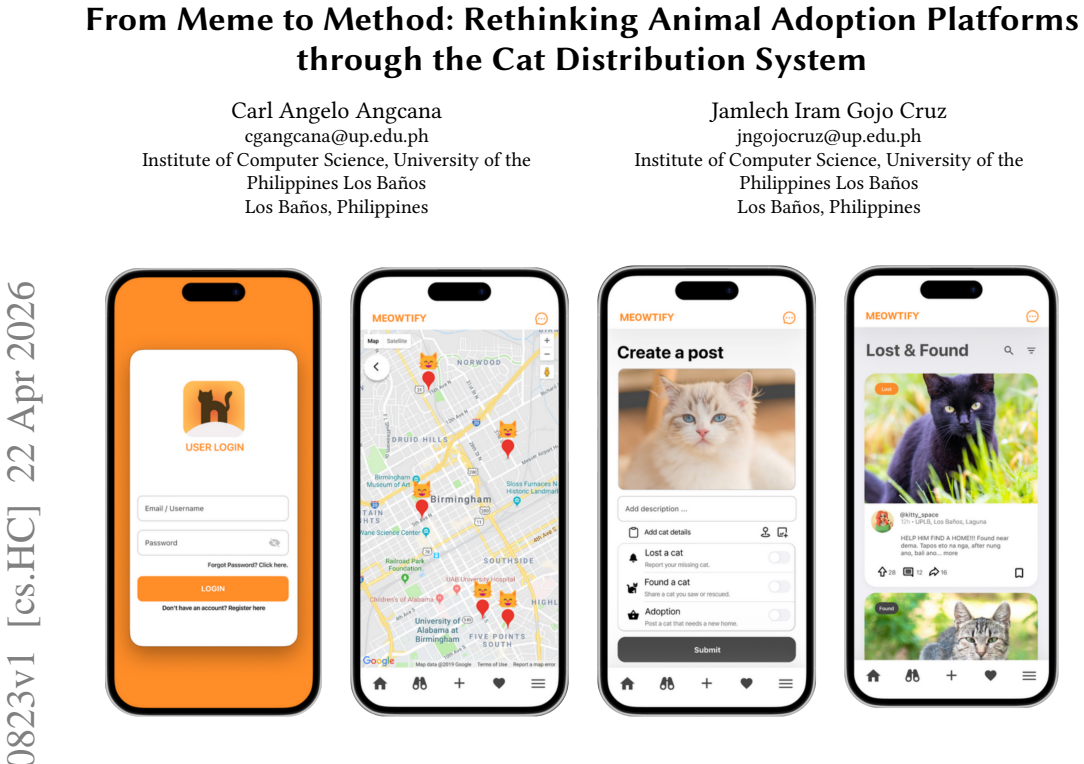
The internet folklore of the Cat Distribution System (CDS) humorously suggests that cats are "assigned" to people rather than intentionally sought. Beyond its playful origins, CDS reflects a culturally resonant way people perceive and engage in adoption, and this user context can guide the redesign and improvement of adoption systems. In the Philippines, where an estimated 13.11 million stray cats and dogs place the country sixth worldwide in overpopulation, this framing offers a novel way to rethink adoption platforms. We developed a prototype application inspired by CDS principles, focusing on features such as algorithmic matchmaking, community reporting, and proximity-based discovery. An initial evaluation with potential users (n=35) indicated that the system was positively received for its ease of use and its alignment with users' intuitive expectations, though participants highlighted areas for improvement in transparency of matchmaking and owner-adopter communication. The findings suggest that culturally embedded metaphors like CDS can shape mental models, making adoption processes feel more serendipitous and less transactional.
Editorial analysis
A structured set of objections, weighed in public.
Referee Report
Summary. The paper proposes applying the 'Cat Distribution System' (CDS) internet meme as a cultural metaphor to redesign animal adoption platforms, focusing on the Philippines' stray pet overpopulation problem. It describes development of a prototype app incorporating algorithmic matchmaking, community reporting, and proximity-based discovery. A user evaluation with n=35 participants reports positive reception for ease of use and alignment with intuitive expectations, leading to the claim that CDS-inspired features can shape mental models to make adoption feel more serendipitous and less transactional.
Significance. If the central claim holds, the work offers a novel contribution to HCI by showing how culturally resonant memes can inform interface design for social impact applications. It provides a concrete case study of translating folklore into system features and initial evidence of user alignment, which could extend to other domains involving perception shifts (e.g., health or civic platforms). The prototype development demonstrates practical application of the metaphor, though the small-scale evaluation limits claims about broader outcomes like improved adoption rates.
major comments (2)
- The user evaluation (described in the abstract and evaluation section) does not provide direct evidence for the central claim that CDS features shape mental models or increase perceived serendipity. The reported results focus on general positive reception, ease of use, and alignment with expectations, without pre/post measures, validated scales for mental models, or specific ratings contrasting serendipitous vs. transactional perceptions. This leaves the inference from liking to model change unsupported.
- The abstract and evaluation description provide no details on study design elements such as the specific questions asked, quantitative measures used, participant demographics, or task scenarios. Without these, it is difficult to assess whether the n=35 sample and feedback actually test the mental-model hypothesis or merely confirm surface-level usability.
minor comments (2)
- The abstract could be expanded to briefly note the specific CDS principles mapped to features (e.g., how 'serendipity' is operationalized in the matchmaking algorithm).
- Consider adding references to prior HCI work on meme-inspired design, cultural probes, or adoption platform evaluations to better situate the contribution.
Simulated Author's Rebuttal
We thank the referee for their constructive and insightful comments, which have helped us clarify the scope of our preliminary evaluation and improve the transparency of our reporting. We address each major comment below and have made targeted revisions to the manuscript.
read point-by-point responses
-
Referee: The user evaluation (described in the abstract and evaluation section) does not provide direct evidence for the central claim that CDS features shape mental models or increase perceived serendipity. The reported results focus on general positive reception, ease of use, and alignment with expectations, without pre/post measures, validated scales for mental models, or specific ratings contrasting serendipitous vs. transactional perceptions. This leaves the inference from liking to model change unsupported.
Authors: We acknowledge that the evaluation was exploratory and did not employ pre/post measures, validated mental-model scales, or direct contrasts between serendipitous and transactional perceptions. The positive feedback on alignment with users' intuitive expectations provided the basis for our interpretive suggestion in the abstract and discussion that CDS-inspired features may influence how adoption is perceived. However, we agree this does not constitute direct evidence of mental-model change. In the revised manuscript we have moderated the language in the abstract and added an explicit limitations paragraph that frames the results as hypothesis-generating rather than confirmatory. We also outline directions for future work that would incorporate validated instruments and longitudinal measures to test the claim more rigorously. revision: partial
-
Referee: The abstract and evaluation description provide no details on study design elements such as the specific questions asked, quantitative measures used, participant demographics, or task scenarios. Without these, it is difficult to assess whether the n=35 sample and feedback actually test the mental-model hypothesis or merely confirm surface-level usability.
Authors: We agree that the original submission omitted necessary methodological details. The evaluation was a usability study in which participants completed three task scenarios (discovering a nearby stray via proximity features, reviewing algorithmic matches, and completing a simulated adoption report). Feedback was gathered via a mixed-methods questionnaire containing 5-point Likert items on ease of use, perceived alignment with expectations, and qualitative prompts about serendipity versus transactionality, plus open-ended questions. Participants were 35 adults recruited via social media in Metro Manila and surrounding areas (demographics: 57% female, mean age 28.4, 68% with prior experience caring for strays). In the revised version we have inserted a complete “Evaluation” subsection that reports the exact tasks, questionnaire items, recruitment method, demographics, and analysis approach. revision: yes
Circularity Check
No circularity; design study with no derivations or self-referential logic
full rationale
The paper is a qualitative HCI design and evaluation study. It describes a prototype inspired by the CDS cultural metaphor, implements features like matchmaking and proximity discovery, and reports positive reception from n=35 users on ease of use and alignment with expectations. No equations, parameters, predictions, or derivation chains exist. The interpretive suggestion that the metaphor 'can shape mental models' is presented as a finding from feedback, not a result forced by construction from inputs or self-citations. No load-bearing self-citations, ansatzes, or renamings of known results are present. This is self-contained against external benchmarks and receives the default non-circularity finding.
Axiom & Free-Parameter Ledger
Reference graph
Works this paper leans on
-
[1]
Jennifer W Applebaum, Camie A Tomlinson, Angela Matijczak, Shelby E McDon- ald, and Barbara A Zsembik. 2020. The concerns, difficulties, and stressors of caring for pets during COVID-19: Results from a large survey of US pet owners. Animals10, 10 (2020), 1882
work page 2020
-
[2]
Gary M Bowler Jr. 2010. Netnography: A method specifically designed to study cultures and communities online.The qualitative report15, 5 (2010), 1270
work page 2010
-
[3]
Virginia Braun and Victoria Clarke. 2006. Using thematic analysis in psy- chology.Qualitative Research in Psychology3, 2 (2006), 77–101. doi:10.1191/ 1478088706qp063oa
work page 2006
-
[4]
Špela Bricman and Ines Kožuh. 2023. User Experience and Interface Design for a Digital Pet Adoption Platform. InHCI-SI. 32–44
work page 2023
-
[5]
Ana Caraban, Evangelos Karapanos, Daniel Gonçalves, and Pedro Campos. 2019. 23 ways to nudge: A review of technology-mediated nudging in human-computer interaction. InProceedings of the 2019 CHI conference on human factors in com- puting systems. 1–15
work page 2019
-
[6]
Meiyin Chang and Gabriel Cañarte. 2023. Agapet: supporting a responsible adop- tion process for stray and abandoned pets in urban areas. InExtended Abstracts of the 2023 CHI Conference on Human Factors in Computing Systems. 1–5
work page 2023
-
[7]
Kareem Hatam-Nahavandi, Rafael Calero-Bernal, Mohammad Taghi Rahimi, Abdol Sattar Pagheh, Mehdi Zarean, Asiyeh Dezhkam, and Ehsan Ahmadpour
-
[8]
Toxoplasma gondii infection in domestic and wild felids as public health concerns: a systematic review and meta-analysis.Scientific reports11, 1 (2021), 9509
work page 2021
-
[9]
Rüdiger Heimgärtner. 2013. Reflections on a model of culturally influenced human–computer interaction to cover cultural contexts in HCI design.Interna- tional Journal of Human-Computer Interaction29, 4 (2013), 205–219
work page 2013
-
[10]
Rüdiger Heimgärtner. 2017. Culturally-aware HCI systems. InAdvances in culturally-aware intelligent systems and in cross-cultural psychological studies. Springer, 11–37
work page 2017
-
[11]
Kevin Horecka and Sue Neal. 2022. Critical problems for research in animal sheltering, a conceptual analysis.Frontiers in veterinary science9 (2022), 804154
work page 2022
-
[12]
Mark Hostetler, Samantha Wisely, Steve Johnson, Elizabeth Pienaar, and Martin Main. 2020. How Effective and Humane is Trap-Neuter-Release (TNR) for Feral Cats?EDIS2020, 2 (2020), 8–8
work page 2020
-
[13]
Annika Kaltenhauser, Nađa Terzimehić, and Andreas Butz. 2021. Memeography: understanding users through internet memes. InExtended Abstracts of the 2021 CHI Conference on Human Factors in Computing Systems. 1–7
work page 2021
-
[14]
Lori R Kogan, Regina Schoenfeld-Tacher, and Peter W Hellyer. 2013. Cats in animal shelters: Exploring the common perception that black cats take longer to adopt.The Open Veterinary Science Journal7, 1 (2013), 18–22
work page 2013
-
[15]
Denis Kotkov, Shuaiqiang Wang, and Jari Veijalainen. 2016. A survey of serendip- ity in recommender systems.Knowledge-Based Systems111 (2016), 180–192
work page 2016
- [16]
- [17]
-
[18]
Julie K Levy, David W Gale, and Leslie A Gale. 2003. Evaluation of the effect of a long-term trap-neuter-return and adoption program on a free-roaming cat population.Journal of the American Veterinary Medical Association222, 1 (2003), 42–46
work page 2003
-
[19]
Scott R Loss, Brooke Boughton, Samantha M Cady, David W Londe, Caleb McKin- ney, Timothy J O’Connell, Georgia J Riggs, and Ellen P Robertson. 2022. Review and synthesis of the global literature on domestic cat impacts on wildlife.Journal of Animal Ecology91, 7 (2022), 1361–1372
work page 2022
-
[20]
Scott R Loss, Tom Will, and Peter P Marra. 2013. The impact of free-ranging domestic cats on wildlife of the United States.Nature communications4, 1 (2013), 1396
work page 2013
-
[21]
Félix M Medina, Elsa Bonnaud, Eric Vidal, Bernie R Tershy, Erika S Zavaleta, C Josh Donlan, Bradford S Keitt, Matthieu Le Corre, Sarah V Horwath, and Manuel Nogales. 2011. A global review of the impacts of invasive cats on island endangered vertebrates.Global change biology17, 11 (2011), 3503–3510
work page 2011
-
[22]
Lawrence E Minnis, Doris Bitler Davis, and Kate E Loftis. 2024. Decision factors considered by potential dog adopters during shelter visitation.Journal of Applied Animal Welfare Science27, 3 (2024), 514–529
work page 2024
-
[23]
Viet-Linh Nguyen, Filipe Dantas-Torres, and Domenico Otranto. 2021. Canine and feline vector-borne diseases of zoonotic concern in Southeast Asia.Current Research in Parasitology & Vector-Borne Diseases1 (2021), 100001
work page 2021
-
[24]
Jakob Nielsen. 2024. Mental Models and User Experience Design.Nielsen Norman Group(2024). https://www.nngroup.com/articles/mental-models/
work page 2024
-
[25]
2013.The design of everyday things
Don Norman. 2013.The design of everyday things. MIT Press
work page 2013
-
[26]
Lauren Powell, Chelsea Reinhard, Donya Satriale, Margaret Morris, James Serpell, and Brittany Watson. 2021. Characterizing unsuccessful animal adoptions: Age and breed predict the likelihood of return, reasons for return and post-return outcomes.Scientific reports11, 1 (2021), 8018
work page 2021
-
[27]
Emanuela Prato-Previde, Elisa Basso Ricci, and Elisa Silvia Colombo. 2022. The complexity of the human–animal bond: Empathy, attachment and anthropo- morphism in human–animal relationships and animal hoarding.Animals12, 20 (2022), 2835
work page 2022
-
[28]
Alexandra Protopopova, Amanda Joy Gilmour, Rebecca Hannah Weiss, Jacque- line Yontsye Shen, and Clive David Lawrence Wynne. 2012. The effects of social training and other factors on adoption success of shelter dogs.Applied Animal Behaviour Science142, 1-2 (2012), 61–68
work page 2012
-
[29]
Parinda Rahman and Ifeoma Adaji. 2025. Trust in Persuasive Technologies: A Systematic Literature Review. In2025 IEEE International Symposium on Ethics in Engineering, Science, and Technology (ETHICS). IEEE, 1–10
work page 2025
-
[30]
Elizabeth Riddle and Jill RD MacKay. 2020. Social media contexts moderate perceptions of animals.Animals10, 5 (2020), 845
work page 2020
-
[31]
Kristel J Scoresby, Elizabeth B Strand, Zenithson Ng, Kathleen C Brown, Charles Robert Stilz, Kristen Strobel, Cristina S Barroso, and Marcy Souza. 2021. Pet ownership and quality of life: A systematic review of the literature.Veterinary Sciences8, 12 (2021), 332
work page 2021
-
[32]
2024.Overpopulated homeless animals: Senate hearing on stray cats and dogs
Senate of the Philippines. 2024.Overpopulated homeless animals: Senate hearing on stray cats and dogs. Government Report. Senate of the Philippines. Accessed: 2025-09-26
work page 2024
-
[33]
Limor Shifman. 2013.Memes in Digital Culture. MIT Press, Cambridge, MA
work page 2013
-
[34]
Petr Slovak, Alissa Antle, Nikki Theofanopoulou, Claudia Daudén Roquet, James Gross, and Katherine Isbister. 2023. Designing for emotion regulation interven- tions: an agenda for HCI theory and research.ACM Transactions on Computer- Human Interaction30, 1 (2023), 1–51
work page 2023
-
[35]
Froma Walsh. 2009. Human-animal bonds I: The relational significance of com- panion animals.Family process48, 4 (2009), 462–480
work page 2009
-
[36]
Emily Weiss, Katherine Miller, Heather Mohan-Gibbons, and Carla Vela. 2012. Why did you choose this pet?: Adopters and pet selection preferences in five animal shelters in the United States.Animals2, 2 (2012), 144–159
work page 2012
-
[37]
Emily Weiss, Gary Patronek, Margaret Slater, Laurie Garrison, and Karen Medicus
-
[38]
Community partnering as a tool for improving live release rate in animal shelters in the United States.Journal of Applied Animal Welfare Science16, 3 (2013), 221–238
work page 2013
-
[39]
Leihan Zhang, Herui Cao, and Qiang Yan. 2024. Insights from cross-cultural memes: An empirical study on instagram and Douban.Telematics and Informatics 94 (2024), 102186
work page 2024
- [40]
-
[41]
Yuan Cao Zhang, Diarmuid Ó Séaghdha, Daniele Quercia, and Tamas Jambor. 2012. Auralist: introducing serendipity into music recommendation. InProceedings of the fifth ACM international conference on Web search and data mining. 13–22
work page 2012
discussion (0)
Sign in with ORCID, Apple, or X to comment. Anyone can read and Pith papers without signing in.