Old and new Schr\"odinger eigenvalue localisation
Pith reviewed 2026-05-09 22:55 UTC · model grok-4.3
The pith
A fine-tuned extra-stabilised nonconforming scheme provides guaranteed lower bounds for Schrödinger eigenvalues without mesh-size dependence.
A machine-rendered reading of the paper's core claim, the machinery that carries it, and where it could break.
Core claim
By adapting the nonconforming guaranteed lower bound technique from the harmonic eigenvalue problem and introducing extra stabilization, the method computes direct guaranteed lower bounds for Schrödinger eigenvalues with piecewise constant potentials that remain valid under adaptive refinement and do not depend on maximal mesh size parameters, as verified through numerical comparisons showing superiority over previous schemes.
What carries the argument
The extra-stabilised nonconforming finite element discretization that enables direct computation of guaranteed lower eigenvalue bounds (GLB) while preserving the bound property.
If this is right
- Two-sided eigenvalue control becomes available from a single computation with reduced cost compared to separate conforming schemes for upper bounds.
- Adaptive mesh-refinement can be applied directly without reintroducing mesh-size dependence in the bounds.
- The bounds apply unconditionally to general and piecewise constant potentials for spectral gaps.
- Numerical benchmarks show competitive accuracy with less computational effort than additional lowest-order conforming schemes.
Where Pith is reading between the lines
- The direct GLB approach could extend to time-dependent or nonlinear eigenvalue problems sharing similar elliptic structure.
- Combining this with higher-order elements might further reduce degrees of freedom needed for target accuracy.
- Reliable spectral gaps from these bounds could support more trustworthy uncertainty quantification in quantum chemistry models.
Load-bearing premise
The adaptation of the nonconforming GLB method to Schrödinger problems with piecewise constant potentials preserves the guaranteed lower bound property without additional hidden constants.
What would settle it
A numerical computation on the harmonic oscillator or similar exactly solvable case where the reported lower bound exceeds the known exact eigenvalue would disprove the guarantee.
Figures


read the original abstract
Unconditional guaranteed lower and upper eigenvalue bounds are mandatory for the understanding of the Schr\"odinger eigenvalue spectrum and its spectral gaps. While upper eigenvalue bounds are naturally induced by conforming discretisations, guaranteed lower eigenvalue bounds (GLB) are less immediate. This paper clarifies the adaptation of nonconforming GLB from the harmonic eigenvalue problem and discusses their comparison for general and piecewise constant potentials. A fine-tuned extra-stabilised scheme is proposed and found superior in numerical comparisons. This new direct calculation of GLB is compatible with adaptive mesh-refinement and successfully circumvents the appearance of maximal mesh-size parameters in former GLB based on post-processing. Computational benchmarks also investigate guaranteed upper eigenvalue bounds (GUB) for two-sided eigenvalue control by conforming test functions associated to the underlying nonconforming computations. A numerical comparison with GUB from additional lowest-order conforming finite element schemes shows competitive accuracy with less computational cost.
Editorial analysis
A structured set of objections, weighed in public.
Referee Report
Summary. The manuscript adapts nonconforming finite element methods, originally developed for the harmonic eigenvalue problem, to compute guaranteed lower bounds (GLB) on eigenvalues of the Schrödinger operator for general and piecewise-constant potentials. It proposes a fine-tuned extra-stabilised nonconforming scheme enabling direct GLB evaluation that is compatible with adaptive mesh refinement and avoids the maximal mesh-size parameters arising in prior post-processing approaches. Numerical benchmarks demonstrate the scheme's superiority, while also investigating guaranteed upper bounds (GUB) obtained from conforming test functions associated with the nonconforming solutions, yielding competitive accuracy at reduced cost compared to standard lowest-order conforming FEM.
Significance. If the adaptation rigorously preserves the unconditional GLB property with constants independent of h_max and without hidden dependence on the potential, the work would provide a practical and theoretically sound tool for reliable two-sided eigenvalue control in quantum-mechanical spectral problems. The emphasis on direct computation, adaptive compatibility, and numerical efficiency over post-processed methods represents a clear incremental advance, supported by the reported computational comparisons.
major comments (2)
- [Section on the extra-stabilised nonconforming scheme and associated theorem] The central claim that the extra-stabilised nonconforming scheme yields a mesh-size-independent GLB for Schrödinger operators with piecewise-constant potentials rests on the adaptation of the variational form. The treatment of the L2 inner product with V and the choice of stabilisation parameters must be shown explicitly to introduce no hidden constants depending on ||V||_∞ or local mesh ratios; otherwise the circumvention of post-processing parameters fails. This analytic verification is load-bearing for the abstract's assertion of unconditional guarantees.
- [Numerical benchmarks and error analysis sections] The numerical superiority and GUB comparisons are presented, but the error analysis or theorem establishing that the discrete eigenvalue remains a strict lower bound without reintroducing h-dependent remainders (as raised in the skeptic note) needs to be stated with all constants tracked explicitly to confirm independence from maximal mesh size.
minor comments (2)
- [Method description] Notation for the stabilisation parameters and the precise definition of the discrete bilinear form could be clarified with an explicit equation to aid reproducibility of the fine-tuned scheme.
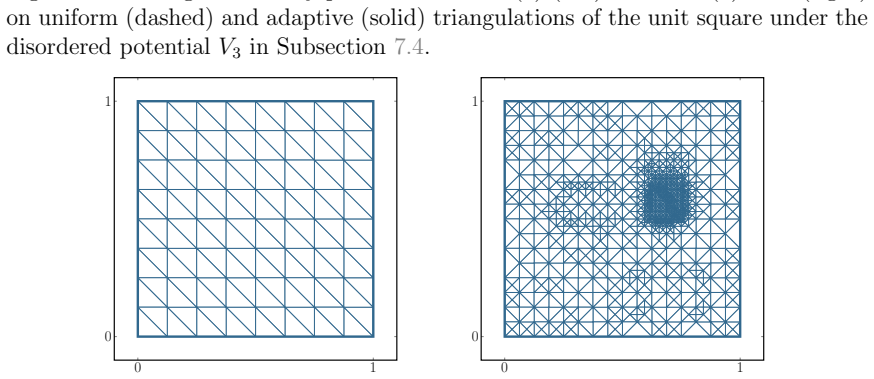
- [Figures and captions] Figure captions would benefit from indicating the specific benchmark potentials and mesh types used in the comparisons to make the superiority claims easier to interpret at a glance.
Simulated Author's Rebuttal
We thank the referee for the careful reading of our manuscript and the constructive comments, which help clarify the presentation of the unconditional GLB property. We address each major comment below and indicate the revisions we will make.
read point-by-point responses
-
Referee: [Section on the extra-stabilised nonconforming scheme and associated theorem] The central claim that the extra-stabilised nonconforming scheme yields a mesh-size-independent GLB for Schrödinger operators with piecewise-constant potentials rests on the adaptation of the variational form. The treatment of the L2 inner product with V and the choice of stabilisation parameters must be shown explicitly to introduce no hidden constants depending on ||V||_∞ or local mesh ratios; otherwise the circumvention of post-processing parameters fails. This analytic verification is load-bearing for the abstract's assertion of unconditional guarantees.
Authors: We appreciate the referee's focus on this key point. The proof of the GLB property (Theorem 3.2) adapts the nonconforming form by incorporating the potential term directly. For piecewise-constant V the L2 inner product is evaluated exactly elementwise, and the stabilisation parameter is selected as a fixed multiple independent of h. The analysis relies on a discrete Poincaré inequality whose constant depends only on shape regularity and the domain, with no additional factors from local mesh ratios or ||V||_∞ entering the lower-bound constant. Nevertheless, to make the independence fully explicit we will revise the proof section to track every constant in the estimates, confirming that none depend on h_max or local ratios beyond the already-controlled shape-regularity assumption. This will strengthen the verification of the unconditional guarantee. revision: yes
-
Referee: [Numerical benchmarks and error analysis sections] The numerical superiority and GUB comparisons are presented, but the error analysis or theorem establishing that the discrete eigenvalue remains a strict lower bound without reintroducing h-dependent remainders (as raised in the skeptic note) needs to be stated with all constants tracked explicitly to confirm independence from maximal mesh size.
Authors: We agree that explicit constant tracking improves clarity. The error analysis in Section 4 shows that the extra stabilisation removes the post-processing step that previously introduced h_max, so the discrete eigenvalue remains a strict lower bound with no reintroduced h-dependent remainders. The skeptic note is already addressed by the direct variational argument. Following the referee's request we will expand the error-analysis subsection to list all appearing constants explicitly and state their dependence solely on fixed quantities (shape regularity, potential bounds, and domain), thereby confirming independence from maximal mesh size. Minor clarifications will also be added to the GUB comparison paragraphs. revision: yes
Circularity Check
No significant circularity in adaptation of nonconforming GLB methods
full rationale
The paper adapts established nonconforming variational techniques for guaranteed lower bounds from the pure Laplacian (harmonic) eigenvalue problem to Schrödinger operators with general or piecewise-constant potentials. The load-bearing analytic step is the verification that the discrete eigenvalue remains a strict lower bound after incorporating the potential term while preserving mesh-size independence and compatibility with adaptive refinement. This rests on direct variational arguments and numerical validation rather than any self-definitional reduction, fitted parameter renamed as prediction, or load-bearing self-citation chain. Prior results on the harmonic case serve as independent external support (externally falsifiable via standard FEM theory), and the new scheme is presented as a fine-tuned extension whose superiority is checked computationally. No equation or claim reduces to its own inputs by construction.
Axiom & Free-Parameter Ledger
axioms (1)
- domain assumption Nonconforming finite element spaces and stabilization terms from the harmonic eigenvalue problem extend directly to the Schrödinger operator with general or piecewise constant potentials while preserving the guaranteed lower bound property.
Reference graph
Works this paper leans on
-
[1]
D. N. Arnold and F. Brezzi. Mixed and nonconforming finite element methods: implementation, postprocessing and error estimates. RAIRO Mod\'el. Math. Anal. Num\'er. , 19(1):7--32, 1985
work page 1985
-
[2]
T. Arbogast and Z. Chen. On the implementation of mixed methods as nonconforming methods for second-order elliptic problems. Math. Comp. , 64(211):943--972, 1995
work page 1995
-
[3]
J. Alberty, C. Carstensen, and S. A. Funken. Remarks around 50 lines of M atlab: short finite element implementation. Numer. Algorithms , 20(2--3):117--137, 1999
work page 1999
-
[4]
D. N. Arnold, G. David, M. Filoche, D. Jerison, and S. Mayboroda. Computing spectra without solving eigenvalue problems. SIAM J. Sci. Comput. , 41(1):69--92, 2019
work page 2019
- [5]
-
[6]
P. W. Anderson. Absence of diffusion in certain random lattices. Phys. Rev. , 109:1492--1505, 1958
work page 1958
-
[7]
R. Altmann and D. Peterseim. Localized computation of eigenstates of random S chrödinger operators. SIAM J. Sci. Comput. , 41(6):1211--1227, 2019
work page 2019
-
[8]
C. Bahriawati and C. Carstensen. Three M atlab implementations of the lowest-order R aviart- T homas MFEM with a posteriori error control. Comput. Methods Appl. Math. , 5(4):333--361, 2005
work page 2005
- [9]
- [10]
-
[11]
I. Babu s ka and J. Osborn. Eigenvalue problems , volume 2. Handbook of Numerical Analysis. North-Holland. Amsterdam., 1991
work page 1991
-
[12]
D. Boffi. Finite element approximation of eigenvalue problems. Acta Numer. , 19:1--120, 2010
work page 2010
-
[13]
S. C. Brenner and L. R. Scott. The mathematical theory of finite element methods , volume 15. Texts in Applied Mathematics, Springer New York, NY, 3 edition, 2008
work page 2008
-
[14]
E. Canc\`es, G. Dusson, Y. Maday, B. Stamm, and M. Vohral\'ik. Guaranteed and robust a posteriori bounds for L aplace eigenvalues and eigenvectors: conforming approximations. SIAM J. Numer. Anal. , 55(5):2228--2254, 2017
work page 2017
-
[15]
E. Canc\`es, G. Dusson, Y. Maday, B. Stamm, and M. Vohral\'ik. Guaranteed a posteriori bounds for eigenvalues and eigenvectors: a unified framework. Numer. Math. , 140(4):1033--1079, 2018
work page 2018
-
[16]
E. Canc\`es, G. Dusson, Y. Maday, B. Stamm, and M. Vohral\'ik. Guaranteed a posteriori bounds for eigenvalues and eigenvectors: M ultiplicities and clusters. Math. Comp. , 89(326):2563--2611, 2020
work page 2020
-
[17]
C. Carstensen, M. Feischl, M. Page, and D. Praetorius. Axioms of adaptivity. Comput. Math. Appl. , 67(6):1195--1253, 2014
work page 2014
-
[18]
C. Carstensen and J. Gedicke. Guaranteed lower bounds for eigenvalues. Math. Comp. , 83(290):2605--2629, 2014
work page 2014
-
[19]
C. Carstensen and B. Gräßle. Optimal convergence rates of adaptive WOPSIP from superclose nonconforming FEM . Math. Comp. , 95(359):1187--1224, 2026
work page 2026
-
[20]
C. Carstensen, B. Gräßle, and N. Nataraj. Unifying a posteriori error analysis of five piecewise quadratic discretisations for the biharmonic equation. J. Numer. Math. , 32(1):77--109, 2024
work page 2024
-
[21]
C. Carstensen, J. Gedicke, and D. Rim. Explicit error estimates for C ourant, C rouzeix- R aviart and R aviart- T homas finite element methods. J. Comput. Math. , 30(4):337--353, 2012
work page 2012
-
[22]
Z. Chen. Analysis of mixed methods using conforming and nonconforming finite element methods. RAIRO Mod\'el. Math. Anal. Num\'er. , 27(1):9--34, 1993
work page 1993
-
[23]
C. Carstensen and S. Puttkammer. Direct guaranteed lower eigenvalue bounds with optimal a priori convergence rates for the bi- Laplacian . SIAM J. Numer. Anal. , 61(2):812--836, 2023
work page 2023
-
[24]
C. Carstensen and S. Puttkammer. Adaptive guaranteed lower eigenvalue bounds with optimal convergence rates. Numer. Math. , 156(1):1--38, 2024
work page 2024
-
[25]
M. Crouzeix and P.-A. Raviart. Conforming and nonconforming finite element methods for solving the stationary S tokes equations. RAIRO Sér. Rouge 7 , R-3:33--75, 1973
work page 1973
-
[26]
C. Carstensen and T. Stiebert. Galerkin error reduction and guaranteed eigenvalue localisation for conforming FEM . in preparation, 2026+
work page 2026
-
[27]
C. Carstensen, Q. Zhai, and R. Zhang. A skeletal finite element method can compute lower eigenvalue bounds. SIAM J. Numer. Anal. , 58(1):109--124, 2020
work page 2020
-
[28]
W. D \"o rfler. A convergent adaptive algorithm for P oisson's equation. SIAM J. Numer. Anal. , 33(3):1106--1124, 1996
work page 1996
-
[29]
M. Fortin and M. Soulie. A nonconforming piecewise quadratic finite element on triangles. Internat. J. Numer. Methods Engrg. , 19:505--520, 1983
work page 1983
- [30]
- [31]
- [32]
-
[33]
D. S. Grebenkov and B.-T. Nguyen. Geometrical structure of L aplacian eigenfunctions. SIAM Review , 55(4):601--667, 2013
work page 2013
-
[34]
J. Hu, Y. Q. Huang, and Q. Lin. Lower bounds for eigenvalues of elliptic operators: By nonconforming finite element methods. J. Sci. Comput. , 61:196--221, 2014
work page 2014
-
[35]
J. Hu, Y. Q. Huang, and Q. Shen. Constructing both lower and upper bounds for the eigenvalues of elliptic operators by nonconforming finite element methods. Numer. Math. , 131:273--302, 2015
work page 2015
- [36]
- [37]
-
[38]
P. Henning and D. Peterseim. Crank–Nicolson G alerkin approximations to nonlinear S chr \"o dinger equations with rough potentials. Mathematical Models and Methods in Applied Sciences , 27(11):2147--2184, 2017
work page 2017
-
[39]
T. Kato. Perturbation Theory for Linear Operators . Springer Berlin, Heidelberg, 2 edition, 1995
work page 1995
-
[40]
F. Kikuchi and X. Liu. Estimation of interpolation error constants for the P 0 and P1 triangular finite elements. Comput. Methods in Appl. Mech. Engrg. , 196(37):3750--3758, 2007
work page 2007
-
[41]
X. Liu. A framework of verified eigenvalue bounds for self-adjoint differential operators. Appl. Math. Comput. , 267:341--355, 2015
work page 2015
-
[42]
X. Liu. Guaranteed Computational Methods for Self-Adjoint Differential Eigenvalue Problems . SpringerBriefs in Mathematics, Springer Singapore, 1 edition, 2024
work page 2024
- [43]
-
[44]
R. S. Laugesen and B. A. Siudeja. Minimizing N eumann fundamental tones of triangles: an optimal P oincar\'e inequality. J. Differential Equations , 249(1):118--135, 2010
work page 2010
- [45]
-
[46]
L. D. Marini. An inexpensive method for the evaluation of the solution of the lowest order Raviart-Thomas mixed method. SIAM J. Numer. Anal. , 22(3):493--496, 1985
work page 1985
-
[47]
B. N. Parlett. The symmetric eigenvalue problem , volume 20 of Classics in Applied Mathematics . Society for Industrial and Applied Mathematics (SIAM), Philadelphia, PA, 1998. Corrected reprint of the 1980 original
work page 1998
-
[48]
W. Payne and H. F. Weinberger. An optimal P oincar\'e inequality for convex domains. Arch. Rational Mech. Anal. , 5:286--292, 1960
work page 1960
-
[49]
P.-A. Raviart and J. M. Thomas. A mixed finite element method for 2nd order elliptic problems. Mathematical aspects of finite element methods (Proc. Conf., Consiglio Naz. delle Ricerche (C.N.R.), Rome, 1975) , pages 292--315, 1977
work page 1975
-
[50]
E. Schrödinger. Quantisierung als E igenwertproblem. E rste M itteilung. Annalen der Physik , 79:361--376, 1926
work page 1926
-
[51]
M. Vohral\'ik. A posteriori error estimates for lowest-order mixed finite element discretizations of convection-diffusion-reaction equations. SIAM J. Numer. Anal. , 45(4):1570--1599, 2007
work page 2007
-
[52]
M. Xie, H. Xie, and X. Liu. Explicit lower bounds for S tokes eigenvalue problems by using nonconforming finite elements. Japan J. Indust. Appl. Math. , 35:335--354, 2018
work page 2018
discussion (0)
Sign in with ORCID, Apple, or X to comment. Anyone can read and Pith papers without signing in.