Frequency Security Assessment in Power Systems With High Penetration of Renewables Considering Spatio-Temporal Frequency Distribution
Pith reviewed 2026-05-09 21:20 UTC · model grok-4.3
The pith
The effective nodal inertia is the dominant factor determining frequency security at individual nodes in power systems with high renewable penetration.
A machine-rendered reading of the paper's core claim, the machinery that carries it, and where it could break.
Core claim
Under temporary power disturbances, the effective nodal inertia emerges as the parameter with greatest influence on nodal frequency security. This leads to an analytical derivation of the critical nodal inertia required to maintain security at every node. A system frequency security index is then constructed from the ratio of actual to critical inertia, supporting an offline-online assessment workflow.
What carries the argument
The effective nodal frequency model, which approximates nodal frequency dynamics using constant effective nodal inertia, damping, and primary regulation parameters.
Load-bearing premise
That keeping only the dominant constant component in the effective nodal frequency model is enough to capture the essential dynamics and security behavior during actual disturbances.
What would settle it
Running a full dynamic simulation on the modified IEEE 39-bus system with a known temporary disturbance and checking whether the observed nodal frequency nadir and rate of change match the predictions from the critical ENI formula; a consistent mismatch at multiple nodes would falsify the model's sufficiency.
Figures




read the original abstract
The increasing integration of renewable energy sources exacerbates the spatial and temporal differences in frequency across the power system, posing a serious challenge to the accurate and efficient assessment of system frequency security. To address this issue, a generic effective nodal frequency (ENF) model is first established to concisely characterize nodal frequency dynamics. This model is featured by the effective nodal inertia (ENI), damping, and primary regulation parameters, which retain only the dominant constant component governing nodal frequency dynamic performance. This model enables the tractable analytical formulation of nodal frequency trajectory and the key frequency security indicators. Quantitative analysis under the temporary power disturbance condition reveals that the ENI is the most influential parameter governing frequency security. Consequently, the critical nodal inertia for ensuring nodal frequency security is analytically derived. A system-level frequency security index based on the actual ENI and critical nodal inertia is proposed. On the basis of the proposed index, the system frequency security assessment is carried out with the procedure of ``offline calculation and online evaluation'', which is achieved using a lookup table approach and an interpolation method. Simulations on the modified IEEE 39-bus system verify the effectiveness of the proposed assessment method.
Editorial analysis
A structured set of objections, weighed in public.
Referee Report
Summary. The paper proposes a generic effective nodal frequency (ENF) model that simplifies nodal frequency dynamics in high-renewable power systems by retaining only the dominant constant components of effective nodal inertia (ENI), damping, and primary regulation parameters. This enables analytical derivation of nodal frequency trajectories and security indicators (nadir, RoCoF, settling). Quantitative analysis under temporary power disturbances identifies ENI as the most influential parameter, from which critical nodal inertia is analytically derived. A system-level frequency security index is then defined, supporting an offline-calculation/online-evaluation procedure via lookup tables and interpolation. The approach is verified through simulations on a modified IEEE 39-bus system.
Significance. If the ENF reduction is shown to be sufficiently accurate, the work provides a tractable analytical framework for assessing spatio-temporal frequency security, which could support practical offline-online tools for system operators. The explicit identification of ENI as dominant and the derivation of critical inertia are potentially useful contributions, as is the emphasis on nodal-level security in renewable-heavy grids. However, the significance is moderated by the absence of quantitative validation of the model approximation.
major comments (3)
- [ENF model] ENF model section (as described in the abstract): The reduction to dominant constant components for ENI, damping, and regulation is presented as enabling tractable analytics, but no error bounds, residual analysis, or direct comparison to the full-order dynamic model are provided. This is load-bearing because the subsequent ranking of ENI influence and the closed-form critical inertia expression are derived directly from the reduced model.
- [Quantitative analysis and critical inertia] Quantitative analysis and critical inertia derivation (abstract and results): The claim that ENI is the most influential parameter and the analytical critical nodal inertia formula lack sensitivity checks across disturbance locations, durations, or renewable variability levels, as well as comparison of predicted vs. simulated frequency trajectories. Without these, the system-level index and the offline/online procedure rest on an unquantified approximation.
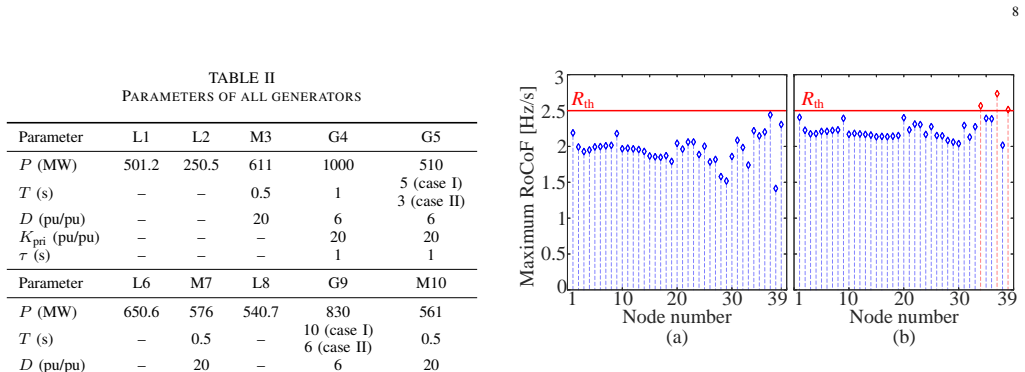
- [Simulations] Verification on modified IEEE 39-bus system (simulation section): The effectiveness claim is supported only by the modified 39-bus case; no full-order model benchmarks, error metrics (e.g., nadir/RoCoF deviation), or tests under varied renewable penetration scenarios are reported, weakening confidence that the index reliably captures security under realistic conditions.
minor comments (2)
- [Abstract] The abstract and introduction could more explicitly state the scope of the ENF approximation (e.g., valid disturbance types) to help readers assess applicability.
- [Notation] Notation: Ensure consistent use of 'ENI' versus 'effective nodal inertia' and define all security indicators (nadir, RoCoF) with equations in the main text.
Simulated Author's Rebuttal
We thank the referee for the thorough and constructive review of our manuscript. The comments have identified key areas where additional validation can strengthen the presentation of the ENF model and its applications. We provide point-by-point responses below and will revise the manuscript to incorporate the suggested analyses.
read point-by-point responses
-
Referee: [ENF model] ENF model section (as described in the abstract): The reduction to dominant constant components for ENI, damping, and regulation is presented as enabling tractable analytics, but no error bounds, residual analysis, or direct comparison to the full-order dynamic model are provided. This is load-bearing because the subsequent ranking of ENI influence and the closed-form critical inertia expression are derived directly from the reduced model.
Authors: We acknowledge that the original manuscript did not include explicit error bounds or residual analysis for the ENF approximation. The reduction is motivated by retaining only the dominant constant terms that govern the primary frequency dynamics, based on the separation of time scales between inertia, damping, and slower regulation effects. To directly address this concern, we will add a dedicated subsection in the revised manuscript that compares the ENF-predicted nodal frequency trajectories against the full-order dynamic model. This will include quantitative error metrics (e.g., maximum deviation in nadir and RoCoF) across multiple disturbance scenarios, thereby quantifying the approximation accuracy and supporting the subsequent analytical derivations. revision: yes
-
Referee: [Quantitative analysis and critical inertia] Quantitative analysis and critical inertia derivation (abstract and results): The claim that ENI is the most influential parameter and the analytical critical nodal inertia formula lack sensitivity checks across disturbance locations, durations, or renewable variability levels, as well as comparison of predicted vs. simulated frequency trajectories. Without these, the system-level index and the offline/online procedure rest on an unquantified approximation.
Authors: The original quantitative analysis focused on temporary power disturbances to establish ENI dominance and derive the closed-form critical inertia. We agree that broader sensitivity checks would improve robustness. In the revision, we will expand the results section to include sensitivity analyses with respect to disturbance location, duration, and varying renewable penetration levels. We will also add direct comparisons of ENF-predicted frequency trajectories versus full simulations, reporting deviation metrics for nadir, RoCoF, and settling frequency. These additions will provide quantitative support for the system-level security index and the offline-calculation/online-evaluation procedure. revision: yes
-
Referee: [Simulations] Verification on modified IEEE 39-bus system (simulation section): The effectiveness claim is supported only by the modified 39-bus case; no full-order model benchmarks, error metrics (e.g., nadir/RoCoF deviation), or tests under varied renewable penetration scenarios are reported, weakening confidence that the index reliably captures security under realistic conditions.
Authors: The verification used the modified IEEE 39-bus system with high renewable penetration as a representative test case. We recognize the value of additional benchmarks. The revised manuscript will incorporate full-order model comparisons with explicit error metrics for nadir and RoCoF. We will also present results under multiple renewable penetration scenarios to demonstrate the index's behavior across different system conditions. These extensions will strengthen the evidence for the method's effectiveness in realistic renewable-heavy grids. revision: yes
Circularity Check
No significant circularity; derivation is model-based and self-contained
full rationale
The paper first defines the ENF model by retaining only dominant constant components of nodal inertia, damping, and regulation parameters, then analytically formulates nodal frequency trajectories and security indicators directly from this reduced model. Quantitative analysis under temporary disturbances identifies ENI influence and derives critical nodal inertia as an analytical consequence of the same model equations. The system-level index is constructed from the actual ENI values versus these derived critical values, with assessment performed via lookup tables and interpolation. No step reduces the final index or critical inertia formula to a fitted parameter by construction, no load-bearing self-citation is invoked for uniqueness or ansatz, and the chain remains independent of the target security claims rather than tautological.
Axiom & Free-Parameter Ledger
axioms (1)
- domain assumption Nodal frequency dynamics can be adequately captured by retaining only the dominant constant components of inertia, damping, and primary regulation.
Reference graph
Works this paper leans on
-
[1]
G. Hu, Y . Yang, H. Xin, L. Huang, X. Liu, H. Ruan, and H. Gao, “A unified method for assessing frequency support capability of diverse renewable power generation units,”IEEE Transactions on Sustainable Energy, vol. 17, no. 1, pp. 377–392, 2026
work page 2026
-
[2]
Review of frequency regulation requirements for wind power plants in international grid codes,
L. Li, D. Zhu, X. Zou, J. Hu, Y . Kang, and J. M. Guerrero, “Review of frequency regulation requirements for wind power plants in international grid codes,”Renewable and Sustainable Energy Reviews, vol. 187, p. 113731, 2023
work page 2023
-
[3]
J. Bialek, “What does the gb power outage on 9 august 2019 tell us about the current state of decarbonised power systems?,”Energy Policy, vol. 146, p. 111821, 2020
work page 2019
-
[4]
Analytic assessment of the power system frequency security,
P. Ju, Y . Zheng, Y . Jin, C. Qin, Y . Jiang, and L. Cao, “Analytic assessment of the power system frequency security,”IET Generation, Transmission & Distribution, vol. 15, no. 15, pp. 2215–2225, 2021
work page 2021
-
[5]
Y . Lan, Y . Zhang, W. Yao, S. Wei, T. Chen, H. Shuai, and J. Wen, “Trustworthy data-driven prefault frequency security assessment for power systems using disturbance-informed learning,”IEEE Transactions on Industrial Informatics, vol. 22, no. 3, pp. 1950–1961, 2026
work page 1950
-
[6]
Frequency stability of synchronous machines and grid-forming power converters,
A. Tayyebi, D. Groß, A. Anta, F. Kupzog, and F. D ¨orfler, “Frequency stability of synchronous machines and grid-forming power converters,” IEEE Journal of Emerging and Selected Topics in Power Electronics, vol. 8, no. 2, pp. 1004–1018, 2020
work page 2020
-
[7]
Online frequency security assessment based on analytical model considering limiting modules,
Y . Zhang, Q. Guo, Y . Zhou, and H. Sun, “Online frequency security assessment based on analytical model considering limiting modules,” CSEE Journal of Power and Energy Systems, vol. 8, no. 5, pp. 1363– 1372, 2022
work page 2022
-
[8]
Z. Peng, Q. Peng, Y . Zhang, H. Han, Y . Yin, and T. Liu, “Online inertia allocation for grid-connected renewable energy systems based on generic asf model under frequency nadir constraint,”IEEE Transactions on Power Systems, vol. 39, no. 1, pp. 1615–1627, 2024
work page 2024
-
[9]
Long-term frequency stability assessment based on extended frequency response model,
Y . Xie, C. Li, H. Zhang, H. Sun, and V . Terzija, “Long-term frequency stability assessment based on extended frequency response model,”IEEE Access, vol. 8, pp. 122444–122455, 2020
work page 2020
-
[10]
G. Zhang, J. Ren, Y . Zeng, F. Liu, S. Wang, and H. Jia, “Security as- sessment method for inertia and frequency stability of high proportional renewable energy system,”International Journal of Electrical Power & Energy Systems, vol. 153, p. 109309, 2023
work page 2023
-
[11]
Study on the necessity and role of inertia in power system frequency response,
M. Sun, G. Xie, L. Chen, Y . Liu, X. Li, and Y . Min, “Study on the necessity and role of inertia in power system frequency response,” in2020 IEEE 4th Conference on Energy Internet and Energy System Integration (EI2), pp. 155–159, 2020
work page 2020
-
[12]
Inertia security evaluation and application in low-inertia power systems,
W. Zhang, Y . Wen, and C. Y . Chung, “Inertia security evaluation and application in low-inertia power systems,”IEEE Transactions on Power Systems, vol. 40, no. 2, pp. 1725–1737, 2025
work page 2025
-
[13]
Extracting spatial-temporal characteristics of frequency dynamic in large-scale power grids,
N. Ma and D. Wang, “Extracting spatial-temporal characteristics of frequency dynamic in large-scale power grids,”IEEE Transactions on Power Systems, vol. 34, no. 4, pp. 2654–2662, 2019
work page 2019
-
[14]
Analysis and control of frequency stability in low-inertia power systems: A review,
C. He, H. Geng, K. Rajashekara, and A. Chandra, “Analysis and control of frequency stability in low-inertia power systems: A review,” IEEE/CAA Journal of Automatica Sinica, vol. 11, no. 12, pp. 2363–2383, 2024
work page 2024
-
[15]
Frequency security assessment of power systems based on dynamic inertia con- stants,
J. Fu, Q. Zhang, W.-L. Tao, X.-T. Wang, and H.-W. Wang, “Frequency security assessment of power systems based on dynamic inertia con- stants,” in2025 10th International Symposium on Advances in Electrical, Electronics and Computer Engineering (ISAEECE), pp. 119–123, 2025
work page 2025
-
[16]
S. Ke, L. Ding, X. Shi, P. Fan, H. Wang, L. Chen, J. Yang, and C. Y . Chung, “Response characteristics and regulation feasibility of dc charging station controlled by gfm/gfl virtual inertia for grid frequency stability,”IEEE Transactions on Transportation Electrification, vol. 11, no. 3, pp. 7743–7758, 2025
work page 2025
-
[17]
Frequency support strategy for fast response energy storage systems,
A. E. Leon, ´A. R. del Nozal, and J. M. Mauricio, “Frequency support strategy for fast response energy storage systems,”IEEE Transactions on Power Systems, vol. 39, no. 3, pp. 5439–5442, 2024. 11
work page 2024
-
[18]
A new fault type classification method in the presence of inverter-based resources,
M. M. Mobashsher, A. A. Abdoos, S. M. Hosseini, S. M. Hashemi, and M. Sanaye-Pasand, “A new fault type classification method in the presence of inverter-based resources,”International Journal of Electrical Power & Energy Systems, vol. 147, p. 108793, 2023
work page 2023
-
[19]
C. He, L. Zhang, Q. Liu, and R. Zou, “Inertia matching principle: Improving transient synchronization stability in hybrid power systems with vsgs and sgs,” 2026
work page 2026
discussion (0)
Sign in with ORCID, Apple, or X to comment. Anyone can read and Pith papers without signing in.