BV photometry of the ultracompact binary star GP Com
Pith reviewed 2026-05-09 20:30 UTC · model grok-4.3
The pith
BV photometry of GP Com detects 0.04-0.05 mag orbital modulation from a bright spot on the accretion disk.
A machine-rendered reading of the paper's core claim, the machinery that carries it, and where it could break.
Core claim
We find an orbital modulation with amplitude 0.04-0.05 mag in B and V bands. Adopting that it is due to a bright spot, we estimate its temperature 19700 ± 3000 K. We estimate mass accretion rate onto the white dwarf of about 2.10^{-12} M_sun/yr, consistent with the predicted rate for a cool donor.
What carries the argument
Orbital modulation in the BV light curve, interpreted as emission from a bright spot on the accretion disk whose temperature is derived from the observed amplitude and color.
If this is right
- The derived accretion rate matches the low value expected when the donor is cool and mass transfer is driven by gravitational waves.
- The bright spot temperature of about 19700 K indicates localized heating where the stream impacts the disk.
- The amplitude is similar in B and V, suggesting the spot dominates the variable light over a broad optical range.
- The 7.7-hour and 2.9-hour data sets provide a reference light curve for detecting changes in spot strength over longer timescales.
Where Pith is reading between the lines
- Confirmation of the bright-spot picture would imply that optical photometry alone can locate the impact region even in low-accretion AM CVn systems.
- Similar modulation searches in other ultracompact binaries could reveal how spot properties scale with orbital period and accretion rate.
- If the rate remains steady, the system should evolve on a timescale set by gravitational-wave losses, testable by measuring period change over decades.
Load-bearing premise
The observed orbital modulation is produced by a bright spot on the accretion disk.
What would settle it
A spectroscopic or multi-wavelength campaign that finds no temperature contrast or no phase-locked hot region at the expected disk location would falsify the bright-spot interpretation.
Figures
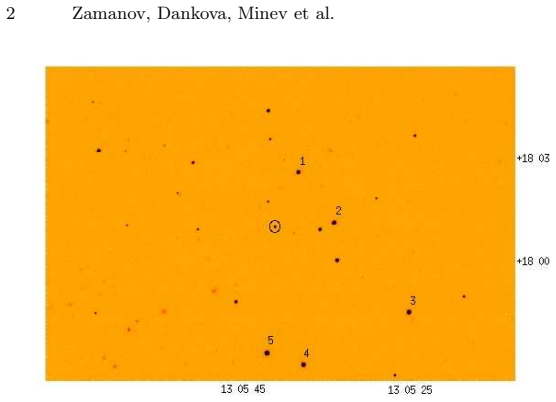


read the original abstract
We present optical B and V band photometry of GP Com - an ultracompact binary consisting of an accreting white dwarf and helium secondary component. Our data set contains 7.7 hours observations in V band with the 2.0m telescope and 2.9 hours simultaneous observations in B and V bands with the 1.5m telescope of the Rozhen National Astronomical Obsevatory, Bulgaria. The observations cover of about 13 orbital periods. We find an orbital modulation with amplitude 0.04-0.05 mag in B and V bands. Adopting that it is due to a bright spot, we estimate its temperature 19700 \pm 3000 K. We estimate mass accretion rate onto the white dwarf of about 2.10^{-12} M_sun/yr, consistent with the predicted rate for a cool donor. The data are available on Zenodo: zenodo.org/records/18768211.
Editorial analysis
A structured set of objections, weighed in public.
Referee Report
Summary. The manuscript presents new BV photometry of the ultracompact AM CVn binary GP Com obtained with the Rozhen 2.0 m and 1.5 m telescopes, totaling 7.7 h in V and 2.9 h of simultaneous B+V data that span roughly 13 orbital periods. It reports a coherent orbital modulation with amplitude 0.04–0.05 mag in both bands. Adopting the interpretation that this modulation arises from a bright spot on the accretion disk, the authors derive a spot temperature of 19700 ± 3000 K and a mass-accretion rate onto the white dwarf of ~2 × 10^{-12} M_⊙ yr^{-1}, which they note is consistent with the expected rate for a cool helium donor. The data are made public via Zenodo.
Significance. If the bright-spot interpretation can be robustly justified, the derived accretion rate would constitute a rare, observationally anchored constraint on mass transfer in an AM CVn system with a cool donor, directly testing evolutionary models that predict low but non-zero transfer rates. The public release of the time-series photometry is a clear strength that enables independent verification and follow-up.
major comments (2)
- [Abstract] Abstract (and corresponding Results/Discussion sections): The temperature and accretion-rate estimates rest entirely on the explicit adoption that the 0.04–0.05 mag orbital modulation is produced by a localized bright spot. No quantitative support is provided for this choice—no periodogram or false-alarm probability, no phase-folded light-curve morphology or stability across the 13 cycles, no B–V color variation across the orbit, and no explicit comparison to or exclusion of plausible alternatives (ellipsoidal variation of the donor, disk precession, or incoherent flickering). Because both derived quantities are obtained only after this assumption, the central claims cannot be evaluated without the missing analysis.
- [Observations] Observations and data reduction (presumably §2): With only 7.7 h of V-band coverage and 2.9 h of simultaneous B+V data, the coherence and amplitude stability of the reported modulation remain unquantified. The manuscript should report the formal significance of the periodicity, the rms scatter after subtracting the orbital signal, and any checks for systematic trends with airmass or seeing that could mimic a low-amplitude periodic signal.
minor comments (3)
- [Abstract] The abstract contains the typographical error 'Obsevatory' (should be 'Observatory').
- [Abstract] The accretion rate is written as '2.10^{-12}'; standard notation is 2 × 10^{-12}.
- The manuscript would be strengthened by inclusion of the phase-folded light curves (B and V) and the periodogram as figures, together with a brief description of the data-reduction pipeline and error estimation.
Simulated Author's Rebuttal
We thank the referee for their careful and constructive review of our manuscript. We address each major comment below and have made revisions to incorporate additional analysis and clarifications where feasible.
read point-by-point responses
-
Referee: [Abstract] Abstract (and corresponding Results/Discussion sections): The temperature and accretion-rate estimates rest entirely on the explicit adoption that the 0.04–0.05 mag orbital modulation is produced by a localized bright spot. No quantitative support is provided for this choice—no periodogram or false-alarm probability, no phase-folded light-curve morphology or stability across the 13 cycles, no B–V color variation across the orbit, and no explicit comparison to or exclusion of plausible alternatives (ellipsoidal variation of the donor, disk precession, or incoherent flickering). Because both derived quantities are obtained only after this assumption, the central claims cannot be evaluated without the missing analysis.
Authors: We agree that explicit quantitative support for the periodicity and bright-spot interpretation is necessary for readers to evaluate the central claims. In the revised manuscript we will add a Lomb-Scargle periodogram with false-alarm probability, the phase-folded B and V light curves demonstrating morphology and consistency across the 13 cycles, and the orbital B–V color curve. We will also briefly compare the observed amplitude and coherence to plausible alternatives (ellipsoidal variation of the donor, disk precession, and incoherent flickering) and explain why the bright-spot model remains the most consistent with the data. revision: yes
-
Referee: [Observations] Observations and data reduction (presumably §2): With only 7.7 h of V-band coverage and 2.9 h of simultaneous B+V data, the coherence and amplitude stability of the reported modulation remain unquantified. The manuscript should report the formal significance of the periodicity, the rms scatter after subtracting the orbital signal, and any checks for systematic trends with airmass or seeing that could mimic a low-amplitude periodic signal.
Authors: We acknowledge that the short total baseline limits the ability to demonstrate long-term coherence. In the revision we will report the formal statistical significance of the periodicity, the rms scatter of the residuals after subtraction of the orbital signal, and checks for correlations with airmass and seeing. We will also note explicitly that the 13-cycle span precludes a full assessment of stability over longer timescales. revision: partial
Circularity Check
No circularity: results follow directly from new photometry via standard conversions
full rationale
The paper presents fresh BV observations spanning ~13 orbital periods and reports a detected modulation amplitude of 0.04-0.05 mag. The temperature and accretion-rate estimates are obtained only after an explicit adoption of the bright-spot interpretation, followed by application of conventional astrophysical relations to convert amplitude into temperature and luminosity into accretion rate. No equation in the provided text defines a quantity in terms of itself, renames a fitted parameter as a prediction, or relies on a load-bearing self-citation whose validity is presupposed. The derivation chain therefore remains self-contained against external benchmarks and does not reduce to its own inputs by construction.
Axiom & Free-Parameter Ledger
axioms (1)
- domain assumption The orbital modulation is due to a bright spot on the accretion disk.
Reference graph
Works this paper leans on
-
[1]
Bailer-Jones, C. A. L., Rybizki, J., Fouesneau, M., et al . (2021) Estimating Distances from Parallaxes. V. Geometric and Photogeometric Distance s to 1.47 Billion Stars in Gaia Early Data Release 3, Astronomical Journal, 161 (3), 14 7, 24pp
work page 2021
-
[2]
Marsh, T. R. (1999) Kinematics of the helium accretor GP C OM, MNRAS, 304 (2), 443-450
work page 1999
-
[3]
Podsiadlowski, P., Han, Z., & Rappaport, S. (2003) Catac lysmic variables with evolved secondaries and the progenitors of AM CVn stars, MNRAS, 340 ( 4), 1214-1228
work page 2003
-
[4]
(2010) AM CVn Stars: Status and Challenge s, PASP, 122, 1133-1163
Solheim, J.-E. (2010) AM CVn Stars: Status and Challenge s, PASP, 122, 1133-1163
work page 2010
-
[5]
J., van Roestel, J., & Wong, T
Green, M. J., van Roestel, J., & Wong, T. L. S. (2025) Astro nomy & Astrophysics, 700, A107, 22pp
work page 2025
-
[6]
(2025) Photomet ry with the New 1.5-meter Telescope of the Rozhen Observatory, C
Semkov, E., Petrov, N., Minev, M., et al. (2025) Photomet ry with the New 1.5-meter Telescope of the Rozhen Observatory, C. R. Acad. Bulg. Sci., 78 (6), 797-804
work page 2025
-
[7]
Gaia Collaboration, Vallenari, A., Brown, A. G. A., et al . (2023) Gaia Data Release 3. Summary of the content and survey properties, Astronomy & As trophysics, 674, A1, 22pp
work page 2023
- [8]
- [9]
-
[10]
Verbunt, F., Rappaport, S. (1988) Mass Transfer Instab ilities Due to Angular Momentum Flows in Close Binaries, Astrophysical Journal, 332, 193-1 98
work page 1988
-
[11]
Eggleton, P. P. (1983) Aproximations to the radii of Roc he lobes, Astrophysical Journal, 268, 368-369
work page 1983
-
[12]
Morales-Rueda, L., Marsh, T. R., Steeghs, D., et al. (20 03) New results on GP Com, Astronomy & Astrophysics, 405, 249-261
-
[13]
Ramsay, G., Green, M. J., Marsh, T. R., et al. (2018) Phys ical properties of AM CVn stars: New insights from Gaia DR2, Astronomy & Astrophysics , 620, A141, 17 pp
work page 2018
-
[14]
Rodrigo, C. & Solano, E. (2020) The SVO Filter Profile Ser vice, XIV.0 Scientific Meeting of the Spanish Astronomical Society, 182. 8 Zamanov, Dankova, Minev et al
work page 2020
-
[15]
(1992) Multicolor stellar photometry, Tu cson, USA: Pachart Pub House, 576 pp
Straizys, V. (1992) Multicolor stellar photometry, Tu cson, USA: Pachart Pub House, 576 pp
work page 1992
-
[16]
(2025) Zones of accretion disk activity, Pu bl
Yankova, K. (2025) Zones of accretion disk activity, Pu bl. Astron. Obs. Belgrade, 107, 139-144
work page 2025
-
[17]
(2025) Firs t-ever discovery of a superoutburst in GP Comae Berenices buried in archival data, Publ
Kojiguchi, N., Isogai, K., Tampo, Y., et al. (2025) Firs t-ever discovery of a superoutburst in GP Comae Berenices buried in archival data, Publ. Astron. Soc. Japan, 77 (5), 1126- 1134
work page 2025
-
[18]
Schaefer, B. E. (2024) Evolutionary Period Changes for 52 Cataclysmic Variables, and the Failure for the Most-fundamental Prediction of the Magn etic Braking Model, Astro- physical Journal, 966 (2), 155, 29 pp
work page 2024
-
[19]
Kupfer, T., Groot, P. J., Levitan, D., et al. (2013) Orbi tal periods and accretion disc structure of four AM CVn systems, MNRAS, 432 (3), 2048-2060. 1Institute of Astronomy and National Astronomical Observat ory, Bulgarian Academy of Sciences, Tsarigradsko Shose 72, BG-1784, Sofia, Bulgaria 2Space Research and Technology Institute, Bulgarian Academ y of S...
work page 2013
discussion (0)
Sign in with ORCID, Apple, or X to comment. Anyone can read and Pith papers without signing in.