Recognition: unknown
XRISM High-Resolution X-ray Spectroscopy of Cygnus X-1 -- highly ionized Iron absorption structures
Pith reviewed 2026-05-09 21:18 UTC · model grok-4.3
The pith
XRISM Resolve detects narrow highly ionized iron absorption lines in Cygnus X-1 with blueshift of 100 km/s and ionization parameter near 3.
A machine-rendered reading of the paper's core claim, the machinery that carries it, and where it could break.
Core claim
The central claim is that XRISM Resolve can securely detect narrow absorption features only a few eV wide in Cygnus X-1, revealing a photoionized plasma absorber whose properties are an ionization parameter of approximately 3, column densities of a few times 10^21 cm^-2, and a line-of-sight blueshift of approximately 100 km s^-1, with the absorption becoming prominent during the dipping orbital phase.
What carries the argument
The photoionized plasma absorption model fitted to the resolved He-like Fe K-alpha and H-like Fe Ly-alpha lines, which simultaneously returns the ionization parameter, column density, and Doppler velocity of the wind material.
If this is right
- The absorbing plasma is spatially distributed such that its column becomes detectable only during the dipping phase.
- The measured 100 km s^-1 blueshift traces the line-of-sight motion of wind material in the vicinity of the black hole.
- The derived ionization parameter and column density constrain the physical conditions in the wind that feeds the accretion flow.
- Continued high-resolution observations can further map how the wind kinematics vary with orbital phase.
Where Pith is reading between the lines
- The phase-dependent strength suggests the wind is clumpy or focused along certain sightlines through the binary.
- The same Resolve capabilities could be used on other high-mass X-ray binaries to compare wind launching radii and velocities across systems.
- If the velocity remains stable in future epochs, the absorber may originate from a fixed region such as the companion's wind or the disk atmosphere.
Load-bearing premise
The spectral fitting assumes the absorption arises from a uniform photoionized plasma component whose properties can be captured by a single ionization parameter and column density, with the orbital phase cut at phi_orb=0.9 cleanly separating dipping and non-dipping intervals without significant continuum or instrumental contamination.
What would settle it
A repeat high-resolution observation that fails to detect absorption lines with equivalent widths near 2.3 eV, 0.4 eV, and 1.2 eV or that measures a velocity shift significantly different from 100 km s^-1 during the dipping phase would falsify the reported plasma properties.
Figures


read the original abstract
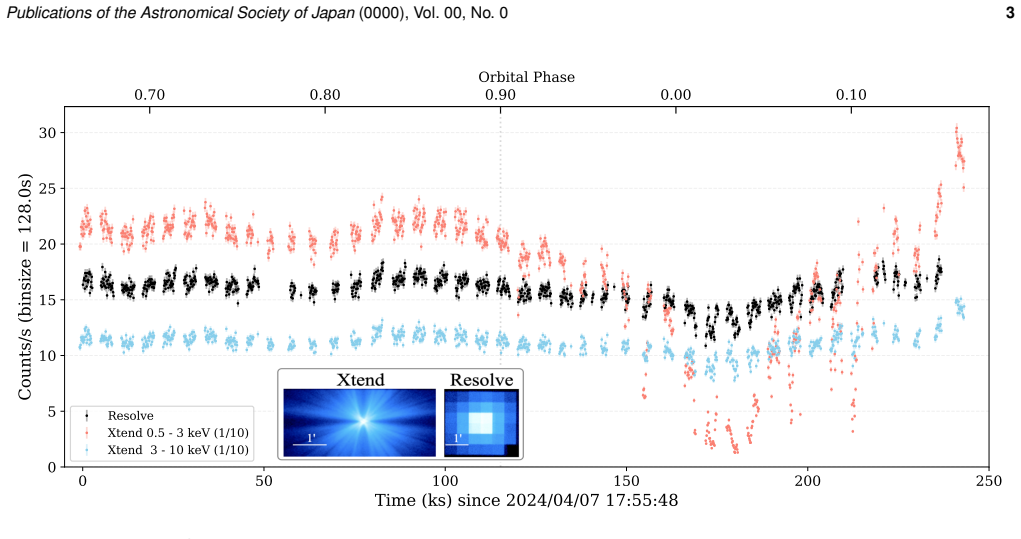
We present the first high-resolution X-ray spectral analysis of Cygnus X-1 using XRISM. The observation was carried out from April 7 to 10, 2024, covering the orbital phase range 0.65--0.17 during its low/hard state. Taking advantage of the exceptional energy resolution of the Resolve instrument, we examined highly ionized iron absorption lines and characterized the ionization states, column densities, and line-of-sight velocities of the absorbing plasma. Spectral analysis revealed an ionization parameter of approximately 3, column densities of a few times 10^21 cm^-2, and a blueshifted velocity of approximately 100 km s^-1. The observation was divided into two phases: before and after orbital phase phi_orb = 0.9, corresponding to non-dipping and dipping intervals. While only weak absorption features were present before phi_orb = 0.9, strong absorption by He-like and H-like Fe appeared during the dipping phase. We measured equivalent widths of 2.3 eV, 0.4 eV, and 1.2 eV for He-like Fe K-alpha, and H-like Ly-alpha1 and Ly-alpha2, respectively, demonstrating the capability of XRISM Resolve to securely detect narrow absorption features of only a few eV. These measurements trace the motion of the absorbing material and offer insight into the kinematics and spatial distribution of the wind in the vicinity of the black hole. These findings enhance our understanding of wind-fed accretion in Cygnus X-1 and highlight the importance of continued high-resolution X-ray observations to further constrain the physical properties of winds and accretion flows in high-mass X-ray binaries.
Editorial analysis
A structured set of objections, weighed in public.
Referee Report
Summary. The manuscript presents the first high-resolution X-ray spectroscopic analysis of Cygnus X-1 using the XRISM Resolve instrument during its low/hard state (orbital phases 0.65--0.17). The data are split at phi_orb=0.9 into non-dipping and dipping intervals. Spectral fitting of highly ionized Fe absorption lines (He-like K-alpha and H-like Ly-alpha) with a photoionized plasma model yields an ionization parameter of approximately 3, column density of a few times 10^21 cm^{-2}, and blueshifted velocity of approximately 100 km s^{-1}. Equivalent widths of 2.3 eV, 0.4 eV, and 1.2 eV are reported for the respective lines, detected primarily in the dipping phase.
Significance. If the modeling assumptions hold, this work demonstrates XRISM Resolve's capability to securely detect narrow absorption features with equivalent widths of only a few eV and provides new phase-resolved constraints on the highly ionized wind in the archetypal black-hole binary Cygnus X-1. It links dipping behavior to enhanced absorption and offers initial kinematic and ionization insights into wind-fed accretion near the compact object.
major comments (2)
- [§4] §4 (Spectral Analysis and phase-resolved fitting): The central results (xi≈3, N_H≈few×10^{21} cm^{-2}, v≈100 km s^{-1}) rest on a single-zone photoionized plasma model applied to the dipping interval. The manuscript must show that this model is statistically adequate (e.g., chi^2/dof, residual plots, and line-profile fits) and address whether a multi-zone or clumpy absorber is required, as the dipping material is expected to be inhomogeneous. Without such validation, the reported parameters are effective averages whose physical meaning for the wind remains unclear.
- [Results] Results section (equivalent-width measurements): The quoted equivalent widths (2.3 eV, 0.4 eV, 1.2 eV) are presented without uncertainties or detection significances. These must be included, together with the continuum-subtraction method and atomic data source, to substantiate the claim of secure detection of narrow features.
minor comments (2)
- The abstract and introduction would benefit from explicit reference to the energy band and specific transitions used in the line fitting.
- A summary table of best-fit parameters (with 1-sigma errors) for both orbital-phase intervals would improve clarity and allow direct comparison with prior lower-resolution studies.
Simulated Author's Rebuttal
We thank the referee for their thorough review and valuable comments, which have helped us improve the clarity and robustness of our analysis. We provide point-by-point responses below and will make the necessary revisions to the manuscript.
read point-by-point responses
-
Referee: [§4] §4 (Spectral Analysis and phase-resolved fitting): The central results (xi≈3, N_H≈few×10^{21} cm^{-2}, v≈100 km s^{-1}) rest on a single-zone photoionized plasma model applied to the dipping interval. The manuscript must show that this model is statistically adequate (e.g., chi^2/dof, residual plots, and line-profile fits) and address whether a multi-zone or clumpy absorber is required, as the dipping material is expected to be inhomogeneous. Without such validation, the reported parameters are effective averages whose physical meaning for the wind remains unclear.
Authors: We agree that additional validation of the single-zone photoionized plasma model is necessary to support our conclusions. In the revised manuscript, we will include the chi^2/dof values for the spectral fits to the dipping interval, along with residual plots and detailed line-profile fits showing the model components. We will also explicitly address the potential need for multi-zone or clumpy absorbers by discussing the expected inhomogeneity of the dipping material and noting that our reported parameters represent effective averages over the line of sight. We will test whether adding a second absorption zone significantly improves the fit statistics and include this in the revised analysis section. This will clarify the physical interpretation of the wind properties. revision: yes
-
Referee: [Results] Results section (equivalent-width measurements): The quoted equivalent widths (2.3 eV, 0.4 eV, 1.2 eV) are presented without uncertainties or detection significances. These must be included, together with the continuum-subtraction method and atomic data source, to substantiate the claim of secure detection of narrow features.
Authors: We thank the referee for pointing out this omission. In the revised manuscript, we will report the equivalent widths with their uncertainties and include the detection significances (e.g., in terms of sigma). We will describe the continuum-subtraction method employed, which involves fitting a local power-law or spline continuum around each absorption line, and specify the atomic data source used in the photoionization modeling. These additions will strengthen the evidence for the secure detection of the narrow features with XRISM Resolve. revision: yes
Circularity Check
No circularity: parameters are direct spectral-fit outputs
full rationale
The paper performs standard X-ray spectral fitting of Resolve data using conventional photoionized plasma models (e.g., single-zone absorption components) on observed line positions and strengths. The reported ionization parameter (≈3), column density (few × 10^21 cm^-2), blueshift (≈100 km s^-1), and equivalent widths are direct numerical outputs of that fitting process applied to the data split at phi_orb=0.9. No equations, self-citations, or ansatzes reduce these quantities to quantities defined by the fit itself; the central results remain independent empirical measurements rather than tautological re-expressions of inputs.
Axiom & Free-Parameter Ledger
free parameters (3)
- ionization parameter =
~3
- column density =
few x 10^21 cm^-2
- line-of-sight velocity =
~100 km/s
axioms (2)
- domain assumption The detected features are absorption lines from He-like and H-like iron in a photoionized plasma.
- domain assumption Orbital phase phi_orb = 0.9 cleanly divides intervals with distinct absorption properties.
Reference graph
Works this paper leans on
-
[1]
D., Acernese, F., et al
Abbott, R., Abbott, T. D., Acernese, F., et al. 2023, Phys. Rev. X, 13, 011048,
2023
-
[2]
2018, Monthly Notices of the Royal Astronomical Society, 480, 751,
Axelsson, M., & Done, C. 2018, Monthly Notices of the Royal Astronomical Society, 480, 751,
2018
-
[3]
J., Charles, P
Balucinska-Church, M., Church, M. J., Charles, P . A., et al. 2000, Mon. Not. R. Astron. Soc., 311, 861,
2000
-
[4]
2022, in Space Telescopes and Instrumentation 2022: Ultraviolet to Gamma Ray, ed
Boissay-Malaquin, R., Hayashi, T., Tamura, K., et al. 2022, in Space Telescopes and Instrumentation 2022: Ultraviolet to Gamma Ray, ed. J.-W. A. den Herder, K. Nakazawa, & S. Nikzad (SPIE),
2022
-
[5]
2024, in Space Telescopes and Instrumentation 2024: Ultraviolet to Gamma Ray, ed
Boissay-Malaquin, R., Hayashi, T., Tamura, K., et al. 2024, in Space Telescopes and Instrumentation 2024: Ultraviolet to Gamma Ray, ed. J.-W. A. den Herder, K. Nakazawa, & S. Nikzad (SPIE), 237,
2024
-
[6]
1952, Mon
Bondi, H. 1952, Mon. Not. R. Astron. Soc., 112, 195,
1952
-
[7]
1944, Mon
Bondi, H., & Hoyle, F. 1944, Mon. Not. R. Astron. Soc., 104, 273,
1944
-
[8]
Boroson, B., & Vrtilek, S. D. 2010, Astrophys. J., 710, 197,
2010
-
[9]
P ., Larionov, V ., et al
Brocksopp, C., Fender, R. P ., Larionov, V ., et al. 1999, Mon. Not. R. Astron. Soc., 309, 1063,
1999
-
[10]
I., Abbott, D
Castor, J. I., Abbott, D. C., & Klein, R. I. 1975, Astrophys. J., 195, 157,
1975
-
[11]
2015, Astron
Cechura, P ., & Hadrava, P . 2015, Astron. Astrophys., 575, A5,
2015
-
[12]
2007, Astrophys
Chang, C., & Cui, W. 2007, Astrophys. J., 663, 1207,
2007
-
[13]
2023, Rev
Chatzikos, M., Bianchi, S., Camilloni, F., et al. 2023, Rev. Mex. Astron. Astrofis., 59, 327, de Vries, C. P ., Haas, D., Y amasaki, N. Y ., et al. 2017, JA TIS, 4, 011204,
2023
-
[14]
Dexter, J., & Begelman, M. C. 2023, Mon. Not. R. Aston. Soc. Lett., 528, L157,
2023
-
[15]
2007, The Astronomy and Astrophysics Review, 15, 1,
Done, C., Gierli ´nski, M., & Kubota, A. 2007, The Astronomy and Astrophysics Review, 15, 1,
2007
-
[16]
A., Miller, J
Draghis, P . A., Miller, J. M., Costantini, E., et al. 2024, Astrophys. J., 969, 40,
2024
-
[17]
E., Adams, J
Eckart, M. E., Adams, J. S., Boyce, K. R., et al. 2018, J. Astron. Telesc. Instrum. Syst., 4, 1,
2018
-
[18]
E., Brown, G
Eckart, M. E., Brown, G. V ., Chiao, M. P ., et al. 2025b, Journal of Astronomical Telescopes, Instruments, and Systems, 11, 042018, El Mellah, I., Grinberg, V ., Sundqvist, J. O., Driessen, F. A., & Leutenegger, M. A. 2020, Astron. Astrophys., 643, A9,
2020
-
[19]
X., Tennant, A
Feng, Y . X., Tennant, A. F., & Zhang, S. N. 2003, The Astrophysical Journal, 597, 1017,
2003
-
[20]
B., & Castor, J
Friend, D. B., & Castor, J. I. 1982, Astrophys. J., 261, 293,
1982
-
[21]
R., & Bolton, C
Gies, D. R., & Bolton, C. T. 1986, Astrophys. J., 304, 371, 14 Publications of the Astronomical Society of Japan (0000), Vol. 00, No. 0
1986
-
[22]
1999, Astronomy and Astrophysics, 352, 182, Gräfener, G., Koesterke, L., & Hamann, W.-R
Gilfanov, M., Churazov, E., & Revnivtsev, M. 1999, Astronomy and Astrophysics, 352, 182, Gräfener, G., Koesterke, L., & Hamann, W.-R. 2002, Astronomy and Astrophysics, 387, 244,
1999
-
[23]
2013, Astron
Grinberg, V ., Hell, N., Pottschmidt, K., et al. 2013, Astron. Astrophys., 554, A88,
2013
-
[24]
A., Hell, N., et al
Grinberg, V ., Leutenegger, M. A., Hell, N., et al. 2015, Astron. Astrophys., 576, A117,
2015
-
[25]
M., van Hoof, P
Gunasekera, C. M., van Hoof, P . A. M., Chatzikos, M., & Ferland, G. J. 2023, Research Notes of the American Astronomical Society, 7, 246,
2023
-
[26]
A., et al
Hanke, M., Wilms, J., Nowak, M. A., et al. 2009, Astrophys. J., 690, 330,
2009
-
[27]
2022, in Space Telescopes and Instrumentation 2022: Ultraviolet to Gamma Ray, ed
Hayashi, T., Boissay-Malaquin, R., Tamura, K., et al. 2022, in Space Telescopes and Instrumentation 2022: Ultraviolet to Gamma Ray, ed. J.-W. A. den Herder, K. Nakazawa, & S. Nikzad (SPIE),
2022
-
[28]
P ., Gabler, R., Vilchez, J
Herrero, A., Kudritzki, R. P ., Gabler, R., Vilchez, J. M., & Gabler, A. 1995, Astron. Astrophys., 297, 556
1995
-
[29]
2021, pasa, 38, e056,
Hirai, R., & Mandel, I. 2021, pasa, 38, e056,
2021
-
[30]
2019, Astron
Hirsch, M., Hell, N., Grinberg, V ., et al. 2019, Astron. Astrophys., 626, A64,
2019
-
[31]
S., Kaluzienski, L
Holt, S. S., Kaluzienski, L. J., Boldt, E. A., & Serlemitsos, P . J. 1976, Nature, 261, 213, Hölzer, G., Fritsch, M., Deutsch, M., Härtwig, J., & Förster, E. 1997, Phys. Rev. A, 56, 4554,
1976
-
[32]
2016, Nucl
Inoue, S., Hayashida, K., Katada, S., et al. 2016, Nucl. Instrum. Methods Phys. Res. A, 831, 415,
2016
-
[33]
2018, JA TIS, 4, 011217,
Ishisaki, Y ., Y amada, S., Seta, H., et al. 2018, JA TIS, 4, 011217,
2018
-
[34]
L., Awaki, H., et al
Ishisaki, Y ., Kelley, R. L., Awaki, H., et al. 2022, in Society of Photo-Optical Instrumentation Engineers (SPIE) Conference Series, V ol. 12181, Space Telescopes and Instrumentation 2022: Ultraviolet to Gamma Ray, ed. J.- W. A. den Herder, K. Nakazawa, & S. Nikzad (SPIE), 121811S,
2022
-
[35]
2001, The Astrophysical Journal Supplement Series, 133, 221,
Kallman, T., & Bautista, M. 2001, The Astrophysical Journal Supplement Series, 133, 221,
2001
-
[36]
L., Akamatsu, H., Azzarello, P ., et al
Kelley, R. L., Akamatsu, H., Azzarello, P ., et al. 2016, in Space Telescopes and Instrumentation 2016: Ultraviolet to Gamma Ray, ed. J.-W. A. den
2016
-
[37]
T., et al
Kitamoto, S., Miyamoto, S., Tanaka, Y . T., et al. 1984, Publications of the Astronomical Society of Japan, 36, 731 König, O., Mastroserio, G., Dauser, T., et al. 2024, arXiv [astro-ph.HE]
1984
-
[38]
2007, Publications of the Astronomical Society of Japan, 59, S23
Koyama, K., Tsunemi, H., Dotani, T., et al. 2007, Publications of the Astronomical Society of Japan, 59, S23
2007
-
[39]
V ., et al
Kravtsov, V ., V eledina, A., Berdyugin, A. V ., et al. 2023, Astron. Astrophys., 678, A58,
2023
-
[40]
2022, Science, 378, 650,
Krawczynski, H., Muleri, F., Dov ˇciak, M., et al. 2022, Science, 378, 650,
2022
-
[41]
A., Holland, S
Krimm, H. A., Holland, S. T., Corbet, R. H. D., et al. 2013, The Astrophysical Journal Supplement, 209, 14,
2013
-
[42]
V ., De Marco, B., Cavecchi, Y ., et al
Lai, E. V ., De Marco, B., Cavecchi, Y ., et al. 2024, Astron. Astrophys., 691, A78,
2024
-
[43]
Lamers, H. J. G. L. M., & Leitherer, C. 1993, Astrophys. J., 412, 771,
1993
-
[44]
A., Gregory, V
Leutenegger, M. A., Gregory, V . B., Chiao, M. P ., et al. 2025, in JA TIS (SPIE)
2025
-
[45]
2008, Publ
Makishima, K., Takahashi, H., Y amada, S., et al. 2008, Publ. Astron. Soc. Jpn. Nihon Tenmon Gakkai, 60, 585,
2008
-
[46]
2009, Publ
Matsuoka, M., Kawasaki, K., Ueno, S., et al. 2009, Publ. Astron. Soc. Jpn. Nihon Tenmon Gakkai, 61, 999,
2009
-
[47]
S., & Kallman, T
Mehdipour, M., Kaastra, J. S., & Kallman, T. 2016, Astron. Astrophys., 596, A65,
2016
-
[48]
2020, in Space Telescopes and Instrumentation 2020: Ultraviolet to Gamma Ray, ed
Midooka, T., Tsujimoto, M., Kitamoto, S., et al. 2020, in Space Telescopes and Instrumentation 2020: Ultraviolet to Gamma Ray, ed. J.-W. A. den
2020
-
[49]
2011, Publ
Mihara, T., Nakajima, M., Sugizaki, M., et al. 2011, Publ. Astron. Soc. Jpn. Nihon Tenmon Gakkai, 63, S623,
2011
-
[50]
M., Wojdowski, P ., Schulz, N
Miller, J. M., Wojdowski, P ., Schulz, N. S., et al. 2005, Astrophys. J., 620, 398,
2005
-
[51]
Miller-Jones, J. C. A., Bahramian, A., Orosz, J. A., et al. 2021, Science, 371, 1046, Miškoviˇcová, I., Hell, N., Hanke, M., et al. 2016, Astron. Astrophys., 590, A114,
2021
-
[52]
1988, Nature, 336, 450,
Miyamoto, S., Kitamoto, S., Mitsuda, K., & Dotani, T. 1988, Nature, 336, 450,
1988
-
[53]
2025, Publications of the Astronomical Society of Japan, saf071,
Mizumoto, M., Kanemaru, Y ., Y amada, S., et al. 2025, Publications of the Astronomical Society of Japan, saf071,
2025
-
[54]
2022, in Society of Photo-Optical Instrumentation Engineers (SPIE) Conference Series, V ol
Mori, K., Tomida, H., Nakajima, H., et al. 2022, in Society of Photo-Optical Instrumentation Engineers (SPIE) Conference Series, V ol. 12181, Space Telescopes and Instrumentation 2022: Ultraviolet to Gamma Ray, ed. J.-W. A. den Herder, S. Nikzad, & K. Nakazawa (Proceedings of SPIE Astronomical Telescopes and Instrumentation 2022), 121811T,
2022
-
[55]
2024, in Society of Photo-Optical Instrumentation Engineers (SPIE) Conference Series, V ol
Mori, K., Tomida, H., Nakajima, H., et al. 2024, in Society of Photo-Optical Instrumentation Engineers (SPIE) Conference Series, V ol. 13093, Space Telescopes and Instrumentation 2024: Ultraviolet to Gamma Ray, ed. J.- W. A. den Herder, S. Nikzad, & K. Nakazawa, 130931I,
2024
-
[56]
2025, Publ
Noda, H., Mori, K., Tomida, H., et al. 2025, Publ. Astron. Soc. Jpn. Nihon Tenmon Gakkai, 77, S10,
2025
-
[57]
A., V aughan, B
Nowak, M. A., V aughan, B. A., Wilms, J., Dove, J. B., & Begelman, M. C. 1999, The Astrophysical Journal, 510, 874,
1999
-
[58]
1971, ApJL, 166, L1,
Oda, M., Gorenstein, P ., Gursky, H., et al. 1971, ApJL, 166, L1,
1971
-
[59]
A., McClintock, J
Orosz, J. A., McClintock, J. E., Aufdenberg, J. P ., et al. 2011, Astrophys. J., 742, 84,
2011
-
[60]
S., Adams, J
Porter, F. S., Adams, J. S., Brown, G. V ., et al. 2010, in Space Telescopes and Instrumentation 2010: Ultraviolet to Gamma Ray, ed. M. Arnaud, S. S. Murray, & T. Takahashi, V ol. 7732 (SPIE), 77323J,
2010
-
[61]
S., Boyce, K
Porter, F. S., Boyce, K. R., Chiao, M. P ., et al. 2018, JA TIS, 4, 011218,
2018
-
[62]
A., et al
Pottschmidt, K., Wilms, J., Nowak, M. A., et al. 2000, å, 357, L17,
2000
-
[63]
Poutanen, J., V eledina, A., & Beloborodov, A. M. 2023, Astrophys. J. Lett., 949, L10,
2023
-
[64]
A., & Ibragimov, A
Poutanen, J., Zdziarski, A. A., & Ibragimov, A. 2008, Mon. Not. R. Astron. Soc., 389, 1427,
2008
-
[65]
H., White, N
Pravdo, S. H., White, N. E., Kondo, Y ., et al. 1980, Astrophys. J., 237, L71,
1980
-
[66]
Ramachandran, V ., Sander, A. A. C., Oskinova, L. M., et al. 2025, Astron. Astrophys., 698, A37,
2025
-
[67]
2020, Mon
Rao, A., Gandhi, P ., Knigge, C., et al. 2020, Mon. Not. R. Astron. Soc., 495, 1491,
2020
-
[68]
A., & McClintock, J
Remillard, R. A., & McClintock, J. E. 2006, ARA&A, 44, 49,
2006
-
[69]
2023, in High-Resolution X-ray Spectroscopy (Singapore: Springer Nature Singapore), 93–123,
Sato, K., Uchida, Y ., & Ishikawa, K. 2023, in High-Resolution X-ray Spectroscopy (Singapore: Springer Nature Singapore), 93–123,
2023
-
[70]
S., Cui, W., Canizares, C
Schulz, N. S., Cui, W., Canizares, C. R., et al. 2002, Astrophys. J., 565, 1141,
2002
-
[71]
F., Kitamoto, S., Wolfs, R., et al
Shipman, R. F., Kitamoto, S., Wolfs, R., et al. 2024, in Space Telescopes and Instrumentation 2024: Ultraviolet to Gamma Ray, ed. J.-W. A. den
2024
-
[72]
J., Kimball, M
Shirron, P . J., Kimball, M. O., James, B. L., et al. 2018, J. Astron. Telesc. Instrum. Syst., 4, 1,
2018
-
[73]
F., Nathan, E., Hu, K., et al
Steiner, J. F., Nathan, E., Hu, K., et al. 2024, Astrophys. J. Lett., 969, L30,
2024
-
[74]
2016, Publications of the Astronomical Society of Japan, 68, S17,
Sugimoto, J., Mihara, T., Kitamoto, S., et al. 2016, Publications of the Astronomical Society of Japan, 68, S17,
2016
-
[75]
O., Owocki, S
Sundqvist, J. O., Owocki, S. P ., & Puls, J. 2018, Astron. Astrophys., 611, A17,
2018
-
[76]
E., Kelley, R
Szymkowiak, A. E., Kelley, R. L., Moseley, S. H., & Stahle, C. K. 1993, J. Low Temp. Phys., 93, 281,
1993
-
[77]
2022, in Space Telescopes and Instrumentation 2022: Ultraviolet to Gamma Ray, ed
Tamura, K., Hayashi, T., Boissay-Malaquin, R., et al. 2022, in Space Telescopes and Instrumentation 2022: Ultraviolet to Gamma Ray, ed. J.-W. A. den Herder, K. Nakazawa, & S. Nikzad (SPIE),
2022
-
[78]
2024, in Society of Photo-Optical Instrumentation Engineers (SPIE) Conference Series, V ol
Tamura, K., Hayashi, T., Boissay-Malaquin, R., et al. 2024, in Society of Photo-Optical Instrumentation Engineers (SPIE) Conference Series, V ol. 13093, Space Telescopes and Instrumentation 2024: Ultraviolet to Gamma Ray, ed. J.-W. A. den Herder, S. Nikzad, & K. Nakazawa, 130931M,
2024
-
[79]
1972, ApJL, 177, L5,
Tananbaum, H., Gursky, H., Kellogg, E., Giacconi, R., & Jones, C. 1972, ApJL, 177, L5,
1972
-
[80]
B., Tucker, W
Tarter, C. B., Tucker, W. H., & Salpeter, E. E. 1969, Astrophys. J., 156, 943,
1969
discussion (0)
Sign in with ORCID, Apple, or X to comment. Anyone can read and Pith papers without signing in.