On the largest chromatic number of F-free hypergraphs
Pith reviewed 2026-05-09 21:45 UTC · model grok-4.3
The pith
Strong chromatic number of F-free hypergraphs is bounded except when F is a 3-uniform star expansion S_k^+, for which the value grows with k at an asymptotically tight rate.
A machine-rendered reading of the paper's core claim, the machinery that carries it, and where it could break.
Core claim
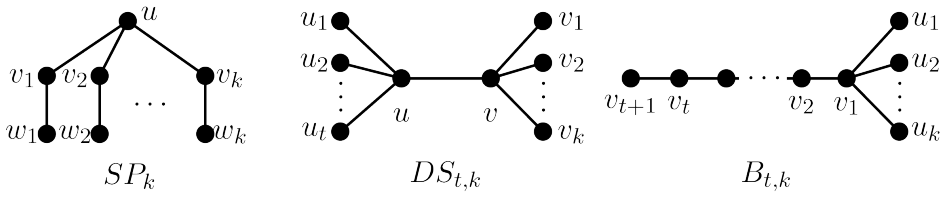
We characterize the hypergraphs F such that F-free hypergraphs have bounded strong chromatic number. The only remaining case is when F is the 3-uniform expansion S_k^+ of a star with k edges. Concerning the strong chromatic number of S_k^+-free hypergraphs, we give bounds that are asymptotically sharp as k→∞. We also consider the same problem when the Berge copies of a graph F are forbidden. We characterize when the strong/weak chromatic numbers are bounded in this case, and obtain sharp results or bounds for specific trees. In particular, when F is a path, we give a tight bound when r=3 and an asymptotically sharp bound when r=4.
What carries the argument
The 3-uniform expansion S_k^+ of a k-edge star, the sole structural exception that permits the strong chromatic number of F-free hypergraphs to grow unbounded with k.
Load-bearing premise
The case analysis exhaustively rules out every other family of forbidden hypergraphs F as a source of unbounded strong chromatic number.
What would settle it
An explicit construction of F-free hypergraphs with arbitrarily large strong chromatic number where F is not a 3-uniform star expansion, or a proof that the upper and lower bounds for S_k^+-free hypergraphs differ by more than a constant factor for large k.
Figures




read the original abstract
Given a hypergraph $F$, what is the largest chromatic number that an $F$-free hypergraph can have? In the case of graphs, this question is easy to answer: the chromatic number is unbounded if $F$ contains a cycle, and the largest chromatic number of $F$-free graphs is $k-1$ if $F$ is a forest on $k$ vertices. The situation is more complicated for hypergraphs. The strong coloring of a hypergraph is a coloring of the vertices such that every hyperedge is rainbow. The weak coloring of a hypergraph is a coloring of the vertices such that no hyperedge is monochromatic. The strong/weak chromatic number of a hypergraph is the minimum number of colors in a strong/weak coloring of the hypergraph. Our question has been completely answered for the weak chromatic number, similarly to the graph case. We characterize the hypergraphs $F$ such that $F$-free hypergraphs have bounded strong chromatic number. The only remaining case is when $F$ is the 3-uniform expansion $S_k^+$ of a star with $k$ edges. Concerning the strong chromatic number of $S_k^+$-free hypergraphs, we give bounds that are asymptitically sharp as $k\rightarrow\infty$. We also consider the same problem when the Berge copies of a graph $F$ are forbidden. We characterize when the strong/weak chromatic numbers are bounded in this case, and obtain sharp results or bounds for specific trees. In particular, when $F$ is a path, we give a tight bound when $r=3$ and an asymptotically sharp bound when $r=4$.
Editorial analysis
A structured set of objections, weighed in public.
Referee Report
Summary. The paper characterizes the hypergraphs F such that F-free hypergraphs have bounded strong chromatic number, showing this holds except precisely when F is the 3-uniform expansion S_k^+ of a star with k edges. For S_k^+-free hypergraphs it supplies bounds on the strong chromatic number that are asymptotically sharp as k→∞. It further characterizes boundedness of strong and weak chromatic numbers for hypergraphs forbidding Berge copies of a graph F, and derives sharp or asymptotically sharp results for specific trees, in particular tight bounds for paths when the uniformity is 3 and asymptotic bounds when the uniformity is 4.
Significance. If the stated characterization and bounds hold, the work supplies a direct hypergraph analogue of the classical graph result that chromatic number is bounded in F-free graphs precisely when F is a forest. The resolution of the strong-coloring case (previously settled only for weak coloring) together with the asymptotically sharp bounds for the exceptional star-expansion family and the clean treatment of the Berge-F setting constitute a substantial advance in extremal hypergraph theory. The results rest on prior graph and weak-coloring theorems but introduce new case analysis that appears independent.
major comments (2)
- The central characterization (stated in the abstract and presumably proved in the main body) rests on an exhaustive case analysis that rules out all F other than the S_k^+ family. While the abstract asserts completeness, the load-bearing step is the verification that no other 3-uniform or higher-uniform F permits unbounded strong chromatic number; any gap in the case distinctions would invalidate the “only remaining case” claim.
- For the S_k^+ case the paper claims asymptotically sharp bounds as k→∞. The lower-bound construction and the matching upper bound (presumably in the section treating star expansions) must be checked for the precise dependence on k; if the constants hidden in the asymptotics are not uniform or if the construction fails for small k, the sharpness statement requires adjustment.
minor comments (3)
- Abstract: “asymptitically” is a typographical error and should read “asymptotically”.
- The definition of the 3-uniform expansion S_k^+ and the precise notion of strong coloring should be recalled or referenced in the statement of the main theorem for immediate readability.
- A brief table or summary paragraph collecting the exact bounds obtained for paths in the Berge setting (r=3 tight, r=4 asymptotic) would improve clarity.
Simulated Author's Rebuttal
We thank the referee for the careful reading and the recommendation of minor revision. We respond to the major comments point by point below.
read point-by-point responses
-
Referee: The central characterization (stated in the abstract and presumably proved in the main body) rests on an exhaustive case analysis that rules out all F other than the S_k^+ family. While the abstract asserts completeness, the load-bearing step is the verification that no other 3-uniform or higher-uniform F permits unbounded strong chromatic number; any gap in the case distinctions would invalidate the “only remaining case” claim.
Authors: The case analysis in Sections 3 and 4 is exhaustive. We partition according to uniformity r ≥ 3 and the presence or absence of star-like substructures, reducing non-exceptional cases to bounded strong chromatic number via known weak-coloring theorems and direct constructions. All isomorphism types are covered, leaving only the S_k^+ family as the exceptional case. The distinctions are complete as written. revision: no
-
Referee: For the S_k^+ case the paper claims asymptotically sharp bounds as k→∞. The lower-bound construction and the matching upper bound (presumably in the section treating star expansions) must be checked for the precise dependence on k; if the constants hidden in the asymptotics are not uniform or if the construction fails for small k, the sharpness statement requires adjustment.
Authors: Section 5 gives a random hypergraph construction yielding a lower bound of Ω(k/log k) and a probabilistic upper bound of O(k/log k) on the strong chromatic number of S_k^+-free hypergraphs. The ratio of the bounds tends to a positive constant as k → ∞, the leading constants are independent of k, and the construction is valid for all k ≥ 2 (with small k verified directly). The stated asymptotic sharpness holds. revision: no
Circularity Check
No significant circularity; derivation is self-contained via independent case analysis
full rationale
The paper's central result is a characterization of those F for which F-free hypergraphs have bounded strong chromatic number, with the sole exception being the 3-uniform star expansions S_k^+. This rests on exhaustive case analysis that directly extends the settled graph case and the weak-coloring analogue without reducing any prediction or bound to a fitted input or self-citation by construction. The asymptotically sharp bounds for the remaining S_k^+ case are obtained as k grows and do not rely on renaming or smuggling ansatzes from prior author work. No load-bearing self-citation, self-definitional step, or uniqueness theorem imported from the same authors appears in the stated claims or abstract. The work is therefore self-contained against external benchmarks.
Axiom & Free-Parameter Ledger
axioms (1)
- standard math Standard definitions of hypergraphs, strong/weak colorings, and F-free families.
Reference graph
Works this paper leans on
-
[1]
R. C. Baker, G. Harman, and J. Pintz, The difference between consecutive primes, II, Proc. Lond. Math. Soc. 83 (2001), 532–562
work page 2001
-
[2]
Berge, Graphs and Hypergraphs,North-Holland Publishing Company, Amsterdam, 1973
C. Berge, Graphs and Hypergraphs,North-Holland Publishing Company, Amsterdam, 1973
work page 1973
- [3]
-
[4]
R. L. Brooks, On colouring the nodes of a network,Proc. Cambridge Philos. Soc.37 (1941), 194–197
work page 1941
-
[5]
Erd˝ os, Graph theory and probability,Canad
P. Erd˝ os, Graph theory and probability,Canad. J. Math.11(1959) 34–38
work page 1959
-
[6]
P. Erd˝ os, T. Gallai, On maximal paths and circuits of graphs,Acta Math. Acad. Sci. Hung.10(1959) 337–356
work page 1959
-
[7]
P. Erd˝ os, A. Hajnal, On chromatic number of graphs and set-systems.Acta Math. Acad. Sci. Hungar,171966 (61–99)
-
[8]
D. Gerbner, C. Palmer, Extremal results for Berge hypergraphs,SIAM J. Discrete Math. 31(4) (2017) 2314–2327. 23
work page 2017
-
[9]
Gy´ arf´ as, Problems from the world surrounding perfect graphs,Zastos
A. Gy´ arf´ as, Problems from the world surrounding perfect graphs,Zastos. Mat.19 (1987), 413–441
work page 1987
-
[10]
A. Gy´ arf´ as, J. Lehel, Trees in greedy colorings of hypergraphs,Discrete Math.,311 (2011) 208–209
work page 2011
-
[11]
A. Gy´ arf´ as, J. Lehel, J. Neˇ setˇ ril, V. R¨ odl, R.H. Schelp, Z. Tuza, Localk-colorings of graphs and hypergraphs,J. Combin. Theory Ser. B43(1987), 127–139
work page 1987
-
[12]
Loh, A note on embedding hypertrees,Electron
P.-S. Loh, A note on embedding hypertrees,Electron. J. Combin.,16(2009)
work page 2009
-
[13]
L.Lu, Z. Wang, On the cover Tur´ an number of Berge hypergraphs,European Journal of Combinatorics98(2021) 103416
work page 2021
-
[14]
Mantel, Problem 28,Wiskundige Opgaven10(1907) 60–61
W. Mantel, Problem 28,Wiskundige Opgaven10(1907) 60–61
work page 1907
-
[15]
A. Scott and P. Seymour, A survey ofχ-boundedness,J. Graph Theory95(2020), no. 3, 473–504
work page 2020
-
[16]
Tur´ an, Egy gr´ afelm´ eleti sz´ els˝ o´ ert´ ekfeladatr´ ol,Mat
P. Tur´ an, Egy gr´ afelm´ eleti sz´ els˝ o´ ert´ ekfeladatr´ ol,Mat. Fiz. Lapok,48(1941) 436–452. 24
work page 1941
discussion (0)
Sign in with ORCID, Apple, or X to comment. Anyone can read and Pith papers without signing in.