Resilience Revisited: A Multidimensional Framework Derived from Realistic Attack Scenarios
Pith reviewed 2026-05-09 21:02 UTC · model grok-4.3
The pith
A multidimensional index shows coordinated attacks degrade power systems 5.6 times more than linear sums predict due to cross-dimensional couplings.
A machine-rendered reading of the paper's core claim, the machinery that carries it, and where it could break.
Core claim
The Multidimensional Resilience Index decomposes power-system degradation across five interacting dimensions and applies a calibrated multiplicative interaction term to isolate endogenous coupling; when applied to the IEEE 39-bus system under two attack scenarios derived from the December 2025 Polish energy cyberattack, the index shows multi-vector attacks produce degradation 5.6 times greater than linear expectations, with simultaneous dimensional failures contributing an additional 60.6 percent through endogenous coupling and exogenous factors amplifying degradation by a further 84 percent.
What carries the argument
The Multidimensional Resilience Index (MDRI), which decomposes total degradation into independent dimensional contributions plus a calibrated multiplicative interaction term that captures endogenous cross-dimensional couplings.
Load-bearing premise
The five chosen dimensions together with the calibrated multiplicative interaction term correctly represent the real-world couplings that occur between physical, operational, cyber, climatic, and regulatory factors during attacks.
What would settle it
Direct measurement of degradation during a multi-vector attack on a power system (or on a larger-scale model) that shows the excess over linear summation is substantially smaller or larger than the reported 5.6 factor would falsify the central quantitative claim.
Figures
read the original abstract
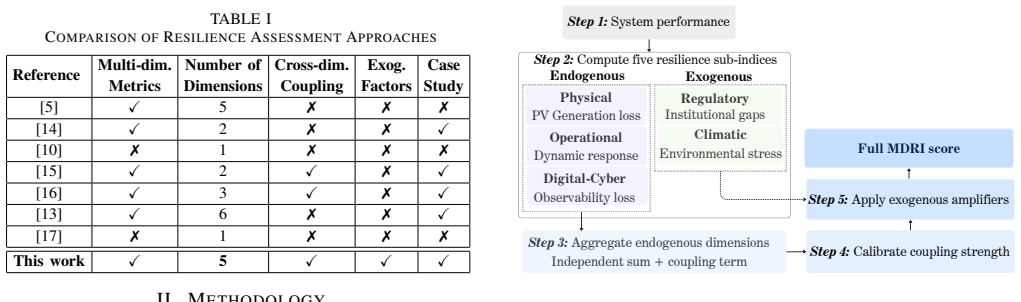
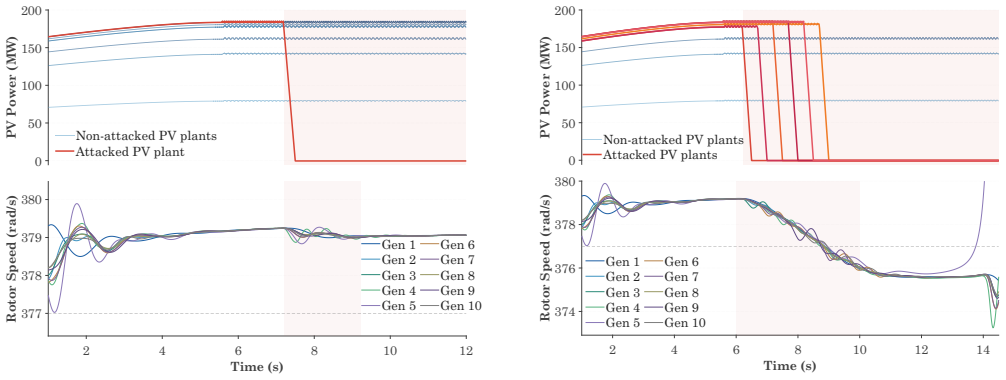
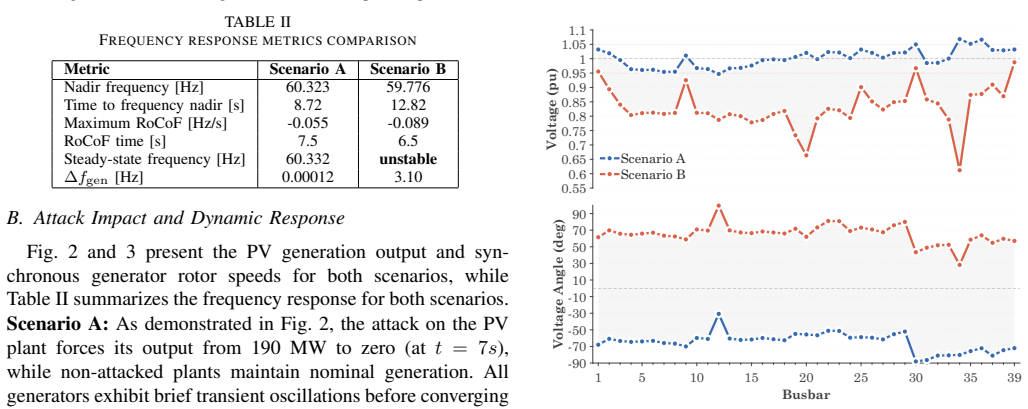
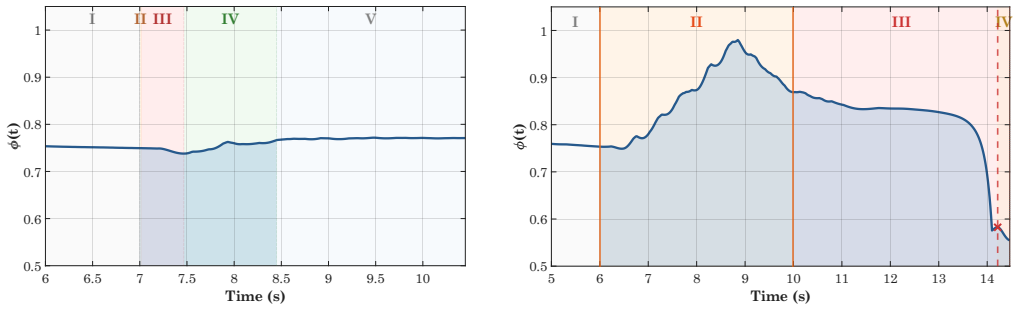
Power systems are increasingly vulnerable to high-impact, low-probability (HILP) events, including coordinated cyberattacks targeting inverter-based resources. Existing resilience frameworks rely on single-dimensional metrics that fail to capture cross-dimensional coupling effects, underestimating real system degradation under multi-vector attack conditions. This study proposes a Multidimensional Resilience Index (MDRI) that decomposes power system degradation into five interacting dimensions: physical, operational, digital-cyber, climatic, and regulatory, explicitly separating independent and coupled contributions via a calibrated multiplicative interaction term. The framework is validated on the IEEE 39-bus system under two attack scenarios derived from the December 2025 cyberattack on the Polish energy infrastructure. MDRI results show that multi-vector attacks produce degradation exceeding linear expectations by a factor of 5.6, with simultaneous dimensional failures contributing an additional 60.6% through endogenous coupling, and exogenous factors amplifying it by an additional 84%.
Editorial analysis
A structured set of objections, weighed in public.
Referee Report
Summary. The manuscript proposes a Multidimensional Resilience Index (MDRI) to address limitations of single-dimensional metrics in power system resilience assessment for high-impact low-probability events such as coordinated cyberattacks on inverter-based resources. It decomposes system degradation into five interacting dimensions (physical, operational, digital-cyber, climatic, and regulatory) and introduces a calibrated multiplicative interaction term to separate independent effects from endogenous coupling and exogenous amplification. The framework is validated using the IEEE 39-bus test system under two attack scenarios derived from the December 2025 Polish energy infrastructure cyberattack, with reported results that multi-vector attacks produce degradation exceeding linear expectations by a factor of 5.6, endogenous coupling contributing an additional 60.6%, and exogenous factors amplifying by an additional 84%.
Significance. If the calibrated multiplicative interaction term can be shown to correctly encode real cross-dimensional couplings rather than being an artifact of the chosen testbed, the MDRI would offer a useful extension beyond linear superposition assumptions in resilience analysis, particularly for multi-vector threats. The grounding of scenarios in a specific historical event is a constructive element that improves relevance over purely synthetic cases. However, the quantitative claims rest on a single free parameter whose validity is assessed only within one system and two scenarios, limiting the strength of the superiority argument over existing metrics.
major comments (2)
- [Abstract] Abstract: the numerical claims (degradation factor of 5.6, 60.6% endogenous contribution, 84% exogenous amplification) are presented without derivation details, error bars, or full validation methods; the 'calibrated' multiplicative interaction term and specific factors lack supporting equations or data transparency, directly undermining assessment of the central decomposition result.
- [Validation] Validation description: the framework is tested only on the IEEE 39-bus system with two scenarios derived from one historical event, with no reported cross-validation on other test systems, sensitivity analysis on the calibration parameter, or independent verification that the multiplicative term captures genuine couplings rather than fitting artifacts of the chosen cases.
minor comments (2)
- [Framework] The five dimensions are introduced but the manuscript would benefit from explicit definitions or equations showing how each dimension is quantified individually before the interaction term is applied.
- Consider adding a table or figure that isolates the linear baseline degradation versus the coupled contributions for each scenario to improve readability of the 5.6 factor claim.
Simulated Author's Rebuttal
Thank you for the opportunity to respond to the referee's report. We address the major comments point by point below, proposing revisions where appropriate to enhance the clarity and robustness of our work.
read point-by-point responses
-
Referee: [Abstract] Abstract: the numerical claims (degradation factor of 5.6, 60.6% endogenous contribution, 84% exogenous amplification) are presented without derivation details, error bars, or full validation methods; the 'calibrated' multiplicative interaction term and specific factors lack supporting equations or data transparency, directly undermining assessment of the central decomposition result.
Authors: We agree that the abstract, due to its brevity, does not include full derivation details or equations. These are provided in the main text, specifically in Sections 3 and 4, where the MDRI formulation, the calibrated multiplicative interaction term, and the decomposition into independent, endogenous, and exogenous components are derived and applied to the scenarios. To address this, we will revise the abstract to briefly indicate the validation method and direct readers to the relevant sections for methodological details. Additionally, we will ensure error bars are included in the results figures and tables in the revised manuscript. The calibration of the interaction term is based on the attack scenarios derived from the historical event, with transparency in the parameter selection process described in Section 3.2. revision: partial
-
Referee: [Validation] Validation description: the framework is tested only on the IEEE 39-bus system with two scenarios derived from one historical event, with no reported cross-validation on other test systems, sensitivity analysis on the calibration parameter, or independent verification that the multiplicative term captures genuine couplings rather than fitting artifacts of the chosen cases.
Authors: The choice of the IEEE 39-bus system and scenarios grounded in the December 2025 Polish cyberattack was intentional to provide realistic, high-impact low-probability event modeling rather than purely synthetic cases. We acknowledge the limitation of not performing cross-validation on additional systems. In the revised version, we will add a sensitivity analysis varying the calibration parameter across a range to assess its impact on the reported factors (5.6, 60.6%, 84%). We will also include a discussion on why the multiplicative term reflects physical couplings (e.g., cyber-physical interactions in inverter-based resources) rather than artifacts, supported by the scenario construction. Full cross-validation on other testbeds is planned for future extensions but is not included in this study due to scope. revision: partial
Circularity Check
Degradation factors (5.6x excess, 60.6% endogenous, 84% exogenous) computed from calibrated multiplicative interaction term on IEEE 39-bus scenarios
specific steps
-
fitted input called prediction
[Abstract]
"This study proposes a Multidimensional Resilience Index (MDRI) that decomposes power system degradation into five interacting dimensions: physical, operational, digital-cyber, climatic, and regulatory, explicitly separating independent and coupled contributions via a calibrated multiplicative interaction term. ... MDRI results show that multi-vector attacks produce degradation exceeding linear expectations by a factor of 5.6, with simultaneous dimensional failures contributing an additional 60.6% through endogenous coupling, and exogenous factors amplifying it by an additional 84%."
The multiplicative interaction term is calibrated (i.e., fitted) to the chosen IEEE 39-bus scenarios derived from the Polish cyberattack; the reported 5.6x, 60.6%, and 84% factors are then produced by direct application of this fitted term to the same scenarios, so the numerical claims are statistically forced outputs of the calibration rather than independent predictions or first-principles derivations.
full rationale
The MDRI framework introduces a five-dimensional decomposition and a multiplicative interaction term to capture couplings. However, the term is explicitly calibrated to the two attack scenarios on the IEEE 39-bus testbed, and the headline numerical results are obtained by applying that same term to the identical scenarios. This reduces the central quantitative claims to in-sample outputs of the fitting process (fitted_input_called_prediction). The framework itself contains independent structural content, so the circularity is partial rather than total; no self-citation chain or self-definitional loop is evident from the provided text.
Axiom & Free-Parameter Ledger
free parameters (1)
- multiplicative interaction term
axioms (1)
- domain assumption The five dimensions (physical, operational, digital-cyber, climatic, regulatory) capture all relevant resilience aspects and their interactions
invented entities (1)
-
MDRI
no independent evidence
Forward citations
Cited by 1 Pith paper
-
Multidimensional Resilience for Electrical Power Systems: Systematic Review, Integrated Index, and Validation under Real-World Cyber-Physical Attack Scenarios
A new Multidimensional Resilience Index shows that simultaneous failures across physical, cyber, and exogenous dimensions produce 46-fold greater resilience loss in power systems than isolated stress.
Reference graph
Works this paper leans on
-
[1]
C. Wanget al., “A systematic review on power system resilience from the perspective of generation, network, and load,”Renewable and Sustainable Energy Reviews, 2022
work page 2022
-
[2]
Modeling of power system resilience during a catastrophic disaster and application of the model,
T.-H. Yoo and H. Park, “Modeling of power system resilience during a catastrophic disaster and application of the model,”IEEE Access, vol. 12, pp. 81 550–81 566, 2024
work page 2024
-
[3]
Cybersecurity and Infrastructure Security Agency, “Iranian-affiliated cyber actors exploit programmable logic controllers across US critical infrastructure,” Cybersecurity Advisory AA26-097A, 2026, available: https://www.cisa.gov/news-events/cybersecurity-advisories/aa26-097a
work page 2026
-
[4]
Y . Sunet al., “Scenario construction and vulnerability assessment of natural hazards-triggered power grid accidents,”Journal of Safety Science and Resilience, 2024
work page 2024
-
[5]
Resilience a means to development: A resilience assessment framework and a catalogue of indicators,
F. Mujjuniet al., “Resilience a means to development: A resilience assessment framework and a catalogue of indicators,”Renewable and Sustainable Energy Reviews, 2021
work page 2021
-
[6]
Resilience indices for power/cyberphysical systems,
S. Talukder, M. Ibrahim, and R. Kumar, “Resilience indices for power/cyberphysical systems,”IEEE Trans. on Systems, Man, and Cybernetics: Systems, vol. 51, pp. 2159–2172, 2021
work page 2021
-
[7]
Power system resilience evaluation framework and metric review,
Y . Yao, W. Liu, and R. Jain, “Power system resilience evaluation framework and metric review,”2022 IEEE Power & Energy Society Innovative Smart Grid Technologies Conference (ISGT), pp. 1–5, 2022
work page 2022
-
[8]
Event-triggered islanding in inverter-based grids,
I. Zografopoulos and C. Konstantinou, “Event-triggered islanding in inverter-based grids,”Electric Power Systems Research, vol. 243, 2025
work page 2025
-
[9]
G. V . Iswaran, R. Vakili, and M. Khorsand, “Power system resiliency against windstorms: A systematic framework based on dynamic and steady-state analysis,”2022 North American Power Symposium, 2022
work page 2022
-
[10]
Methods for analysis and quantification of power system resilience,
A. Stankovi ´cet al., “Methods for analysis and quantification of power system resilience,”IEEE Trans. on Power Systems, vol. 38, pp. 4774– 4787, 2023
work page 2023
-
[11]
Time series-based detection and impact analysis of firmware attacks in micro- grids,
I. Zografopoulos, A. P. Kuruvila, K. Basu, and C. Konstantinou, “Time series-based detection and impact analysis of firmware attacks in micro- grids,”Energy Reports, vol. 8, pp. 11 221–11 234, 2022
work page 2022
-
[12]
Q. Sunet al., “Resilience assessment for integrated energy system considering gas-thermal inertia and system interdependency,”IEEE Trans. on Smart Grid, vol. 15, no. 2, pp. 1509–1524, 2024
work page 2024
-
[13]
M. R. Kelly-Gorhamet al., “Ranking the impact of interdependencies on power system resilience using stratified sampling of utility data,”IEEE Trans. on Power Systems, vol. 39, pp. 1251–1262, 2024
work page 2024
-
[14]
F. Wanget al., “A multi-stage resilience analysis framework of criti- cal infrastructure systems based on component importance measures,” Reliab. Eng. Syst. Saf., vol. 256, p. 110720, 2024
work page 2024
-
[15]
Resilience assessment and improvement for cyber-physical power systems under typhoon disasters,
B. Ti, G. Li, M. Zhou, and J. Wang, “Resilience assessment and improvement for cyber-physical power systems under typhoon disasters,” IEEE Trans. on Smart Grid, vol. 13, pp. 783–794, 2022
work page 2022
-
[16]
Models, metrics, and their formulas for typical electric power system resilience events,
I. Dobson, “Models, metrics, and their formulas for typical electric power system resilience events,”IEEE Trans. on Power Systems, vol. 38, pp. 5949–5952, 2023
work page 2023
-
[17]
Power systems’ resilience: A comprehensive literature review,
J. N. Chivunga, Z. Lin, and R. Blanchard, “Power systems’ resilience: A comprehensive literature review,”Energies, 2023
work page 2023
-
[18]
ENTSO-E, “Project inertia – phase II: Updated frequency stability anal- ysis in long-term scenarios, relevant solutions and mitigation measures,” ENTSO-E, Brussels, Belgium, First Report, Nov. 2023
work page 2023
-
[19]
Energy sector incident report – 29 december 2025,
CERT Polska, “Energy sector incident report – 29 december 2025,” NASK – National Research Institute, Tech. Rep., 2026, available: https: //cert.pl/en/posts/2026/01/incident-report-energy-sector-2025/
work page 2025
-
[20]
ELECTRUM: Cyber attack on Poland’s electric system 2025,
Dragos, Inc., “ELECTRUM: Cyber attack on Poland’s electric system 2025,” Tech. Rep., 2026, available: https://tinyurl.com/5xj7vahn
work page 2025
-
[21]
Sandworm Behind Cyberattack on Poland’s Power Grid in Late 2025,
ESET Research, “Sandworm Behind Cyberattack on Poland’s Power Grid in Late 2025,” 2026, available: https://tinyurl.com/22dyw6yr
work page 2025
-
[22]
Polish grid systems targeted in cyberattack had little security, per new report,
K. Zetter, “Polish grid systems targeted in cyberattack had little security, per new report,” Zero Day, 2026, available: https://tinyurl.com/fkas2dt3
work page 2026
-
[23]
A composite metric for evaluating system resilience with non-idealistic performance curves,
M. Yeligetiet al., “A composite metric for evaluating system resilience with non-idealistic performance curves,”PLOS One, vol. 20, 2025
work page 2025
-
[24]
Resilience assessment framework for high-penetration renewable energy power system,
D. Zhouet al., “Resilience assessment framework for high-penetration renewable energy power system,”Sustainability, 2025
work page 2025
-
[25]
R. Heet al., “Reliability assessment of cyber-physical distribution system using multi-dimensional information network model,”IEEE Trans on Smart Grid, vol. 14, no. 6, pp. 4683–4692, 2023
work page 2023
-
[26]
Y . Zhuet al., “Scaling graph neural networks for large-scale power systems analysis: Empirical laws for emergent abilities,”IEEE Trans. on Power Systems, vol. 39, pp. 7445–7448, 2024
work page 2024
discussion (0)
Sign in with ORCID, Apple, or X to comment. Anyone can read and Pith papers without signing in.