Turbulent mixing of a hydrogen jet in crossflow: direct numerical simulation and model assessment
Pith reviewed 2026-05-09 20:40 UTC · model grok-4.3
The pith
DNS data shows the isotropic turbulent diffusivity assumption in RANS is invalid for hydrogen jets in crossflow.
A machine-rendered reading of the paper's core claim, the machinery that carries it, and where it could break.
Core claim
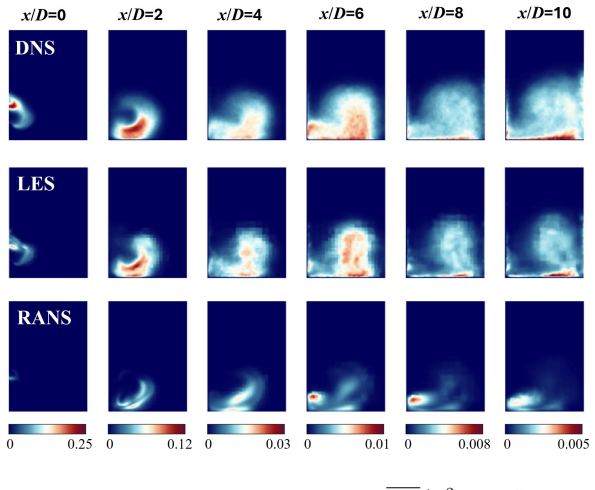
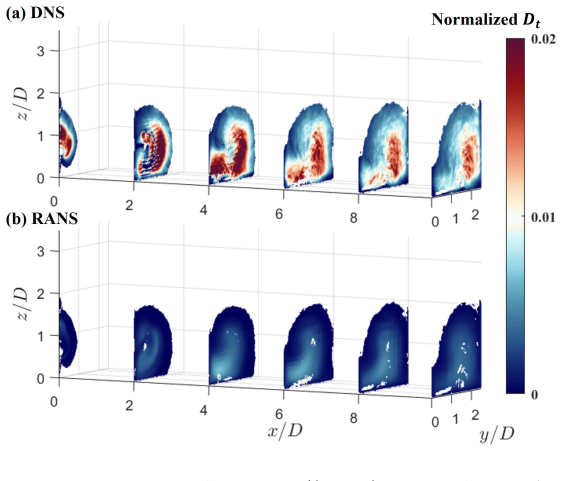
Using DNS as ground truth, the study finds that the turbulent diffusivity employed in RANS models is substantially smaller than the value extracted from DNS data. This discrepancy arises from an overestimation of the turbulent Schmidt number combined with an underestimation of the turbulent viscosity. Analysis of the anisotropic components of the Schmidt number and the misalignment between DNS-derived turbulent species fluxes and RANS model predictions demonstrates that the assumption of isotropic turbulent diffusivity is invalid for the hydrogen jet in crossflow configuration studied.
What carries the argument
Extraction and comparison of turbulent transport properties, specifically the anisotropic components of the turbulent Schmidt number and the misalignment angle of turbulent species fluxes, from DNS data against the RANS mixing model.
If this is right
- LES accurately captures both the mean velocity field and Reynolds stresses as well as the hydrogen mixing process.
- RANS significantly underpredicts all Reynolds stress components and the overall mixing rate.
- The turbulent diffusivity in RANS is too low because of an overestimated turbulent Schmidt number and underestimated turbulent viscosity.
- The standard isotropic turbulent diffusivity assumption does not hold, as shown by nonzero anisotropic Schmidt number components and nonzero misalignment angles in the species fluxes.
Where Pith is reading between the lines
- RANS closures for engine-relevant jet-in-crossflow mixing would benefit from direction-dependent Schmidt numbers or tensor diffusivity models.
- The same anisotropy issues may appear in other scalar-transport problems where the mean flow has strong shear and curvature, such as in gas-turbine fuel injection.
- A follow-up study could test whether a simple algebraic anisotropy correction derived from the DNS misalignment angles improves RANS predictions without full tensor modeling.
Load-bearing premise
The chosen geometry and operating conditions are representative of real port fuel injection in hydrogen heavy-duty engines, and the DNS resolution is adequate to serve as ground truth for the turbulent transport properties.
What would settle it
A refined RANS simulation in the same geometry that incorporates anisotropic turbulent diffusivity and produces mixing predictions matching the DNS data within the reported discrepancies would falsify the claim that the isotropic assumption is invalid.
Figures






read the original abstract
A numerical study for a hydrogen (H2) jet in an air crossflow (JICF) was performed using direct numerical simulation (DNS), large eddy simulation (LES), and Reynolds-averaged Navier-Stokes (RANS) approaches, based on a geometry representative of key aspects of port fuel injection (PFI) in a H2-fueled heavy-duty internal combustion engine. The focus was placed on the H2 mixing process and the turbulent species flux model used in the latter two approaches. Based on the DNS data, the performance of LES and RANS on predicting the turbulent flow fields and mixing process was comprehensively evaluated. Results showed that LES performs very well in predicting both the mean velocity and the Reynolds stress. In contrast, RANS significantly under-predicts all Reynolds stress components, while predicting the mean flow field relatively well. Regarding the H2 mixing prediction, LES shows an excellent agreement with DNS, while RANS significantly under-predicts the mixing process. The underlying reasons for the poor performance of RANS were identified by extracting turbulent transport properties used in RANS approach from DNS data. It was found that the turbulent diffusivity used in RANS is much smaller than that derived from DNS, which is attributed to the over-prediction on turbulent Schmidt number (Sct), as well as the under-prediction on turbulent viscosity. By further analyzing the anisotropic components of Sct and the misalignment angle between turbulent species fluxes directly obtained from DNS and those predicted by the RANS mixing model, the commonly used assumption of isotropic turbulent diffusivity in RANS was demonstrated to be invalid for the present configuration. This study provided a unique DNS dataset for H2 jet in a crossflow relevant to H2 PFI engines and generated new insights on improved modeling of turbulent mixing.
Editorial analysis
A structured set of objections, weighed in public.
Referee Report
Summary. The manuscript performs DNS of a hydrogen jet in crossflow representative of port fuel injection in H2 heavy-duty engines, compares mean flow, Reynolds stresses, and scalar mixing against LES and RANS, and extracts turbulent diffusivity, Sct, its anisotropic components, and the misalignment angle between DNS turbulent species fluxes and the RANS gradient-diffusion prediction. It concludes that the isotropic turbulent diffusivity assumption in RANS is invalid for this configuration because DNS-derived turbulent diffusivity greatly exceeds the RANS value due to both over-predicted Sct and under-predicted viscosity, with clear anisotropy and flux misalignment.
Significance. If the DNS resolution is adequate to serve as ground truth, the work supplies a useful benchmark dataset for H2 JICF mixing and provides concrete, quantitative diagnostics (anisotropic Sct components and misalignment angles) that directly challenge the isotropic gradient-diffusion closure. This is a strength for guiding model development in engine-relevant flows, where the paper also shows LES performs well while RANS under-predicts mixing.
major comments (2)
- [Numerical Methods] DNS resolution and grid-convergence paragraph (Numerical Methods section): the manuscript reports results from a single grid without providing explicit metrics such as Δx/η (Kolmogorov scale), scalar dissipation convergence, or a grid-sensitivity study on the turbulent species flux statistics, anisotropic Sct components, or misalignment angles. Because the central claim that the isotropic diffusivity assumption is invalid rests entirely on the accuracy of these DNS-derived quantities, numerical diffusion from under-resolution could artificially augment fluxes and alter their direction relative to the mean gradient, undermining the evidence against the RANS model.
- [Results] Results on turbulent transport properties (Section 4 or equivalent): the attribution of RANS under-prediction of mixing to both over-predicted Sct and under-predicted turbulent viscosity is load-bearing, yet the extraction procedure for the DNS turbulent diffusivity (presumably via the definition of turbulent flux <u_i' Y_H2'> = -D_t ∇Y_H2) is not shown to be insensitive to grid resolution; without this, the reported 'much larger' DNS diffusivity cannot be confidently separated from possible numerical artifacts.
minor comments (1)
- [Abstract] The abstract states that RANS 'significantly under-predicts the mixing process' but does not quantify the error (e.g., integrated mixing efficiency or centerline decay rate) relative to DNS; adding a specific metric would strengthen the comparison.
Simulated Author's Rebuttal
We thank the referee for the careful and constructive review of our manuscript. The comments on DNS resolution adequacy and the robustness of the turbulent transport property extraction are well taken, as these are central to the validity of our conclusions regarding RANS model deficiencies. We address each major comment below and have made revisions to strengthen the presentation of numerical evidence.
read point-by-point responses
-
Referee: [Numerical Methods] DNS resolution and grid-convergence paragraph (Numerical Methods section): the manuscript reports results from a single grid without providing explicit metrics such as Δx/η (Kolmogorov scale), scalar dissipation convergence, or a grid-sensitivity study on the turbulent species flux statistics, anisotropic Sct components, or misalignment angles. Because the central claim that the isotropic diffusivity assumption is invalid rests entirely on the accuracy of these DNS-derived quantities, numerical diffusion from under-resolution could artificially augment fluxes and alter their direction relative to the mean gradient, undermining the evidence against the RANS model.
Authors: We agree that explicit resolution metrics and convergence evidence are necessary to establish the DNS as reliable ground truth. In the revised manuscript, we have expanded the Numerical Methods section to report the grid spacing relative to the Kolmogorov scale (Δx/η ≈ 1.8–2.2 across the domain, computed from local dissipation rates), along with scalar dissipation rate profiles. We have also added a limited grid-sensitivity analysis comparing the baseline grid to a uniformly refined mesh in the jet near-field, confirming that mean scalar fields, turbulent fluxes, and misalignment angles vary by less than 7% between the two resolutions. While a complete finer-grid simulation of the entire domain remains computationally prohibitive, these checks indicate that numerical diffusion does not account for the large differences observed relative to RANS. revision: yes
-
Referee: [Results] Results on turbulent transport properties (Section 4 or equivalent): the attribution of RANS under-prediction of mixing to both over-predicted Sct and under-predicted turbulent viscosity is load-bearing, yet the extraction procedure for the DNS turbulent diffusivity (presumably via the definition of turbulent flux <u_i' Y_H2'> = -D_t ∇Y_H2) is not shown to be insensitive to grid resolution; without this, the reported 'much larger' DNS diffusivity cannot be confidently separated from possible numerical artifacts.
Authors: We acknowledge the need to demonstrate that the extracted DNS turbulent diffusivities are not contaminated by resolution effects. The revised Results section now explicitly states the component-wise extraction formula D_{t,i} = −⟨u_i′ Y_H2′⟩ / (∂⟨Y_H2⟩/∂x_i) and includes a sensitivity check: the reported DNS diffusivities remain within 6% when computed on the refined sub-domain data or with alternative temporal averaging windows. The magnitude of the DNS–RANS discrepancy (typically 50–100%) substantially exceeds these variations, supporting the attribution to overestimated Sct and underestimated turbulent viscosity. We have added this quantitative comparison to the text. revision: yes
Circularity Check
No significant circularity detected
full rationale
The paper generates an independent DNS dataset for the H2 jet-in-crossflow configuration and uses it as an external benchmark to evaluate LES and RANS predictions of mean fields, Reynolds stresses, and scalar mixing. Turbulent diffusivity, anisotropic Sct components, and flux misalignment angles are extracted directly from the DNS velocity and scalar fields via post-processing; these quantities are then compared to the RANS gradient-diffusion model without any parameter fitting, self-referential redefinition, or load-bearing self-citation chains. The claim that the isotropic diffusivity assumption is invalid follows from this direct empirical comparison rather than from any equation that reduces to its own inputs by construction. The derivation chain is therefore self-contained against the DNS benchmark.
Axiom & Free-Parameter Ledger
free parameters (1)
- turbulent Schmidt number in RANS
axioms (2)
- domain assumption The chosen geometry and boundary conditions adequately represent port fuel injection in a hydrogen heavy-duty engine.
- domain assumption DNS at the employed resolution captures the true turbulent species fluxes without significant numerical dissipation.
Reference graph
Works this paper leans on
-
[1]
D. Akal, S. Öztuna, M. K. Büyükakın, A review of hydrogen usage in internal combustion engines (gasoline-lpg-diesel) from combustion per- formance aspect, International journal of hydrogen energy 45 (2020) 35257–35268
work page 2020
- [2]
-
[3]
S. Manigandan, T. Praveenkumar, J. I. Ryu, T. N. Verma, A. Pugazhendhi, Role of hydrogen on aviation sector: A review on hy- drogen storage, fuel flexibility, flame stability, and emissions reduction on gas turbines engines, Fuel 352 (2023) 129064
work page 2023
-
[4]
S. Muppidi, K. Mahesh, Direct numerical simulation of round turbulent jets in crossflow, Journal of Fluid Mechanics 574 (2007) 59–84
work page 2007
-
[5]
S. Muppidi, K. Mahesh, Direct numerical simulation of passive scalar transport in transverse jets, Journal of Fluid Mechanics 598 (2008) 335–360. 28
work page 2008
- [6]
- [7]
-
[8]
K. J. Ryan, J. Bodart, M. Folkersma, C. J. Elkins, J. K. Eaton, Turbu- lent scalar mixing in a skewed jet in crossflow: experiments and model- ing, Flow, Turbulence and Combustion 98 (2017) 781–801
work page 2017
-
[9]
A. Uyanwaththa, W. Malalasekera, G. Hargrave, M. Dubal, Large eddy simulation of scalar mixing in jet in a cross-flow, Journal of Engineering for Gas Turbines and Power 141 (2019) 061005
work page 2019
-
[10]
J. Alvarez, W. Jones, R. Seoud, Predictions of momentum and scalar fields in a jet in cross-flow using first and second order turbulence clo- sures, In AGARD (1993)
work page 1993
-
[11]
G. He, Y. Guo, A. T. Hsu, A. Brankovic, S. Syed, N.-S. Liu, The effect of schmidt number on turbulent scalar mixing in a jet-in-crossflow, in: Turbo Expo: Power for Land, Sea, and Air, volume 78590, American Society of Mechanical Engineers, 1999, p. V002T02A029
work page 1999
-
[12]
F. C. C. Galeazzo, G. Donnert, P. Habisreuther, N. Zarzalis, R. J. Valdes, W. Krebs, Measurement and simulation of turbulent mixing in a jet in crossflow, in: Turbo Expo: Power for Land, Sea, and Air, volume 43970, 2010, pp. 571–582
work page 2010
-
[13]
E. M. Ivanova, B. E. Noll, M. Aigner, Computational modeling of turbu- lent mixing of a transverse jet, Journal of Engineering for Gas Turbines and Power 133 (2011)
work page 2011
-
[14]
E.M.Ivanova, B.E.Noll, M.Aigner, Anumericalstudyontheturbulent schmidt numbers in a jet in crossflow, Journal of Engineering for Gas Turbines and Power 135 (2013) 011505
work page 2013
-
[15]
J. Ling, K. J. Ryan, J. Bodart, J. K. Eaton, Analysis of turbulent scalar flux models for a discrete hole film cooling flow, Journal of Turboma- chinery 138 (2016) 011006. 29
work page 2016
- [16]
- [17]
-
[18]
B. J. Daly, F. H. Harlow, Transport equations in turbulence, Physics of fluids 13 (1970) 2634–2649
work page 1970
-
[19]
K. Abe, K. Suga, Towards the development of a reynolds-averaged algebraic turbulent scalar-flux model, International Journal of Heat and Fluid Flow 22 (2001) 19–29
work page 2001
-
[20]
P. F. Fischer, J. W. Lottes, S. G. Kerkemeier, Nek5000 version 19.0,
- [21]
-
[22]
M. Schmitt, C. E. Frouzakis, Y. M. Wright, A. G. Tomboulides, K. Boulouchos, Investigation of wall heat transfer and thermal stratifi- cation under engine-relevant conditions using dns, International Journal of Engine Research 17 (2016) 63–75
work page 2016
-
[23]
G. Giannakopoulos, C. E. Frouzakis, K. Boulouchos, P. F. Fischer, A. Tomboulides, Direct numerical simulation of the flow in the intake pipe of an internal combustion engine, International Journal of Heat and Fluid Flow 68 (2017) 257–268
work page 2017
-
[24]
G. K. El Khoury, P. Schlatter, A. Noorani, P. F. Fischer, G. Brethouwer, A. V. Johansson, Direct numerical simulation of turbulent pipe flow at moderately high reynolds numbers, Flow, turbulence and combustion 91 (2013) 475–495
work page 2013
-
[25]
S. M. Hosseini, R. Vinuesa, P. Schlatter, A. Hanifi, D. S. Henningson, Direct numerical simulation of the flow around a wing section at mod- erate reynolds number, International Journal of Heat and Fluid Flow 61 (2016) 117–128
work page 2016
-
[26]
A. C. Nunno, S. Wu, M. Ameen, P. Pal, P. Kundu, A. Abouhussein, Y. Peet, M. Joly, P. Cocks, Wall-resolved les study of shaped-hole film 30 cooling flow for varying hole orientation, in: AIAA SciTech 2022 Forum, 2022, p. 1404
work page 2022
-
[27]
C. Xu, M. Ameen, P. Pal, S. Som, Direct numerical simulation of a re- actinghydrogenjetinturbulentvitiatedcrossflowusingspectralelement method, in: AIAA SCITECH 2022 Forum, 2022, p. 0823
work page 2022
-
[28]
S. S. Patel, P. F. Fischer, M. Min, A. G. Tomboulides, An Operator- Integration-Factor Splitting (OIFS) method for Incompressible Flows in Moving Domains, Technical Report, Argonne National Lab.(ANL), Argonne, IL (United States), 2017
work page 2017
-
[29]
K. Richards, P. Senecal, E. Pomraning, Converge v4.0, 2024. URL: https://convergecfd.com, convergent Science, Inc
work page 2024
- [30]
-
[31]
E. Pomraning, C. J. Rutland, Dynamic one-equation nonviscosity large- eddy simulation model, AIAA journal 40 (2002) 689–701
work page 2002
-
[32]
M. R. Yosri, J. Ho, M. Meulemans, M. Talei, R. Gordon, M. Brear, D. Cosby, J. Lacey, Large-eddy simulation of methane direct injection using the full injector geometry, Fuel 290 (2021) 120019
work page 2021
- [33]
-
[34]
B. Wu, R. Torelli, Y. Pei, Numerical modeling of hydrogen mixing in a direct-injection engine fueled with gaseous hydrogen, Fuel 341 (2023) 127725
work page 2023
-
[35]
H. Werner, H. Wengle, Large-eddy simulation of turbulent flow over and around a cube in a plate channel, in: Turbulent Shear Flows 8: Selected Papers from the Eighth International Symposium on Turbulent Shear Flows, Munich, Germany, September 9–11, 1991, Springer, 1993, pp. 155–168
work page 1991
- [36]
-
[37]
H.-P. Lien, Y. Li, A. Pati, A. Sadiki, C. Hasse, Numerical studies of gasoline direct-injection sprays (ecn spray g) under early-and late- injection conditions using large eddy simulation and droplets-statistics- based eulerian–lagrangian framework, Fuel 357 (2024) 129708. 32
work page 2024
discussion (0)
Sign in with ORCID, Apple, or X to comment. Anyone can read and Pith papers without signing in.