Strong solutions and stability for a thin-film equation of shear-thinning fluids with contact line in partial wetting
Pith reviewed 2026-05-08 10:48 UTC · model grok-4.3
The pith
Strong solutions to the shear-thinning thin-film equation exist as stable perturbations of a linear profile near the contact line.
A machine-rendered reading of the paper's core claim, the machinery that carries it, and where it could break.
Core claim
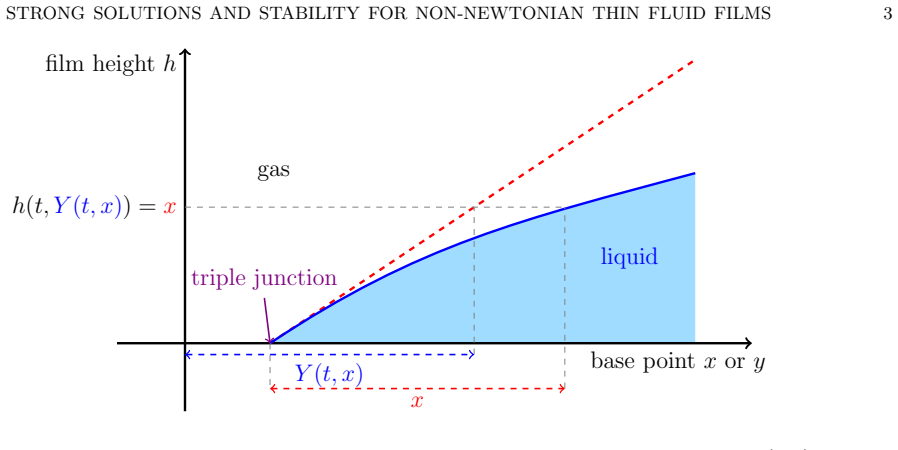
The paper proves existence and asymptotic stability of strong solutions to the thin-film equation that are perturbations of the linear profile. In von-Mises coordinates the leading-order fourth-order equation is treated as a variational problem. A time-discretization scheme produces solutions, and the limit is passed by controlling higher-order nonlinear terms together with compactness arguments while carefully tracking singular terms to obtain control on the contact-line velocity. The analysis also supports shear thinning as an alternative mechanism for resolving the no-slip paradox without introducing slip at the liquid-solid interface.
What carries the argument
Leading-order problem in von-Mises coordinates, a fourth-order evolution equation analogous to the p-Laplacian, solved variationally through time discretization.
If this is right
- Strong solutions exist for perturbations of the linear profile in the contact-line region.
- These solutions are asymptotically stable.
- The contact-line velocity remains controlled through estimates that track singular terms.
- The shear-thinning model provides a mathematically consistent way to handle contact-line motion without slip conditions.
Where Pith is reading between the lines
- The same von-Mises transformation and discretization may apply to other degenerate fourth-order parabolic equations with power-law structure.
- Stability of the linear-profile perturbations indicates that small initial deviations are unlikely to trigger immediate film rupture or blow-up.
- The variational time-discretization could serve as the basis for convergent numerical schemes to compute thin-film flows with shear thinning.
- Physically, the result suggests that strongly shear-thinning fluids can sustain regular contact-line motion under strict no-slip at the substrate.
Load-bearing premise
The higher-order nonlinear terms in the leading-order von-Mises equation can be controlled sufficiently to pass to the limit in the time-discretization scheme while preserving the perturbation structure near the contact line.
What would settle it
A calculation or simulation in which the nonlinear remainder terms cannot be bounded independently of the discretization parameter for some power-law exponent, causing the contact-line velocity bound to fail or the strong solution to cease to exist.
Figures
read the original abstract
We consider a power-law thin-film equation for strongly shear-thinning fluids. Weak solutions to this equation have been constructed more than twenty years ago by Ansini and Giacomelli. Here, we pass over to analyzing strong solutions with nonzero contact angle (partial-wetting regime), and place emphasis on studying the behavior of solutions near points where the film height vanishes (the contact-line region) by considering perturbations of a linear profile. The leading-order equation in von-Mises coordinates shows similarities with the evolution equation for the $p$-Laplace, though being of fourth order. Using a time discretization, we reduce the leading-order problem to finding a variational solution, and pass to the limit in the discretization scheme on suitably estimating higher-order nonlinear terms in conjunction with compactness arguments. This proves existence and asymptotic stability of strong solutions that are perturbations of the linear profile, and yields control on the contact-line velocity on carefully tracking singular terms in our estimates. While we believe that the transformed equation shows mathematical features the analysis of which stands on its own merit, it also physically corroborates shear thinning behavior as an alternative in resolving the no-slip paradox, as opposed to more standard approaches like introducing slip at the liquid-solid interface.
Editorial analysis
A structured set of objections, weighed in public.
Referee Report
Summary. The paper claims to prove the existence and asymptotic stability of strong solutions to the power-law thin-film equation for strongly shear-thinning fluids in the partial wetting regime. These solutions are constructed as perturbations of a linear profile near the contact line by transforming to von-Mises coordinates. The leading-order problem is reduced via time discretization to a variational formulation, and the limit is passed using compactness arguments while controlling higher-order nonlinear terms and tracking singular terms near the contact line. This also provides control on the contact-line velocity.
Significance. If the result holds, it is significant for extending the theory of thin-film equations beyond the known weak solutions by Ansini and Giacomelli to strong solutions with detailed analysis of the contact line. The variational approach to the fourth-order p-Laplacian-like equation and the physical corroboration of shear thinning as an alternative to slip conditions add value. The manuscript provides a direct existence proof using standard tools and compactness, which is a strength.
major comments (1)
- The control of higher-order nonlinear terms in the time-discretization scheme and the precise compactness arguments used to pass to the limit while preserving the perturbation structure are load-bearing for the central existence claim. The abstract indicates these are handled by carefully tracking singular terms, but without the explicit estimates or the details of how the variational solution for the leading-order problem is obtained, it is difficult to confirm that the nonlinear remainders are dominated uniformly.
minor comments (1)
- The abstract mentions 'our estimates' but the manuscript should clarify the notation for the power-law exponent and the von-Mises transformation in the introduction for better readability.
Simulated Author's Rebuttal
We thank the referee for their careful reading of the manuscript and for the positive assessment of its significance. We address the single major comment below and have revised the manuscript accordingly to improve clarity on the technical estimates.
read point-by-point responses
-
Referee: The control of higher-order nonlinear terms in the time-discretization scheme and the precise compactness arguments used to pass to the limit while preserving the perturbation structure are load-bearing for the central existence claim. The abstract indicates these are handled by carefully tracking singular terms, but without the explicit estimates or the details of how the variational solution for the leading-order problem is obtained, it is difficult to confirm that the nonlinear remainders are dominated uniformly.
Authors: We thank the referee for identifying this point as central to the existence result. The variational formulation of the leading-order problem is obtained in Section 2 by transforming to von-Mises coordinates and minimizing a suitable energy functional that incorporates the partial-wetting boundary condition. The time-discretization scheme is then introduced in Section 3, where uniform a priori bounds are derived in Proposition 3.4 by tracking singular terms near the contact line via weighted norms; these bounds are used to dominate the higher-order nonlinear remainders uniformly with respect to the discretization parameter. Compactness is applied in Section 4 via an adapted Aubin-Lions argument that preserves the perturbation structure around the linear profile. To address the concern that these steps may not be sufficiently explicit, we have added a new subsection 3.5 containing the full step-by-step estimates on the nonlinear remainders and an expanded discussion of the variational solution in Section 2. These additions make the domination of the remainders fully transparent without altering the original arguments. revision: yes
Circularity Check
No significant circularity detected
full rationale
The paper constructs strong solutions via time discretization of the leading-order problem in von-Mises coordinates, reducing it to a variational formulation and passing to the limit with compactness while controlling nonlinear terms near the contact line. This is a direct existence and stability argument relying on standard functional-analytic tools applied to the given PDE; no step reduces by construction to fitted inputs, self-definitions, or load-bearing self-citations. The external reference to Ansini-Giacomelli weak solutions is independent prior work and does not carry the central claim. The derivation remains self-contained against the PDE and mathematical machinery without circular reduction.
Axiom & Free-Parameter Ledger
axioms (2)
- standard math Standard tools from functional analysis (Sobolev spaces, compactness theorems) are available for the limit passage.
- domain assumption The power-law thin-film model accurately describes strongly shear-thinning fluids in the partial-wetting regime.
Reference graph
Works this paper leans on
-
[1]
L. Ansini and L. Giacomelli. Shear-thinning liquid films: macroscopic and asymptotic behaviour by quasi-self- similar solutions.Nonlinearity, 15(6):2147–2164, 2002
work page 2002
-
[2]
L. Ansini and L. Giacomelli. Doubly nonlinear thin-film equations in one space dimension.Arch. Ration. Mech. Anal., 173(1):89–131, 2004
work page 2004
-
[3]
D. Bonn, J. Eggers, J. Indekeu, J. Meunier, and E. Rolley. Wetting and spreading.Rev. Mod. Phys., 81:739–805, May 2009
work page 2009
-
[4]
H. Br´ ezis.Op´ erateurs maximaux monotones et semi-groupes de contractions dans les espaces de Hilbert, volume 5 ofNorth-Holland Math. Stud.North-Holland, Amsterdam, 1973
work page 1973
-
[5]
Br´ ezis.Functional analysis, Sobolev spaces and partial differential equations
H. Br´ ezis.Functional analysis, Sobolev spaces and partial differential equations. Universitext. Springer, New York, 2011
work page 2011
-
[6]
Smooth zero-contact-angle solutions to a thin-film equation around the steady state
B. Bringmann, L. Giacomelli, H. Kn¨ upfer, and F. Otto. Corrigendum to “Smooth zero-contact-angle solutions to a thin-film equation around the steady state” [J. Differential Equations 245 (2008) 1454–1506] [MR2436450]. J. Differential Equations, 261(2):1622–1635, 2016
work page 2008
-
[7]
P. Constantin, T. Elgindi, H. Nguyen, and V. Vicol. On singularity formation in a Hele-Shaw model.Comm. Math. Phys., 363(1):139–171, 2018
work page 2018
-
[8]
P. G. de Gennes. Wetting: statics and dynamics.Rev. Mod. Phys., 57:827–863, Jul 1985
work page 1985
-
[9]
L. Giacomelli, M. V. Gnann, H. Kn¨ upfer, and F. Otto. Well-posedness for the Navier-slip thin-film equation in the case of complete wetting.J. Differential Equations, 257(1):15–81, 2014
work page 2014
-
[10]
L. Giacomelli, H. Kn¨ upfer, and F. Otto. Smooth zero-contact-angle solutions to a thin-film equation around the steady state.J. Differential Equations, 245(6):1454–1506, 2008
work page 2008
-
[11]
M. V. Gnann. Well-posedness and self-similar asymptotics for a thin-film equation.SIAM J. Math. Anal., 47(4):2868–2902, 2015. STRONG SOLUTIONS AND STABILITY FOR NON-NEWTONIAN THIN FLUID FILMS 51
work page 2015
-
[12]
M. V. Gnann. On the regularity for the Navier-slip thin-film equation in the perfect wetting regime.Arch. Ration. Mech. Anal., 222(3):1285–1337, 2016
work page 2016
-
[13]
M. V. Gnann, S. Ibrahim, and N. Masmoudi. Stability of receding traveling waves for a fourth order degenerate parabolic free boundary problem.Adv. Math., 347:1173–1243, 2019
work page 2019
-
[14]
M. V. Gnann and M. Petrache. The Navier-slip thin-film equation for 3D fluid films: existence and uniqueness. J. Differential Equations, 265(11):5832–5958, 2018
work page 2018
-
[15]
M. V. Gnann and A. C. Wisse. Classical solutions to the thin-film equation with general mobility in the perfect- wetting regime.J. Funct. Anal., 289(8):Paper No. 110941, 61, 2025
work page 2025
- [16]
- [17]
-
[18]
D. John. On uniqueness of weak solutions for the thin-film equation.J. Differential Equations, 259(8):4122–4171, 2015
work page 2015
-
[19]
J. R. King. The spreading of power-law fluids. In A. C. King and Y. D. Shikhmurzaev, editors,IUTAM Sympo- sium on Free Surface Flows, pages 153–160, Dordrecht, 2001. Springer Netherlands
work page 2001
-
[20]
J. R. King. Two generalisations of the thin film equation.Math. Comput. Modelling, 34(7-8):737–756, 2001
work page 2001
- [21]
- [22]
-
[23]
H. Kn¨ upfer and J. J. L. Vel´ azquez. Solutions of the thin film equation obtained in the limit of vanishing slip. arXiv:2512.17463, 2026
-
[24]
C. Lienstromberg and S. M¨ uller. Local strong solutions to a quasilinear degenerate fourth-order thin-film equa- tion.NoDEA Nonlinear Differential Equations Appl., 27(2):Paper No. 16, 28, 2020
work page 2020
-
[25]
A. Oron, S. H. Davis, and S. G. Bankoff. Long-scale evolution of thin liquid films.Rev. Mod. Phys., 69:931–980, Jul 1997
work page 1997
-
[26]
C. Seis. The thin-film equation close to self-similarity.Anal. PDE, 11(5):1303–1342, 2018
work page 2018
-
[27]
J. Simon. Compact sets in the spaceL p(0, T;B).Annali di Matematica pura ed applicata, 146(1):65–96, 1986
work page 1986
-
[28]
D. E. Weidner and L. W. Schwartz. Contact-line motion of shear-thinning liquids.Physics of Fluids, 6(11):3535– 3538, 11 1994. (Manuel V. Gnann)Delft Institute of Applied Mathematics, F aculty of Electrical Engineering, Mathematics and Computer Science, Delft University of Technology, Mekelweg 4, 2628CD Delft, Netherlands Email address:M.V.Gnann@tudelft.nl...
work page 1994
discussion (0)
Sign in with ORCID, Apple, or X to comment. Anyone can read and Pith papers without signing in.