Memory in Integrated Photonic Neural Networks: From Physical Mechanisms to Neuromorphic Architectures
Pith reviewed 2026-05-08 10:29 UTC · model grok-4.3
The pith
Physical mechanisms such as delay lines, slow-light effects, and phase-change materials supply memory in silicon photonics, allowing neuromorphic architectures to co-locate computation and storage.
A machine-rendered reading of the paper's core claim, the machinery that carries it, and where it could break.
Core claim
Memory in integrated photonic neural networks arises from intrinsic physical processes in silicon platforms that simultaneously store and process information, and these processes can be grouped by mechanism to guide the construction of neuromorphic systems that emulate biological co-localization of memory and computation.
What carries the argument
Classification of memory mechanisms according to their physical principles, from delay lines and slow-light structures for short-term effects to multistable dynamics, charge trapping, and phase-change materials for long-term storage, which then map onto specific neural architectures.
If this is right
- Reservoir computing and spiking photonic networks become viable for real-time signal processing tasks such as telecommunications equalization.
- Hybrid optoelectronic recurrent systems gain concrete design options from the separation of volatile and non-volatile memory types.
- Energy efficiency gains follow directly when memory and processing share the same optical path rather than requiring separate data movement.
- The classification identifies specific challenges in material stability and integration that must be solved for hardware deployment.
Where Pith is reading between the lines
- The framework could be used to predict which memory type matches a given task timescale before fabrication.
- Combining photonic memory elements with electronic control layers may accelerate near-term prototypes while retaining optical bandwidth advantages.
- Testing the classification on a benchmark like real-time speech recognition would reveal whether the physical mechanisms deliver measurable speed or power benefits.
Load-bearing premise
The reviewed physical mechanisms can be integrated into complete architectures at scale without prohibitive optical losses or fabrication complexity.
What would settle it
A working large-scale photonic neuromorphic chip built from the classified mechanisms that consumes more energy per operation or achieves lower accuracy than an electronic baseline on a standardized time-series task would falsify the practical value of the framework.
Figures








read the original abstract
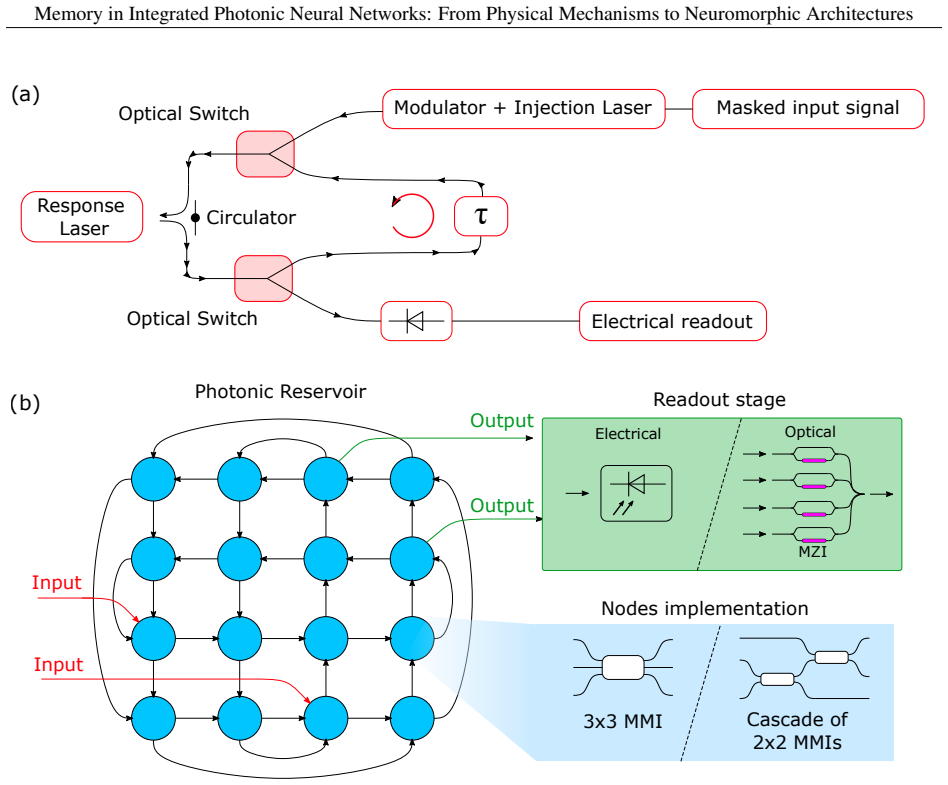
The rapid scaling of artificial neural networks has exposed fundamental limitations of conventional von Neumann computing architectures. In these systems, the physical separation between memory and processing creates a bottleneck, as computational capabilities outpace the ability of memory and interconnects to supply and retrieve data. In contrast, biological neural systems inherently co-localize computation and memory through distributed, dynamical processes. Neuromorphic computing seeks to emulate this paradigm by leveraging physical substrates whose intrinsic dynamics simultaneously encode and process information. Among emerging platforms, silicon photoncis offer a compelling approach due to its high bandwidth, low-loss propagation, and inherent parallelism. This review examines the role of memory in integrated photonic neuromorphic systems, with emphasis on the physical mechanisms that provide volatile (short-term) and non-volatile (long-term) memory in silicon-on-insulator and hybrid silicon-on-insulator platforms. Drawing inspiration from digital, biological, and photonic memory architectures, we classify existing approaches based on their underlying physical principles. We cover implementations ranging from delay lines and slow-light structures to multistable dynamics and structural memory based on charge trapping and phase-change materials. We then discuss how these mechanisms support photonic neural network architectures, including feed-forward, reservoir computing, spiking and hybrid optoelectronic recurrent systems, and assess their relevance for time-dependent singal-processing tasks such as channel equalization in telecommunications. This review aims to establish a unified framework for understanding memory and learning in neuromorphic photonics and outlines key challenges and opportunities for scalable, energy-efficient neuromorphic hardware.
Editorial analysis
A structured set of objections, weighed in public.
Referee Report
Summary. The paper is a review that classifies memory mechanisms in integrated photonic neuromorphic systems according to their underlying physical principles, covering volatile and non-volatile approaches such as delay lines, slow-light structures, multistable dynamics, charge trapping, and phase-change materials in silicon-on-insulator and hybrid platforms. It connects these mechanisms to architectures including feed-forward networks, reservoir computing, spiking systems, and hybrid optoelectronic recurrent networks, with discussion of applications like time-dependent signal processing (e.g., channel equalization), and concludes by outlining a unified framework along with challenges and opportunities for scalable, energy-efficient hardware.
Significance. If the classification and framework hold, the review is significant as a structured synthesis that bridges physical mechanisms with neuromorphic photonic architectures, providing a reference point for researchers working on co-localized memory and computation in optics. It explicitly credits the diversity of existing implementations across platforms and highlights practical relevance for telecommunications tasks without claiming new experimental results.
minor comments (3)
- §3 (classification of mechanisms): the distinction between 'structural memory' via charge trapping and phase-change materials could be clarified with a brief table comparing volatility timescales and integration compatibility, as the current prose description risks conflating short-term and long-term behaviors in hybrid platforms.
- §4.2 (reservoir computing architectures): the discussion of delay-line-based reservoirs would benefit from explicit citation of at least two recent experimental benchmarks on energy per operation to strengthen the claim of 'low-loss propagation' advantages over electronic counterparts.
- Abstract and §5 (challenges): the phrase 'prohibitive losses or complexity' in the context of scalability is used without a quantitative threshold; adding a short paragraph with example loss budgets from cited SOI works would improve precision.
Simulated Author's Rebuttal
We thank the referee for their positive assessment of our review, accurate summary of its scope, and recommendation for minor revision. We are pleased that the classification of memory mechanisms and the proposed unified framework are viewed as a useful synthesis bridging physical principles with neuromorphic photonic architectures.
Circularity Check
No significant circularity: review paper with no derivations
full rationale
This is a survey/review paper whose stated purpose is to classify existing memory mechanisms (delay lines, slow-light, multistable dynamics, charge trapping, phase-change materials) in silicon-on-insulator and hybrid platforms and to outline challenges for neuromorphic photonic architectures. No original equations, predictions, fitted parameters, or derivation chains are presented in the abstract or described scope. The central claim reduces to literature synthesis and classification rather than any self-referential construction, self-citation load-bearing argument, or renaming of results. The paper is therefore self-contained as a review and exhibits no circularity by the defined criteria.
Axiom & Free-Parameter Ledger
Reference graph
Works this paper leans on
-
[1]
Deep learning
Yann LeCun, Yoshua Bengio, and Geoffrey Hinton. “Deep learning”. In:nature521.7553 (2015), pp. 436– 444
2015
-
[2]
A comprehensive review of deep learning: Architectures, recent advances, and applications
Ibomoiye Domor Mienye and Theo G Swart. “A comprehensive review of deep learning: Architectures, recent advances, and applications”. In:Information15.12 (2024), p. 755
2024
-
[3]
Gordon E Moore et al.Cramming more components onto integrated circuits. 1965
1965
-
[4]
Design of ion-implanted MOSFET’s with very small physical dimensions
Robert H Dennard et al. “Design of ion-implanted MOSFET’s with very small physical dimensions”. In:IEEE Journal of solid-state circuits9.5 (2003), pp. 256–268
2003
-
[5]
Dark silicon and the end of multicore scaling
Hadi Esmaeilzadeh et al. “Dark silicon and the end of multicore scaling”. In:Proceedings of the 38th annual international symposium on Computer architecture. 2011, pp. 365–376
2011
-
[6]
1.1 computing’s energy problem (and what we can do about it)
Mark Horowitz. “1.1 computing’s energy problem (and what we can do about it)”. In:2014 IEEE international solid-state circuits conference digest of technical papers (ISSCC). IEEE. 2014, pp. 10–14
2014
-
[7]
Attention is all you need
Ashish Vaswani et al. “Attention is all you need”. In:Advances in neural information processing systems30 (2017)
2017
-
[8]
Ai and memory wall
Amir Gholami et al. “Ai and memory wall”. In:IEEE Micro44.3 (2024), pp. 33–39
2024
-
[9]
Eric R Kandel et al.Principles of neural science. V ol. 4. McGraw-hill New York, 2000
2000
-
[10]
Memory engram cells have come of age
Susumu Tonegawa et al. “Memory engram cells have come of age”. In:Neuron87.5 (2015), pp. 918–931
2015
-
[11]
Neuromorphic electronic systems
Carver Mead. “Neuromorphic electronic systems”. In:Proceedings of the IEEE78.10 (2002), pp. 1629–1636
2002
-
[12]
Memory and information processing in neuromorphic systems
Giacomo Indiveri and Shih-Chii Liu. “Memory and information processing in neuromorphic systems”. In: Proceedings of the IEEE103.8 (2015), pp. 1379–1397
2015
-
[13]
Neuromorphic computing at scale
Dhireesha Kudithipudi et al. “Neuromorphic computing at scale”. In:Nature637.8047 (2025), pp. 801–812
2025
-
[14]
Femtojoule per MAC Neuromorphic Photonics: An Energy and Technology Roadmap,
Daniel Brunner et al. “Roadmap on neuromorphic photonics”. In:arXiv preprint arXiv:2501.07917(2025)
-
[15]
Computer science as empirical inquiry: Symbols and search
Allen Newel and Herbert A Simon. “Computer science as empirical inquiry: Symbols and search”. In:Com- munications of the ACM19.3 (1976), pp. 113–126
1976
-
[16]
A modern approach
Stuart Russell, Peter Norvig, and Artificial Intelligence. “A modern approach”. In:Artificial Intelligence. Prentice-Hall, Egnlewood Cliffs25.27 (1995), pp. 79–80
1995
-
[17]
Neural networks and physical systems with emergent collective computational abilities
John J Hopfield. “Neural networks and physical systems with emergent collective computational abilities.” In: Proceedings of the national academy of sciences79.8 (1982), pp. 2554–2558
1982
-
[18]
Learning internal representations by error propagation
David E. Rumelhart, Geoffrey E. Hinton, and Ronald J. Williams. “Learning internal representations by error propagation”. In: 1986.URL:https://api.semanticscholar.org/CorpusID:62245742
1986
-
[19]
Photonics for artificial intelligence and neuromorphic computing
Bhavin J Shastri et al. “Photonics for artificial intelligence and neuromorphic computing”. In:Nature Photon- ics15.2 (2021), pp. 102–114
2021
-
[20]
Experimental realization of any discrete unitary operator
Michael Reck et al. “Experimental realization of any discrete unitary operator”. In:Physical review letters 73.1 (1994), p. 58
1994
-
[21]
Deep learning with coherent nanophotonic circuits
Yichen Shen et al. “Deep learning with coherent nanophotonic circuits”. In:Nature photonics11.7 (2017), pp. 441–446
2017
-
[22]
John Wiley & Sons, 2012
Govind P Agrawal.Fiber-optic communication systems. John Wiley & Sons, 2012
2012
-
[23]
All-optical computing with beyond 100-GHz clock rates
Gordon HY Li et al. “All-optical computing with beyond 100-GHz clock rates”. In:arXiv preprint arXiv:2501.05756(2025)
-
[24]
Optical nonlinearity, bistability, and signal processing in semi- conductors
Nasser Peyghambarian and Hyatt M Gibbs. “Optical nonlinearity, bistability, and signal processing in semi- conductors”. In:Journal of the Optical Society of America B2.7 (1985), pp. 1215–1227
1985
-
[25]
Holography in artificial neural networks
Demetri Psaltis et al. “Holography in artificial neural networks”. In:Nature343.6256 (1990), pp. 325–330
1990
-
[26]
Analog optical computing
Daniel R Solli and Bahram Jalali. “Analog optical computing”. In:Nature Photonics9.11 (2015), pp. 704– 706
2015
-
[27]
Taylor & Francis, 2016
Laurent Vivien and Lorenzo Pavesi.Handbook of silicon photonics. Taylor & Francis, 2016. 54 Memory in Integrated Photonic Neural Networks: From Physical Mechanisms to Neuromorphic Architectures
2016
-
[28]
CRC press, 2017
Paul R Prucnal and Bhavin J Shastri.Neuromorphic photonics. CRC press, 2017
2017
-
[29]
An introduction to InP-based generic integration technology
Meint Smit et al. “An introduction to InP-based generic integration technology”. In:Semiconductor Science and Technology29.8 (2014), p. 083001
2014
-
[30]
Integrated photonics on thin-film lithium niobate
Di Zhu et al. “Integrated photonics on thin-film lithium niobate”. In:Advances in Optics and Photonics13.2 (2021), pp. 242–352
2021
-
[31]
The past, present, and future of silicon photonics
Richard Soref. “The past, present, and future of silicon photonics”. In:IEEE Journal of selected topics in quantum electronics12.6 (2006), pp. 1678–1687
2006
-
[32]
Silicon optical modulators
Graham T Reed et al. “Silicon optical modulators”. In:Nature photonics4.8 (2010), pp. 518–526
2010
-
[33]
Roadmapping the next generation of silicon photonics
Sudip Shekhar et al. “Roadmapping the next generation of silicon photonics”. In:Nature Communications 15.1 (2024), p. 751
2024
-
[34]
Hybrid and heterogeneous photonic integration
Paramjeet Kaur et al. “Hybrid and heterogeneous photonic integration”. In:APL photonics6.6 (2021)
2021
-
[35]
Psychology press, 2005
Donald Olding Hebb.The organization of behavior: A neuropsychological theory. Psychology press, 2005
2005
-
[36]
Dynamic analysis and reservoir computing applica- tion of a nonlinear microring resonator
Stefano Gretter, Mattia Mancinelli, and Lorenzo Pavesi. “Dynamic analysis and reservoir computing applica- tion of a nonlinear microring resonator”. In:ACS photonics12.9 (2025), pp. 4956–4966
2025
-
[37]
All-optical spiking neurosynaptic networks with self-learning capabilities
Johannes Feldmann et al. “All-optical spiking neurosynaptic networks with self-learning capabilities”. In: Nature569.7755 (2019), pp. 208–214
2019
-
[38]
Computation at the edge of chaos: Phase transitions and emergent computation
Chris G Langton. “Computation at the edge of chaos: Phase transitions and emergent computation”. In:Phys- ica D: nonlinear phenomena42.1-3 (1990), pp. 12–37
1990
-
[39]
Stable Hebbian learning from spike timing- dependent plasticity
Mark CW Van Rossum, Guo Qiang Bi, and Gina G Turrigiano. “Stable Hebbian learning from spike timing- dependent plasticity”. In:Journal of neuroscience20.23 (2000), pp. 8812–8821
2000
-
[40]
Structured chaos shapes spike-response noise entropy in balanced neural networks
Guillaume Lajoie, Jean-Philippe Thivierge, and Eric Shea-Brown. “Structured chaos shapes spike-response noise entropy in balanced neural networks”. In:Frontiers in computational neuroscience8 (2014), p. 123
2014
-
[41]
Integrated all-photonic non-volatile multi-level memory
Carlos R ´ıos et al. “Integrated all-photonic non-volatile multi-level memory”. In:Nature photonics9.11 (2015), pp. 725–732
2015
-
[42]
Exploring the potential of self-pulsing optical microresonators for spiking neural networks and sensing
Stefano Biasi et al. “Exploring the potential of self-pulsing optical microresonators for spiking neural networks and sensing”. In:Communications Physics7.1 (2024), p. 380
2024
-
[43]
Emergent Self-Adaptation in an Integrated Photonic Neural Network for Backpropagation-Free Learning
Alessio Lugnan et al. “Emergent Self-Adaptation in an Integrated Photonic Neural Network for Backpropagation-Free Learning”. In:Advanced Science12.2 (2025), p. 2404920
2025
-
[44]
Progress in Optoelectronic Synapses for Reservoir Computing: Materials, Device Inte- gration, and Neuromorphic System Applications
Yongsheng Lei et al. “Progress in Optoelectronic Synapses for Reservoir Computing: Materials, Device Inte- gration, and Neuromorphic System Applications”. In:Laser & Photonics Reviews(2025), e02338
2025
-
[45]
Integrated photonic synapses, neurons, memristors, and neural networks for photonic neu- romorphic computing
Shufei Han et al. “Integrated photonic synapses, neurons, memristors, and neural networks for photonic neu- romorphic computing”. In:Opto-Electronic Technology1.3 (2025), pp. 1–17
2025
-
[46]
Intelligent nanophotonics: when machine learning sheds light
Nanfan Wu et al. “Intelligent nanophotonics: when machine learning sheds light”. In:eLight5.1 (2025), p. 5
2025
-
[47]
Algorithms, architectures, and platform implementations of inte- grated photonic neural networks
Xinyi Wang, Kun Liao, and Xiaoyong Hu. “Algorithms, architectures, and platform implementations of inte- grated photonic neural networks”. In:Applied Physics Reviews13.1 (2026)
2026
-
[48]
Elements of episodic memory
Endel Tulving. “Elements of episodic memory”. In: (1983)
1983
-
[49]
Larry R Squire and Eric R Kandel.Memory: From mind to molecules. V ol. 69. Macmillan, 2003
2003
-
[50]
Charles R Gallistel.The organization of learning.The MIT Press, 1990
1990
-
[51]
Long-lasting potentiation of synaptic transmission in the dentate area of the anaesthetized rabbit following stimulation of the perforant path
Tim VP Bliss and Terje Lømo. “Long-lasting potentiation of synaptic transmission in the dentate area of the anaesthetized rabbit following stimulation of the perforant path”. In:The Journal of physiology232.2 (1973), pp. 331–356
1973
-
[52]
The molecular biology of memory storage: a dialogue between genes and synapses
Eric R Kandel. “The molecular biology of memory storage: a dialogue between genes and synapses”. In: Science294.5544 (2001), pp. 1030–1038
2001
-
[53]
Synaptic computation
Larry F Abbott and Wade G Regehr. “Synaptic computation”. In:Nature431.7010 (2004), pp. 796–803
2004
-
[54]
Working memory: Theories, models, and controversies
Alan Baddeley. “Working memory: Theories, models, and controversies”. In:Annual review of psychology 63.1 (2012), pp. 1–29
2012
-
[55]
Neuroscience-inspired artificial intelligence
Demis Hassabis et al. “Neuroscience-inspired artificial intelligence”. In:Neuron95.2 (2017), pp. 245–258
2017
-
[56]
Toward an integration of deep learning and neuroscience
Adam H Marblestone, Greg Wayne, and Konrad P Kording. “Toward an integration of deep learning and neuroscience”. In:Frontiers in computational neuroscience10 (2016), p. 215943
2016
-
[57]
Towards biologically plausible deep learning
Yoshua Bengio et al. “Towards biologically plausible deep learning”. In:arXiv preprint arXiv:1502.04156 (2015)
-
[58]
Backpropagation and the brain
Timothy P Lillicrap et al. “Backpropagation and the brain”. In:Nature Reviews Neuroscience21.6 (2020), pp. 335–346. 55 Memory in Integrated Photonic Neural Networks: From Physical Mechanisms to Neuromorphic Architectures
2020
-
[59]
Synaptic modifications in cultured hippocampal neurons: dependence on spike timing, synaptic strength, and postsynaptic cell type
Guo-qiang Bi and Mu-ming Poo. “Synaptic modifications in cultured hippocampal neurons: dependence on spike timing, synaptic strength, and postsynaptic cell type”. In:Journal of neuroscience18.24 (1998), pp. 10464–10472
1998
-
[60]
The neurobiology of consolidations, or, how stable is the engram?
Yadin Dudai. “The neurobiology of consolidations, or, how stable is the engram?” In:Annu. Rev. Psychol.55.1 (2004), pp. 51–86
2004
-
[61]
Synapses and memory storage
Mark Mayford, Steven A Siegelbaum, and Eric R Kandel. “Synapses and memory storage”. In:Cold Spring Harbor perspectives in biology4.6 (2012), a005751
2012
-
[62]
Memory formation depends on both synapse-specific modifications of synaptic strength and cell-specific increases in excitability
John Lisman et al. “Memory formation depends on both synapse-specific modifications of synaptic strength and cell-specific increases in excitability”. In:Nature neuroscience21.3 (2018), pp. 309–314
2018
-
[63]
The molecular and systems biology of memory
Eric R Kandel, Yadin Dudai, and Mark R Mayford. “The molecular and systems biology of memory”. In:Cell 157.1 (2014), pp. 163–186
2014
-
[64]
Memory consolidation
Larry R Squire et al. “Memory consolidation”. In:Cold Spring Harbor perspectives in biology7.8 (2015), a021766
2015
-
[65]
Human memory: A proposed system and its control processes
Richard C Atkinson and Richard M Shiffrin. “Human memory: A proposed system and its control processes”. In:Psychology of learning and motivation. V ol. 2. Elsevier, 1968, pp. 89–195
1968
-
[66]
Working memory: The interface between memory and cognition
Alan Baddeley. “Working memory: The interface between memory and cognition”. In:Journal of cognitive neuroscience4.3 (1992), pp. 281–288
1992
-
[67]
Neuron activity related to short-term memory
Joaquin M Fuster and Garrett E Alexander. “Neuron activity related to short-term memory”. In:Science 173.3997 (1971), pp. 652–654
1971
-
[68]
Synaptic mechanisms and network dynamics underlying spatial working memory in a cortical network model
Albert Compte et al. “Synaptic mechanisms and network dynamics underlying spatial working memory in a cortical network model”. In:Cerebral cortex10.9 (2000), pp. 910–923
2000
-
[69]
Working memory: Past, present. . . and future
AD Baddeley and GJ Hitch. “Working memory: Past, present. . . and future”. In:The cognitive neuroscience of working memory(2007), pp. 1–20
2007
-
[70]
Cellular basis of working memory
Patricia S Goldman-Rakic. “Cellular basis of working memory”. In:Neuron14.3 (1995), pp. 477–485
1995
-
[71]
An integrative theory of prefrontal cortex function
Earl K Miller and Jonathan D Cohen. “An integrative theory of prefrontal cortex function”. In:Annual review of neuroscience24.1 (2001), pp. 167–202
2001
-
[72]
Working memory in the prefrontal cortex
Shintaro Funahashi. “Working memory in the prefrontal cortex”. In:Brain sciences7.5 (2017), p. 49
2017
-
[73]
Structural changes accompanying memory storage
Craig H Bailey and Eric R Kandel. “Structural changes accompanying memory storage.” In:Annual review of physiology(1993)
1993
-
[74]
The organization of recent and remote memories
Paul W Frankland and Bruno Bontempi. “The organization of recent and remote memories”. In:Nature reviews neuroscience6.2 (2005), pp. 119–130
2005
-
[75]
Memory systems of the brain: a brief history and current perspective
Larry R Squire. “Memory systems of the brain: a brief history and current perspective”. In:Neurobiology of learning and memory82.3 (2004), pp. 171–177
2004
-
[76]
A neostriatal habit learning system in humans
Barbara J Knowlton, Jennifer A Mangels, and Larry R Squire. “A neostriatal habit learning system in humans”. In:Science273.5280 (1996), pp. 1399–1402
1996
-
[77]
Actions and habits: the development of behavioural autonomy
Anthony Dickinson. “Actions and habits: the development of behavioural autonomy”. In:Philosophical Trans- actions of the Royal Society of London. B, Biological Sciences308.1135 (1985), pp. 67–78
1985
-
[78]
Episodic and semantic memory
Endel Tulving et al. “Episodic and semantic memory”. In:Organization of memory1.381-403 (1972), p. 1
1972
-
[79]
Imaging cognition II: An empirical review of 275 PET and fMRI studies
Roberto Cabeza and Lars Nyberg. “Imaging cognition II: An empirical review of 275 PET and fMRI studies”. In:Journal of cognitive neuroscience12.1 (2000), pp. 1–47
2000
-
[80]
Transforming experiences: Neurobiology of memory updating/editing
Daniel Osorio-G ´omez et al. “Transforming experiences: Neurobiology of memory updating/editing”. In:Fron- tiers in Systems Neuroscience17 (2023), p. 1103770
2023
discussion (0)
Sign in with ORCID, Apple, or X to comment. Anyone can read and Pith papers without signing in.