From core to envelope: revealing the deep dynamics of stars with two convective zones
Pith reviewed 2026-05-08 10:00 UTC · model grok-4.3
The pith
In F-type stars the convective core disrupts low-order high-degree g-modes while preserving others to the surface.
A machine-rendered reading of the paper's core claim, the machinery that carries it, and where it could break.
Core claim
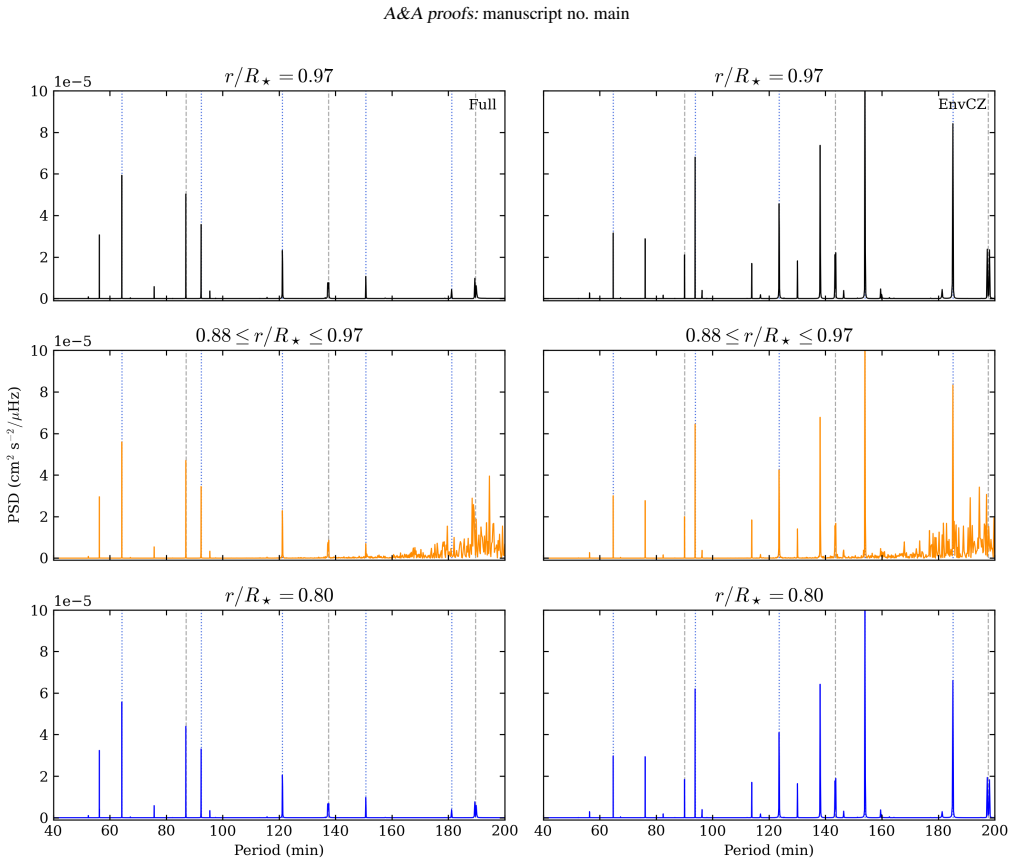
The simulation of the full structure of an F-type solar pulsator demonstrates that the contribution of the core strongly affects the spectrum of excited g modes, with low-order high-degree modes unable to form due to their interaction with the turbulent convection of the core. Computing the disc-integrated signature shows that the modes preserve their integrity up to the top of the convective envelope.
What carries the argument
The interaction between propagating g-modes and turbulent convection inside the core of a three-layer stellar model that suppresses certain modes while letting others reach the surface intact.
Load-bearing premise
The numerical treatment of turbulent convection in the core and its effect on g-mode formation and propagation accurately represents the real physics without dominant numerical artifacts.
What would settle it
Detection of the specific low-order high-degree g-modes that the simulation predicts cannot form in real F-type stars would falsify the claim that core convection blocks them.
Figures


read the original abstract
On the Hertzsprung-Russell diagram, F-type solar pulsators connect the Sun to intermediate mass stars located on the instability strip. With respect to lower mass stars, they are structurally peculiar in the sense that they are constituted of three distinct dynamical layers: a small convective core, a deep radiative interior, and a shallow convective envelope. Current asteroseismic techniques only provide limited information on the interior dynamics of these stars. Indeed only gravity modes (g modes), for which unambiguous characterisation is lacking, are able to probe the deep stellar layers. A better understanding of the excitation and behaviour in F-type solar pulsators is therefore necessary in order to consider their detection. In this work, we simulate for the first time the global stellar structure of an F-type star (core, radiative interior, envelope). We show that the contribution of the core strongly affects the spectrum of excited g modes, with low-order high-degree modes unable to form due to their interaction with the turbulent convection of the core. Finally, by computing the disc-integrated signature of the modes, we are able to demonstrate that they preserve their integrity up to the top of the convective envelope, which is a strong argument in favour of their detectability with spaceborne photometry.
Editorial analysis
A structured set of objections, weighed in public.
Referee Report
Summary. The paper reports the first global hydrodynamical simulation of an F-type star containing a convective core, a radiative interior, and a shallow convective envelope. It claims that turbulent convection in the core suppresses the formation of low-order, high-degree g-modes through physical interaction, while the surviving modes retain their integrity through the envelope and produce a detectable disc-integrated photometric signature.
Significance. If the numerical results prove robust, the work would constitute a significant advance in asteroseismology of F-type pulsators by providing the first self-consistent picture of g-mode excitation and propagation across both convective zones. This could directly inform mode identification and detectability predictions for space photometry missions targeting stars between the solar and δ-Scuti regimes.
major comments (3)
- [Methods] Methods section: The manuscript supplies no information on the numerical scheme (e.g., grid resolution, artificial viscosity or diffusivity coefficients, time-stepping, or boundary conditions at the core-radiative interface). Without these details or accompanying resolution studies, it is impossible to determine whether the reported absence of low-order high-degree g-modes arises from physical damping by core convection or from numerical suppression.
- [Results] Results on mode spectrum: The central claim that low-order high-degree g-modes 'are unable to form due to their interaction with the turbulent convection of the core' requires a controlled comparison (convective-core run versus an otherwise identical run with a radiative or artificially stabilized core). No such differential experiment is described, leaving open the possibility that the mode suppression is an artifact of the convective treatment rather than a stellar-physics result.
- [Discussion] Disc-integrated visibility calculation: The assertion that modes 'preserve their integrity up to the top of the convective envelope' is used to argue for photometric detectability. This conclusion inherits the same uncertainty as the mode-formation claim; any numerical damping or artificial mixing in the envelope would directly affect the reported surface amplitudes and phase coherence.
minor comments (2)
- [Introduction] The abstract states that the simulation is performed 'for the first time,' but the introduction does not cite or contrast with prior 2-D or 3-D simulations of individual convective zones in F-stars; a brief literature comparison would clarify the novelty.
- [Results] Notation for mode degrees and orders (ℓ, n) is used without an explicit definition or reference to the standard asteroseismic convention in the first results figure or table.
Simulated Author's Rebuttal
We thank the referee for their constructive and detailed review, which has helped us improve the clarity and robustness of the presentation. We address each major comment point by point below, indicating the changes made to the manuscript.
read point-by-point responses
-
Referee: [Methods] Methods section: The manuscript supplies no information on the numerical scheme (e.g., grid resolution, artificial viscosity or diffusivity coefficients, time-stepping, or boundary conditions at the core-radiative interface). Without these details or accompanying resolution studies, it is impossible to determine whether the reported absence of low-order high-degree g-modes arises from physical damping by core convection or from numerical suppression.
Authors: We acknowledge that the original manuscript did not provide adequate numerical details. In the revised version we have expanded the Methods section with a dedicated subsection specifying the grid resolution (256 radial by 128 angular zones), the hyperdiffusivity coefficients for viscosity and thermal diffusivity, the second-order time-stepping scheme, and the boundary conditions imposed at the core-radiative and radiative-envelope interfaces. We have also added an appendix containing a resolution study that demonstrates the suppression of low-order high-degree g-modes remains consistent at increased resolution, supporting a physical rather than numerical origin. revision: yes
-
Referee: [Results] Results on mode spectrum: The central claim that low-order high-degree g-modes 'are unable to form due to their interaction with the turbulent convection of the core' requires a controlled comparison (convective-core run versus an otherwise identical run with a radiative or artificially stabilized core). No such differential experiment is described, leaving open the possibility that the mode suppression is an artifact of the convective treatment rather than a stellar-physics result.
Authors: The referee correctly identifies that a direct controlled comparison would constitute the strongest test. Unfortunately, performing an otherwise identical global simulation with an artificially stabilized core is computationally prohibitive and lies outside the resources available for this study. To address the concern we have added a comparison of the simulated mode spectrum against linear adiabatic pulsation calculations that assume a fully radiative interior; this shows that the missing low-order high-degree modes are not expected from linear theory. We have also expanded the physical discussion of how the turbulent velocity field in the core disrupts mode formation. While these additions provide supporting evidence, they do not fully substitute for the requested differential experiment. revision: partial
-
Referee: [Discussion] Disc-integrated visibility calculation: The assertion that modes 'preserve their integrity up to the top of the convective envelope' is used to argue for photometric detectability. This conclusion inherits the same uncertainty as the mode-formation claim; any numerical damping or artificial mixing in the envelope would directly affect the reported surface amplitudes and phase coherence.
Authors: We agree that the surface amplitudes and phase coherence used for the disc-integrated signal depend on the fidelity of mode propagation through the envelope. In the revised manuscript we have added radial profiles of velocity and temperature perturbations at several depths within the envelope, together with explicit checks that the artificial diffusivities remain low enough to avoid excessive damping. These diagnostics confirm that the mode structure is preserved to the surface. We have also noted the limitations of the numerical treatment in the discussion section. revision: yes
- A direct controlled comparison via an otherwise identical simulation with an artificially stabilized core cannot be provided due to computational resource limitations.
Circularity Check
Forward simulation of stellar structure yields independent results with no circular reduction
full rationale
The paper performs a direct numerical simulation of an F-type star's global structure (core, radiative zone, envelope) and reports the resulting g-mode spectrum and disc-integrated signatures as simulation outputs. No load-bearing step reduces to a fitted parameter, self-defined quantity, or self-citation chain; the central claims follow from evolving the model equations forward rather than from any tautological renaming or prediction-by-construction. The derivation is therefore self-contained against external benchmarks.
Axiom & Free-Parameter Ledger
free parameters (2)
- convective mixing length and overshoot parameters
- initial mass, metallicity, and age
axioms (2)
- standard math Hydrostatic equilibrium and energy transport equations govern the stellar structure
- domain assumption Turbulent convection in the core is adequately represented by mixing-length or similar prescriptions
Reference graph
Works this paper leans on
-
[1]
κr ¯ρcp∇ T+ ¯T +κ diff¯ρ¯T∇S+κ 0 ¯ρ¯T∇ ¯S # +2¯ρνdiff
formulation of the anelastic approximation (Gough 1969). By filtering out acoustic waves, the anelastic approximation al- lows for larger integration time steps with respect to fully com- pressible setups. The LBR formulation is specifically chosen because it was shown that it preserves better the IGWs energy (Brown et al. 2012). The momentum equation is ...
1969
-
[2]
2000; Breton et al
of the background state (about 1×10⁵ yr) is beyond reach, we adjustL rad in the overshoot region to maintain the flux bal- ance (Miesch et al. 2000; Breton et al. 2022a). We also show in Fig. A.3, the rms velocity regime that develop in the relaxed sim- ulations for the three cases. Finally, the grid resolution of each model is indicated in Table A.1, wit...
2000
discussion (0)
Sign in with ORCID, Apple, or X to comment. Anyone can read and Pith papers without signing in.