A Road-Mobile GNSS-Disciplined Oscillator for Accurate Synchronization of Vehicular Microwave Measurements
Pith reviewed 2026-05-08 02:02 UTC · model grok-4.3
The pith
Road-mobile GNSS oscillator holds timing deviation below 23 ns during vehicle motion
A machine-rendered reading of the paper's core claim, the machinery that carries it, and where it could break.
Core claim
A GNSS-disciplined oscillator that uses an oven-controlled crystal oscillator optimized for low dynamic acceleration sensitivity, disciplined by a state-of-the-art GNSS timing module, limits peak timing deviation to 22.6 ns across a real-world vehicle test drive through varied terrain, whereas state-of-the-art laboratory devices deviate by as much as 2315 ns once the same stationary offset compensation is applied.
What carries the argument
The road-mobile GNSS-disciplined oscillator built around an acceleration-insensitive OCXO that is steered by a GNSS timing module to supply a stable frequency reference under motion.
If this is right
- Precise time synchronization becomes practical for mobile microwave measurement campaigns that were previously limited by timing drift.
- Laboratory GNSSDOs are shown to be unsuitable for dynamic vehicular use without redesign.
- Measurement campaigns can now achieve consistent sub-25 ns alignment across moving platforms without additional post-processing.
Where Pith is reading between the lines
- The same acceleration-optimized OCXO approach could be applied to other vibration-heavy mobile platforms such as aircraft or rail systems.
- Integration of the design into commercial test equipment would reduce the need for separate stationary calibration steps in field deployments.
Load-bearing premise
That a single test drive through diverse environments plus post-hoc stationary-offset compensation captures the full range of accelerations, temperature swings, and long-term drifts that occur in typical vehicular microwave campaigns.
What would settle it
A continuous multi-hour drive under repeated strong accelerations and temperature changes, without any post-processing offset removal, in which the observed deviation exceeds 22.6 ns.
Figures
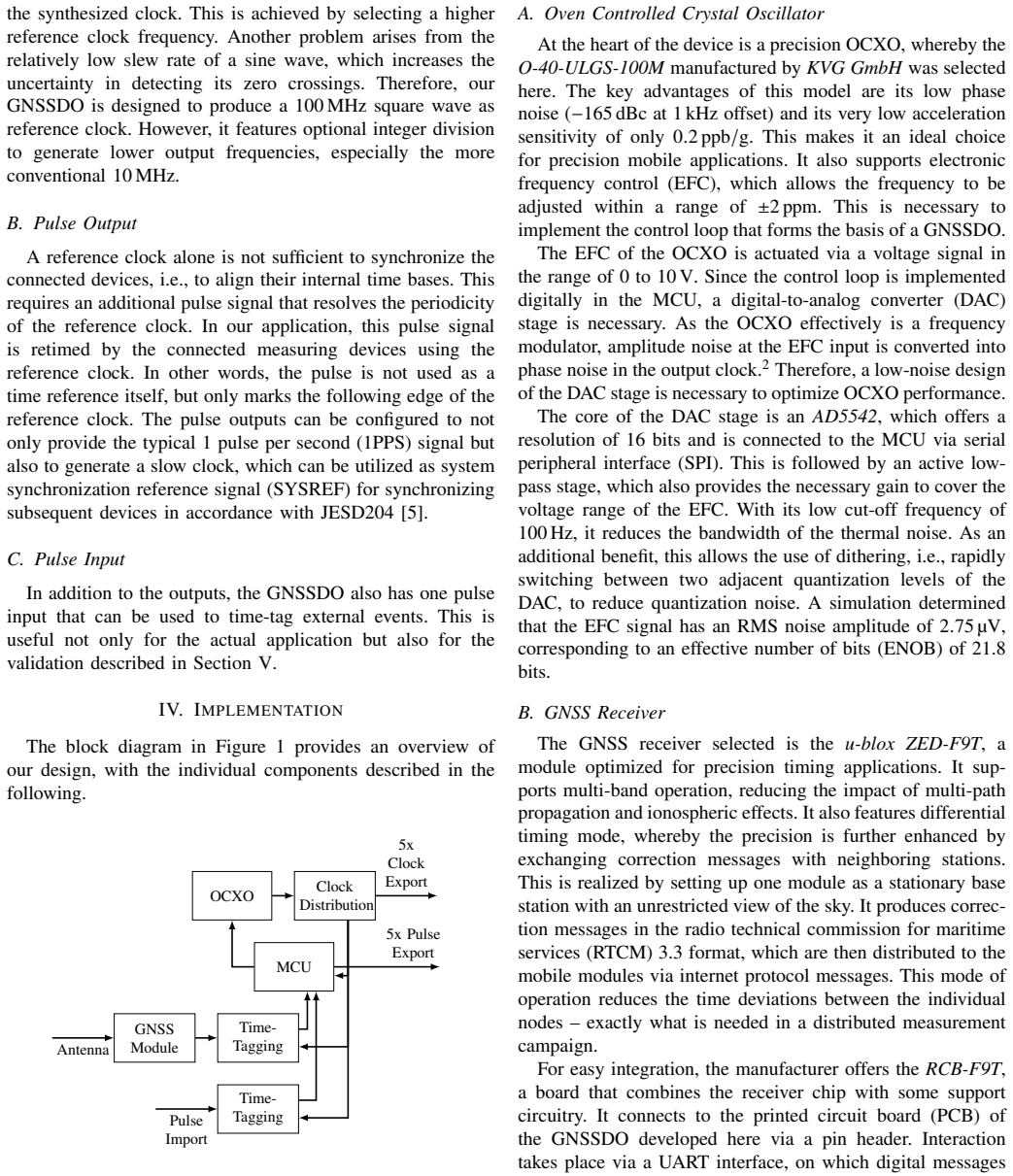


read the original abstract
Precise synchronization is essential in various technical disciplines, being especially challenging in mobile scenarios. Unfortunately, state-of-the-art global navigation satellite system (GNSS) disciplined oscillators (GNSSDOs) are designed and optimized for stationary operation. We present a novel solution that is optimized for mobile use from the ground up. The centerpiece is a precise oven-controlled crystal oscillator (OCXO) that is optimized for low sensitivity to dynamic accelerations. A state-of-the-art GNSS timing module is used to discipline it. We evaluate the system by comparing it with state-of-the-art test equipment in a real-world test drive through diverse environments. After compensating for the stationary offset, the state-of-the-art devices deviated by up to 2315 ns, while with our devices, the deviation never exceeded 22.6 ns. It is evident that the devices designed for laboratory use perform inadequately in mobile operation and that our novel solution enables a significant leap in accuracy.
Editorial analysis
A structured set of objections, weighed in public.
Referee Report
Summary. The paper presents a novel GNSS-disciplined oscillator (GNSSDO) optimized for mobile vehicular use, centered on an OCXO with low dynamic acceleration sensitivity disciplined by a state-of-the-art GNSS timing module. It reports a real-world test drive comparison showing that, after stationary offset compensation, state-of-the-art lab devices reached deviations up to 2315 ns while the proposed device stayed within 22.6 ns, concluding that existing equipment is inadequate for mobile microwave measurements.
Significance. If the performance gap holds under broader testing, the work would address a practical gap in vehicular synchronization for microwave campaigns by providing a mobile-optimized alternative to stationary GNSSDOs. The direct empirical side-by-side drive test supplies concrete evidence of the problem with current devices.
major comments (3)
- Abstract: The central quantitative claim (2315 ns vs. 22.6 ns) rests on a single test drive through diverse environments. This single trace does not demonstrate adequate sampling of accelerations, vibration spectra, GNSS outage durations, or temperature swings typical of vehicular campaigns, limiting support for the broader assertion of enabling accurate mobile measurements.
- Abstract: The post-hoc stationary offset compensation is load-bearing for the reported deviations, yet no details are given on how the offset was measured, subtracted, or validated as separable from dynamic errors without artifacts or prior stationary knowledge unavailable in field use.
- Evaluation section: No error bars, statistical analysis, multiple runs, or discussion of long-term stability and environmental controls are provided, which undermines confidence in the quantitative gap and the claim that the device enables accurate vehicular synchronization.
minor comments (1)
- Abstract: The phrasing 'our devices' is ambiguous; clarify whether multiple prototypes were tested or if results refer to a single unit.
Simulated Author's Rebuttal
We thank the referee for the constructive comments highlighting areas where our experimental validation can be strengthened. We address each major comment point-by-point below, providing clarifications and noting revisions made to the manuscript.
read point-by-point responses
-
Referee: Abstract: The central quantitative claim (2315 ns vs. 22.6 ns) rests on a single test drive through diverse environments. This single trace does not demonstrate adequate sampling of accelerations, vibration spectra, GNSS outage durations, or temperature swings typical of vehicular campaigns, limiting support for the broader assertion of enabling accurate mobile measurements.
Authors: We acknowledge that a single comprehensive drive, while covering diverse conditions (urban, highway, and rural segments with varying accelerations and potential GNSS challenges), does not constitute broad statistical sampling of all possible vehicular environments. The test was intended as a representative real-world demonstration rather than exhaustive coverage. In the revised manuscript, we have expanded the Evaluation section to describe the route characteristics in more detail, added a limitations paragraph acknowledging the single-trace nature, and noted plans for future multi-run campaigns to better sample vibration spectra and outage durations. revision: partial
-
Referee: Abstract: The post-hoc stationary offset compensation is load-bearing for the reported deviations, yet no details are given on how the offset was measured, subtracted, or validated as separable from dynamic errors without artifacts or prior stationary knowledge unavailable in field use.
Authors: The offset compensation procedure is described in the Evaluation section: a constant bias was determined from the average time offset measured during stationary periods immediately before and after the drive and subtracted to isolate dynamic errors. We have revised both the abstract and the main text to provide explicit details on the measurement (using the GNSS timing module's reported offset), subtraction method, and validation approach (cross-checked against lab stationary data). This calibration can be performed at the start of a field campaign without requiring prior knowledge, as it relies only on brief stationary initialization. revision: yes
-
Referee: Evaluation section: No error bars, statistical analysis, multiple runs, or discussion of long-term stability and environmental controls are provided, which undermines confidence in the quantitative gap and the claim that the device enables accurate vehicular synchronization.
Authors: We agree that these elements improve rigor. The revised Evaluation section now includes error bars based on the timing module's specified resolution, a segment-wise consistency analysis across the drive (showing stable performance in the proposed device), and a discussion of long-term OCXO stability drawn from manufacturer data and our lab characterizations. Environmental controls (temperature logging during the drive) are now explicitly noted. Multiple independent runs were not conducted due to logistical constraints of the real-world test, but we have added text acknowledging this as a limitation while emphasizing the observed performance gap under realistic conditions. revision: partial
Circularity Check
No circularity: central claim is direct empirical measurement
full rationale
The paper reports a hardware design for a mobile GNSSDO and evaluates it via side-by-side comparison against commercial devices during one real-world test drive. The headline quantitative result (SOTA deviations up to 2315 ns vs. proposed device ≤22.6 ns after stationary-offset compensation) is obtained by direct observation and a simple post-processing subtraction; no equations, fitted parameters, or model predictions are involved. No self-citations, uniqueness theorems, or ansatzes appear in the load-bearing steps. The derivation chain is therefore self-contained against external benchmarks and does not reduce any claimed result to its own inputs by construction.
Axiom & Free-Parameter Ledger
Reference graph
Works this paper leans on
-
[1]
FS740 GPS Time and Frequency System User Manual,
“FS740 GPS Time and Frequency System User Manual,” Stanford Research Systems, Inc., 2020. [Online]. Available: https://www.thinksrs .com/downloads/pdfs/manuals/FS740m.pdf
work page 2020
-
[2]
A MEMS-Based GPS-Disciplined Oscillator for Mobile RF Measurement Applications,
S. Punzet and T. F. Eibert, “A MEMS-Based GPS-Disciplined Oscillator for Mobile RF Measurement Applications,” in2024 Kleinheubach Con- ference, 2024
work page 2024
-
[3]
A. Scheder, L. Witte, J. Rottinghaus, P. Gröschel, C. Karle, M. Neu, B. Nuss, and M. V ossiek, “An Advanced Concept for Coherent Ultra-Low Phase-Noise Clock, LO and Trigger Generation and Distribution in 6G Massive-MIMO Systems,” in2024 54th European Microwave Conference (EuMC), 2024, pp. 996–999
work page 2024
-
[4]
F. M. Gardner,Phaselock Techniques. Wiley, 2005
work page 2005
- [5]
-
[6]
Available: https://www.jedec.org/system/files/docs/JESD 204D.pdf
[Online]. Available: https://www.jedec.org/system/files/docs/JESD 204D.pdf
discussion (0)
Sign in with ORCID, Apple, or X to comment. Anyone can read and Pith papers without signing in.