Optimizing power by selective IP card shutdown using transport slicing
Pith reviewed 2026-05-08 01:17 UTC · model grok-4.3
The pith
A dual-slice IP strategy lets operators deactivate more than 40 percent of line cards during low-traffic periods by switching between a performance-focused daytime slice and an energy-minimized nighttime slice.
A machine-rendered reading of the paper's core claim, the machinery that carries it, and where it could break.
Core claim
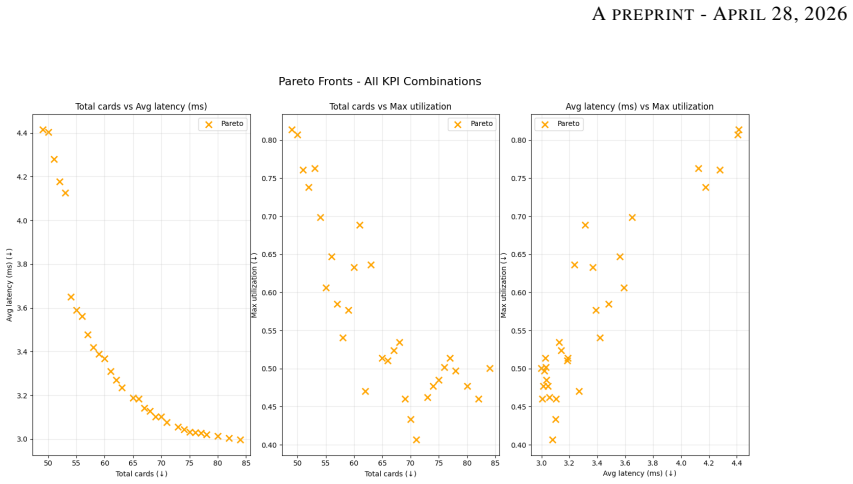
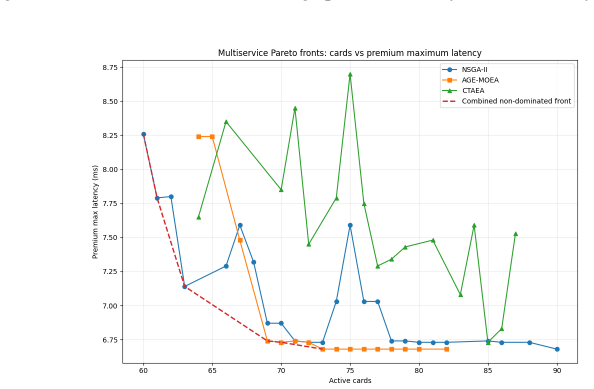
By defining separate Day and Night slices and switching traffic between them at fixed times, an IP router network can selectively power down line cards in the Night Slice during off-peak hours; multi-objective optimization with NSGA-II, CTAEA, and AGE-MOEA keeps latency within bounds, yielding more than 40 percent card deactivation on the india35 topology and preserving substantial savings even when premium traffic receives differentiated QoS limits below 7 ms.
What carries the argument
The dual-slice transport mechanism that routes traffic to a reduced-card Night Slice at predefined low-demand intervals, with Pareto evolutionary algorithms jointly minimizing energy and latency.
If this is right
- More than 40 percent of line cards can remain off during low-traffic intervals while latency stays within operator targets.
- Multi-objective evolutionary search finds practical trade-offs between energy reduction and delay on realistic topologies.
- Premium traffic can be given tighter latency guarantees in the same Night Slice without erasing most of the energy benefit.
- The approach applies directly to existing card-based IP routers without requiring new hardware.
Where Pith is reading between the lines
- Dynamic rather than fixed-time slice switching could further increase savings if traffic prediction improves.
- The same slicing pattern might extend to other router types or optical layers if line-card power models are updated.
- Operators facing rising 6G and AI traffic could combine this method with existing energy-aware routing protocols.
Load-bearing premise
Traffic can be moved between the Day and Night slices at set times without breaking sessions or causing large latency spikes, provided existing traffic engineering handles the hand-off.
What would settle it
Live measurements on the india35 topology (or an equivalent network) showing that slice switches produce latency jumps above the modeled bounds or cause session drops would falsify the claimed energy savings.
Figures







read the original abstract
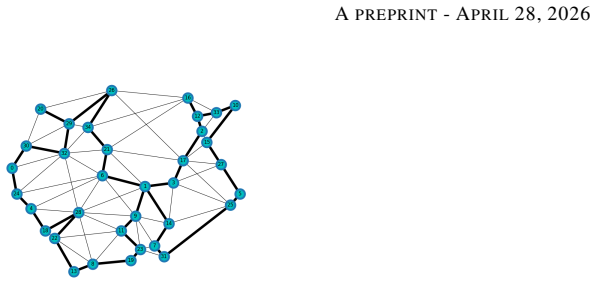
The increasing energy demands of upcoming sixth-generation (6G) mobile networks and networks supporting AI applications pose significant challenges for network operators in terms of operational costs and environmental impact. To address these challenges, this paper proposes a novel IP-based network slicing strategy that optimizes energy efficiency through a dual-slice approach. The proposed solution consists of a Day Slice, designed to meet high-performance requirements during peak traffic hours, and a Night Slice, optimized for energy savings by deactivating excess line-cards in card-based routers during periods of low traffic demand. The traffic is switched between the Day and Night Slices at predefined times, assuming appropriate traffic engineering mechanisms are in place to minimize disruption and support session continuity. We apply Pareto-based evolutionary algorithms (NSGA-II, CTAEA, and AGE-MOEA) to jointly optimize energy consumption and latency. Experiments conducted on the SNDlib india35 topology demonstrate that multi-objective optimization can deactivate over 40% of line cards during low-traffic periods, providing significant energy savings while maintaining acceptable performance. Additionally, a multi-service extension using AGE-MOEA introduces differentiated QoS constraints, maintaining latency below 7 ms for premium traffic while preserving substantial energy savings.
Editorial analysis
A structured set of objections, weighed in public.
Referee Report
Summary. The paper proposes a dual-slice IP transport strategy for energy-efficient 6G networks: a Day Slice sized for peak traffic and a Night Slice that deactivates excess line cards in card-based routers during low-demand periods. Traffic is switched between slices at fixed times under the assumption that existing traffic-engineering mechanisms ensure session continuity and acceptable performance. Multi-objective evolutionary algorithms (NSGA-II, CTAEA, AGE-MOEA) are used to jointly minimize energy and latency; on the SNDlib india35 topology the approach reports deactivation of over 40% of line cards while keeping latency acceptable, with a multi-service extension that enforces differentiated QoS.
Significance. If the unmodeled switching assumption can be substantiated, the work offers a concrete, topology-grounded demonstration that standard Pareto-based MOEAs can identify substantial line-card shutdown opportunities in IP networks without violating latency targets. The use of a public SNDlib topology and three distinct algorithms is a positive reproducibility feature.
major comments (2)
- [Abstract and experimental evaluation] The headline result (over 40% line-card deactivation on india35) is obtained by optimizing two independent static routing problems (Day and Night slices). No model of the slice-transition process, session hand-off, routing convergence, or transient latency/loss appears in the formulation or experiments, yet the practical energy-saving claim is meaningful only if this transition can be performed with “acceptable performance.” This assumption is load-bearing for the central contribution.
- [Experimental evaluation] The experimental section supplies no traffic matrix details, exact algorithm parameter settings (population size, generations, crossover/mutation rates), error bars, or comparison against single-objective or heuristic baselines. Without these, the 40% deactivation figure cannot be independently verified or assessed for robustness.
minor comments (1)
- [Multi-service extension] The multi-service extension using AGE-MOEA is mentioned only briefly; clarifying how the premium-traffic latency constraint (<7 ms) is encoded in the objective/constraint set would improve reproducibility.
Simulated Author's Rebuttal
We thank the referee for the constructive feedback and positive evaluation of the paper's significance and reproducibility features. We address each major comment below and will incorporate revisions to strengthen the manuscript.
read point-by-point responses
-
Referee: [Abstract and experimental evaluation] The headline result (over 40% line-card deactivation on india35) is obtained by optimizing two independent static routing problems (Day and Night slices). No model of the slice-transition process, session hand-off, routing convergence, or transient latency/loss appears in the formulation or experiments, yet the practical energy-saving claim is meaningful only if this transition can be performed with “acceptable performance.” This assumption is load-bearing for the central contribution.
Authors: We agree that the transition process is not modeled and that the assumption regarding traffic-engineering mechanisms for session continuity is central to the practical claim. The manuscript explicitly states this assumption in the abstract and introduction but does not simulate transients. In the revised version, we will add a new subsection in the methodology discussing the assumption, citing relevant literature on IP/MPLS traffic engineering and SDN-based handover techniques that support low-disruption slice switching. We will also add a limitations paragraph noting that transient latency and loss are not evaluated in the current static optimization framework. This provides substantiation via references without expanding the scope to full dynamic simulation. revision: partial
-
Referee: [Experimental evaluation] The experimental section supplies no traffic matrix details, exact algorithm parameter settings (population size, generations, crossover/mutation rates), error bars, or comparison against single-objective or heuristic baselines. Without these, the 40% deactivation figure cannot be independently verified or assessed for robustness.
Authors: We agree that these omissions hinder independent verification. In the revised manuscript, we will: (1) specify the traffic matrix details or generation procedure for the india35 topology, (2) report exact parameter settings for NSGA-II, CTAEA, and AGE-MOEA including population size, generations, crossover and mutation rates, (3) include error bars from multiple independent runs of each algorithm, and (4) add comparisons to a single-objective genetic algorithm baseline and a simple heuristic (e.g., utilization-threshold-based card deactivation). These additions will be placed in the experimental evaluation section. revision: yes
Circularity Check
No circularity: optimization results derive from standard algorithms on public topology
full rationale
The paper applies off-the-shelf Pareto evolutionary algorithms (NSGA-II, CTAEA, AGE-MOEA) to jointly minimize energy and latency on two static slices defined over the public SNDlib india35 topology. The reported >40% line-card deactivation is the direct numerical output of those runs under the stated traffic matrices; no parameter is fitted to the target metric and then re-labeled as a prediction, no self-citation supplies a uniqueness theorem, and the slice-switching assumption is declared as an external prerequisite rather than being embedded in the optimization equations. The derivation chain is therefore self-contained against external benchmarks.
Axiom & Free-Parameter Ledger
free parameters (2)
- Slice switching times
- Latency threshold for premium traffic
axioms (1)
- domain assumption Appropriate traffic engineering mechanisms exist that can switch slices at fixed times while minimizing disruption and preserving session continuity
Reference graph
Works this paper leans on
-
[1]
A framework for network slices in networks built from ietf technologies
Adrian Farrel, John Drake, Reza Rokui, Shunsuke Homma, Kiran Makhijani, Luis M Contreras, and Jeff Tantsura. A framework for network slices in networks built from ietf technologies. Technical report, RFC 9543, IETF, Tech. 17 APREPRINT- APRIL28, 2026 Rep. 9543, 2024
work page 2026
-
[2]
Robert Botez, Andres-Gabriel Pasca, Alin-Tudor Sferle, Iustin-Alexandru Ivanciu, and Virgil Dobrota. Efficient network slicing with sdn and heuristic algorithm for low latency services in 5g/b5g networks.Sensors, 23(13), 2023
work page 2023
-
[3]
Josip Lorincz, Amar Kukuruzovi ´c, and Zoran Blaževi ´c. A comprehensive overview of network slicing for improving the energy efficiency of fifth-generation networks.Sensors, 24(10), 2024
work page 2024
-
[4]
Rumeng Tan, Ying Shi, Yingying Fan, Wentao Zhu, and Tong Wu. Energy saving technologies and best practices for 5g radio access network.IEEE Access, 10:51747–51756, 2022
work page 2022
-
[5]
Meysam Masoudi, Özlem Tu˘gfe Demir, Jens Zander, and Cicek Cavdar. Energy-optimal end-to-end network slicing in cloud-based architecture.IEEE Open Journal of the Communications Society, 3:574–592, 2022
work page 2022
- [6]
-
[7]
Time efficient energy- aware routing in software defined networks
Yu-Hao Chen, Tai-Lin Chin, Chin-Ya Huang, Shan-Hsiang Shen, and Ruei-Yan Huang. Time efficient energy- aware routing in software defined networks. In2018 IEEE 7th International Conference on Cloud Networking (CloudNet), pages 1–7, 2018
work page 2018
-
[8]
Energy-aware routing in sdn enabled data center network
Priyanka Kamboj and Sujata Pal. Energy-aware routing in sdn enabled data center network. In2022 IEEE 21st International Symposium on Network Computing and Applications (NCA), volume 21, pages 123–130, 2022
work page 2022
-
[9]
Jinhong Zhang, Xingwei Wang, Xiancun Zhou, Min Huang, Ruixia Li, and Zhonghua Wu. Multi-stage power- aware intelligent adaptive routing algorithms in bundled links based backbone networks.IEEE Access, 10:109863– 109893, 2022
work page 2022
-
[10]
Jinhong Zhang, Xingwei Wang, Ruixia Li, Bo Yi, Min Huang, and Dongxing Shui. Tepg: a traffic engineering based power-aware greedy routing algorithm in backbone networks with bundled links.Frontiers of Computer Science, 18:183313, 2024
work page 2024
-
[11]
Mengjia Zhang, Wenguo Yang, Suixiang Gao, and Wei Xu. Network energy-saving adjustment routing under changing demands: Models and algorithms.IEEE Access, 8:90676–90685, 2020
work page 2020
-
[12]
Romain Jacob, Jackie Lim, and Laurent Vanbever. Does rate adaptation at daily timescales make sense? In Proceedings of the 2nd Workshop on Sustainable Computer Systems, HotCarbon ’23, New York, NY , USA, 2023. Association for Computing Machinery
work page 2023
-
[13]
Saving energy in ip-over-wdm networks by switching off line cards in low-demand scenarios
Filip Idzikowski, Sebastian Orlowski, Christian Raack, Hagen Woesner, and Adam Wolisz. Saving energy in ip-over-wdm networks by switching off line cards in low-demand scenarios. In2010 14th Conference on Optical Network Design and Modeling (ONDM), pages 1–6, 2010
work page 2010
-
[14]
Q-learning and simulated annealing-based routing for software-defined networks
Marwa Kandil, Mohamad Khattar Awad, Eiman Mohammed Alotaibi, and Reza Mohammadi. Q-learning and simulated annealing-based routing for software-defined networks. In2022 International Conference on Computer and Applications (ICCA), pages 1–10, 2022
work page 2022
-
[15]
Energy-saving method in sdn networks based on deployment location and link traffic
Hangyu Wang. Energy-saving method in sdn networks based on deployment location and link traffic. In2023 3rd International Symposium on Computer Technology and Information Science (ISCTIS), pages 69–74, 2023
work page 2023
-
[16]
Lessons learned from ip routers power measurements and characterization
David de la Osa Mostazo, Pablo Armingol Robles, Óscar González de Dios, and Juan Pedro Fernández- Palacios Giménez. Lessons learned from ip routers power measurements and characterization. In2024 15th International Conference on Network of the Future (NoF), pages 245–253, 2024
work page 2024
-
[17]
Springer Berlin Heidelberg, Berlin, Heidelberg, 2004
Jouni Lampinen and Rainer Storn.Differential Evolution, pages 123–166. Springer Berlin Heidelberg, Berlin, Heidelberg, 2004
work page 2004
-
[18]
Y Xiang, D.Y Sun, W Fan, and X.G Gong. Generalized simulated annealing algorithm and its application to the thomson model.Physics Letters A, 233(3):216–220, 1997
work page 1997
-
[19]
K. Deb, A. Pratap, S. Agarwal, and T. Meyarivan. A fast and elitist multiobjective genetic algorithm: Nsga-ii. IEEE Transactions on Evolutionary Computation, 6(2):182–197, 2002
work page 2002
-
[20]
Ke Li, Renzhi Chen, Guangtao Fu, and Xin Yao. Two-archive evolutionary algorithm for constrained multiobjective optimization.IEEE Transactions on Evolutionary Computation, 23(2):303–315, 2019
work page 2019
-
[21]
An adaptive evolutionary algorithm based on non-euclidean geometry for many-objective optimization
Annibale Panichella. An adaptive evolutionary algorithm based on non-euclidean geometry for many-objective optimization. InProceedings of the Genetic and Evolutionary Computation Conference, GECCO ’19, page 595–603, New York, NY , USA, 2019. Association for Computing Machinery
work page 2019
-
[22]
S. Orlowski, R. Wessäly, M. Pióro, and A. Tomaszewski. Sndlib 1.0—survivable network design library.Networks, 55(3):276–286, 2010. 18
work page 2010
discussion (0)
Sign in with ORCID, Apple, or X to comment. Anyone can read and Pith papers without signing in.