A Particle Multi-Relaxation Bhatnagar-Gross-Krook Method for Rarefied Monatomic Gas Mixtures
Pith reviewed 2026-05-08 01:48 UTC · model grok-4.3
The pith
A multi-relaxation particle BGK method for monatomic gas mixtures preserves pairwise interactions and recovers Navier-Stokes-Fourier transport.
A machine-rendered reading of the paper's core claim, the machinery that carries it, and where it could break.
Core claim
By extending the single-species UBGK framework to a multi-relaxation formulation that preserves the pairwise interaction structure of the mixture Boltzmann equation and by fixing the relaxation parameters through direct matching of production terms, the model recovers correct Navier-Stokes-Fourier transport coefficients while capturing species-dependent non-equilibrium effects for an arbitrary number of monatomic species.
What carries the argument
Multi-relaxation formulation that allows independent species-pair relaxations, with rates set by matching Boltzmann production terms.
If this is right
- The model handles any number of species through independent pair relaxations without reformulation.
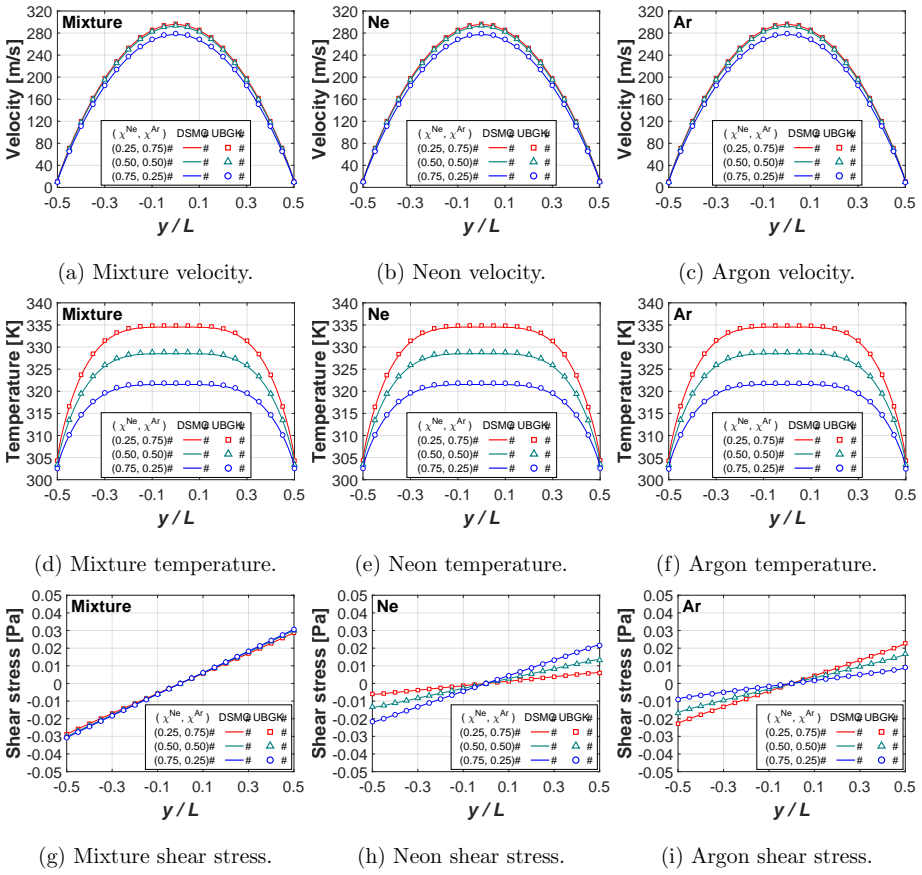
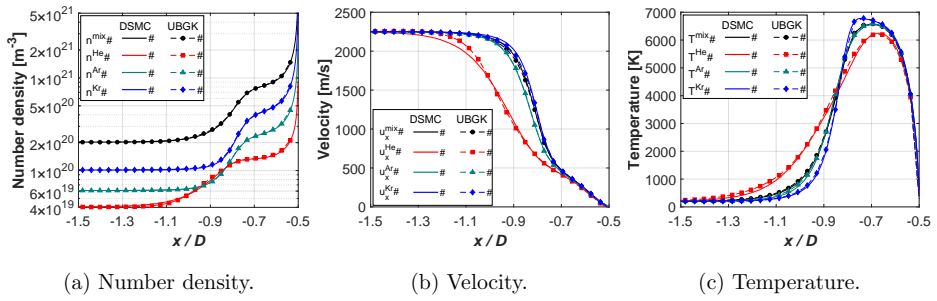
- It reproduces species-dependent velocity and temperature differences in good agreement with DSMC for the tested benchmarks.
- The scheme is more efficient than DSMC once the time step becomes sufficiently large.
- The implementation remains first-order accurate, limiting resolution of sharp non-equilibrium features.
Where Pith is reading between the lines
- The same production-term matching strategy could be applied to polyatomic or reactive mixtures if the corresponding Boltzmann production terms are known.
- Higher-order time or spatial schemes could be combined with the current relaxation model to raise overall accuracy without changing the transport properties.
- The pairwise structure preservation may allow the method to be used as a building block for hybrid kinetic-continuum solvers that treat different species pairs at different fidelity levels.
Load-bearing premise
Matching production terms to the Boltzmann equation in the multi-relaxation particle scheme will produce correct transport coefficients and species-specific non-equilibrium behavior across all flow regimes.
What would settle it
A test case at high Knudsen number and strong species non-equilibrium in which the computed species velocity or temperature profiles deviate systematically from DSMC results at the Navier-Stokes level.
Figures






read the original abstract
Kinetic models based on the Bhatnagar-Gross-Krook (BGK) framework provide an efficient alternative to the Boltzmann equation for rarefied gas flows; however, existing formulations for gas mixtures remain limited in representing pair-dependent relaxation processes and recovering correct Navier-Stokes-Fourier (NSF) transport behavior. A particle-based unified BGK (UBGK) model for monatomic gas mixtures is developed by extending the single-species UBGK framework to a multi-relaxation formulation. The model preserves the pairwise interaction structure of the mixture Boltzmann equation, enabling independent species-pair relaxations for an arbitrary number of species. The relaxation properties of the mixture UBGK model are determined by matching the production terms to those of the Boltzmann equation, ensuring correct NSF-level transport behavior. The model is implemented within the particle framework and validated against DSMC using four benchmark cases: homogeneous relaxation, Poiseuille flow, Couette flow, and hypersonic flow around a cylinder. The results demonstrate that the mixture UBGK model captures species-specific non-equilibrium effects, including species-dependent differences in velocity and temperature, across a range of mole fractions and Knudsen numbers in good agreement with DSMC. Furthermore, cost and accuracy analyses show that the mixture UBGK model becomes more efficient than DSMC at sufficiently large time step sizes, but its first-order accuracy suggests further improvement through higher-order schemes.
Editorial analysis
A structured set of objections, weighed in public.
Referee Report
Summary. The manuscript develops a particle-based multi-relaxation unified BGK (UBGK) model for monatomic gas mixtures by extending the single-species UBGK framework. It preserves the pairwise interaction structure of the Boltzmann equation to enable independent species-pair relaxations for an arbitrary number of species. Relaxation frequencies are obtained by matching the moment production terms of the multi-relaxation UBGK operator to those of the Boltzmann equation, with the goal of recovering correct Navier-Stokes-Fourier transport coefficients. The model is implemented in a stochastic particle framework and validated against DSMC for four cases (homogeneous relaxation, Poiseuille flow, Couette flow, and hypersonic cylinder flow), reporting agreement in species-specific non-equilibrium effects and improved efficiency relative to DSMC at larger time steps.
Significance. If the central claims hold, the work provides a practical, scalable alternative to DSMC for rarefied monatomic mixtures while retaining the pairwise structure of the underlying Boltzmann equation and targeting correct NSF-level transport. The explicit production-term matching procedure and the particle implementation with cost-accuracy analysis are strengths that could benefit simulations of multi-species rarefied flows in aerospace and vacuum applications. The approach avoids ad-hoc fitting by grounding parameters in kinetic theory.
major comments (2)
- [§3] §3 (production-term matching): The relaxation frequencies are determined by equating continuous UBGK moment production terms to the Boltzmann equation. However, the subsequent particle implementation (§4) employs stochastic resampling from pair-specific Maxwellians. No direct verification is provided that the realized discrete production rates recover the matched continuous values to within a controllable statistical tolerance, independent of flow regime or time-step size. This verification is load-bearing for the claim that the particle scheme inherits correct NSF transport behavior.
- [§5] §5 (benchmark results): The four DSMC comparisons show overall agreement, but the manuscript reports no quantitative error norms (e.g., L2 or integrated moment errors) or convergence studies with respect to particle number and time-step size. Without such metrics, it remains unclear whether observed agreement stems from the analytic matching or from numerical compensation in the resampling scheme, particularly in the hypersonic cylinder case where non-equilibrium effects are strongest.
minor comments (2)
- [Abstract] The abstract states that the model has 'first-order accuracy' but does not identify the order of the time integrator or the spatial discretization employed in the particle scheme.
- [Figures] Figure captions for the velocity and temperature profiles would benefit from explicit mention of the number of particles per cell and the statistical sampling uncertainty.
Simulated Author's Rebuttal
We thank the referee for the thorough and constructive review. The comments highlight important aspects of the continuous-to-discrete transition and validation rigor. We address each major comment below and will incorporate revisions to strengthen the manuscript.
read point-by-point responses
-
Referee: [§3] §3 (production-term matching): The relaxation frequencies are determined by equating continuous UBGK moment production terms to the Boltzmann equation. However, the subsequent particle implementation (§4) employs stochastic resampling from pair-specific Maxwellians. No direct verification is provided that the realized discrete production rates recover the matched continuous values to within a controllable statistical tolerance, independent of flow regime or time-step size. This verification is load-bearing for the claim that the particle scheme inherits correct NSF transport behavior.
Authors: We agree that explicit verification of the discrete production rates is necessary to confirm inheritance of the continuous matching. In the revised manuscript we will add a dedicated subsection (likely in §4) that computes the realized moment production rates from the stochastic particle scheme for representative time-step sizes and Knudsen numbers. These will be compared directly to the analytically matched continuous values, with statistical error bars obtained from ensemble averaging. This will demonstrate that the discrete scheme recovers the target production terms to within controllable tolerance across regimes, thereby supporting the NSF transport claim. revision: yes
-
Referee: [§5] §5 (benchmark results): The four DSMC comparisons show overall agreement, but the manuscript reports no quantitative error norms (e.g., L2 or integrated moment errors) or convergence studies with respect to particle number and time-step size. Without such metrics, it remains unclear whether observed agreement stems from the analytic matching or from numerical compensation in the resampling scheme, particularly in the hypersonic cylinder case where non-equilibrium effects are strongest.
Authors: We acknowledge the value of quantitative metrics. The revised manuscript will include L2 and integrated error norms for species velocity, temperature, and heat flux profiles in all four benchmark cases. In addition, we will present convergence studies varying particle number (at fixed time step) and time-step size (at fixed particle number), with particular emphasis on the hypersonic cylinder flow. These will be accompanied by cost-accuracy trade-off curves to show that the observed agreement is consistent with the analytic production-term matching rather than fortuitous compensation. revision: yes
Circularity Check
No significant circularity; derivation matches external Boltzmann production terms and validates against independent DSMC
full rationale
The central derivation determines relaxation frequencies by equating moment production terms of the multi-relaxation UBGK operator to those of the Boltzmann equation. This is a standard construction to enforce desired transport coefficients rather than a self-referential fit or renamed input. The particle implementation is then tested on four independent benchmark flows against DSMC, which itself approximates the Boltzmann equation. No quoted step reduces the claimed preservation of pairwise interactions or NSF behavior to the model's own fitted values by construction. Extension from single-species UBGK is presented as a direct generalization without load-bearing self-citation chains that would require external verification. The skeptic concern about discrete resampling noise is a question of numerical fidelity, not a circular reduction in the analytic chain.
Axiom & Free-Parameter Ledger
free parameters (1)
- species-pair relaxation parameters
axioms (1)
- domain assumption Production terms of the Boltzmann equation for gas mixtures can be matched to define relaxation rates in a BGK-type model while preserving pairwise structure.
Reference graph
Works this paper leans on
-
[1]
Convergence behavior of a new dsmc algorithm,
1G. A. Bird,Molecular Gas Dynamics And The Direct Simulation Of Gas Flows(Oxford University Press, 1994). 2M. Gallis, J. Torczynski, D. Rader, and G. Bird, “Convergence behavior of a new dsmc algorithm,” Journal of Computational Physics228, 4532–4548 (2009). 3E. Jun, “Cubic fokker-planck-dsmc hybrid method for diatomic rarefied gas flow through a slit and...
work page 1994
-
[2]
A particle simulation method for the bgk equation,
22M. N. Macrossan, “A particle simulation method for the bgk equation,” AIP Conference Proceedings585, 426–433 (2001). 23M. Pfeiffer, “Extending the particle ellipsoidal statistical bhatnagar-gross-krook method to diatomic molecules including quantized vibrational energies,” Physics of Fluids30, 116103 (2018). 24J. Mathiaud, L. Mieussens, and M. Pfeiffer,...
work page 2001
discussion (0)
Sign in with ORCID, Apple, or X to comment. Anyone can read and Pith papers without signing in.