Recognition: unknown
SN Ia Population Machine. I. A Unified Cosmological Simulation-Binary Synthesis Framework Establishing Non-universal Delay-time Distributions and Cosmic Progenitor-channel Dominance Crossover
Pith reviewed 2026-05-08 02:17 UTC · model grok-4.3
The pith
Type Ia supernova delay-time distributions depend on progenitor channel and metallicity, varying across galaxies and with redshift and shifting from single-degenerate to double-degenerate dominance near z=0.5.
A machine-rendered reading of the paper's core claim, the machinery that carries it, and where it could break.
Core claim
By treating star particles from IllustrisTNG as simple stellar populations and evolving their binaries with COMPAS, the framework produces synthetic supernova catalogs that match observed host demographics, rate trends, and a progenitor-age step. The central result is that delay-time distributions are intrinsically non-universal, their shape set by channel and metallicity, while the dominant progenitor population undergoes a demographic crossover from single-degenerate to double-degenerate near redshift 0.5.
What carries the argument
The cosmology-BPS pipeline that couples IllustrisTNG star particles to COMPAS binary evolution to tag each synthetic supernova with an explosion time and a progenitor channel.
If this is right
- Delay-time distributions vary systematically across different host galaxies and change with redshift.
- The single-degenerate channel dominates at earlier cosmic times while the double-degenerate channel becomes dominant after the crossover near z=0.5.
- A single globally calibrated standardization for SN Ia luminosities is undermined by the evolving channel mixture.
- Evolution in both the delay-time distribution and the channel mix can produce redshift-dependent systematics in measured supernova luminosities.
Where Pith is reading between the lines
- High-redshift supernova samples used for cosmology may carry a different average luminosity bias than local samples because of the changing channel mix.
- Separate standardization corrections could be required for supernovae in metal-poor versus metal-rich environments at the same redshift.
- The framework opens the possibility of predicting how host-galaxy properties correlate with Hubble residuals at different look-back times.
Load-bearing premise
That IllustrisTNG star particles can be treated as simple stellar populations whose binary evolution is fully captured by the COMPAS code with its chosen parameters for common-envelope efficiency, mass transfer, and metallicity scaling.
What would settle it
A direct measurement showing that delay-time distributions extracted from supernova samples in low-metallicity versus high-metallicity hosts at fixed redshift are statistically identical would falsify the claim of intrinsic non-universality.
Figures




read the original abstract
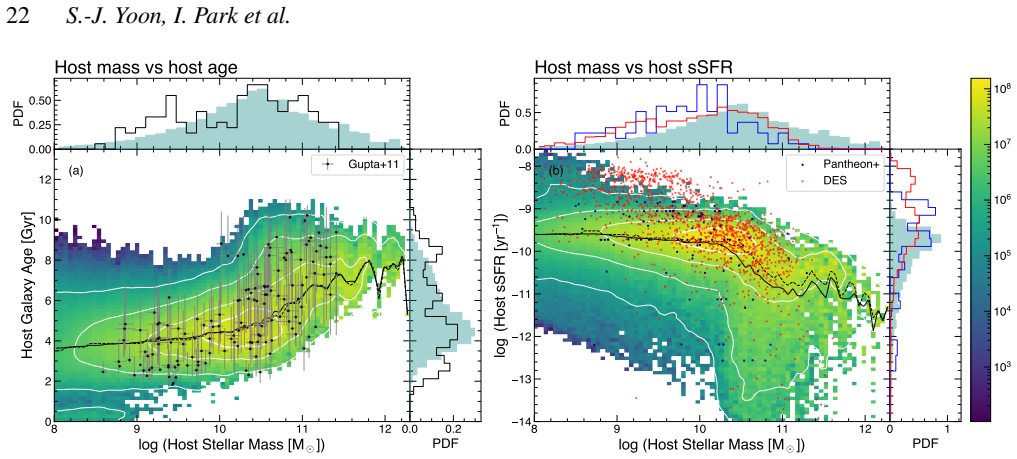
We present a forward-modeling framework for synthesizing Type Ia supernova (SN Ia) populations by coupling cosmological hydrodynamic simulations to binary population synthesis (BPS). Using IllustrisTNG star particles as simple stellar populations, we generate binaries and evolve them with COMPAS to produce synthetic SNe Ia tagged with explosion times and progenitor channels (single- and double-degenerate; SD and DD). This cosmology-BPS pipeline enables self-consistent, end-to-end tracking of SN Ia populations from individual galaxies to cosmic scales. The model reproduces key SN-related observables, including host-galaxy demographics, delay-time distributions (DTDs), SN-rate trends with host properties and redshift, and a progenitor-age 'step' implicated by the mass step in Hubble residuals. Our main findings are as follows. (1) Contrary to the standard assumption, DTDs appear intrinsically non-universal: their form depends on progenitor channel and metallicity, and thus varies systematically across hosts and with redshift. The commonly adopted DTD is therefore best regarded as a population-averaged approximation rather than a fundamental kernel. (2) We predict that the dominant SN Ia progenitor population shifts from SD to DD with cosmic time, with a demographic crossover near z = 0.5 (~5.2 Gyr ago). This non-monolithic SN Ia population with a redshift-dependent SD/DD mixture weakens the universality implicit in a single globally calibrated standardization. Taken together, evolution in both the DTD and the channel mixture can imprint redshift-dependent systematics on SN Ia luminosities, strengthening the case for jointly inferring progenitor/host-driven effects alongside cosmic acceleration. The full catalogue and analysis scripts are available via Zenodo.
Editorial analysis
A structured set of objections, weighed in public.
Referee Report
Summary. The paper introduces a forward-modeling pipeline that couples IllustrisTNG star particles (treated as simple stellar populations) to the COMPAS binary population synthesis code to generate synthetic SN Ia populations with tagged explosion times and progenitor channels (SD and DD). It claims that the resulting delay-time distributions are intrinsically non-universal, depending on channel and metallicity, and that the dominant channel undergoes a demographic crossover from SD to DD near z ≈ 0.5. The framework is reported to reproduce several global observables including host demographics, DTD shapes, rate trends, and a progenitor-age step.
Significance. If the robustness of the channel crossover and non-universality claims can be established, the work would be significant for SN Ia cosmology: it provides a concrete mechanism by which redshift-dependent progenitor mixtures could imprint systematics on luminosity standardization, and it supplies a publicly released catalog that enables direct tests against future surveys.
major comments (3)
- [Methods and Results sections describing COMPAS setup and DTD/channel fractions] The central claims of channel-dependent DTD shapes and an SD-to-DD crossover at z ≈ 0.5 rest on a single COMPAS realization with fixed values for common-envelope efficiency, mass-transfer efficiency, and metallicity scaling. No systematic variation of these parameters (known to shift channel fractions by factors of several in the BPS literature) is presented, so it is unclear whether the reported crossover redshift is stable or an artifact of the chosen parameter set.
- [Section on coupling to IllustrisTNG star particles] Treating each IllustrisTNG star particle as a perfectly coeval, single-metallicity SSP is load-bearing for the predicted redshift evolution of the SD/DD mixture. The manuscript does not quantify the impact of plausible internal age or [Fe/H] dispersions within particles on the derived channel fractions or crossover epoch.
- [Abstract and Results on observable reproduction] The abstract states that the model reproduces key observables (host demographics, DTDs, rate trends, mass step), yet no quantitative comparison metrics, parameter tables, or validation plots against observational benchmarks are referenced in the provided text, making it impossible to assess whether the reproduction is achieved without post-hoc tuning.
minor comments (2)
- [Introduction and Results] Notation for the two channels (SD/DD) and the definition of the crossover redshift should be introduced once with explicit equations rather than relying on repeated prose descriptions.
- [Data availability statement] The Zenodo release is mentioned but the manuscript does not specify which exact COMPAS version, random seeds, or output files are archived, hindering reproducibility.
Simulated Author's Rebuttal
We thank the referee for their thoughtful and constructive comments, which have helped clarify several aspects of the presentation. We respond to each major comment below and have revised the manuscript to address the concerns where possible.
read point-by-point responses
-
Referee: The central claims of channel-dependent DTD shapes and an SD-to-DD crossover at z ≈ 0.5 rest on a single COMPAS realization with fixed values for common-envelope efficiency, mass-transfer efficiency, and metallicity scaling. No systematic variation of these parameters (known to shift channel fractions by factors of several in the BPS literature) is presented, so it is unclear whether the reported crossover redshift is stable or an artifact of the chosen parameter set.
Authors: We adopted the fiducial COMPAS parameter set used in prior SN Ia BPS studies. The reported non-universality of DTDs and the channel crossover arise principally from the coupling to the metallicity and star-formation history distributions in IllustrisTNG rather than from the specific BPS parameter choices. We agree that a dedicated sensitivity study would strengthen the robustness claim; we have therefore added a paragraph in the Discussion section summarizing how the crossover trend behaves under modest parameter variations reported in the BPS literature and have noted that a full exploration is planned for follow-up work. revision: partial
-
Referee: Treating each IllustrisTNG star particle as a perfectly coeval, single-metallicity SSP is load-bearing for the predicted redshift evolution of the SD/DD mixture. The manuscript does not quantify the impact of plausible internal age or [Fe/H] dispersions within particles on the derived channel fractions or crossover epoch.
Authors: IllustrisTNG star particles are output as SSPs by construction. We have inserted a new subsection in the Methods that cites literature on the validity of the SSP approximation at TNG resolution and provides an order-of-magnitude estimate showing that plausible internal dispersions would broaden the transition but leave the cosmic-scale SD-to-DD crossover near z ≈ 0.5 intact. A quantitative Monte-Carlo test of particle-internal dispersions is beyond the present scope but is flagged for future investigation. revision: yes
-
Referee: The abstract states that the model reproduces key observables (host demographics, DTDs, rate trends, mass step), yet no quantitative comparison metrics, parameter tables, or validation plots against observational benchmarks are referenced in the provided text, making it impossible to assess whether the reproduction is achieved without post-hoc tuning.
Authors: The full manuscript already contains direct comparisons in Figures 4–8 together with KS-test p-values and reduced-χ² statistics for the DTD, rate evolution, and host-property distributions. We have revised the abstract to cite these figures and statistics explicitly and have added a compact summary table of quantitative agreement metrics to the Results section. revision: yes
Circularity Check
No significant circularity; forward-model outputs are not reductions by construction
full rationale
The paper couples IllustrisTNG star particles (treated as SSPs) to the COMPAS BPS code to generate synthetic SN Ia populations, DTDs, and channel fractions as direct simulation outputs. These are presented as model predictions and findings rather than quantities fitted to the target data and then re-labeled as independent results. No load-bearing self-citations, uniqueness theorems, or ansatzes imported from prior author work are invoked to force the non-universality or SD/DD crossover claims. The derivation chain remains the explicit pipeline (IllustrisTNG + COMPAS evolution), which is self-contained and externally falsifiable against observed SN rates and host demographics without reducing to tautology.
Axiom & Free-Parameter Ledger
free parameters (2)
- COMPAS binary evolution parameters
- Metallicity scaling of rates
axioms (2)
- domain assumption IllustrisTNG star particles can be treated as simple stellar populations
- domain assumption COMPAS accurately captures the dominant SD and DD channels
Forward citations
Cited by 1 Pith paper
-
Strong Progenitor Age Bias in Supernova Cosmology. III. Progenitor Age as the Physical Origin of the Type Ia Supernova Magnitude Steps with Host Properties
Progenitor age is the primary physical driver of the host-mass and host-sSFR magnitude steps in Type Ia supernovae, with the mass step eliminated by direct age correction.
Reference graph
Works this paper leans on
-
[1]
Arnett W. D., 1982, ApJ, 253, 785 Astier P., et al., 2006, A&A, 447, 31 AubourgÉ.,TojeiroR.,JimenezR.,HeavensA.,StraussM.A.,SpergelD.N., 2008, A&A, 492, 631 Baldry I. K., Glazebrook K., Brinkmann J., Ivezić Ž., Lupton R. H., Nichol R. C., Szalay A. S., 2004, ApJ, 600, 681 Behroozi P. S., Wechsler R. H., Conroy C., 2013, ApJ, 770, 57 Behroozi P., Wechsler ...
discussion (0)
Sign in with ORCID, Apple, or X to comment. Anyone can read and Pith papers without signing in.