Forward modeling solar spectra onto Doppler images of {λ} And
Pith reviewed 2026-05-07 17:56 UTC · model grok-4.3
The pith
A forward model using solar spectra on Doppler temperature maps of λ And shows that starspots can qualitatively reproduce its chromospheric activity modulation.
A machine-rendered reading of the paper's core claim, the machinery that carries it, and where it could break.
Core claim
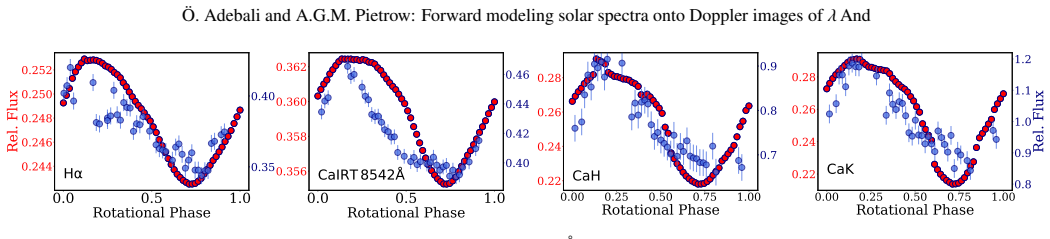
Using this approach, we show that even with simplified assumptions the spectral behavior of λ And can be qualitatively reproduced... spot activity seemingly modulates the chromospheric signal and can explain the bulk of its variations over a rotation.
Load-bearing premise
Due to a lack of publicly available starspot models for its stellar type, we adopt observed solar spectra as the only available approximation of λ And's spots.
Figures
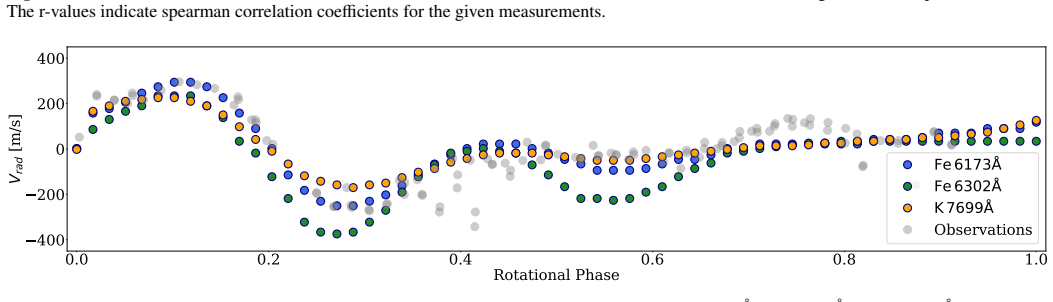
read the original abstract
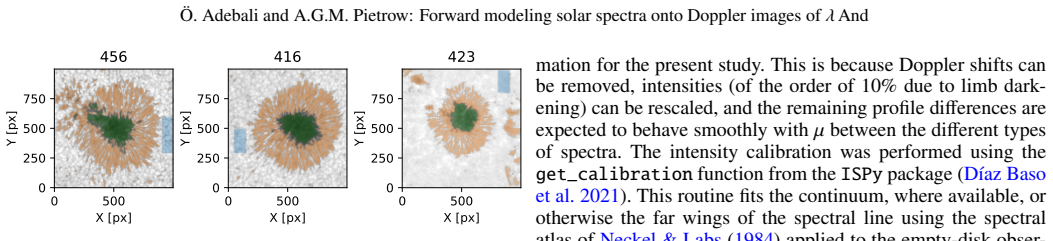
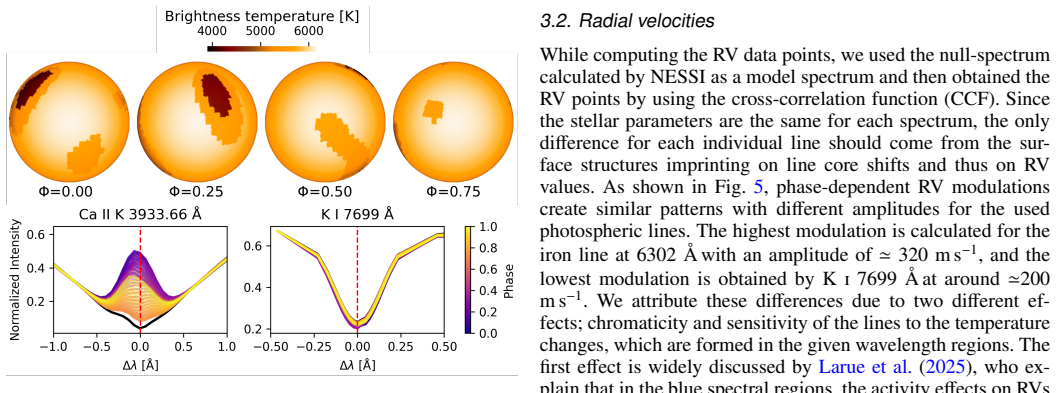
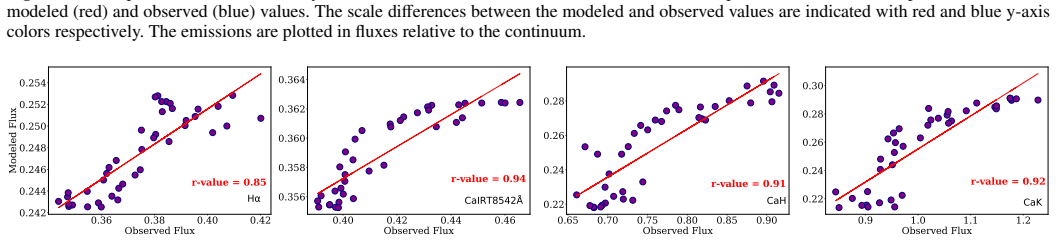
By using the Doppler images of {\lambda} And, we aim to investigate whether surface temperature information can be reversed to create its activity parameters, by feeding a toy model with solar spectra, based on the surface images. At the same time, we examine whether spot contributions alone are sufficient to explain the observed activity modulation of the RS CVn star {\lambda} And while quantifying the differences with the actual observations of this star that are obtained simultaneously with the Doppler images we use. Due to a lack of publicly available starspot models for its stellar type, we adopt observed solar spectra as the only available approximation of {\lambda} And's spots. These spectra are injected into sequence of full disk temperature map derived from Doppler imaging that represent a full stellar rotation. Using this approach, we show that even with simplified assumptions the spectral behavior of {\lambda} And can be qualitatively reproduced. Toy models such as the one presented in this work procure an additional dimension, providing a relation between the surface structures and chromospheric emissions. It also helps to develop a further understanding for the heating mechanisms of these active giants through comparative techniques, where in this case the spot activity seemingly modulates the chromospheric signal and can explain the bulk of its variations over a rotation.
Editorial analysis
A structured set of objections, weighed in public.
Referee Report
Summary. The manuscript presents a forward-modeling approach that injects observed solar spectra into Doppler-derived full-disk temperature maps of the RS CVn star λ And to simulate its chromospheric activity modulation over one stellar rotation. The authors conclude that, even under simplified assumptions, the spectral behavior is qualitatively reproduced and that spot activity can explain the bulk of the observed chromospheric variations.
Significance. If the solar-proxy assumption holds, the work supplies a concrete link between surface temperature inhomogeneities and chromospheric emission, demonstrating that a non-circular forward model can connect independent Doppler images to activity indicators. This comparative technique could be applied to other active giants once better spot spectra become available.
major comments (2)
- The central claim rests on the adoption of solar spectra as a proxy for spots on λ And. The star has Teff ≈ 4800 K and log g ≈ 2.8 while the Sun has 5772 K and log g = 4.44; these differences alter continuum opacity, pressure broadening, and the formation of chromospheric lines (e.g., Ca II H&K). The abstract states that solar spectra are used “due to a lack of publicly available starspot models,” but no quantitative estimate of the resulting uncertainty in modulation amplitude is provided. This approximation directly controls whether the forward model can be said to reproduce the observations even qualitatively.
- The abstract reports only “qualitative agreement” and “the bulk of its variations” without supplying any numerical metrics (correlation coefficient, RMS residual, or fractional variance explained), error bars, or sensitivity tests to the choice of solar spectra versus plausible K-giant spot spectra. Without these, it is impossible to assess how much of the observed signal is actually captured by the spot contribution.
minor comments (2)
- The specific chromospheric diagnostics (wavelength ranges, equivalent-width definitions, or line-core indices) used for the comparison should be stated explicitly in the methods section.
- A short discussion of how the temperature maps are discretized and how the solar spectra are scaled and injected (e.g., area-weighted summation, limb darkening) would improve reproducibility.
Axiom & Free-Parameter Ledger
axioms (2)
- domain assumption Observed solar spectra are a valid approximation for starspot spectra on λ And
- domain assumption Doppler images provide accurate full-disk temperature maps
Reference graph
Works this paper leans on
-
[1]
Adebali, Ö., Strassmeier, K. G., Ilyin, I. V ., et al. 2025, A&A, 695, A89 Adebali, Ö., Weber, M., Strassmeier, K. G., et al. 2026, A&A, 706, A179 Alvarado-Gómez, J. D., Hussain, G. A. J., et al. 2016, A&A, 594, A95 Astropy Collaboration, Price-Whelan, A. M., et al. 2018, AJ, 156, 123 Astropy Collaboration, Price-Whelan, A. M., et al. 2022, ApJ, 935, 167 ...
work page 2025
-
[2]
Avrett, E., Tian, H., Landi, E., Curdt, W., & Wülser, J.-P. 2015, ApJ, 811, 87
work page 2015
- [3]
- [4]
- [5]
-
[6]
Chakraborty, H., Lendl, M., Akinsanmi, B., et al. 2024, A&A, 685, A173
work page 2024
-
[7]
Cretignier, M., Pietrow, A. G. M., & Aigrain, S. 2024, MNRAS, 527, 2940
work page 2024
-
[8]
Cristo, E., Faria, J. P., Santos, N. C., et al. 2025, A&A, 702, A84 De Wilde, M., Pietrow, A. G. M., Druett, M. K., et al. 2025, A&A, 700, A275 Díaz Baso, C. J., Vissers, G., Calvo, F., et al. 2021, in Zenodo Software package, V ol. 56 (Zenodo), 5608441
work page 2025
- [9]
-
[10]
Ellwarth, M., Schäfer, S., Reiners, A., & Zechmeister, M. 2023, A&A, 673, A19
work page 2023
-
[11]
Fontenla, J. M., Avrett, E. H., & Loeser, R. 1993, ApJ, 406, 319 Görgei, A., Kriskovics, L., Vida, K., et al. 2026, A&A, 706, A54
work page 1993
-
[12]
Gray, D. F. 2022, The observation and analysis of stellar photospheres
work page 2022
-
[13]
Hall, D. S. 1972, PASP, 84, 323
work page 1972
- [14]
-
[15]
Hanassi-Savari, F., Pietrow, A. G. M., Druett, M. K., Cretignier, M., & Ellwarth, M. 2025, A&A, 702, A97
work page 2025
-
[16]
Harris, C. R., Millman, K. J., van der Walt, S. J., et al. 2020, Nature, 585, 585 Järvinen, S. P. & Strassmeier, K. G. 2025, A&A, 698, A93 Järvinen, S. P., Strassmeier, K. G., Carroll, T. A., et al. 2018, A&A, 620, A162 K˝ovári, Z., Künstler, A., Strassmeier, K. G., et al. 2016, A&A, 596, A53
work page 2020
-
[17]
Kuckein, C., Balthasar, H., Quintero Noda, C., et al. 2021, A&A, 653, A165
work page 2021
-
[18]
2025, A&A, 701, A216 Lößnitz, E
Larue, P., Delfosse, X., Carmona, A., et al. 2025, A&A, 701, A216 Lößnitz, E. J., Pietrow, A. G. M., Chakraborty, H., et al. 2025, A&A, 703, A187
work page 2025
-
[19]
Martin, J., Fuhrmeister, B., Mittag, M., et al. 2017, A&A, 605, A113
work page 2017
-
[20]
Mittag, M., Schmitt, J. H. M. M., & Schröder, K.-P. 2013, A&A, 549, A117
work page 2013
-
[21]
Moulds, V . E., Watson, C. A., Bonfils, X., et al. 2013, MNRAS, 430, 1709
work page 2013
- [22]
- [23]
-
[24]
Pesnell, W. D., Thompson, B. J., & Chamberlin, P. C. 2012, Sol. Phys., 275, 3 Petit dit de la Roche, D. J. M., Chakraborty, H., et al. 2024, A&A, 692, A83
work page 2012
-
[25]
Pietrow, A. G. M. 2026, The Open Journal of Astrophysics, 9, 58273
work page 2026
-
[26]
Pietrow, A. G. M., Cretignier, M., Druett, M. K., et al. 2024, A&A, 682, A46
work page 2024
-
[27]
Pietrow, A. G. M., Kiselman, D., Andriienko, O., et al. 2023, A&A, 671, A130
work page 2023
-
[28]
Pietrow, A. G. M., Kuckein, C., Verma, M., et al. 2026, A&A, 705, A116
work page 2026
-
[29]
Pietrow, A. G. M. & Pastor Yabar, A. 2024, in IAU Symposium, V ol. 365, Dy- namics of Solar and Stellar Convection Zones and Atmospheres, ed. A. V . Getling & L. L. Kitchatinov, 389–393
work page 2024
-
[30]
2009, A&A, 498, 853 Rödberg, H
Reiners, A. 2009, A&A, 498, 853 Rödberg, H. 1966, Nature, 211, 394
work page 2009
-
[31]
C., Cabral, A., Leite, I., et al
Santos, N. C., Cabral, A., Leite, I., et al. 2025, The Messenger, 194, 21
work page 2025
-
[32]
2017, in SOLARNET IV: The Physics of the Sun from the Interior to the Outer Atmosphere, 85
Scharmer, G. 2017, in SOLARNET IV: The Physics of the Sun from the Interior to the Outer Atmosphere, 85
work page 2017
-
[33]
Scharmer, G. B., Bjelksjo, K., et al. 2003, in Society of Photo-Optical Instrumen- tation Engineers (SPIE) Conference Series, V ol. 4853, Innovative Telescopes and Instrumentation for Solar Astrophysics, ed. S. L. Keil & S. V . Avakyan, 341–350
work page 2003
-
[34]
B., Narayan, G., Hillberg, T., et al
Scharmer, G. B., Narayan, G., Hillberg, T., et al. 2008, ApJ, 689, L69
work page 2008
-
[35]
Scherrer, P. H., Schou, J., Bush, R. I., et al. 2012, Sol. Phys., 275, 207
work page 2012
-
[36]
Simpson, E. R., Fetherolf, T., Kane, S. R., et al. 2022, AJ, 163, 215
work page 2022
-
[37]
Smitha, H. N., Shapiro, A. I., Witzke, V ., et al. 2025, ApJ, 978, L13
work page 2025
-
[38]
Solanki, S. K. 2003, A&A Rev., 11, 153
work page 2003
-
[39]
Solanki, S. K. & Unruh, Y . C. 2004, MNRAS, 348, 307
work page 2004
-
[40]
Strassmeier, K. G. 2009, A&A Rev., 17, 251
work page 2009
- [41]
-
[42]
Wallace, L., Livingston, W. C., Bernath, P. F., & Ram, R. S. 1999, An atlas of the sunspot umbral spectrum in the red and infrared from 8900 to 15,050 cm(-1) (6642 to 11,230 [angstroms]), revised Article number, page 6 of 8 Ö. Adebali and A.G.M. Pietrow: Forward modeling solar spectra onto Doppler images ofλAnd Appendix A: Figures 0 10 20 30 40 0 10 20 30...
work page 1999
discussion (0)
Sign in with ORCID, Apple, or X to comment. Anyone can read and Pith papers without signing in.