Dual-Polarized Massive MIMO Based on Precoding for Vehicle-To-Ground Communication in Urban Rail Transit
Pith reviewed 2026-05-07 15:28 UTC · model grok-4.3
The pith
Dual-polarized MIMO precoding enables high-rate vehicle-to-ground links in urban rail tunnels despite strong cross-polarization.
A machine-rendered reading of the paper's core claim, the machinery that carries it, and where it could break.
Core claim
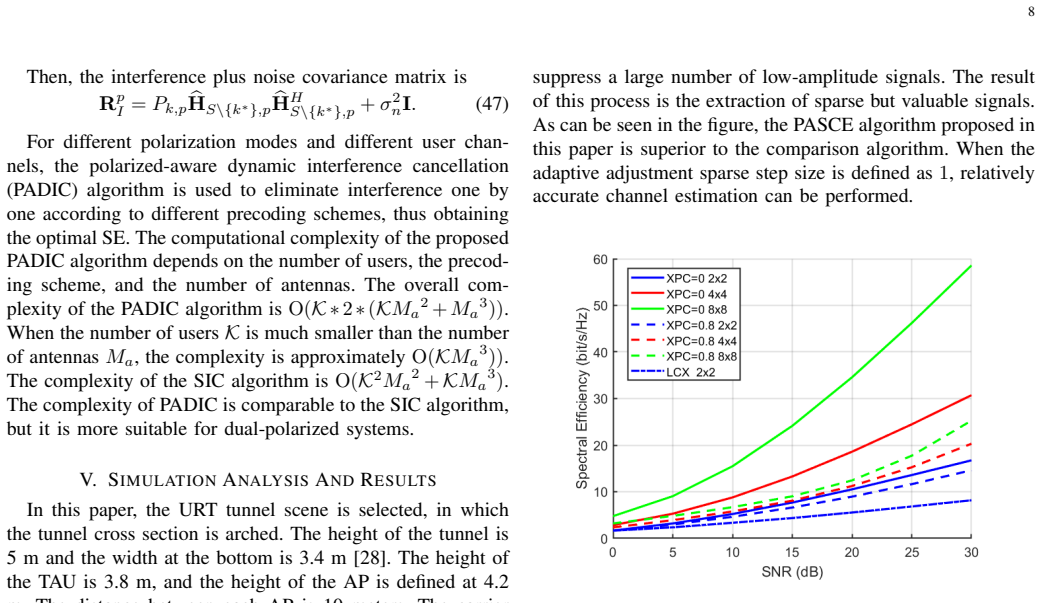
The proposed dual-polarized precoding algorithm, built on the polarized-aware sparse channel estimation method and the polarized-aware dynamic interference cancellation algorithm, can withstand high cross-polarization correlation and improve the efficiency of vehicle-to-ground communication to achieve high rates in urban rail transit scenarios.
What carries the argument
The polarized-aware dynamic interference cancellation (PADIC) algorithm, which removes interference between polarization modes and multiple users after applying MMSE or MR precoding in the dual-polarized setup.
If this is right
- Higher data rates become feasible for vehicle-to-ground links in tunnels without requiring additional spectrum.
- The system continues to deliver performance when cross-polarization correlation is high.
- Closed-form precoding expressions reduce computational load for real-time implementation.
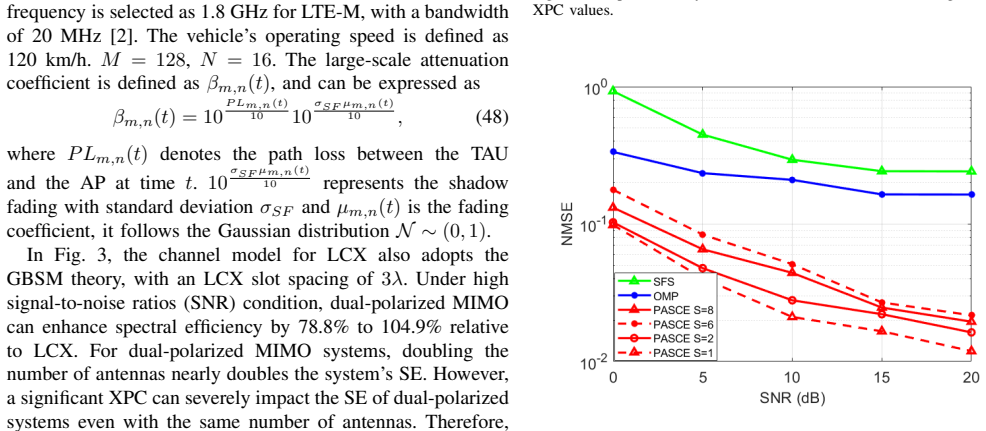
- Polarized-aware channel estimation improves accuracy in the presence of dual-polarization effects.
Where Pith is reading between the lines
- The same architecture might apply to other linear confined spaces such as road tunnels or underground mines where similar geometry and polarization challenges occur.
- Real-world validation would require comparing measured bit-error rates or throughput against the simulated curves under varying train speeds.
- Integration with existing rail signaling could be tested by checking whether the precoding overhead affects latency-critical control messages.
Load-bearing premise
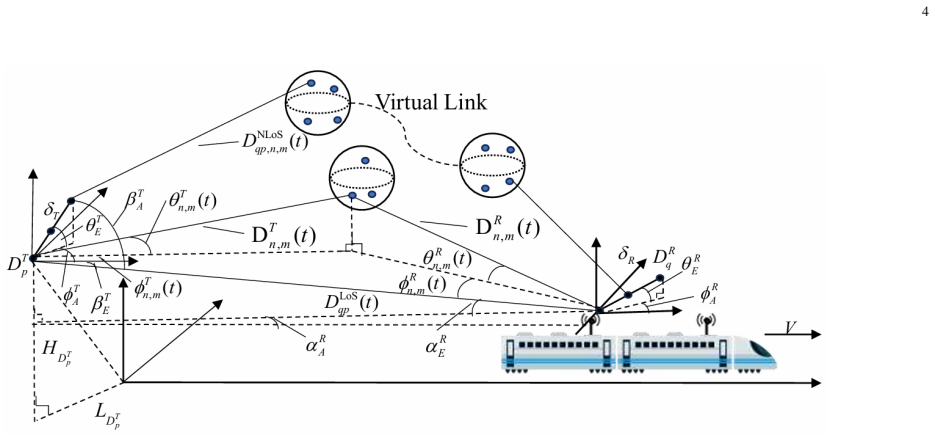
The spatial three-dimensional non-stationary geometry-based stochastic channel model accurately represents real propagation conditions in urban rail transit tunnels, including cross-polarization effects and geometric distributions.
What would settle it
Field measurements in actual urban rail tunnels that show cross-polarization correlation levels or spatial statistics materially different from those assumed in the model would undermine the simulated rate improvements.
Figures

read the original abstract
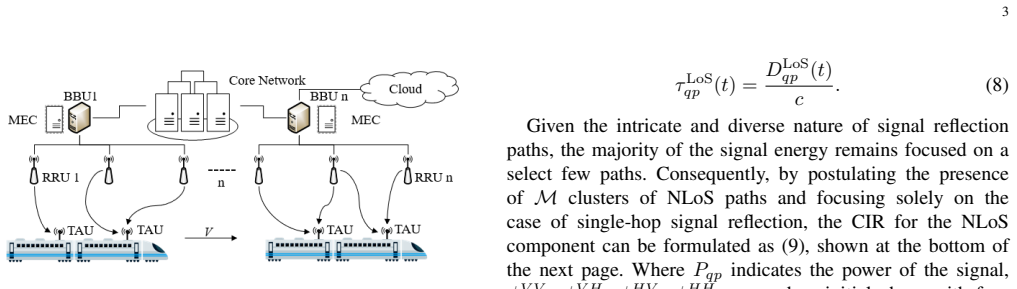
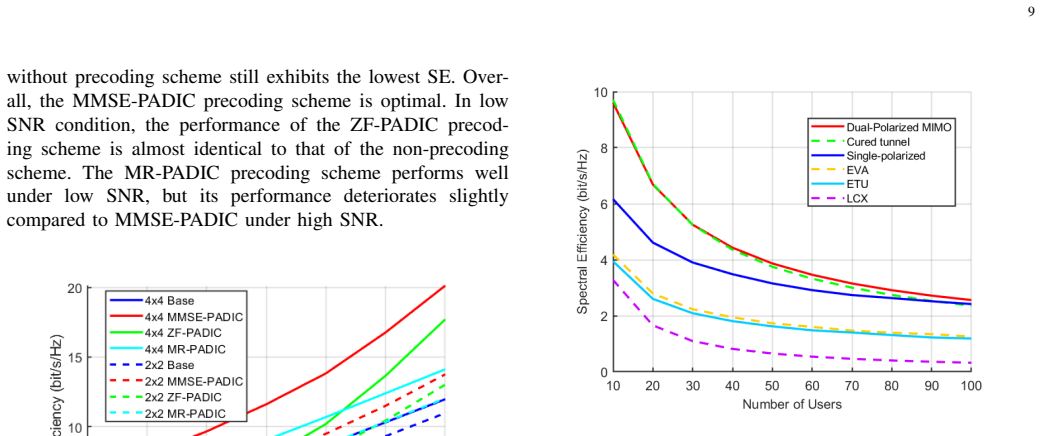
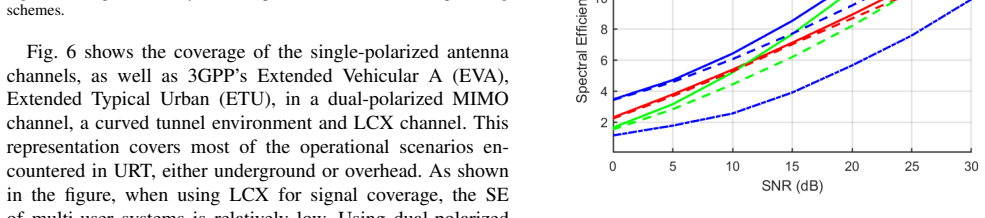
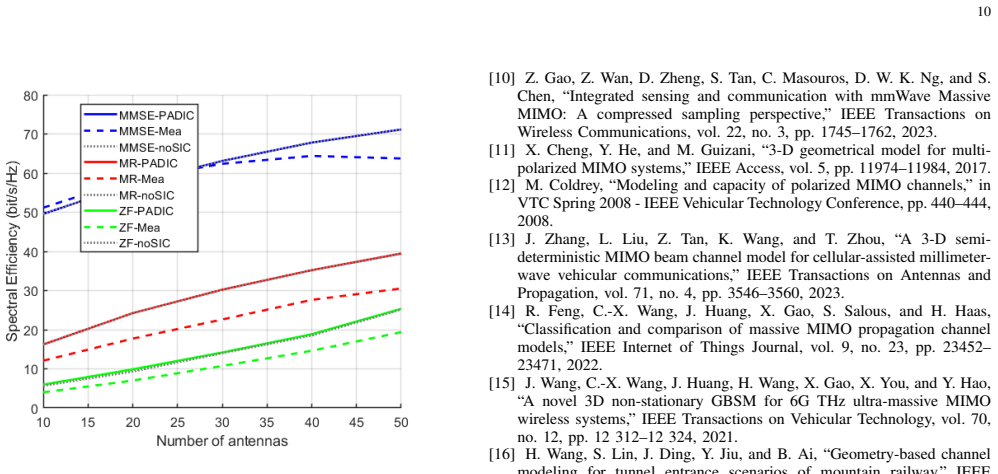
The development of intelligent and diversified ser vices in urban rail transit (URT) has resulted in an increasing de mand for high-rate communication between vehicles and ground equipment. However, existing URT communication systems strug gle to handle the massive data exchange required for vehicle-to ground (V2G) communication. To address this issue, we propose a distributed dual-polarized MIMO architecture suitable for URT tunnel scenarios. Specifically, the channel model is based on spatial three-dimensional (3D) non-stationary geometry-based stochastic model (GBSM), which takes into account the geometric distribution of URT tunnels and the cross-polarization effects between dual-polarized antennas. For dual-polarized MIMO systems, the polarized-aware sparse channel estimation (PASCE) method is proposed for effective channel estimation. Additionally, we derive closed-form expressions for the MMSE and MR precoding schemes. The polarized-aware dynamic interference cancellation (PADIC) algorithm is developed to eliminate in terference between different polarization modes and multiple users. The simulation results demonstrate that the proposed dual-polarized precoding algorithm can withstand high cross polarization correlation (XPC) and improve the efficiency of V2G communication to achieve high rates.
Editorial analysis
A structured set of objections, weighed in public.
Referee Report
Summary. The paper proposes a distributed dual-polarized massive MIMO architecture for vehicle-to-ground (V2G) communication in urban rail transit (URT) tunnels. It develops a spatial 3D non-stationary geometry-based stochastic channel model (GBSM) incorporating tunnel geometry and cross-polarization effects, a polarized-aware sparse channel estimation (PASCE) method, closed-form expressions for MMSE and MR precoding, and a polarized-aware dynamic interference cancellation (PADIC) algorithm. Monte Carlo simulations are presented to demonstrate robustness to high cross-polarization correlation (XPC) and improved data rates.
Significance. If the GBSM accurately captures real URT tunnel propagation statistics and the simulation results generalize, the polarization-aware precoding and cancellation techniques could enable higher-rate V2G links in geometrically constrained environments. The closed-form precoding derivations represent a potential technical contribution for handling non-stationary dual-polarized channels.
major comments (1)
- [Channel Model and Simulation Results] The headline simulation claim that the dual-polarized precoding (PASCE + MMSE/MR + PADIC) withstands high XPC and delivers high rates rests entirely on Monte Carlo results generated from the authors' 3D non-stationary GBSM. No section compares the model's XPC coefficients, scatterer distributions, power angular spectra, or non-stationarity time scales against published measurement campaigns in URT tunnels. If these parameters deviate from reality, the reported interference-cancellation gains become simulator artifacts rather than evidence of practical performance.
minor comments (1)
- [Abstract] Abstract contains line-break artifacts ('ser vices', 'de mand', 'inter ference').
Simulated Author's Rebuttal
We thank the referee for the positive evaluation of our manuscript's technical contributions and for the constructive major comment. We address the concern regarding channel model validation point by point below.
read point-by-point responses
-
Referee: [Channel Model and Simulation Results] The headline simulation claim that the dual-polarized precoding (PASCE + MMSE/MR + PADIC) withstands high XPC and delivers high rates rests entirely on Monte Carlo results generated from the authors' 3D non-stationary GBSM. No section compares the model's XPC coefficients, scatterer distributions, power angular spectra, or non-stationarity time scales against published measurement campaigns in URT tunnels. If these parameters deviate from reality, the reported interference-cancellation gains become simulator artifacts rather than evidence of practical performance.
Authors: We acknowledge this valid concern. Our 3D non-stationary GBSM extends established geometry-based stochastic frameworks for tunnel propagation, with parameters (including XPC coefficients, scatterer distributions, power angular spectra, and non-stationarity timescales) selected to align with statistics reported in prior URT and confined-space measurement literature referenced in the manuscript. To make this grounding explicit, the revised manuscript will add a dedicated paragraph in Section II that directly compares our chosen model parameters against published URT tunnel measurement campaigns. This addition will clarify the link between the simulated performance gains and realistic propagation conditions, strengthening the evidence that the PASCE, MMSE/MR precoding, and PADIC results are not simulator artifacts. revision: yes
Circularity Check
No significant circularity; derivations and simulations remain independent
full rationale
The paper proposes a 3D non-stationary GBSM incorporating tunnel geometry and XPC, derives closed-form MMSE/MR precoders, introduces PASCE and PADIC algorithms, and reports Monte Carlo results showing robustness to high XPC. No equations, parameter-fitting steps, or self-citations are quoted that reduce any claimed prediction or performance metric to the inputs by construction. The model serves as the evaluation environment rather than a fitted surrogate for outcomes, and all algorithmic steps are presented as independent derivations. This is standard simulation-based validation and does not trigger any of the enumerated circularity patterns.
Axiom & Free-Parameter Ledger
Reference graph
Works this paper leans on
-
[1]
Future 5G-oriented system for urban rail transit: Opportunities and challenges,
J. Zhao, J. Liu, L. Yang, B. Ai, and S. Ni, “Future 5G-oriented system for urban rail transit: Opportunities and challenges,” China Communications, vol. 18, no. 2, pp. 1–12, 2021
work page 2021
-
[2]
LTE-M system design and performance test of FAO urban rails,
Y . Pu and H. Zhao, “LTE-M system design and performance test of FAO urban rails,” in 2021 IEEE International Conference on Electronic Technology, Communication and Information (ICETCI), pp. 89–92, 2021
work page 2021
-
[3]
A TP-DDPG algorithm based on cache assistance for task offloading in urban rail transit,
J. Zhao, L. He, D. Zhang, and X. Gao, “A TP-DDPG algorithm based on cache assistance for task offloading in urban rail transit,” IEEE Transac- tions on Vehicular Technology, vol. 72, no. 8, pp. 10671–10681,2023
work page 2023
-
[4]
Dynamic resource allocation for multi-access edge computing in urban rail transit,
Q. Zhang, C. Zhang, J. Zhao, D. Wang, and W. Xu, “Dynamic resource allocation for multi-access edge computing in urban rail transit,” IEEE Transactions on Vehicular Technology, vol. 74, no. 2, pp. 3296–3310, 2025
work page 2025
-
[5]
Dynamic task offloading for mobile edge computing in urban rail transit,
L. He, J. Zhao, X. Sun, and D. Zhang, “Dynamic task offloading for mobile edge computing in urban rail transit,” in 2021 13th Interna- tional Conference on Wireless Communications and Signal Processing (WCSP), pp. 1–5, 2021
work page 2021
-
[6]
Cell-free massive MIMO-OFDM for high-speed train communications,
J. Zheng, J. Zhang, E. Bj ¨ornson, Z. Li, and B. Ai, “Cell-free massive MIMO-OFDM for high-speed train communications,” IEEE Journal on Selected Areas in Communications, vol. 40, no. 10, pp. 2823–2839, 2022
work page 2022
-
[7]
Orthogonal time frequency space modu- lation,
R. Hadani, S. Rakib, M. Tsatsanis, A. Monk, A. J. Goldsmith, A. F. Molisch, and R. Calderbank, “Orthogonal time frequency space modu- lation,” in 2017 IEEE Wireless Communications and Networking Con- ference (WCNC), pp. 1–6, 2017
work page 2017
-
[8]
H. Wymeersch, “Integrated sensing and communications with MIMO- OTFS: ISI/ICI exploitation and delay-doppler multiplexing,” IEEE Transactions on Wireless Communications, vol. 23, no. 8, pp. 10229–10246,2024
work page 2024
-
[9]
Compressive-sensing-based grant-free massive access for 6G massive communication,
Z. Gao, M. Ke, Y . Mei, L. Qiao, S. Chen, D. W. K. Ng, and H. V . Poor, “Compressive-sensing-based grant-free massive access for 6G massive communication,” IEEE Internet of Things Journal, vol. 11, no. 5, pp. 7411–7435, 2024
work page 2024
-
[10]
Integrated sensing and communication with mmWave Massive MIMO: A compressed sampling perspective,
Z. Gao, Z. Wan, D. Zheng, S. Tan, C. Masouros, D. W. K. Ng, and S. Chen, “Integrated sensing and communication with mmWave Massive MIMO: A compressed sampling perspective,” IEEE Transactions on Wireless Communications, vol. 22, no. 3, pp. 1745–1762, 2023
work page 2023
-
[11]
3-D geometrical model for multi- polarized MIMO systems,
X. Cheng, Y . He, and M. Guizani, “3-D geometrical model for multi- polarized MIMO systems,” IEEE Access, vol. 5, pp. 11974–11984, 2017
work page 2017
-
[12]
Modeling and capacity of polarized MIMO channels,
M. Coldrey, “Modeling and capacity of polarized MIMO channels,” in VTC Spring 2008 - IEEE Vehicular Technology Conference, pp. 440–444, 2008
work page 2008
-
[13]
J. Zhang, L. Liu, Z. Tan, K. Wang, and T. Zhou, “A 3-D semi- deterministic MIMO beam channel model for cellular-assisted millimeter- wave vehicular communications,” IEEE Transactions on Antennas and Propagation, vol. 71, no. 4, pp. 3546–3560, 2023
work page 2023
-
[14]
Classification and comparison of massive MIMO propagation channel models,
R. Feng, C.-X. Wang, J. Huang, X. Gao, S. Salous, and H. Haas, “Classification and comparison of massive MIMO propagation channel models,” IEEE Internet of Things Journal, vol. 9, no. 23, pp. 23452– 23471, 2022
work page 2022
-
[15]
A novel 3D non-stationary GBSM for 6G THz ultra-massive MIMO wireless systems,
J. Wang, C.-X. Wang, J. Huang, H. Wang, X. Gao, X. You, and Y . Hao, “A novel 3D non-stationary GBSM for 6G THz ultra-massive MIMO wireless systems,” IEEE Transactions on Vehicular Technology, vol. 70, no. 12, pp. 12 312–12 324, 2021
work page 2021
-
[16]
Geometry-based channel modeling for tunnel entrance scenarios of mountain railway,
H. Wang, S. Lin, J. Ding, Y . Jiu, and B. Ai, “Geometry-based channel modeling for tunnel entrance scenarios of mountain railway,” IEEE Transactions on Antennas and Propagation, vol. 72, no. 3, pp. 2620–2630, 2024
work page 2024
-
[17]
A general 3D non- stationary wireless channel model for 5G and beyond,
J. Bian, C.-X. Wang, X. Gao, X. You, and M. Zhang, “A general 3D non- stationary wireless channel model for 5G and beyond,” IEEE Transactions on Wireless Communications, vol. 20, no. 5, pp. 3211–3224, 2021
work page 2021
-
[18]
C.-X. Wang, Z. Lv, X. Gao, X. You, Y . Hao, and H. Haas, “Pervasive wireless channel modeling theory and applications to 6G GBSMs for all frequency bands and all scenarios,” IEEE Transactions on Vehicular Technology, vol. 71, no. 9, pp. 9159–9173, 2022
work page 2022
-
[19]
3D non- stationary GBSMs for high-speed train tunnel channels,
Y . Liu, L. Feng, J. Sun, W. Zhang, C.-X. Wang, and P. Fan, “3D non- stationary GBSMs for high-speed train tunnel channels,” in 2018 IEEE 87th Vehicular Technology Conference (VTC Spring), pp. 1–5, 2018
work page 2018
-
[20]
T. Zhou, Y . Yang, L. Liu, C. Tao, and Y . Liang, “A dynamic 3-D wide- band GBSM for cooperative massive MIMO channels in intelligent high- speed railway communication systems,” IEEE Transactions on Wireless Communications, vol. 20, no. 4, pp. 2237–2250, 2021
work page 2021
-
[21]
A 3D non- stationary small-scale fading model for 5G high-speed train massive MIMO channels,
Y . Feng, R. Wang, G. Zheng, A. Saleem, and W. Xiang, “A 3D non- stationary small-scale fading model for 5G high-speed train massive MIMO channels,” IEEE Transactions on Intelligent Transportation Sys- tems, vol. 25, no. 11, pp. 16490–16505, 2024
work page 2024
-
[22]
A general 3-D nonstationary GBSM for underground vehicular channels,
H. Chang, C.-X. Wang, Y . Liu, J. Huang, J. Sun, W. Zhang, Z. Bai, K. An, Z. Li, and E.-H. M. Aggoune, “A general 3-D nonstationary GBSM for underground vehicular channels,” IEEE Transactions on Antennas and Propagation, vol. 71, no. 2, pp. 1804–1819, 2023
work page 2023
-
[23]
M. Yusuf, E. Tanghe, P. Laly, F. Challita, B. Lannoo, R. Halili, R. Berkvens, M. Weyn, L. Martens, D. P. Gaillot, M. Lienard, and W. Joseph, “Experimental study on the impact of antenna characteristics on non-stationary V2I channel parameters in tunnels,” IEEE Transactions on Vehicular Technology, vol. 69, no. 11, pp. 12396–12407, 2020
work page 2020
-
[24]
Dual-polarized FDD massive MIMO: A comprehensive framework,
M. B. Khalilsarai, T. Yang, S. Haghighatshoar, X. Yi, and G. Caire, “Dual-polarized FDD massive MIMO: A comprehensive framework,” IEEE Transactions on Wireless Communications, vol. 21, no. 2, pp. 840–854, 2022
work page 2022
-
[25]
¨O. ¨Ozdogan and E. Bj ¨ornson, ”Massive MIMO with dual-polarized antennas,” in IEEE Transactions on Wireless Communications, vol. 22, no. 2, pp. 1448–1463, 2023
work page 2023
-
[26]
Cell-free massive MIMO meets OTFS modulation,
M. Mohammadi, H. Q. Ngo, and M. Matthaiou, “Cell-free massive MIMO meets OTFS modulation,” IEEE Transactions on Communications, vol. 70, no. 11, pp. 7728–7747, 2022
work page 2022
-
[27]
Channel estimation for orthogonal time frequency space (OTFS) massive MIMO,
W. Shen, L. Dai, J. An, P. Fan, and R. W. Heath, “Channel estimation for orthogonal time frequency space (OTFS) massive MIMO,” IEEE Trans- actions on Signal Processing, vol. 67, no. 16, pp. 4204–4217, 2019
work page 2019
-
[28]
A. Saleem, H. Cui, Y . He, and A. Boag, “Channel propagation charac- teristics for massive multiple-input/multiple-output systems in a tunnel environment [measurements corner],” IEEE Antennas and Propagation Magazine, vol. 64, no. 3, pp. 126–142, 2022
work page 2022
-
[29]
X. Zhang, R. He, M. Yang, Z. Qi, Z. Zhang, B. Ai, and R. Chen, “Narrowband channel measurements and statistical characterization in subway tunnels at 1.8 and 5.8 GHz,” IEEE Transactions on Vehicular Technology, vol. 73, no. 7, pp. 10228–10240, 2024
work page 2024
discussion (0)
Sign in with ORCID, Apple, or X to comment. Anyone can read and Pith papers without signing in.