Recognition: unknown
Coherent structures in Newtonian and viscoelastic turbulent planar jets
Pith reviewed 2026-05-07 12:39 UTC · model grok-4.3
The pith
Elasticity-driven streaks in the near field sustain elastic turbulence in viscoelastic planar jets.
A machine-rendered reading of the paper's core claim, the machinery that carries it, and where it could break.
Core claim
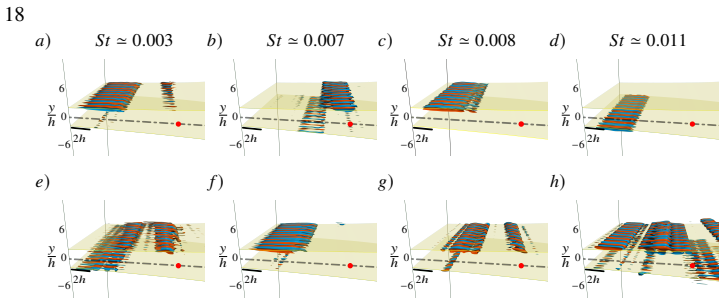
Global flow structures are similar between Newtonian and viscoelastic turbulent planar jets, with low-frequency streaks and high-frequency wave packets dominating the turbulent dynamics. However, structures are strikingly different in the near field, where elasticity-driven streaks affect the dynamics in the potential core of the viscoelastic planar jet, modifying the bulk flow and interacting with the flow instability. The analysis of the polymer field reveals stretched polymer filaments and centre-mode structures, which support the implication of the near-field streaks on sustaining elastic turbulence in three-dimensional viscoelastic planar jets.
What carries the argument
Spatio-temporal Koopman decomposition applied to the velocity and polymer fields, which extracts dominant spatial patterns ordered by frequency and growth rate to isolate the coherent structures.
If this is right
- Elasticity modifies the near-field dynamics of planar jets, producing streaks that alter the potential core and interact with the flow instability.
- Stretched polymer filaments and centre-mode structures appear in the viscoelastic case and correlate with the near-field streaks.
- These near-field features provide a route to sustain elastic turbulence in three-dimensional jets even when inertial effects are weak.
- The global low-frequency streaks and high-frequency wave packets remain comparable to those in Newtonian jets, indicating that elasticity mainly perturbs the near-field region.
Where Pith is reading between the lines
- The same decomposition could be applied to other viscoelastic configurations such as round jets or wakes to test whether near-field streaks play a comparable sustaining role.
- Varying polymer relaxation time or concentration while tracking the strength of near-field streaks would provide a direct test of their causal importance.
- If near-field streaks prove generic, targeted polymer injection near the nozzle exit might offer a practical way to control the onset of elastic turbulence in industrial jets.
Load-bearing premise
That the Koopman decomposition applied to the velocity and polymer fields fully captures the dominant mechanisms without significant truncation error or missing modes that could alter the interpretation of near-field streaks.
What would settle it
A simulation or experiment in which the near-field streaks are selectively suppressed while the polymer field remains unchanged, yet the overall elastic turbulence levels and mixing rates stay the same.
Figures




read the original abstract
The addition of a small amount of long-chain polymers confers viscoelastic properties to Newtonian flows. The resulting non-Newtonian solution now exhibits different dynamics, such as enhanced mixing at low Reynolds, where elastic instabilities can trigger elastic turbulence even though inertial turbulence is absent. Here, we study this phenomenon in viscoelastic planar jets and, in particular, we do it from the perspective of coherent structures to understand how elastic turbulence is triggered and sustained, which remain barely explored in this setup. We introduce the spatio-temporal Koopman decomposition for extracting the dominant flow patterns, and we compare them with those from Newtonian planar jets at high Reynolds number. Global flow structures are similar between jets, with low-frequency streaks and high-frequency wave packets dominating the turbulent dynamics. However, structures are strikingly different in the near field, where elasticity-driven streaks affect the dynamics in the potential core of the viscoelastic planar jet, modifying the bulk flow and interacting with the flow instability. The analysis of the polymer field reveals stretched polymer filaments and centre-mode structures, which support the implication of the near-field streaks on sustaining elastic turbulence in three-dimensional viscoelastic planar jets.
Editorial analysis
A structured set of objections, weighed in public.
Referee Report
Summary. The manuscript uses direct numerical simulations of Newtonian (high-Re) and viscoelastic planar jets to extract coherent structures via a newly introduced spatio-temporal Koopman decomposition applied to velocity and polymer fields. It reports that global structures are similar across both flows, dominated by low-frequency streaks and high-frequency wave packets, but that near-field structures differ markedly in the viscoelastic case: elasticity-driven streaks modify the potential core, interact with the primary instability, and—supported by stretched polymer filaments and centre-mode polymer structures—sustain elastic turbulence in three dimensions.
Significance. If the central interpretation holds, the work offers a concrete mechanistic picture of how elastic turbulence is triggered and maintained in 3-D viscoelastic jets, distinguishing near-field elasticity effects from the inertial mechanisms that dominate farther downstream. The side-by-side comparison with Newtonian jets and the polymer-field analysis provide useful benchmarks for future modeling. The spatio-temporal Koopman approach itself is a methodological contribution whose utility will depend on demonstrated robustness.
major comments (1)
- [Spatio-temporal Koopman decomposition] The claim that near-field elasticity-driven streaks sustain elastic turbulence (abstract and concluding discussion) rests on the retained Koopman modes faithfully representing the dominant dynamics. The skeptic note correctly identifies that finite-mode truncation or choice of observables could omit near-field interactions or polymer-stress contributions that would weaken or reassign this causal role. Without reported residual-energy spectra, mode-convergence tests, or sensitivity to additional observables in the section describing the spatio-temporal Koopman decomposition, the load-bearing interpretation remains vulnerable.
minor comments (2)
- The abstract would be strengthened by stating the specific Reynolds and Weissenberg numbers (or ranges) employed, allowing readers to gauge the inertial versus elastic regime immediately.
- Figure captions and legends should explicitly distinguish Newtonian versus viscoelastic cases and indicate the frequency bands corresponding to the reported streaks and wave packets.
Simulated Author's Rebuttal
Thank you for the constructive feedback on our manuscript. We address the referee's major comment on the spatio-temporal Koopman decomposition below, providing additional evidence and revisions to strengthen the claims regarding the role of near-field structures in sustaining elastic turbulence.
read point-by-point responses
-
Referee: The claim that near-field elasticity-driven streaks sustain elastic turbulence (abstract and concluding discussion) rests on the retained Koopman modes faithfully representing the dominant dynamics. The skeptic note correctly identifies that finite-mode truncation or choice of observables could omit near-field interactions or polymer-stress contributions that would weaken or reassign this causal role. Without reported residual-energy spectra, mode-convergence tests, or sensitivity to additional observables in the section describing the spatio-temporal Koopman decomposition, the load-bearing interpretation remains vulnerable.
Authors: We thank the referee for highlighting the importance of demonstrating the robustness of the Koopman decomposition. While the original manuscript selected modes based on their contribution to the overall energy and frequency content to capture the dominant coherent structures, we acknowledge that explicit residual-energy spectra and convergence tests were not presented. In the revised manuscript, we have added these analyses in the methods section describing the spatio-temporal Koopman decomposition. The residual energy spectra indicate that the retained modes account for the majority of the variance in both velocity and polymer fields, and convergence tests varying the number of modes and including additional polymer stress observables confirm that the near-field elasticity-driven streaks and their interaction with the potential core remain consistent. This supports our interpretation of their role in sustaining elastic turbulence, as further evidenced by the stretched polymer filaments and centre-mode structures identified in the polymer field. We have also clarified this in the abstract and discussion sections. revision: yes
Circularity Check
No significant circularity: claims are observational results from data-driven decomposition
full rationale
The paper performs direct numerical simulations of Newtonian and viscoelastic planar jets and applies a spatio-temporal Koopman decomposition to the resulting velocity and polymer fields to identify coherent structures. All reported findings (global similarity of low-frequency streaks and high-frequency wave packets, near-field differences due to elasticity-driven streaks, stretched polymer filaments, and centre-mode structures) are extracted as dominant modes from the simulated data. No load-bearing step in the abstract or described methodology reduces a prediction to a fitted parameter by construction, invokes a self-citation chain as the sole justification for a uniqueness theorem, or renames a known result under new coordinates. The derivation chain is therefore self-contained as an empirical analysis technique applied to external simulation output, with no self-definitional or fitted-input circularity.
Axiom & Free-Parameter Ledger
axioms (2)
- domain assumption The flow is governed by the incompressible Navier-Stokes equations coupled to a viscoelastic stress tensor.
- domain assumption Koopman decomposition can be applied to the spatio-temporal velocity and polymer fields to extract dominant coherent structures.
Reference graph
Works this paper leans on
-
[1]
I., P´erez, J
Abad´ıa-Heredia, R., L´opez-Mart´ın, M., Carro, B., Arribas, J. I., P´erez, J. M. & Le Clainche, S.2022 A predictive hybrid reduced order model based on proper orthogonal decomposition combined with deep learning architectures.Exp. Syst. With Appl.187, 115910. Amor, C., Corrochano, A., Foggi Rota, G., Rosti, M. E. & Le Clainche, S.2024 Coherent structures...
2022
-
[2]
& Kerswell, R., R.2022 Finite-amplitude elastic waves in viscoelastic channel flow from large to zero Reynolds number.J
Buza, G., Beneitez, M., Page, J. & Kerswell, R., R.2022 Finite-amplitude elastic waves in viscoelastic channel flow from large to zero Reynolds number.J. Fluid Mech.951, A3. Cavalieri, A. V. G., Rodr´ıguez, D., Jordan, P., Colonius, T. & Gervais, Y.2013 Wavepackets in the velocity field of turbulent jets.J. Fluid Mech.730, 559–592. Chen, K. K., Tu, J. H. ...
2022
-
[3]
Fluid Mech.176, 191–219
The linear growth of disturbances near the nozzle.J. Fluid Mech.176, 191–219. Crighton, D. G. & Gaster, M.1976 Stability of slowly diverging jet flow.J. Fluid Mech.77, 397–413. Cros, S. C. & Champagne, F. H.1971 Orderly structure in jet turbulence.J. Fluid Mech.49, 547–591. Da Silva, C. B. & M´etais, O.2002 On the influence of coherent structures upon int...
1976
-
[4]
& Steinberg, V.2004 Elastic turbulence in curvilinear flows of polymer solutions.New J
Groisman, A. & Steinberg, V.2004 Elastic turbulence in curvilinear flows of polymer solutions.New J. Phys.6(1),
2004
-
[5]
& Colonius, T.2011 Instability wave models for the near-field fluctuations of turbulent jets.J
Gudmundsson, K. & Colonius, T.2011 Instability wave models for the near-field fluctuations of turbulent jets.J. Fluid Mech.689, 97–128. Guimar˜aes, M.C., Pimentel, N., Pinho, F.T. & da Silva, C.B.2020 Direct numerical simulations of turbulent viscoelastic jets.J. Fluid Mech.899. Guimar˜aes, M. C., Pinho, F. T. & da Silva, C. B.2023 Viscoelastic jet instab...
2011
-
[6]
Fluid Mech
The near-field region.J. Fluid Mech. 514, 173–204. Kamb, M., Kaiser, E., Brunton, S. & Kutz, N.2020 Time-Delay Observables for Koopman: Theory and Applications.SIAM J. Appl. Dyn. Sys.19, 886–917. Keunings, R.1986 On the high Weissenberg number problem.J. Non-Newton. Fluid Mech.20, 209–226. Khalid, M., Chaudhary, I., Garg, P., V., Shankar & G., Subramanian...
2020
-
[7]
Le Clainche, S., Vega, J. M. & Soria, J.2017 Higher order dynamic mode decomposition of noisy experimental data: The flow structure of a zero-net-mass-flux jet.Exp. Therm. and Fluid Sci.88, 336–353. Lellep, M., Linkmann, M. & Morozov, A.2024 Purely elastic turbulence in pressure-driven channel flows. Proc. Natl. Acad. Sci.121, e2318851121. Lewy, T. & Kers...
2017
-
[8]
Singh, R. K. & Rosti, M. E.2025 The interplay of inertia and elasticity in polymeric flows.J. Fluid Mech. 1018, A24. Soligo, G., Chiarini, A. & Rosti, M. E.2025 Reynolds number effect on the flow statistics and turbulent- non-turbulent interface of a planar jet.J. Fluid Mech.1016, A37. Soligo, G. & Rosti, M.E.2023 Non-Newtonian turbulent jets at low-Reyno...
2025
-
[9]
Fluid Mech.612, 107–141
Proper orthogonal decomposition.J. Fluid Mech.612, 107–141. Tissot, G, Laj ´us, F. C., Cavalieri, A. V. G. & Jordan, P.2017 Wave packets and Orr mechanism in turbulent jets.Phys. Rev. Fluids2, 093901. Tucker, L.1966 Some mathematical notes on three-mode factor analysis.Psikometrica31, 279–311. Valente, P.C., Da Silva, C.B. & Pinho, F.T.2014 The effect of ...
2017
discussion (0)
Sign in with ORCID, Apple, or X to comment. Anyone can read and Pith papers without signing in.