Geometric-Configuration Modulation: A Novel Free-Space Optical Communication Paradigm for D/r₀sim 5 Turbulence Resistance
Pith reviewed 2026-05-07 11:18 UTC · model grok-4.3
The pith
Geometric-Configuration Modulation enables free-space optical links to resist strong turbulence without adaptive optics.
A machine-rendered reading of the paper's core claim, the machinery that carries it, and where it could break.
Core claim
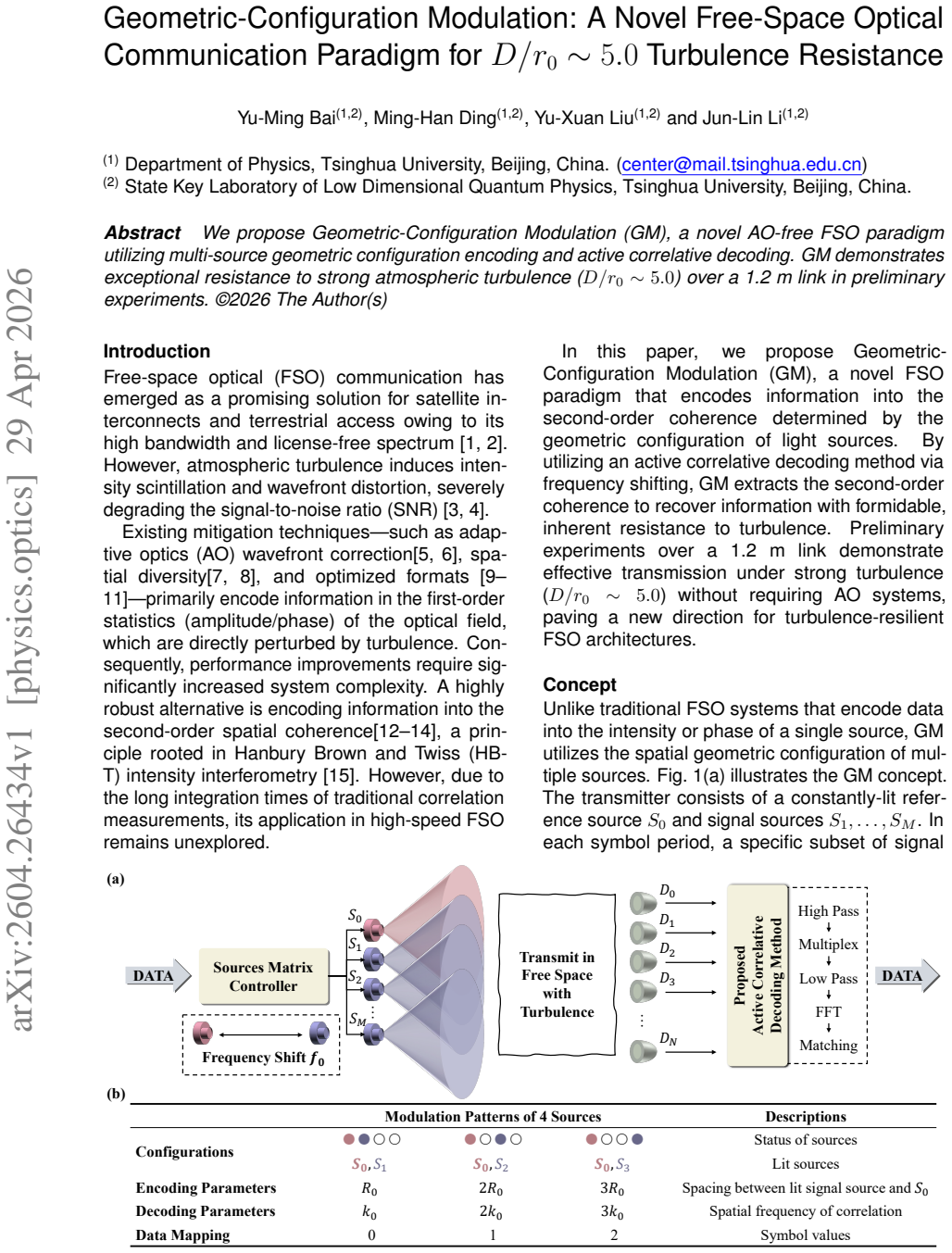
Geometric-Configuration Modulation (GM) is a novel adaptive-optics-free free-space optical communication paradigm that employs multi-source geometric configuration encoding combined with active correlative decoding, enabling exceptional resistance to strong atmospheric turbulence characterized by D/r0 approximately 5, as shown in preliminary experiments conducted over a 1.2 meter link.
What carries the argument
Multi-source geometric configuration encoding paired with active correlative decoding, which places information in the spatial arrangement of multiple optical sources and recovers it by correlating the received intensity patterns against expected templates.
If this is right
- Free-space optical systems can operate in strong turbulence without adaptive optics hardware.
- Multi-source spatial encoding supplies redundancy that survives beam distortions caused by the atmosphere.
- Active correlative decoding extracts the original data by matching received patterns rather than correcting wavefronts.
- Short-range FSO links become viable under turbulence levels previously requiring complex mitigation.
Where Pith is reading between the lines
- If the encoding survives scaling to longer paths, GM could cut the hardware cost of outdoor FSO deployments.
- The geometric approach might combine with conventional intensity or phase modulation to increase data rate further.
- Repeating the test at different link lengths and turbulence strengths would map the practical operating range.
- Similar multi-source geometric patterns could be explored for acoustic or radio links facing scattering media.
Load-bearing premise
That the geometric encoding and correlative decoding will continue to extract clean signals from turbulence-distorted beams without adaptive optics when the link moves beyond the short tested distance.
What would settle it
An experiment that repeats the 1.2 m link under D/r0 approximately 5 turbulence and measures bit-error rates above the acceptable threshold or complete decoding failure when using the GM scheme.
Figures


read the original abstract
We propose Geometric-Configuration Modulation (GM), a novel AO-free FSO paradigm utilizing multi-source geometric configuration encoding and active correlative decoding. GM demonstrates exceptional resistance to strong atmospheric turbulence ($D/r_{0}\sim 5$) over a 1.2 m link in preliminary experiments.
Editorial analysis
A structured set of objections, weighed in public.
Referee Report
Summary. The manuscript proposes Geometric-Configuration Modulation (GM), a novel AO-free free-space optical communication paradigm that employs multi-source geometric configuration encoding together with active correlative decoding. It asserts that this scheme exhibits exceptional resistance to strong atmospheric turbulence (D/r0 ∼ 5) on the basis of preliminary experiments conducted over a 1.2 m link.
Significance. If the central claim were supported by quantitative, scalable data, GM could represent a meaningful simplification for turbulence-resilient FSO links by removing the requirement for adaptive optics. The approach is conceptually distinct from conventional intensity or phase modulation schemes, but the present evidence base is too preliminary to assess practical significance.
major comments (2)
- [Abstract] Abstract: the headline claim of exceptional turbulence resistance at D/r0 ∼ 5 is supported only by an abstract-level reference to “preliminary experiments”; no quantitative metrics (e.g., BER, scintillation index, Strehl ratio), baseline comparisons against conventional FSO formats, turbulence characterization (Rytov variance, inner/outer scale), or statistical analysis are supplied.
- [Experimental validation] Experimental validation section: the 1.2 m link length cannot reproduce the integrated statistics of scintillation, beam wander, or spatial coherence loss that occur over practical FSO distances (tens to hundreds of meters); no scaling analysis, Fresnel-number dependence, or longer-path data are provided to justify extrapolation of the observed resistance.
minor comments (1)
- [Introduction] Notation for D/r0 should be defined explicitly on first use and used consistently; the symbol r0 is introduced without reference to the standard Fried parameter definition.
Simulated Author's Rebuttal
We thank the referee for the thoughtful and constructive review of our manuscript on Geometric-Configuration Modulation (GM). We address each major comment point by point below, indicating where revisions will be made to strengthen the presentation of our preliminary results.
read point-by-point responses
-
Referee: [Abstract] Abstract: the headline claim of exceptional turbulence resistance at D/r0 ∼ 5 is supported only by an abstract-level reference to “preliminary experiments”; no quantitative metrics (e.g., BER, scintillation index, Strehl ratio), baseline comparisons against conventional FSO formats, turbulence characterization (Rytov variance, inner/outer scale), or statistical analysis are supplied.
Authors: We agree that the abstract would benefit from explicit quantitative support. In the revised manuscript we will expand the abstract to include key measured values (BER under turbulence, scintillation index, and Strehl ratio) together with the experimental turbulence parameters (Rytov variance, D/r0) and a brief statement of comparison to conventional intensity modulation. These metrics are already reported in the full experimental section and can be summarized concisely without altering the preliminary nature of the work. revision: yes
-
Referee: [Experimental validation] Experimental validation section: the 1.2 m link length cannot reproduce the integrated statistics of scintillation, beam wander, or spatial coherence loss that occur over practical FSO distances (tens to hundreds of meters); no scaling analysis, Fresnel-number dependence, or longer-path data are provided to justify extrapolation of the observed resistance.
Authors: The 1.2 m link was deliberately chosen to enable controlled, repeatable generation of D/r0 ∼ 5 turbulence in a laboratory setting while isolating the geometric-configuration encoding and correlative decoding mechanisms. We acknowledge that this distance does not capture the full cumulative propagation effects present over longer paths. In the revision we will add a theoretical scaling discussion based on the Rytov approximation and Fresnel-number considerations to indicate how the observed resistance may translate to longer links; however, we do not possess experimental data from extended paths at this stage. revision: partial
- Absence of experimental data over longer propagation distances (tens to hundreds of meters) to fully validate scalability of the observed turbulence resistance.
Circularity Check
No circularity: experimental proposal without self-referential derivations or fits
full rationale
The manuscript presents Geometric-Configuration Modulation as a novel AO-free FSO encoding/decoding scheme whose performance is asserted via preliminary short-link (1.2 m) experiments at D/r0∼5. No equations, parameter-fitting procedures, uniqueness theorems, or self-citations appear in the provided text that would reduce any claimed result to an input by construction. The central claim is therefore an empirical observation rather than a derived quantity that loops back on itself. The skeptic concern about link-length scaling is a question of external validity, not circularity in the paper's own chain.
Axiom & Free-Parameter Ledger
Reference graph
Works this paper leans on
-
[1]
Free-space optical communications
V. W. Chan, “Free-space optical communications”,Jour- nal of Lightwave technology, vol. 24, no. 12, pp. 4750– 4762, 2006.DOI:10.1109/JLT.2006.885252
-
[2]
Optical wireless communication –recent progresses and future perspectives
C. W. Chow, “Optical wireless communication –recent progresses and future perspectives”,Journal of Light- wave Technology, pp. 1–15, 2025.DOI: 10.1109/JLT. 2025.3607690
work page doi:10.1109/jlt 2025
-
[3]
I. A. Alimi and P . P . Monteiro, “Revolutionizing free-space optics: A survey of enabling technologies, challenges, trends, and prospects of beyond 5g free-space optical (fso) communication systems”,Sensors, vol. 24, no. 24, p. 8036, 2024.DOI:10.3390/s24248036
-
[4]
Influence of atmo- spheric turbulence on fso link performance
G. Xu, X. Zhang, J. Wei, and X. Fu, “Influence of atmo- spheric turbulence on fso link performance”, inOptical Transmission, Switching, and Subsystems, vol. 5281, SPIE, pp. 816–823.DOI:10.1117/12.523470
-
[5]
Personalized federated learning based adaptive optical compensation for atmospheric turbu- lence
S. Song, Q. He, Y . Liu, P . Wu, Q. Sun, L. Zhao, T. Wu, and L. Guo, “Personalized federated learning based adaptive optical compensation for atmospheric turbu- lence”,Journal of Lightwave Technology, vol. 43, no. 1, pp. 177–189, 2024.DOI:10.1109/JLT.2024.3447118
-
[6]
H. Zhou, X. Su, Y . Duan, Y . Zuo, Z. Jiang, M. Ramakrish- nan, J. Tepper, V. Ziegler, R. W. Boyd, M. Tur, and A. E. Willner, “Automatic mitigation of dynamic atmospheric turbulence using optical phase conjugation for coher- ent free-space optical communications”,Optica, vol. 12, no. 2, pp. 158–167, Feb. 2025.DOI: 10.1364/OPTICA. 541823
-
[7]
Novel approximate distribution of the generalized turbulence channels for mimo fso communications
W. M. Shakir, A. S. Mahdi, H. Hamdan, J. Charafeddine, H. Al Satai, R. Akrache, S. Haddad, and J. Sayah, “Novel approximate distribution of the generalized turbulence channels for mimo fso communications”,IEEE Photonics Journal, vol. 16, no. 4, pp. 1–15, 2024.DOI: 10.1109/ JPHOT.2024.3418371
-
[8]
Field demon- stration of turbulence-resilient self-coherent free-space optical communications
D. McDonald, R. Bellossi, and S. Gladysz, “Field demon- stration of turbulence-resilient self-coherent free-space optical communications”,Journal of Lightwave Technol- ogy, 2025.DOI:10.1109/JLT.2025.3564551
-
[9]
Turbulence-resilient oam-poisk with 21.92 db sensitivity gain in fsoc direct detection system
C. Chen, H. Zhang, Y . Wei, Z. Li, C. Shen, J. Zhang, H. Cai, N. Chi, and J. Shi, “Turbulence-resilient oam-poisk with 21.92 db sensitivity gain in fsoc direct detection system”, in2025 European Conference on Optical Com- munications (ECOC), IEEE, pp. 1–4.DOI: 10 . 1109 / ECOC66593.2025.11263428
-
[10]
Y . Wang, R. Zeng, Y . Duan, H. Zhou, Z. Jiang, H. Wu, G. Bashan, Y . Zuo, M. Ramakrishnan, and Z. Zhao, “Attenuation-resilient 1-gbit/s ook underwater free-space optical communications using a longitudinally structured multi-kz bessel beam”, in2025 European Conference on Optical Communications (ECOC), IEEE, pp. 1–4.DOI: 10.1109/ECOC66593.2025.11263129
-
[11]
Y . Zuo, H. Zhou, Z. Jiang, A. Alhaddad, W. Ko, Y . Wang, Z. Zhao, A. Ross, A. T. Heiniger, and J. Scheuer, “Demonstration of a mid-ir fso link achieving complex data modulation and a tuneable wavelength covering 4-5 µm based on a 1.55- µm-pumped opo”, in2025 Euro- pean Conference on Optical Communications (ECOC), IEEE, pp. 1–4.DOI: 10 . 1109 / ECOC66593 ...
work page 2025
-
[12]
Electromagnetic hanbury brown and twiss effect in atmospheric turbulence
O. Korotkova and Y . Ata, “Electromagnetic hanbury brown and twiss effect in atmospheric turbulence”, Photonics, vol. 8, no. 6, 2021.DOI: 10 . 3390 / photonics8060186
work page 2021
-
[13]
The physics of turbulence-free ghost imaging
Y . Shih, “The physics of turbulence-free ghost imaging”, Technologies, vol. 4, no. 4, p. 39, 2016.DOI: 10.3390/ technologies4040039
work page 2016
-
[14]
Optical intensity interferometry through atmospheric turbulence
P . K. Tan, A. H. Chan, and C. Kurtsiefer, “Optical intensity interferometry through atmospheric turbulence”,Monthly Notices of the Royal Astronomical Society, vol. 457, no. 4, pp. 4291–4295, 2016.DOI: 10 . 1093 / mnras / stw288
work page 2016
-
[15]
Interferometry of the intensity fluctuations in light iii. applications to astron- omy
R. H. Brown and R. Q. Twiss, “Interferometry of the intensity fluctuations in light iii. applications to astron- omy”,Proceedings of the Royal Society of London. A. Mathematical and Physical Sciences, vol. 248, no. 1253, pp. 199–221, 1958.DOI:10.1098/rspa.1958.0239
-
[16]
Recent progress in semiconductor excitable lasers for photonic spike processing,
C. Peters, V. Cocotos, and A. Forbes, “Structured light in atmospheric turbulence—a guide to its digital imple- mentation: Tutorial”,Advances in Optics and Photonics, vol. 17, no. 1, pp. 113–184, 2025.DOI: 10.1364/AOP. 538883
work page doi:10.1364/aop 2025
discussion (0)
Sign in with ORCID, Apple, or X to comment. Anyone can read and Pith papers without signing in.