Unveiling the dynamics of the ultra-fast outflow in IRAS 13224-3809 with X-ray spectroscopy
Pith reviewed 2026-05-07 10:34 UTC · model grok-4.3
The pith
IRAS 13224-3809 hosts a variable ultra-fast outflow exceeding 0.2c that accelerates rapidly during X-ray flares.
A machine-rendered reading of the paper's core claim, the machinery that carries it, and where it could break.
Core claim
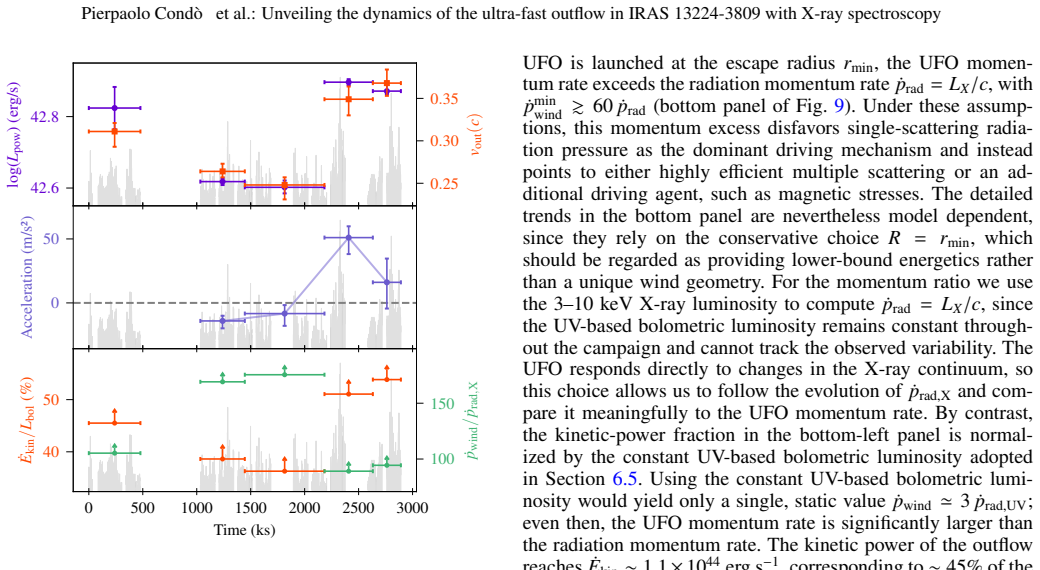
The source harbors a strong, variable ultra-fast outflow with velocities exceeding 0.2c. Absorption-inclusive models reveal a velocity-luminosity correlation of the UFO, persistently large line widths, and no compelling equivalent-width-flux anti-correlation. Clear evidence exists for rapid acceleration of the wind in response to X-ray flares. The outflow carries momentum and kinetic power sufficient to drive efficient AGN feedback, and the rapid response favors magnetic driving over radiative acceleration. The observed variability and structure are consistent with a multiphase, clumpy wind produced by instabilities, with magnetic reconnection providing the acceleration mechanism.
What carries the argument
Uniform application of photo-ionized absorption, broad emission, and relativistic reflection models to time- and flux-resolved X-ray spectra selected with equal counts from the combined 1.5 Ms XMM-Newton and 500 ks NuSTAR observations.
If this is right
- The UFO can drive efficient AGN feedback.
- Magnetic reconnection supplies the rapid acceleration mechanism.
- The wind is multiphase and clumpy due to thermal and hydrodynamic instabilities.
- Prior contrasting claims about the outflow are reconciled.
- High-resolution spectroscopy is needed to resolve wind substructure.
Where Pith is reading between the lines
- Similar acceleration and clumpy structure may appear in other AGN, altering models of how winds shape galaxies.
- Simulations of magnetic reconnection in coronae could be tested against the observed flare response times.
- Future high-resolution X-ray instruments could map the wind's velocity substructure and confirm the driving mechanism.
Load-bearing premise
The absorption features are correctly attributed to a photo-ionized ultra-fast outflow rather than mimicked by emission or relativistic reflection components, and the spectral selections do not introduce systematic biases.
What would settle it
High-resolution spectra or detailed fits that fully account for all features using only relativistic reflection or emission components, without any outflow, or data showing no velocity changes tied to X-ray flares.
Figures


read the original abstract
IRAS 13224-3809 is one of the most intensively studied narrow-line Seyfert 1 galaxies, with a rich literature reporting diverse and sometimes contrasting interpretations of its complex X-ray spectra and variability. Notably, a fast and variable ultra-fast outflow (UFO) was discovered in this source, sparking debate over its nature and driving mechanisms. Motivated by these open questions, we present a systematic, time- and flux-resolved reanalysis of the full 2016 XMM-Newton (1.5 Ms) and NuSTAR (500 ks) datasets, employing careful background treatment and equal-count spectral selections. We uniformly apply three spectral models, including photo-ionized absorption, broad emission, and relativistic reflection, to all intervals. We unambiguously confirm the presence of a strong, variable outflow with velocities exceeding 0.2$c$, and find that models including absorption consistently reveal robust physical trends: a velocity-luminosity correlation of the UFO, persistently large line widths, and no compelling equivalent-width-flux anti-correlation. When emission or reflection components are included, the significance of the absorption features decreases, but significant UFO detections remain in most intervals. We also report clear evidence for rapid acceleration of the wind in response to X-ray flares, with the outflow carrying momentum and kinetic power sufficient to drive an efficient AGN feedback. The observed rapid response favors magnetic driving, analogous to coronal mass ejections, over radiative acceleration. Our results reconcile contrasting previous claims and underline the need for high-resolution spectroscopy to resolve the wind substructure. The observed UFO variability and structure are consistent with a multiphase, clumpy wind produced by thermal and hydrodynamic instabilities, with magnetic reconnection providing the rapid acceleration mechanism.
Editorial analysis
A structured set of objections, weighed in public.
Referee Report
Summary. The paper presents a systematic time- and flux-resolved reanalysis of the full 2016 XMM-Newton (1.5 Ms) and NuSTAR (500 ks) datasets for the narrow-line Seyfert 1 galaxy IRAS 13224-3809. It employs equal-count spectral selections and careful background treatment, uniformly applying three spectral models (photo-ionized absorption, broad emission, and relativistic reflection) to all intervals. The central claims are an unambiguous confirmation of a strong, variable ultra-fast outflow (UFO) with velocities exceeding 0.2c, robust physical trends including a velocity-luminosity correlation, persistently large line widths, and no compelling equivalent-width-flux anti-correlation, plus clear evidence for rapid acceleration of the wind in response to X-ray flares. The analysis concludes that the outflow carries sufficient momentum and kinetic power for efficient AGN feedback, favors magnetic driving (analogous to coronal mass ejections) over radiative acceleration, and is consistent with a multiphase clumpy wind from thermal/hydrodynamic instabilities.
Significance. If the attribution of the absorption features to a photo-ionized UFO holds after addressing model degeneracies and if the reported trends are insensitive to binning choices, the work would be significant for reconciling prior contrasting interpretations of this intensively studied source, constraining AGN wind driving mechanisms, and quantifying feedback efficiency in highly variable NLS1s. The systematic application of multiple models to extensive datasets and the emphasis on high-resolution spectroscopy needs are strengths; the observational nature provides falsifiable trends against external luminosity and flare timing.
major comments (3)
- [Abstract and results] Abstract and results section: The claim of 'unambiguous confirmation' of the UFO (v > 0.2c) and 'robust physical trends' is undercut by the explicit statement that adding broad emission or relativistic reflection components decreases the significance of the absorption features (though detections remain in most intervals). Because the three models are applied separately rather than jointly, it remains possible that the features are partially mimicked by emission or reflection, which would propagate into the velocity-luminosity correlation, large line widths, and flare-driven acceleration inferences.
- [Methods] Methods section on data reduction and spectral selections: The equal-count time/flux binning and background treatment are described in detail, but the manuscript does not report tests against alternative binning schemes or background subtraction methods to quantify their effect on the fitted outflow velocity, ionization parameter, column density, and derived trends (e.g., velocity-luminosity correlation).
- [Spectral modeling and discussion] Spectral modeling and discussion: The inference of magnetic driving (analogous to coronal mass ejections) over radiative acceleration rests on the rapid response to flares and the absence of an equivalent-width-flux anti-correlation, but this is sensitive to the model-dependent significance of the absorption features; a joint fit including absorption + emission + reflection would be needed to assess whether the trends and driving-mechanism conclusion remain load-bearing.
minor comments (2)
- [Abstract] The abstract states 'persistently large line widths' without quoting typical values or uncertainties; these should be summarized quantitatively in the results with reference to specific intervals or tables.
- [Figures and results] Figure captions and text could more explicitly label the time/flux intervals used for the equal-count selections to aid reproducibility.
Simulated Author's Rebuttal
We thank the referee for the constructive and detailed review of our manuscript. We address each major comment below, providing our responses and indicating the revisions we will implement.
read point-by-point responses
-
Referee: [Abstract and results] Abstract and results section: The claim of 'unambiguous confirmation' of the UFO (v > 0.2c) and 'robust physical trends' is undercut by the explicit statement that adding broad emission or relativistic reflection components decreases the significance of the absorption features (though detections remain in most intervals). Because the three models are applied separately rather than jointly, it remains possible that the features are partially mimicked by emission or reflection, which would propagate into the velocity-luminosity correlation, large line widths, and flare-driven acceleration inferences.
Authors: The manuscript already notes that absorption features remain significantly detected in most intervals even after including emission or reflection components. We maintain that this supports a strong confirmation of the UFO, with the reported trends derived from the physically motivated photo-ionized absorption model. However, we agree that the wording 'unambiguous' may overstate the case given the model dependencies. We will revise the abstract and results section to use 'strong confirmation' and expand the discussion of how the trends behave under alternative models. revision: partial
-
Referee: [Methods] Methods section on data reduction and spectral selections: The equal-count time/flux binning and background treatment are described in detail, but the manuscript does not report tests against alternative binning schemes or background subtraction methods to quantify their effect on the fitted outflow velocity, ionization parameter, column density, and derived trends (e.g., velocity-luminosity correlation).
Authors: We concur that explicit tests of alternative choices would better demonstrate robustness. In the revised manuscript we will add a dedicated subsection (or appendix) presenting results from fixed-time binning and alternative background treatments, showing their impact on the outflow parameters and the velocity-luminosity correlation. revision: yes
-
Referee: [Spectral modeling and discussion] Spectral modeling and discussion: The inference of magnetic driving (analogous to coronal mass ejections) over radiative acceleration rests on the rapid response to flares and the absence of an equivalent-width-flux anti-correlation, but this is sensitive to the model-dependent significance of the absorption features; a joint fit including absorption + emission + reflection would be needed to assess whether the trends and driving-mechanism conclusion remain load-bearing.
Authors: The flare-response timing and lack of equivalent-width anti-correlation are primarily observational results that do not depend on the full spectral decomposition. We have already verified that the principal trends persist when emission or reflection components are added individually. A simultaneous joint fit across all intervals introduces severe parameter degeneracies given the data quality. We will strengthen the discussion to justify the separate-modeling strategy, quantify the remaining significance of the absorption features, and explicitly note the limitations of joint fitting. revision: partial
Circularity Check
No significant circularity in observational spectral analysis
full rationale
This paper performs time- and flux-resolved X-ray spectral fitting on archival XMM-Newton and NuSTAR data for IRAS 13224-3809. All reported results (UFO velocities >0.2c, velocity-luminosity trends, line widths, flare-driven acceleration) are extracted parameters from fits of photo-ionized absorption, emission, and reflection models applied to observed spectra in equal-count bins. No equation or derivation reduces a claimed prediction to a quantity defined by the fit itself; the trends are measured against independent observables (luminosity, flare timing). Prior literature on UFOs is cited for context but is not load-bearing for the new multi-model reanalysis or the reported empirical correlations. The analysis is externally benchmarked against the raw count data and alternative model components.
Axiom & Free-Parameter Ledger
free parameters (2)
- outflow velocity
- ionization parameter and column density
axioms (2)
- domain assumption Photo-ionization codes accurately predict the absorption line profiles for the observed gas
- domain assumption Background subtraction and equal-count selection do not introduce artificial variability or line features
Reference graph
Works this paper leans on
-
[1]
An, H., Madsen, K. K., Westergaard, N. J., et al. 2014, in Society of Photo- Optical Instrumentation Engineers (SPIE) Conference Series, V ol. 9144, Space Telescopes and Instrumentation 2014: Ultraviolet to Gamma Ray, ed. T. Takahashi, J.-W. A. den Herder, & M. Bautz, 91441Q Arnaud, K. A. 1996, in Astronomical Society of the Pacific Conference Series, V o...
-
[2]
The code requires an ionizing spectral energy distribution (SED) and parameters describing the physical properties of the absorbing gas
to generate a grid of photo-ionization absorption spectra, aiming to model the ultra-fast outflow (UFO) in IRAS 13224-3809. The code requires an ionizing spectral energy distribution (SED) and parameters describing the physical properties of the absorbing gas. For our SED, we adopted a simple power law with a photon index ofΓ =2 to remain generic, since w...
2024
discussion (0)
Sign in with ORCID, Apple, or X to comment. Anyone can read and Pith papers without signing in.