SPYGLASS. VII-B. Tracing the Fragments of Massive Star Formation Using Low-Mass Associations
Pith reviewed 2026-05-19 17:04 UTC · model grok-4.3
The pith
Dynamical traceback links low-mass associations to shared formation sites whose feedback explains Local and Orion-Eridanus Bubble shapes.
A machine-rendered reading of the paper's core claim, the machinery that carries it, and where it could break.
Core claim
Using dynamical traceback, the authors uncover that many low-mass associations originated at shared sites within larger star-forming complexes. Feedback from the oldest co-spatial and co-moving relatives of these associations can explain the current morphologies of the Local and Orion-Eridanus Bubbles along with the formation of related associations like Sco-Cen and Orion OB1. Most remaining populations show evidence for triggered star formation, while the Leo Association exhibits high vertical velocities and a deceleration signature consistent with formation from an intermediate velocity cloud colliding with gas in Orion.
What carries the argument
Dynamical traceback, which uses current positions, velocities, and ages to reconstruct past formation sites and connections to larger complexes or bubbles.
Load-bearing premise
Dynamical traceback accurately reconstructs past formation sites without large errors from velocity uncertainties, incomplete membership, or unaccounted gravitational interactions.
What would settle it
High-precision follow-up observations or simulations that show the reconstructed formation sites and times for the Leo, CaNMoS, or AquENS groups do not align with independent gas maps or age estimates of the Local and Orion-Eridanus Bubbles.
Figures




read the original abstract
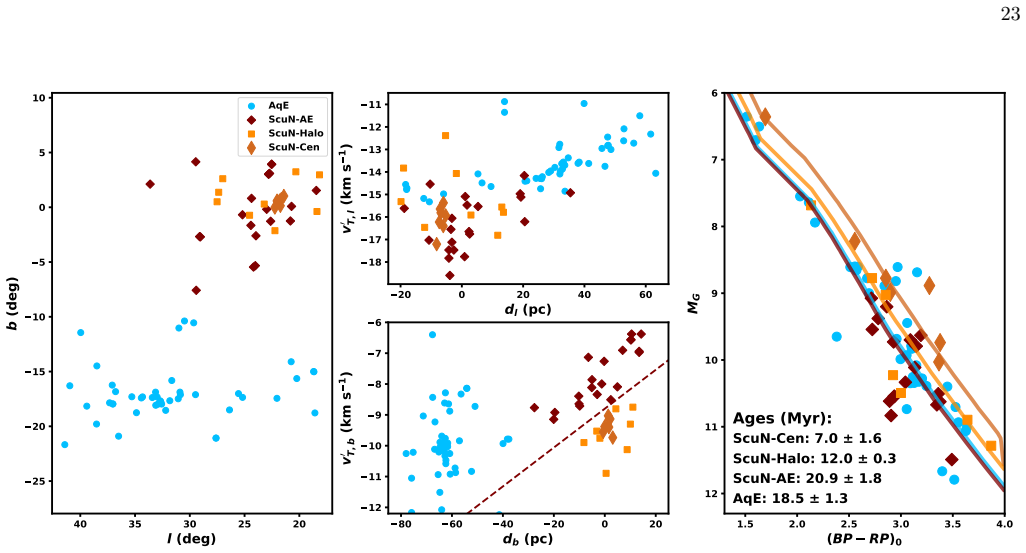
New observations from the Gaia spacecraft have traced an emerging demographic of low-mass associations disconnected from larger associations or GMCs. The first of these associations were recently characterized, but the star-forming environments they trace remain unknown. Using new velocities and ages alongside literature catalogs, we uncover the origins of 16 low-mass associations ($M\lesssim100$ M$_{\odot}$, $\tau\lesssim50$ Myr) using dynamical traceback. We reveal that three groups of currently disparate populations share common formation sites, comprising the Leo, CaNMoS, and AquENS associations. Twelve of 16 associations have plausible connections to larger complexes, six of which form while moving outward from well-established multi-generational star-forming events that drive known or suspected bubbles. We find that feedback from the oldest co-spatial and co-moving relatives of these associations can explain the current morphologies of the Local and Orion-Eridanus Bubbles, along with the formation of related associations like Sco-Cen and Orion OB1. Most remaining populations show evidence for triggered star formation. In the Leo Association, high vertical velocities and a deceleration signature suggest that it formed out of an intermediate velocity cloud colliding with gas in Orion, which would make it the first known case of star formation in one of these clouds. The other newly defined associations show similar asymmetric velocity signatures, such as CaNMoS, which may trace bubble-driven acceleration or a cloud collision. We conclude that the lowest-mass young associations remain undiscovered, and that these populations may have a critical role revealing the small gas overdensities that trace the processes sculpting galactic star formation.
Editorial analysis
A structured set of objections, weighed in public.
Referee Report
Summary. The manuscript uses new velocities, ages, and literature catalogs with Gaia data to perform dynamical traceback on 16 low-mass associations (M ≲ 100 M⊙, τ ≲ 50 Myr). It identifies shared formation sites for groups including Leo, CaNMoS, and AquENS; links twelve associations to larger complexes, with six forming outward from multi-generational events; and concludes that feedback from the oldest co-spatial, co-moving relatives explains the morphologies of the Local and Orion-Eridanus Bubbles as well as the formation of Sco-Cen and Orion OB1. Additional claims include triggered star formation in most populations and a possible intermediate-velocity cloud collision origin for the Leo Association based on vertical velocities and deceleration signatures.
Significance. If the traceback results prove robust against uncertainties, the work would meaningfully advance understanding of hierarchical star formation in the solar neighborhood by connecting low-mass associations to the drivers of superbubbles and providing observational evidence for triggered formation and possible cloud-collision mechanisms. The approach of using these populations to trace small gas overdensities offers a useful complement to studies of more massive complexes.
major comments (3)
- [§3] §3 (Dynamical Traceback Procedure): The integration of Gaia proper motions, radial velocities, and ages backward in time is central to all origin claims, yet the text supplies no quantitative propagation of velocity uncertainties (typically 1–5 km s⁻¹) or Monte Carlo realizations to show how positional errors grow over 10–50 Myr. Without this, the asserted co-spatiality with older populations and the specific bubble-feedback scenario cannot be evaluated for robustness.
- [§4.3] §4.3 (Bubble Morphology and Feedback Claims): The conclusion that feedback from the oldest co-moving relatives explains the current Local and Orion-Eridanus Bubble morphologies rests on the traceback results, but no comparison of predicted energy injection or shell expansion against observed bubble parameters is presented. This leaves the causal link qualitative rather than quantitatively tested.
- [§5.1] §5.1 (Leo Association and Cloud Collision Interpretation): The inference of formation via collision with an intermediate-velocity cloud is drawn from high vertical velocities and a deceleration signature, but the manuscript does not report tests against N-body or hydrodynamical simulations that include gravitational scattering and gas drag; such tests are required to establish whether the observed kinematics uniquely support the collision scenario over other dynamical histories.
minor comments (3)
- [Introduction] The acronyms CaNMoS and AquENS are introduced without immediate expansion or reference to prior SPYGLASS papers; adding a short table of full names and discovery references would improve readability.
- [Figure 4] Traceback trajectory figures would benefit from shaded uncertainty bands derived from velocity errors rather than single-line paths.
- [§2.2] Membership selection criteria for the 16 associations are referenced to literature catalogs but lack a concise summary of proper-motion and parallax cuts or contamination estimates in the main text.
Simulated Author's Rebuttal
We thank the referee for their constructive and detailed review. The comments highlight important areas for strengthening the robustness of our dynamical traceback results and the interpretation of feedback and cloud-collision scenarios. We respond to each major comment below and outline the revisions we will make.
read point-by-point responses
-
Referee: [§3] §3 (Dynamical Traceback Procedure): The integration of Gaia proper motions, radial velocities, and ages backward in time is central to all origin claims, yet the text supplies no quantitative propagation of velocity uncertainties (typically 1–5 km s⁻¹) or Monte Carlo realizations to show how positional errors grow over 10–50 Myr. Without this, the asserted co-spatiality with older populations and the specific bubble-feedback scenario cannot be evaluated for robustness.
Authors: We agree that a quantitative treatment of uncertainties is necessary to support the robustness of the co-spatiality and origin claims. In the revised manuscript we will add a dedicated subsection describing Monte Carlo realizations of the traceback. These will sample the reported velocity uncertainties (1–5 km s⁻¹) and age errors, integrate the orbits over the relevant 10–50 Myr timescales, and report the resulting positional spreads and the statistical significance of the reconstructed overlaps with older populations and bubble centers. revision: yes
-
Referee: [§4.3] §4.3 (Bubble Morphology and Feedback Claims): The conclusion that feedback from the oldest co-moving relatives explains the current Local and Orion-Eridanus Bubble morphologies rests on the traceback results, but no comparison of predicted energy injection or shell expansion against observed bubble parameters is presented. This leaves the causal link qualitative rather than quantitatively tested.
Authors: We acknowledge that the feedback interpretation would be strengthened by quantitative comparison. We will add order-of-magnitude energy estimates derived from the traceback-derived ages, masses, and inferred supernova/wind contributions of the oldest co-spatial populations, and compare these directly to published kinetic energies and expansion velocities of the Local and Orion-Eridanus Bubbles. While full hydrodynamical modeling remains outside the scope of this observational study, the added estimates will place the causal link on a more quantitative footing. revision: yes
-
Referee: [§5.1] §5.1 (Leo Association and Cloud Collision Interpretation): The inference of formation via collision with an intermediate-velocity cloud is drawn from high vertical velocities and a deceleration signature, but the manuscript does not report tests against N-body or hydrodynamical simulations that include gravitational scattering and gas drag; such tests are required to establish whether the observed kinematics uniquely support the collision scenario over other dynamical histories.
Authors: We agree that direct comparison with simulations would help discriminate between cloud-collision and alternative dynamical histories. However, performing new tailored N-body or hydrodynamical simulations constitutes a substantial computational project that exceeds the observational focus and resources of the present work. In revision we will expand the discussion to include qualitative comparisons with existing cloud-collision models in the literature, explicitly state the absence of dedicated simulation tests as a limitation, and identify it as a clear direction for future study while retaining the kinematic evidence as suggestive support for the collision hypothesis. revision: partial
- Dedicated N-body or hydrodynamical simulations to test whether the Leo Association kinematics uniquely favor an intermediate-velocity cloud collision over gravitational scattering or gas-drag alternatives.
Circularity Check
No significant circularity; analysis grounded in external Gaia data and literature catalogs
full rationale
The paper performs dynamical traceback of 16 low-mass associations using Gaia proper motions, radial velocities, and ages drawn from literature catalogs to identify shared formation sites and connections to larger complexes. Central claims about feedback explaining Local and Orion-Eridanus bubble morphologies follow directly from these co-spatiality results rather than from any self-defined fitted quantities, predictions that reduce to inputs by construction, or load-bearing self-citations. No equations or steps in the provided abstract or described method exhibit self-definitional loops, ansatz smuggling, or renaming of known results. The work is self-contained against external benchmarks and receives a minor score only for routine series self-citations that do not carry the primary argument.
Axiom & Free-Parameter Ledger
axioms (1)
- domain assumption Dynamical traceback using current velocities and ages can reliably recover formation sites of young associations.
Reference graph
Works this paper leans on
-
[1]
, " * write output.state after.block = add.period write newline
ENTRY address archivePrefix author booktitle chapter doi edition editor eprint howpublished institution journal key month number organization pages publisher school series title misctitle type volume year version url label extra.label sort.label short.list INTEGERS output.state before.all mid.sentence after.sentence after.block FUNCTION init.state.consts ...
-
[2]
" write newline "" before.all 'output.state := FUNCTION format.url url empty "" new.block "" url * "" * if FUNCTION format.eprint eprint empty "" archivePrefix empty "" archivePrefix "arXiv" = new.block " " eprint * " " * new.block " " eprint * " " * if if if FUNCTION format.doi doi empty "" " " doi * " " * if FUNCTION format.pid doi empty eprint empty ur...
-
[3]
thebibliography [1] 20pt to REFERENCES 6pt =0pt \@twocolumntrue 12pt -12pt 10pt plus 3pt =0pt =0pt =1pt plus 1pt =0pt =0pt -12pt =13pt plus 1pt =20pt =13pt plus 1pt \@M =10000 =-1.0em =0pt =0pt 0pt =0pt =1.0em @enumiv\@empty 10000 10000 `\.\@m \@noitemerr \@latex@warning Empty `thebibliography' environment \@ifnextchar \@reference \@latexerr Missing key o...
discussion (0)
Sign in with ORCID, Apple, or X to comment. Anyone can read and Pith papers without signing in.