Multidisciplinary Design Optimization for Wave-Driven Desalination Systems
Pith reviewed 2026-05-07 08:52 UTC · model grok-4.3
The pith
Optimization reduces wave-driven desalination water costs by 69.5 percent
A machine-rendered reading of the paper's core claim, the machinery that carries it, and where it could break.
Core claim
The paper presents a multidisciplinary design optimization framework for wave-driven desalination systems that integrates wave energy converter hydrodynamics, power take-off transmission, seawater reverse osmosis constraints, and economic analysis. This framework achieves a 69.5% reduction in the levelized cost of water compared to a nominal design. It also outperforms sequential design approaches by producing lower costs and substantially different optimal designs, such as smaller wave energy converters, larger pistons, smaller accumulators, and larger reverse osmosis plants. These trends appear consistent across multiple sea states.
What carries the argument
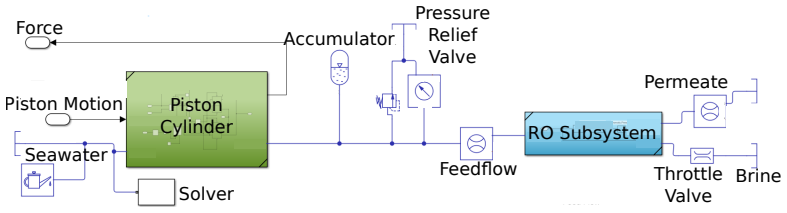
Multidisciplinary design optimization framework integrating hydrodynamics, power take-off, reverse osmosis, and economic models for co-design of the full wave-driven desalination system.
If this is right
- Multidisciplinary optimization yields lower levelized costs of water than sequential approaches.
- Optimal designs differ from literature by favoring smaller wave energy converters and larger reverse osmosis installations.
- Design trends remain consistent across sea states, supporting broader applicability.
- Holistic co-design is essential for achieving competitive costs in coupled energy-water systems.
Where Pith is reading between the lines
- Separate optimization of wave energy and desalination components likely overlooks cost-reducing interactions between them.
- The approach could be tested with real-world wave data variability to confirm robustness.
- Lower costs may enable deployment in more locations facing water scarcity.
Load-bearing premise
The coupled models of hydrodynamics, power take-off, reverse osmosis constraints, and economics sufficiently represent real-world performance and uncertainties.
What would settle it
Building and operating a prototype system using the optimized design parameters in actual ocean conditions and comparing measured water costs to the model's predictions would validate or refute the claimed savings.
Figures




read the original abstract
Wave-driven desalination systems are an innovative solution to the global freshwater crisis, leveraging the complementary characteristics of seawater reverse osmosis and wave energy converters. However, the high costs of this system pose a significant barrier to widespread adoption. Optimization can help these systems reach a more competitive levelized cost of water, but the highly coupled nature of the system necessitates a multidisciplinary design optimization approach. This paper presents a holistic, multidisciplinary design optimization framework for wave-driven desalination system design, integrating models for wave energy converter hydrodynamics, power take-off transmission, seawater reverse osmosis constraints, and economic analysis. This study demonstrates the impact of multidisciplinary design optimization for wave-driven desalination systems, resulting in a 69.5% reduction in levelized cost of water compared to a nominal design. We demonstrate that multidisciplinary design optimization outperforms sequential design approaches, yielding lower levelized costs of water and substantially different optimal designs. The multidisciplinary design optimization results suggest major design changes compared to designs found in the literature. Notably, smaller wave energy converters and larger pistons, along with smaller accumulators and larger seawater reverse osmosis plant installations, are preferred. These design trends are consistent across a range of sea states, suggesting potential generalizability beyond a single location. This study demonstrates the importance of holistic modeling and co-design for wave-driven desalination systems and establishes an effective optimization framework for future studies to build upon.
Editorial analysis
A structured set of objections, weighed in public.
Referee Report
Summary. The manuscript develops a multidisciplinary design optimization (MDO) framework for wave-driven desalination systems that couples wave energy converter (WEC) hydrodynamics, power take-off (PTO) transmission, seawater reverse osmosis (RO) plant constraints, and levelized cost of water (LCOW) economics. It reports that MDO yields a 69.5% LCOW reduction relative to a nominal design, outperforms sequential optimization, produces substantially different optimal component sizes (smaller WEC, larger piston, smaller accumulator, larger RO), and exhibits consistent trends across multiple sea states.
Significance. If the integrated models are shown to be sufficiently complete and the quantitative results are reproducible, the work would establish a useful co-design methodology for wave-powered desalination and demonstrate that holistic optimization can materially lower costs compared with both nominal and sequential baselines. The reported consistency of design trends across sea states would support broader applicability.
major comments (2)
- [§4] §4 (Optimization Results) and Table 2: The 69.5% LCOW reduction and the superiority claim versus sequential design rest on the integrated model capturing all relevant hydrodynamics-PTO-RO-economic couplings. No sensitivity study or validation metric is provided to quantify the effect of neglected nonlinear wave forces, viscous damping, or load-dependent PTO efficiency on the optimal design point or the reported savings.
- [§3.2] §3.2 (PTO and RO sub-models): The RO plant constraints and economic objective are formulated with steady-state assumptions; the manuscript does not demonstrate that pressure fluctuations from the PTO or membrane fouling dynamics are either negligible or conservatively bounded, which directly affects whether the reported optimal RO size and LCOW remain valid.
minor comments (2)
- [Figure 3] Figure 3: Axis labels and units for the LCOW contour plots are inconsistent with the text definition of LCOW; clarify the normalization.
- [§2.1] §2.1: The nominal design parameters used for the 69.5% comparison baseline should be tabulated explicitly rather than referenced only to prior literature.
Simulated Author's Rebuttal
We thank the referee for the constructive feedback on our MDO framework for wave-driven desalination. The comments highlight important aspects of model fidelity that we address below. We have revised the manuscript to incorporate additional discussion and analysis where feasible.
read point-by-point responses
-
Referee: [§4] §4 (Optimization Results) and Table 2: The 69.5% LCOW reduction and the superiority claim versus sequential design rest on the integrated model capturing all relevant hydrodynamics-PTO-RO-economic couplings. No sensitivity study or validation metric is provided to quantify the effect of neglected nonlinear wave forces, viscous damping, or load-dependent PTO efficiency on the optimal design point or the reported savings.
Authors: We agree that quantifying the impact of these modeling approximations would strengthen the results. Our framework employs linear potential flow theory for WEC hydrodynamics and constant PTO efficiency, which are standard in the WEC optimization literature to maintain computational tractability for MDO. All comparisons (MDO vs. nominal and sequential) are performed under identical assumptions, so the 69.5% LCOW reduction and design differences are internally consistent. In the revised manuscript, we will add a dedicated limitations subsection to §4 that qualitatively assesses the neglected effects (citing relevant studies on nonlinear forces and variable efficiency) and includes a sensitivity analysis on PTO efficiency to demonstrate that the key design trends (smaller WEC, larger piston, etc.) remain robust. revision: yes
-
Referee: [§3.2] §3.2 (PTO and RO sub-models): The RO plant constraints and economic objective are formulated with steady-state assumptions; the manuscript does not demonstrate that pressure fluctuations from the PTO or membrane fouling dynamics are either negligible or conservatively bounded, which directly affects whether the reported optimal RO size and LCOW remain valid.
Authors: The PTO sub-model includes an accumulator sized to smooth pressure delivery to the RO plant, and RO constraints are evaluated using time-averaged power and permeate flow. This follows common practice in wave-powered desalination studies where accumulators are designed to maintain near-steady operation. We acknowledge that explicit bounds on residual fluctuations or fouling dynamics are not quantified via dynamic simulation. In the revision, we will expand §3.2 with additional text explaining the accumulator's role in pressure stabilization (supported by literature), clarifying that fouling is addressed through standard operational maintenance outside the scope of this design optimization, and noting that the reported optimal RO size corresponds to average conditions. revision: partial
Circularity Check
No circularity: results follow from explicit optimization of integrated models rather than tautology or self-reference.
full rationale
The paper defines an MDO problem with separate sub-models (hydrodynamics, PTO, RO constraints, economics) and reports the optimizer output (69.5% LCOW reduction, design trends) as the direct consequence of minimizing the levelized-cost objective subject to those models. No step equates a fitted parameter to the final metric by construction, no self-citation supplies a load-bearing uniqueness theorem, and no ansatz is smuggled in. The comparison to a nominal design and to sequential optimization is external to the objective function itself. The derivation chain is therefore self-contained and non-circular.
Axiom & Free-Parameter Ledger
Reference graph
Works this paper leans on
-
[1]
Eliasson, The rising pressure of global water shortages, Nature 517 (6) (Jan
J. Eliasson, The rising pressure of global water shortages, Nature 517 (6) (Jan. 2015).doi:https://doi.org/10.1038/517006a
-
[2]
Z. Li, A. Siddiqi, L. D. Anadon, V. Narayanamurti, Towards sustain- ability in water-energy nexus: Ocean energy for seawater desalina- tion, Renewable and Sustainable Energy Reviews 82 (2018) 3833–3847. doi:10.1016/j.rser.2017.10.087. 23
-
[3]
U.S. Department of Energy, Powering the blue economy: Exploring op- portunities for marine renewable energy in maritime markets (4 2019)
work page 2019
-
[4]
Gillis, California drought is made worseby global warming, scientists say, New York Times (Aug
J. Gillis, California drought is made worseby global warming, scientists say, New York Times (Aug. 2015). URLhttp://web-static-aws.seas.harvard.edu/climate/eli/ Courses/global-change-debates/Sources/California-droughts/ CaliforniaDroughtIsMadeWorsebyGlobalWarming, ScientistsSay-TheNewYorkTimes.pdf
work page 2015
-
[6]
M. R. Elkadeem, K. M. Kotb, S. W. Sharshir, M. A. Hamada, A. E. Kabeel, I. K. Gabr, M. A. Hassan, M. Y. Worku, M. A. Abido, Z. Ullah, H. M. Hasanien, F. F. Selim, Optimize and analyze a large-scale grid- tied solar pv-powered swro system for sustainable water-energy nexus, Desalination 579 (2024) 117440.doi:10.1016/j.desal.2024.117440
-
[8]
A.F.d.O.Falcão, Waveenergyutilization: Areviewofthetechnologies, Renewable and Sustainable Energy Reviews 14 (3) (2010) 899–918.doi: 10.1016/j.rser.2009.11.003
-
[9]
J. Sobieszczanski-Sobieski, Multidisciplinary design optimization: An emerging new engineering discipline, Solid Mechanics and Its Applica- tions (1995) 483–496doi:10.1007/978-94-011-0453-1_14
-
[10]
Y. Peña-Sanchez, D. García-Violini, J. V. Ringwood, Control co- design of power take-off parameters for wave energy systems, IFAC- PapersOnLine 55 (27) (2022) 311–316.doi:10.1016/j.ifacol.2022. 10.531
-
[11]
M. Rosati, J. V. Ringwood, Control co-design of power take-off and bypass valve for owc-based wave energy conversion systems, Renewable Energy 219 (2023) 119523.doi:10.1016/j.renene.2023.119523
-
[12]
C. A. Michelén-Ströfer, D. T. Gaebele, R. G. Coe, G. Bacelli, Control co-design of power take-off systems for wave energy converters using 24 wecopttool, IEEE Transactions on Sustainable Energy 14 (4) (2023) 2157–2167.doi:10.1109/tste.2023.3272868
-
[13]
J. Grasberger, L. Yang, G. Bacelli, L. Zuo, Control co-design and opti- mization of oscillating-surge wave energy converter, Renewable Energy 225 (2024) 120234.doi:10.1016/j.renene.2024.120234
- [14]
-
[15]
R. G. Coe, G. Bacelli, D. Forbush, A practical approach to wave en- ergy modeling and control, Renewable and Sustainable Energy Reviews 142 (represent) (2021) 110791.doi:10.1016/j.rser.2021.110791
-
[16]
R. G. Coe, G. Bacelli, D. Gaebele, A. Keow, D. Forbush, Co-design of a wave energy converter through bi-conjugate impedance matching, Mechatronics 111 (2025) 103395.doi:https: //doi.org/10.1016/j.mechatronics.2025.103395. URLhttps://www.sciencedirect.com/science/article/pii/ S0957415825001047
-
[17]
S. Ladan, K. Wu, Nonlinear modeling and harmonic recycling of millimeter-wave rectifier circuit, IEEE Transactions on Microwave The- ory and Techniques 63 (3) (2015) 937–944.doi:10.1109/TMTT.2015. 2396043
-
[18]
M. M. Ylänen, M. J. Lampinen, Determining optimal operating pres- sure for aaltoro – a novel wave powered desalination system, Renewable Energy 69 (2014) 386–392.doi:10.1016/j.renene.2014.03.061
-
[19]
Y.-H. Yu, D. Jenne, Analysis of a wave-powered, reverse-osmosis sys- tem and its economic availability in the united states, in: Proceedings of the ASME 2017 36th International Conference on Ocean, Offshore and Arctic Engineering OMAE2017, 2017.doi:https://doi.org/10. 1115/OMAE2017-62136
work page 2017
-
[20]
Y.-H. Yu, D. Jenne, Numerical modeling and dynamic analysis of a wave-powered reverse-osmosis system, Journal of Marine Science and Engineering 6 (4) (2018) 132.doi:10.3390/jmse6040132
-
[21]
K. M. Brodersen, E. A. Bywater, A. M. Lanter, H. H. Schennum, K. N. Furia, M. K. Sheth, N. S. Kiefer, B. K. Cafferty, A. K. Rao, J. M. 25 Garcia, D.M.Warsinger, Direct-driveoceanwave-poweredbatchreverse osmosis, Desalination 523 (2022) 115393.doi:10.1016/j.desal.2021. 115393
-
[22]
R. Suchithra, T. K. Das, K. Rajagopalan, A. Chaudhuri, N. Ulm, M. Prabu, A. Samad, P. Cross, Numerical modelling and design of a small-scale wave-powered desalination system, Ocean Engineering 256 (2022) 111419.doi:10.1016/j.oceaneng.2022.111419
-
[23]
J. W. Simmons, J. D. Van de Ven, A comparison of power take-off architectures for wave-powered reverse osmosis desalination of seawater with co-production of electricity, Energies 16 (21) (2023).doi:10.3390/ en16217381. URLhttps://www.mdpi.com/1996-1073/16/21/7381
work page 2023
-
[24]
B. J. Hopkins, N. Padhye, A. Greenlee, J. Torres, L. Thomas, D. M. Ljubicic, M. P. Kassner, A. H. Slocum, Damping pressure pulsations in a wave-powered desalination system, Journal of Energy Resources Technology 136 (2) (Apr. 2014).doi:10.1115/1.4026635
-
[25]
K. A. Sitterley, T. J. Cath, D. S. Jenne, Y.-H. Yu, T. Y. Cath, Perfor- mance of reverse osmosis membrane with large feed pressure fluctuations from a wave-driven desalination system, Desalination 527 (2022) 115546. doi:10.1016/j.desal.2022.115546
-
[26]
B. Robertson, G. Dunkle, T. Mundon, L. Kilcher, Wave resource spatial and temporal variability dependence on wec size, International Marine Energy Journal 5 (1) (2022) 113–121.doi:10.36688/imej.5.113-121. URLhttps://marineenergyjournal.org/imej/article/view/104
-
[27]
J. Mi, X. Wu, J. Capper, X. Li, A. Shalaby, R. Wang, S. Lin, M. Hajj, L. Zuo, Experimental investigation of a reverse osmosis desalination sys- temdirectlypoweredbywaveenergy, AppliedEnergy343(2023)121194. doi:10.1016/j.apenergy.2023.121194
-
[28]
A. B. Lambe, J. R. R. A. Martins, Extensions to the design struc- ture matrix for the description of multidisciplinary design, analysis, and optimization processes, Structural and Multidisciplinary Optimization 46 (2) (2012) 273–284.doi:10.1007/s00158-012-0763-y. URLhttps://doi.org/10.1007/s00158-012-0763-y
- [29]
-
[30]
U.S. National Data Buoy Center, National data buoy center – real-time oceanographic and meteorological data,https://www.ndbc.noaa.gov/ (1971)
work page 1971
-
[31]
N. DeGoede, M. Haji, A multidisciplinary design optimiza- tion framework for wave-driven desalination systems, Vol. Vol- ume 3B: 51st Design Automation Conference (DAC) of Inter- national Design Engineering Technical Conferences and Com- puters and Information in Engineering Conference, 2025, p. V03BT03A010.arXiv:https://asmedigitalcollection. asme.org/ID...
-
[32]
J. D. Seader, E. J. Henley, D. K. Roper, SEPARATION PROCESS PRINCIPLES: Chemical and Biochemical Operations, 3rd Edition, Wi- ley, 2011
work page 2011
-
[33]
K. A. Sitterley, Z. Binger, D. S. Jenne, Comparing constant and tran- sient membrane transport parameters for use in wave desalination mod- els, 2025.doi:.org/10.3390/membranes15080243
-
[34]
DuPont, Filmtec™sw30hr-380 element product data sheet, Datasheet (Oct. 2024)
work page 2024
-
[35]
DuPont, Wave design software
-
[36]
J. Falnes, A. Kurniawan, Ocean Waves and Oscillating Systems: Lin- ear Interactions Including Wave-Energy Extraction, 2nd Edition, Cam- bridge University Press, 2020.doi:10.1017/9781108674812
-
[37]
M. Ancellin, F. Dias, Capytaine: a Python-based linear potential flow solver, Journal of Open Source Software 4 (36) (2019) 1341.doi:10. 21105/joss.01341. URLhttps://doi.org/10.21105%2Fjoss.01341
work page 2019
-
[38]
J. Newman, C.-H. Lee, Boundary-element methods in offshore struc- ture analysis, Journal of Offshore Mechanics and Arctic Engineering 124 (2002) 81.doi:10.1115/1.1464561. 27
-
[39]
URLhttps://wec-sim.github.io/WEC-Sim/master/index.html
Wec-sim (wave energy converter simulator). URLhttps://wec-sim.github.io/WEC-Sim/master/index.html
-
[40]
URLhttps://www.mathworks.com/help/simscape/ug/ advantages-of-using-isothermal-liquid-blocks.html
MathWorks, Advantages of using isothermal liquid blocks, accessed: 2026-04-11 (2025). URLhttps://www.mathworks.com/help/simscape/ug/ advantages-of-using-isothermal-liquid-blocks.html
work page 2026
-
[41]
A. LaBonte, P. O’Connor, C. Fitzpatrick, K. Hallett, Y. Li, Standard- ized cost and performance reporting for marineand hydrokinetic tech- nologies, in: 1st Marine Energy Technology Symposiumt, Washington DC, 2013
work page 2013
-
[42]
Y.-H. Yu, D. Jenne, R. Thresher, A. Copping, S. Geerlofs, L. Hanna, Reference model 5 (rm5): Oscillating surge wave energy converter, Tech. Rep. Report (Jan. 2015)
work page 2015
-
[43]
ReasonTek, Low pressure accuumulator quote (03 2025)
work page 2025
-
[44]
American Society of Mechanical Engineers, Boiler and Pressure Vessel Code, Section VIII, Division 1: Rules for Construction of Pressure Ves- sels, ASME, New York, 2015, aSME BPVC-VIII-1-2015
work page 2015
-
[45]
Jit industries: Hydraulic cylinder quotes (2025)
work page 2025
-
[46]
M. W. Haefner, M. N. Haji, Integrated pumped hydro reverse osmosis system optimization featuring surrogate model development in reverse osmosis modeling, Applied Energy 352 (2023) 121812.doi:10.1016/j. apenergy.2023.121812
work page doi:10.1016/j 2023
-
[47]
A. M. Bilton, R. Wiesman, A. Arif, S. M. Zubair, S. Dubowsky, On the feasibility of community-scale photovoltaic-powered reverse osmosis desalination systems for remote locations, Renewable Energy 36 (12) (2011) 3246–3256.doi:10.1016/j.renene.2011.03.040
-
[48]
International Atomic Energy Agency, Deep 5 user manual, 2013
work page 2013
-
[49]
Voutchkov, Desalination project cost estimating and management, CRC Press, 2019
N. Voutchkov, Desalination project cost estimating and management, CRC Press, 2019
work page 2019
-
[50]
Shane, Comprehensive guide to stainless steel pricing and grades, accessed: 2025-05-14 (March 2025). URLhttps://shop.machinemfg.com/comprehensive-guide-to-stainless-steel-pricing-and-grades/ 28 Appendix A. Tables of Parameters This appendix contains tables of the parameters used in the model. Table A.4: General Parameters Parameter Value Units gravitation...
work page 2025
discussion (0)
Sign in with ORCID, Apple, or X to comment. Anyone can read and Pith papers without signing in.