Designing sparse temporal graphs satisfying connectivity requirements
Pith reviewed 2026-05-07 08:52 UTC · model grok-4.3
The pith
The minimum number of directed temporal arcs to satisfy given connectivity requests is exactly n minus the request graph's components plus its smallest directed feedback vertex set.
A machine-rendered reading of the paper's core claim, the machinery that carries it, and where it could break.
Core claim
The authors prove that in the directed case the number of temporal arcs required is n−cc+dfvs where cc is the number of connected components of the request graph and dfvs is the size of its smallest directed feedback vertex set. It follows that the problem is NP-complete but inherits fixed parameter tractability properties of Directed Feedback Vertex Set. When the temporal graph is undirected they establish a characterization of strongly connected request graphs that admit a solution with n-1 edges: it is possible if and only if any set of pairwise non-vertex-disjoint closed walks all share a common vertex, which can be tested in polynomial time.
What carries the argument
The minimum directed feedback vertex set of the request graph, which gives the exact number of extra temporal arcs needed to satisfy the cyclic reachability requirements beyond a forest structure.
Load-bearing premise
The temporal model requires paths to have strictly increasing timestamps and the request graph precisely defines the pairs that need to be connected.
What would settle it
A request graph whose minimum satisfying temporal arc count differs from n - cc + dfvs, such as certain small graphs with cycles, would falsify the formula.
Figures


read the original abstract
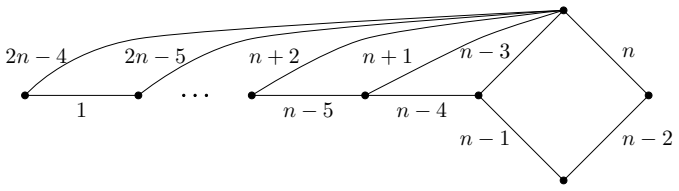
Connectivity of temporal graphs has been widely studied both as graph theory and as gossip theory. In particular, it is well known that in order to connect every vertex to every other, a temporal graph needs to have at least $2n-4$ edges where $n$ is the number of vertices. This paper investigates the optimal number of edges required to satisfy partial connectivity requirements. We introduce the problem of Connectivity Request Satisfaction where we are given a directed graph that we call the request graph, where an arc from $u$ to $v$ means that we need to be able to go from $u$ to $v$. Our goal is to build a temporal graph on the same vertex set with as few temporal edges as possible that would satisfy all the requests. When the graph we build is directed, we prove that the number of temporal arcs required is $n-\mathrm{cc}+\mathrm{dfvs}$ where $\mathrm{cc}$ is the number of connected component of the request graph and $\mathrm{dfvs}$ is the size of its smallest directed feedback vertex set. It follows that the problem is NP-complete but inherits fixed parameter tractability properties of Directed Feedback Vertex Set. When the graph we build is undirected, we establish a characterization of strongly connected request graphs that admit a solution with $n-1$ edges: it is possible if and only if any set of pairwise non-vertex-disjoint closed walks all share a common vertex. We prove that this criteria can be tested in polynomial time.
Editorial analysis
A structured set of objections, weighed in public.
Referee Report
Summary. The paper introduces the Connectivity Request Satisfaction problem: given a request graph encoding required reachability pairs, construct a temporal graph (directed or undirected) on the same vertices using the minimum number of temporal edges that realizes all requests under the standard strictly-increasing-timestamp model. For directed temporal graphs the central claim is that the minimum equals n - cc + dfvs, where cc is the number of (weakly) connected components of the request graph and dfvs is the size of its minimum directed feedback vertex set; the problem is therefore NP-complete yet FPT. For undirected temporal graphs the paper gives a polynomial-time-checkable characterization of the strongly-connected request graphs that admit a solution with exactly n-1 edges: any collection of pairwise non-vertex-disjoint closed walks must share a common vertex.
Significance. An exact closed-form bound linking temporal connectivity to DFVS would be a notable contribution, immediately yielding FPT algorithms and clarifying the gap between static and temporal sparsity. The undirected characterization is also of independent interest for gossip and temporal connectivity problems. Credit is due for framing the problem cleanly in terms of standard graph parameters and for the polynomial-time test in the undirected case. However, the directed bound appears incorrect, which substantially reduces the paper's significance.
major comments (2)
- [Abstract] Abstract (and the directed-formula theorem): the claimed minimum n - cc + dfvs is contradicted by the directed n-cycle request graph (cc = 1, dfvs = 1). For n = 3 the formula asserts exactly 3 temporal arcs suffice, yet no strictly increasing timestamp assignment to the three cycle arcs realizes all six required reachabilities; after traversing the path A→B→C the edge C→A cannot be followed by any earlier edge to reach B. A minimal construction requires 4 arcs (cycle plus one duplicated edge at a later timestamp). The +dfvs term therefore fails to compensate for the monotonicity constraint on cycles.
- [Directed-formula proof] Directed-formula proof (the section containing the proof of the n - cc + dfvs bound): the argument must be re-examined because any construction that realizes a strongly-connected request graph on a cycle must either duplicate arcs or add extra arcs beyond the DFVS size; the current bound therefore undercounts the temporal arcs required once timestamps are enforced to be strictly increasing.
minor comments (2)
- [Abstract] Abstract: 'connected component' should be clarified as weakly connected components of the underlying undirected graph, since the request graph is directed.
- The manuscript should explicitly state whether parallel temporal arcs (same u,v at distinct times) are permitted; the counter-example construction relies on them.
Simulated Author's Rebuttal
We thank the referee for their careful reading and for identifying the flaw in the directed bound. We have verified the counterexample and agree that the claimed formula n - cc + dfvs does not hold under the strict timestamp model. We will revise the manuscript to correct the abstract, remove the incorrect theorem, and address the directed case.
read point-by-point responses
-
Referee: [Abstract] Abstract (and the directed-formula theorem): the claimed minimum n - cc + dfvs is contradicted by the directed n-cycle request graph (cc = 1, dfvs = 1). For n = 3 the formula asserts exactly 3 temporal arcs suffice, yet no strictly increasing timestamp assignment to the three cycle arcs realizes all six required reachabilities; after traversing the path A→B→C the edge C→A cannot be followed by any earlier edge to reach B. A minimal construction requires 4 arcs (cycle plus one duplicated edge at a later timestamp). The +dfvs term therefore fails to compensate for the monotonicity constraint on cycles.
Authors: We agree that the directed n-cycle request graph is a valid counterexample. With cc = 1 and dfvs = 1 the formula predicts n temporal arcs, but the strict increase requirement on timestamps means that a single traversal of the cycle cannot realize all reachability pairs; additional duplicated arcs with later timestamps are needed. We will revise the abstract to remove the incorrect claim and update the directed section. revision: yes
-
Referee: [Directed-formula proof] Directed-formula proof (the section containing the proof of the n - cc + dfvs bound): the argument must be re-examined because any construction that realizes a strongly-connected request graph on a cycle must either duplicate arcs or add extra arcs beyond the DFVS size; the current bound therefore undercounts the temporal arcs required once timestamps are enforced to be strictly increasing.
Authors: The referee is correct that the existing proof does not properly account for the monotonicity constraints on cycles. We will re-examine the section, withdraw the n - cc + dfvs claim, and either derive a corrected bound or provide an alternative characterization for the directed case. revision: yes
Circularity Check
No significant circularity; bound uses independent standard parameters
full rationale
The paper states a theorem equating the minimum temporal arcs to n - cc + dfvs, with cc and dfvs defined as standard properties of the request graph (connected components and minimum directed feedback vertex set). These are external graph invariants with no dependence on the temporal construction or timestamps. No equation or step reduces the claimed optimum to a fitted quantity, self-definition, or self-citation chain. The NP-completeness and FPT inheritance follow from the reduction to an independently studied problem (DFVS). The undirected characterization (condition on pairwise non-vertex-disjoint closed walks) is likewise an independent combinatorial property testable in polynomial time. No load-bearing step collapses to its own inputs by construction.
Axiom & Free-Parameter Ledger
axioms (1)
- domain assumption Connectivity in a temporal graph is defined via the existence of paths whose edge timestamps are strictly increasing.
Reference graph
Works this paper leans on
-
[1]
Akrida, Leszek Gasieniec, George B
Eleni C. Akrida, Leszek Gasieniec, George B. Mertzios, and Paul G. Spirakis. The complexity of optimal design of temporally connected graphs.Theory Comput. Syst., 61(3):907–944, 2017
work page 2017
-
[2]
Tem- poral Connectivity Augmentation
Thomas Bellitto, Jules Bouton Popper, and Bruno Escoffier. Tem- poral Connectivity Augmentation. In4th Symposium on Algorithmic Foundations of Dynamic Networks (SAND 2025), volume 330 ofLeib- 24 niz International Proceedings in Informatics (LIPIcs), pages 3:1–3:16, 2025
work page 2025
-
[3]
Canadian traveler problems in temporal graphs
Thomas Bellitto, Johanne Cohen, Bruno Escoffier, Minh-Hang Nguyen, and Mika¨ el Rabie. Canadian traveler problems in temporal graphs. InGraph-Theoretic Concepts in Computer Science, Lecture Notes in Computer Science, pages 33–47, 2025
work page 2025
-
[4]
Computing Shortest, Fastest, and Foremost Journeys in Dynamic Networks.Int
Binh-Minh Bui-Xuan, Afonso Ferreira, and Aubin Jarry. Computing Shortest, Fastest, and Foremost Journeys in Dynamic Networks.Int. J. Found. Comput. Sci., 14(2):267–285, 2003
work page 2003
-
[5]
R. Bumby. A problem with telephones.Siam Journal on Algebraic and Discrete Methods, 2:13–18, 1981
work page 1981
-
[6]
Edge exploration of tem- poral graphs.Algorithmica, 85(3):688–716, 2022
Benjamin Merlin Bumpus and Kitty Meeks. Edge exploration of tem- poral graphs.Algorithmica, 85(3):688–716, 2022
work page 2022
-
[7]
Realization of Temporally Connected Graphs Based on Degree Sequences
Arnaud Casteigts, Michelle D¨ oring, and Nils Morawietz. Realization of Temporally Connected Graphs Based on Degree Sequences. In36th International Symposium on Algorithms and Computation (ISAAC 2025), volume 359 ofLeibniz International Proceedings in Informatics (LIPIcs), pages 17:1–17:18, 2025
work page 2025
-
[8]
Foremost, fastest, shortest: Temporal graph realization under various path metrics
Justine Cauvi, Nils Morawietz, and Laurent Viennot. Foremost, fastest, shortest: Temporal graph realization under various path metrics. In 43rd International Symposium on Theoretical Aspects of Computer Sci- ence, STACS 2026, Grenoble, France, March 9-13, 2026, LIPIcs, pages 24:1–24:19, 2026
work page 2026
-
[9]
A fixed-parameter algorithm for the directed feedback vertex set problem.J
Jianer Chen, Yang Liu, Songjian Lu, Barry O’Sullivan, and Igor Raz- gon. A fixed-parameter algorithm for the directed feedback vertex set problem.J. ACM, 55(5):21:1–21:19, 2008
work page 2008
-
[10]
Optimizing reachability sets in temporal graphs by delaying.Inf
Argyrios Deligkas and Igor Potapov. Optimizing reachability sets in temporal graphs by delaying.Inf. Comput., 285(Part):104890, 2022
work page 2022
-
[11]
Stuart E. Dreyfus. An Appraisal of Some Shortest-Path Algorithms. Operations Research, 17(3):395–412, 1969
work page 1969
-
[12]
Enright, Kitty Meeks, George B
Jessica A. Enright, Kitty Meeks, George B. Mertzios, and Viktor Za- maraev. Deleting edges to restrict the size of an epidemic in temporal networks.J. Comput. Syst. Sci., 119:60–77, 2021. 25
work page 2021
-
[13]
Graphs with prescribed degrees of ver- tices.Mat
Paul Erd˝ os and Tibor Gallai. Graphs with prescribed degrees of ver- tices.Mat. Lapok, 11:264–274, 1960
work page 1960
-
[14]
Recognizing and realizing temporal reachability graphs
Thomas Erlebach, Othon Michail, and Nils Morawietz. Recognizing and realizing temporal reachability graphs. In33rd Annual European Symposium on Algorithms, ESA 2025, Warsaw, Poland, September 15- 17, 2025, LIPIcs, pages 93:1–93:18, 2025
work page 2025
-
[15]
Parameterized Al- gorithms for Multi-Label Periodic Temporal Graph Realization
Thomas Erlebach, Nils Morawietz, and Petra Wolf. Parameterized Al- gorithms for Multi-Label Periodic Temporal Graph Realization. In3rd Symposium on Algorithmic Foundations of Dynamic Networks (SAND 2024), volume 292 ofLeibniz International Proceedings in Informatics (LIPIcs), pages 12:1–12:16, 2024
work page 2024
-
[16]
Hypergraphes arbor´ es.Discrete Mathematics, 21(3):223–227, 1978
Claude Flament. Hypergraphes arbor´ es.Discrete Mathematics, 21(3):223–227, 1978
work page 1978
-
[17]
Hypertrees and their host trees: a survey, 2025.arXiv:2504.15570
Pablo De Caria Di Fonzo. Hypertrees and their host trees: a survey, 2025.arXiv:2504.15570
-
[18]
F. G¨ obel, J. Orestes Cerdeira, and H. J. Veldman. Label-connected graphs and the gossip problem.Discrete Math., 87(1):29–40, 1991
work page 1991
-
[19]
A. Hajnal, E. C. Milner, and E. Szemer´ edi. A cure for the telephone disease.Canadian Mathematical Bulletin, 15(3):447–450, 1972.doi: 10.4153/CMB-1972-081-0
-
[20]
S. Louis Hakimi and S. S. Yau. Distance matrix of a graph and its realizability.Quarterly of Applied Mathematics, 22:305–317, 1965
work page 1965
-
[21]
Sandra M. Hedetniemi, Stephen T. Hedetniemi, and Arthur L. Liest- man. A survey of gossiping and broadcasting in communication net- works.Networks, 18(4):319–349, 1988
work page 1988
-
[22]
Richard M. Karp. Reducibility among combinatorial problems. InPro- ceedings of a symposium on the Complexity of Computer Computations, The IBM Research Symposia Series, pages 85–103, 1972
work page 1972
-
[23]
David Kempe, Jon M. Kleinberg, and Amit Kumar. Connectivity and inference problems for temporal networks.J. Comput. Syst. Sci., 64(4):820–842, 2002
work page 2002
-
[24]
Mertzios, Hendrik Molter, and Paul G
Nina Klobas, George B. Mertzios, Hendrik Molter, and Paul G. Spi- rakis. The complexity of computing optimum labelings for temporal connectivity.J. Comput. Syst. Sci., 146:103564, 2024. 26
work page 2024
-
[25]
Mertzios, Hendrik Molter, and Paul G
Nina Klobas, George B. Mertzios, Hendrik Molter, and Paul G. Spi- rakis. Temporal graph realization from fastest paths.Theoretical Com- puter Science, 1056:115508, 2025
work page 2025
-
[26]
Spanner Enumeration for Temporal Graphs
Kazuhiro Kurita, Andrea Marino, Jason Schoeters, and Takeaki Uno. Spanner Enumeration for Temporal Graphs. In4th Symposium on Al- gorithmic Foundations of Dynamic Networks (SAND 2025), volume 330 ofLeibniz International Proceedings in Informatics (LIPIcs), pages 9:1–9:21, 2025
work page 2025
-
[27]
Mertzios, Othon Michail, Ioannis Chatzigiannakis, and Paul G
George B. Mertzios, Othon Michail, Ioannis Chatzigiannakis, and Paul G. Spirakis. Temporal network optimization subject to connec- tivity constraints. InAutomata, Languages, and Programming - 40th International Colloquium, ICALP 2013, Riga, Latvia, July 8-12, 2013, Proceedings, Part II, volume 7966 ofLecture Notes in Computer Sci- ence, pages 657–668, 2013
work page 2013
-
[28]
Mertzios, Hendrik Molter, Nils Morawietz, and Paul G
George B. Mertzios, Hendrik Molter, Nils Morawietz, and Paul G. Spi- rakis. Realizing temporal transportation trees. InGraph-Theoretic Con- cepts in Computer Science - 51st International Workshop, WG 2025, Otzenhausen, Germany, June 11-13, 2025, Revised Selected Papers, Lecture Notes in Computer Science, pages 390–404, 2025
work page 2025
-
[29]
Mertzios, Hendrik Molter, Nils Morawietz, and Paul G
George B. Mertzios, Hendrik Molter, Nils Morawietz, and Paul G. Spi- rakis. Temporal graph realization with bounded stretch. In50th In- ternational Symposium on Mathematical Foundations of Computer Sci- ence, MFCS 2025, Warsaw, Poland, August 25-29, 2025, LIPIcs, pages 75:1–75:19, 2025
work page 2025
-
[30]
Di- rected Temporal Tree Realization for Periodic Public Transport: Easy and Hard Cases
Julia Meusel, Matthias M¨ uller-Hannemann, and Klaus Reinhardt. Di- rected Temporal Tree Realization for Periodic Public Transport: Easy and Hard Cases. In25th Symposium on Algorithmic Approaches for Transportation Modelling, Optimization, and Systems (ATMOS 2025), volume 137 ofOpen Access Series in Informatics (OASIcs), pages 3:1– 3:22, 2025
work page 2025
- [31]
-
[32]
Efficient Algorithms for Temporal Path Computation
Huanhuan Wu, James Cheng, Yiping Ke, Silu Huang, Yuzhen Huang, and Hejun Wu. Efficient Algorithms for Temporal Path Computation. IEEE Transactions on Knowledge and Data Engineering, 28(11):2927– 2942, 2016. 27
work page 2016
discussion (0)
Sign in with ORCID, Apple, or X to comment. Anyone can read and Pith papers without signing in.