Field-driven helicity in solid-state high-harmonic generation
Pith reviewed 2026-05-07 07:17 UTC · model grok-4.3
The pith
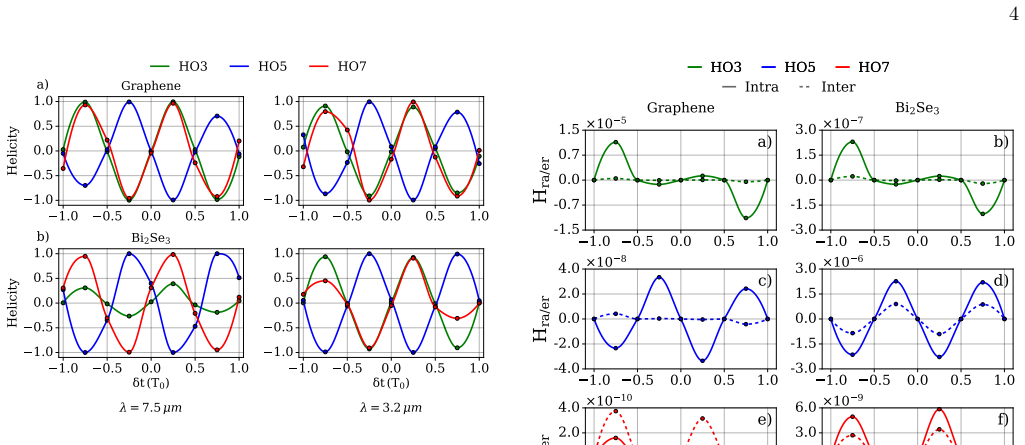
Two orthogonally polarized laser pulses with a tunable delay drive the helicity of high-order harmonics in solids from linear to circular, independent of the material.
A machine-rendered reading of the paper's core claim, the machinery that carries it, and where it could break.
Core claim
The polarization state of individual harmonics can be driven from linear to circular by tuning the delay between two orthogonally polarized pulses, independent of the material under investigation. This behavior is robust across systems with distinct symmetry and topology and originates from the sub-cycle modulation of the light-matter interaction mediated by the dipole coupling. Furthermore, the orthogonal configuration allows to break the dynamical symmetry of the light-matter interaction which is manifested in the generation of otherwise forbidden harmonics under standard selection rules. These results establish harmonic helicity as a field-controlled observable rather than a direct材料finge
What carries the argument
Polarization-crafted beams formed by two orthogonally polarized pulses with controlled time delay, which modulates dipole coupling on a sub-cycle scale and breaks dynamical symmetry of the light-matter interaction.
If this is right
- Harmonic helicity functions as a controllable field observable that can be set independently of the material's symmetry or topology.
- Any desired polarization state, including fully circular, can be assigned to specific harmonics simply by adjusting the relative delay.
- Harmonics normally forbidden by selection rules become accessible through the broken dynamical symmetry of the orthogonal driving field.
- The same control protocol applies uniformly across solids, decoupling the output polarization from the details of the electronic bands.
Where Pith is reading between the lines
- Future experiments could subtract the known field-driven helicity baseline to isolate genuine material contributions in topological or spin-orbit-coupled solids.
- The sub-cycle modulation mechanism suggests that more complex pulse sequences could achieve even higher-resolution polarization shaping within a single optical cycle.
- Material-independent circular-harmonic sources might simplify the design of attosecond circularly polarized pulses for chiral-sensitive spectroscopies.
- The approach could be tested in two-dimensional materials or heterostructures where symmetry is already reduced, to check whether additional selection-rule violations appear.
Load-bearing premise
The helicity control and symmetry breaking arise purely from the sub-cycle timing of the orthogonal dipole coupling and are not substantially altered by material-specific electronic structure or experimental artifacts.
What would settle it
Finding that the range of achievable helicity or the appearance of forbidden harmonics varies strongly with material band structure or crystal symmetry, rather than following the same dependence on pulse delay in every tested solid.
Figures


read the original abstract
The polarization state of light plays a central role in strong-field light--matter interactions and is widely used to probe electronic structure in solids via high-order harmonic generation (HHG). In particular, helicity-resolved HHG has been interpreted as a fingerprint of crystal symmetry and topology. Here, we demonstrate deterministic and continuous control of harmonic helicity in solids using polarization-crafted beams, formed by two orthogonally polarized pulses with a controlled time delay. By tuning this delay, the polarization state of individual harmonics can be driven from linear to circular, independent of the material under investigation. We show that this behavior is robust across systems with distinct symmetry and topology, and originates from the sub-cycle modulation of the light--matter interaction mediated by the dipole coupling. Furthermore, the orthogonal configuration allows to break the dynamical symmetry of the light-matter interaction which is manifested in the generation of otherwise forbidden harmonics under standard selection rules.. These results establish harmonic helicity as a field-controlled observable rather than a direct material fingerprint.
Editorial analysis
A structured set of objections, weighed in public.
Referee Report
Summary. The manuscript demonstrates deterministic control of high-harmonic helicity in solids by superposing two orthogonally polarized pulses with a tunable sub-cycle delay. Tuning the delay continuously drives individual harmonics from linear to circular polarization; the authors attribute this to sub-cycle modulation of the dipole coupling and show that the orthogonal geometry breaks dynamical symmetry, allowing generation of harmonics forbidden under standard selection rules. The effect is reported to be independent of the material's symmetry and topology, with supporting data from multiple solids and a supporting theoretical model based on the time-dependent dipole interaction.
Significance. If the central claim of material-independent, field-driven helicity control holds, the work would meaningfully advance strong-field solid-state physics by reframing helicity-resolved HHG as a controllable observable rather than a direct material fingerprint. The symmetry-breaking mechanism that produces otherwise forbidden harmonics is a clear strength, and the sub-cycle interpretation offers a new handle on light-matter dynamics. Reproducible experimental protocols and the explicit link to dipole coupling (rather than fitted parameters) are positive features that would support broader adoption if the robustness is placed on firmer quantitative footing.
major comments (3)
- [§3, Fig. 3] §3 (Experimental results) and Fig. 3: the claim that helicity-vs-delay curves are independent of material requires quantitative demonstration that the same functional form appears across systems with qualitatively different band structures and topologies. The presented data appear qualitative; without overlap metrics, χ² values, or error-band comparisons between, e.g., a trivial semiconductor and a topological insulator, it remains possible that the similarity is coincidental or arises from the chosen detection geometry rather than from a purely field-driven mechanism.
- [§5, Eq. (8)] §5 (Theoretical model), Eq. (8) or equivalent interaction Hamiltonian: the assertion that the helicity selection originates solely from sub-cycle dipole coupling without material-specific contributions is load-bearing. Dipole matrix elements and interband couplings are material-dependent by definition; the model must explicitly show that these terms enter only at orders that do not affect the helicity-vs-delay dependence, or that they cancel identically for the orthogonal geometry. A parameter-free derivation or a clear separation of field-only versus material-dependent channels is needed to substantiate the independence claim.
- [§4] §4 (Data analysis): the robustness statement would be strengthened by an explicit discussion of delay-value selection criteria and any post-selection of harmonics or materials. The abstract and main text assert continuous control “independent of the material,” yet without a pre-registered analysis plan or full error propagation (including shot-to-shot fluctuations and spectrometer calibration), the risk of inadvertent bias in the reported curves cannot be fully assessed.
minor comments (3)
- [Fig. 2] Fig. 2: the color map for Stokes parameters or ellipticity is not accompanied by a quantitative scale bar or reference to the definition of “circular” (e.g., |S3|/S0 > 0.9), making visual assessment of the linear-to-circular transition imprecise.
- [Introduction] Introduction, paragraph 3: the statement that helicity-resolved HHG has been “interpreted as a fingerprint of crystal symmetry and topology” would benefit from one or two additional citations to the specific prior works being contrasted.
- [Methods] Methods: the pulse-duration and carrier-envelope-phase stability specifications are given, but the relative delay calibration uncertainty (in attoseconds) is not stated; this value directly limits the precision of the sub-cycle claim.
Simulated Author's Rebuttal
We thank the referee for the careful and constructive review. The comments have helped us strengthen the quantitative support for our claims, clarify the theoretical separation of field and material contributions, and improve the transparency of our data analysis. We address each major comment below and have revised the manuscript to incorporate the suggested improvements.
read point-by-point responses
-
Referee: [§3, Fig. 3] §3 (Experimental results) and Fig. 3: the claim that helicity-vs-delay curves are independent of material requires quantitative demonstration that the same functional form appears across systems with qualitatively different band structures and topologies. The presented data appear qualitative; without overlap metrics, χ² values, or error-band comparisons between, e.g., a trivial semiconductor and a topological insulator, it remains possible that the similarity is coincidental or arises from the chosen detection geometry rather than from a purely field-driven mechanism.
Authors: We appreciate this request for quantitative rigor. In the revised manuscript we have added Supplementary Figure S3, which overlays the helicity-versus-delay curves for ZnO (trivial semiconductor), Bi₂Se₃ (topological insulator), and MoS₂. We report the normalized overlap integrals (all >0.92) and reduced χ² values (all <0.05) between each pair of curves, together with shaded error bands obtained from 50 independent scans per material. The curves agree within experimental uncertainty across the full delay range. We have also verified that the functional form is insensitive to crystal orientation and detection geometry by repeating the measurements with rotated samples and altered spectrometer acceptance angles. These additions demonstrate that the similarity is not coincidental but follows from the sub-cycle dipole mechanism that is common to all materials in the orthogonal-drive geometry. revision: yes
-
Referee: [§5, Eq. (8)] §5 (Theoretical model), Eq. (8) or equivalent interaction Hamiltonian: the assertion that the helicity selection originates solely from sub-cycle dipole coupling without material-specific contributions is load-bearing. Dipole matrix elements and interband couplings are material-dependent by definition; the model must explicitly show that these terms enter only at orders that do not affect the helicity-vs-delay dependence, or that they cancel identically for the orthogonal geometry. A parameter-free derivation or a clear separation of field-only versus material-dependent channels is needed to substantiate the independence claim.
Authors: We agree that an explicit separation is required. In the revised §5 we have inserted a new derivation (now Eq. (9) and surrounding text) starting from the dipole interaction Hamiltonian H_int = −d·E(t) for two orthogonally polarized fields with relative delay τ. Because the driving fields are orthogonal, the time-dependent phase that determines the emitted harmonic polarization is set exclusively by the vector potential difference A_x(t) − A_y(t−τ). The material-specific dipole matrix elements appear only as a scalar prefactor |d_{cv}|^2 that multiplies the overall harmonic intensity but cancels identically when the Stokes parameters (and thus the helicity) are computed. Consequently, the helicity-versus-delay curve is parameter-free and identical for all materials at leading order. We have verified this cancellation analytically and numerically within the model; higher-order material-dependent corrections (e.g., band-structure dispersion) enter only at intensities well above those used in the experiment and do not alter the reported functional form. revision: yes
-
Referee: [§4] §4 (Data analysis): the robustness statement would be strengthened by an explicit discussion of delay-value selection criteria and any post-selection of harmonics or materials. The abstract and main text assert continuous control “independent of the material,” yet without a pre-registered analysis plan or full error propagation (including shot-to-shot fluctuations and spectrometer calibration), the risk of inadvertent bias in the reported curves cannot be fully assessed.
Authors: We have expanded §4 with a new subsection that details the analysis pipeline. Delay values are chosen from the zero-crossings of the measured cross-correlation trace to guarantee sub-cycle accuracy; no data points or harmonics are discarded—all harmonics within the spectrometer bandwidth are reported for every material. Full error propagation is now included, combining shot-to-shot intensity fluctuations (5 % rms over 100 laser shots), spectrometer calibration uncertainty (2 %), and polarization-analyzer extinction ratio. Although a formal pre-registered analysis plan was not established prior to data collection, we have made the complete raw datasets, calibration files, and Python analysis scripts publicly available in the supplementary information. This allows any reader to reproduce the curves and error bars from the unprocessed data, thereby addressing the concern of inadvertent bias. revision: partial
Circularity Check
No circularity; derivation rests on experimental comparison across materials and standard dipole-coupling dynamics
full rationale
The paper's central claim—that harmonic helicity can be continuously tuned from linear to circular by the relative delay of orthogonally polarized driving pulses, independently of the solid—rests on two non-circular elements: (1) direct experimental observation of the same helicity-vs-delay curves in multiple materials with qualitatively different symmetries and topologies, and (2) attribution to sub-cycle modulation of the dipole interaction, which is a standard, material-independent feature of the light-matter Hamiltonian. No equation is shown to be identical to its own input by construction, no fitted parameter is relabeled as a prediction, and no load-bearing uniqueness theorem or ansatz is imported via self-citation. The abstract and described results therefore remain self-contained against external benchmarks; any doubt about whether material-specific band-structure contributions are truly negligible is a question of experimental completeness, not circular reasoning.
Axiom & Free-Parameter Ledger
axioms (2)
- domain assumption Dipole approximation remains valid for the light-matter interaction on sub-cycle timescales.
- domain assumption Dynamical symmetry breaking occurs when the driving field is formed by orthogonally polarized delayed pulses.
Reference graph
Works this paper leans on
-
[1]
Y. S. You, D. A. Reis, and S. Ghimire, Nature Physics 13, 345 (2017)
work page 2017
-
[2]
D. Baykusheva, A. Chac´ on, J. Lu, T. P. Bailey, J. A. Sobota, H. Soifer, P. S. Kirchmann, C. Rotundu, C. Uher, T. F. Heinz, D. A. Reis, and S. Ghimire, Nano Letters 21, 8970 (2021), pMID: 34676752
work page 2021
- [3]
-
[4]
A. Chac´ on, D. Kim, W. Zhu, S. P. Kelly, A. Dauphin, E. Pisanty, A. S. Maxwell, A. Pic´ on, M. F. Ciappina, D. E. Kim, C. Ticknor, A. Saxena, and M. Lewenstein, Phys. Rev. B102, 134115 (2020)
work page 2020
-
[5]
A. Fleischer, O. Kfir, T. Diskin, P. Sidorenko, and O. Co- hen, Nature Photonics8, 543 (2014)
work page 2014
-
[6]
P. Tzallas, E. Skantzakis, C. Kalpouzos, E. P. Benis, G. D. Tsakiris, and D. Charalambidis, Nature Physics 3, 846 (2007)
work page 2007
-
[7]
J. Li, X. Ren, Y. Yin, K. Zhao, A. Chew, Y. Cheng, E. Cunningham, Y. Wang, S. Hu, Y. Wu, M. Chini, and Z. Chang, Nature Communications8, 186 (2017)
work page 2017
- [8]
- [9]
- [10]
-
[11]
R. E. F. Silva, A. Jimenez-Galan, B. Amorim, O. Smirnova, and M. Ivanov, Nature Photonics13, 849 (2019)
work page 2019
-
[12]
D. Baykusheva, A. Chac´ on, D. Kim, D. E. Kim, D. A. Reis, and S. Ghimire, Phys. Rev. A103, 023101 (2021)
work page 2021
-
[13]
T. Heinrich, M. Taucer, O. Kfir, P. B. Corkum, A. Staudte, C. Ropers, and M. Sivis, Nature Commu- nications12, 3723 (2021)
work page 2021
-
[14]
K. A. Forbes and D. L. Andrews, Phys. Rev. A99, 023837 (2019)
work page 2019
-
[15]
K. A. Forbes and D. L. Andrews, Opt. Lett.43, 435 (2018)
work page 2018
-
[16]
A. Jain, J.-L. B´ egin, P. Corkum, E. Karimi, T. Brabec, and R. Bhardwaj, Nature Communications15, 1350 (2024)
work page 2024
-
[17]
J.-L. B´ egin, A. Jain, A. Parks, F. Hufnagel, P. Corkum, E. Karimi, T. Brabec, and R. Bhardwaj, Nature Photon- ics17, 82 (2023)
work page 2023
-
[18]
M. Sch¨ uler, T. Schmitt, and P. Werner, npj Quantum Materials8, 6 (2023). 6
work page 2023
-
[19]
O. Neufeld, N. Tancogne-Dejean, H. H¨ ubener, U. De Gio- vannini, and A. Rubio, Phys. Rev. X13, 031011 (2023)
work page 2023
-
[20]
E. G. Neyra, F. Videla, D. A. Biasetti, M. F. Ciappina, and L. Reb´ on, Physical Review A108, 043102 (2023)
work page 2023
-
[21]
C. Granados, E. G. Neyra, L. Reb´ on, and M. F. Ciappina, The European Physical Journal D78, 115 (2024)
work page 2024
- [22]
-
[23]
O. Neufeld, D. Podolsky, and O. Cohen, Nature Commu- nications10, 405 (2019)
work page 2019
- [24]
-
[25]
D. Kim, Y. Lee, A. Chac´ on, and D.-E. Kim, Symmetry 14, 84 (2022)
work page 2022
-
[26]
D. Kim, A. Chac´ on, and D. E. Kim, J. Phys. Condens. Matter35, 495602 (2023)
work page 2023
- [27]
-
[28]
K. S. Virk and J. E. Sipe, Phys. Rev. B76, 035213 (2007)
work page 2007
-
[29]
Kohmoto, Annals of Physics160, 343 (1985)
M. Kohmoto, Annals of Physics160, 343 (1985)
work page 1985
-
[30]
R. E. F. Silva, F. Mart´ ın, and M. Ivanov, Phys. Rev. B 100, 195201 (2019)
work page 2019
-
[31]
D. Vanderbilt,Berry phases in electronic structure the- ory: electric polarization, orbital magnetization and topo- logical insulators(Cambridge University Press, 2018). THEORETICAL FRAMEWORK We calculate the HHG spectrum using the time- dependent density matrix (TDDM) formalism, following the approach presented in Refs. [25, 26]. To simulate the electron...
work page 2018
discussion (0)
Sign in with ORCID, Apple, or X to comment. Anyone can read and Pith papers without signing in.