Recognition: unknown
Induced discommensurations in the lock-in transition of charge-density waves
Pith reviewed 2026-05-09 18:45 UTC · model grok-4.3
The pith
Discommensurations can be excited in the commensurate state of charge-density waves, leading the system to an incommensurate state via topological invariants.
A machine-rendered reading of the paper's core claim, the machinery that carries it, and where it could break.
Core claim
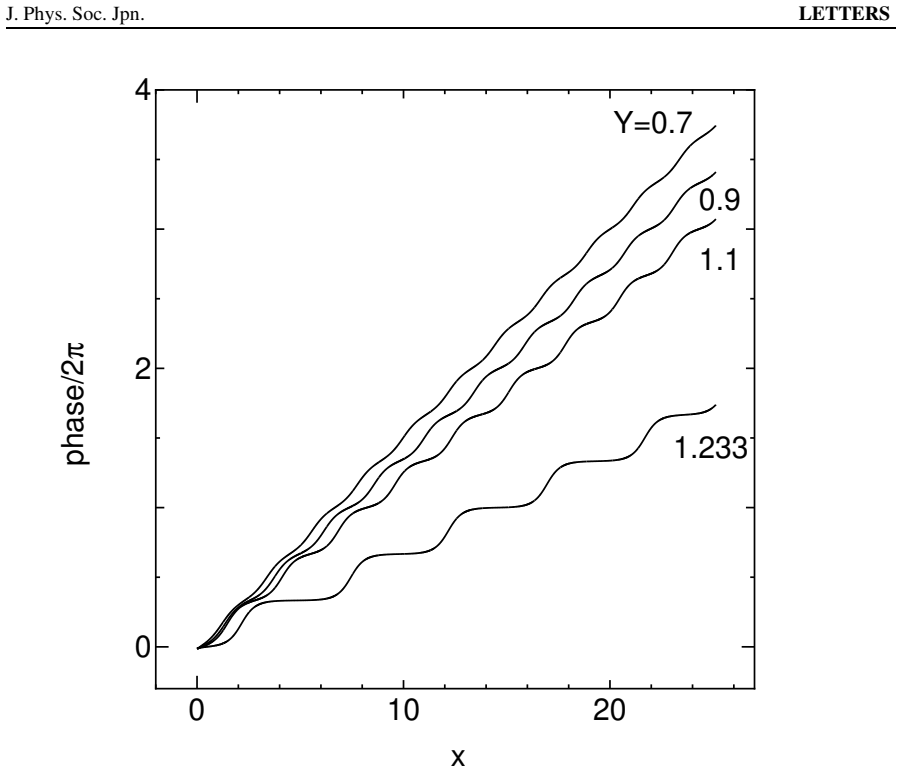
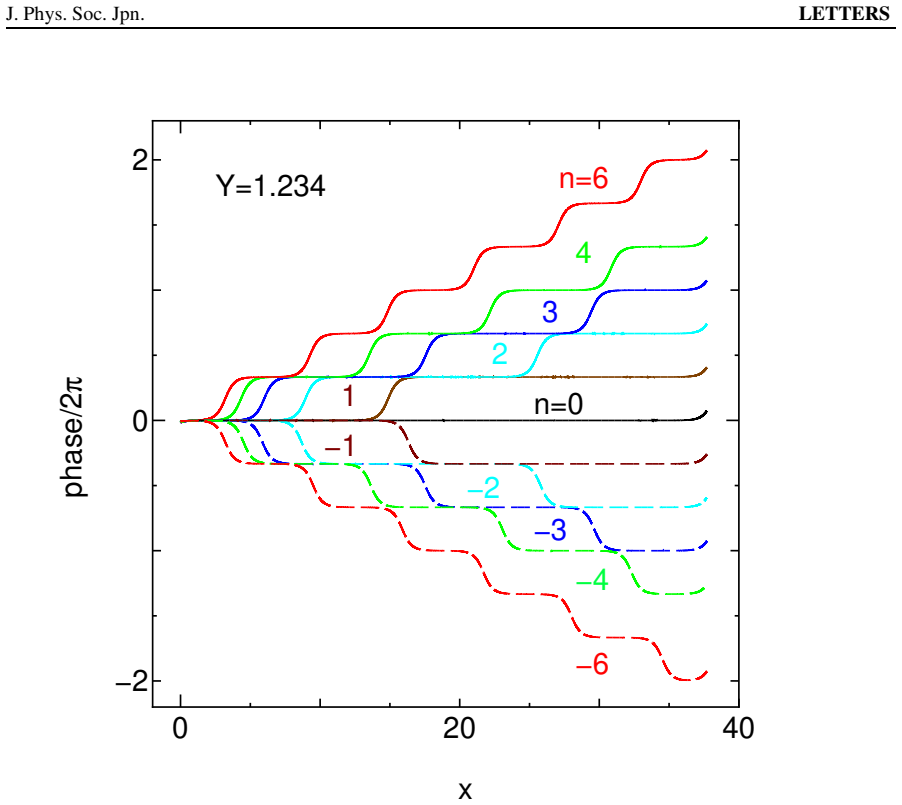
Numerical annealing of McMillan's free energy yields wave profiles with discommensurations near the critical value of the lock-in transition. The same method reveals that such discommensurations can also be excited within the commensurate state, causing the system to become incommensurate. These profiles are proposed to stem from topological invariants, and their excitation is favored in the direction of the original incommensurate wavelength due to the nature of the free energy.
What carries the argument
McMillan's free energy for the charge-density wave lock-in transition, with wave profiles found by numerical annealing that include induced discommensurations.
If this is right
- Discommensurations provide a route for the commensurate state to revert to incommensurate without additional perturbations.
- The wave profiles are determined by topological invariants that allow stable discommensuration configurations.
- Excitation of discommensurations prefers the direction back to the original incommensurate wavelength.
- This mechanism accounts for the current-induced incommensurations observed in o-TaS3 experiments.
Where Pith is reading between the lines
- If the topological invariants control the profiles, similar induced defects could appear in other commensurate-incommensurate systems like adsorbed monolayers or magnetic structures.
- Adding weak pinning or impurities to the model might reveal how real materials stabilize or suppress these induced discommensurations.
- High-resolution probes could test whether annealing-like relaxation occurs in the commensurate phase under slow temperature sweeps.
Load-bearing premise
The numerical annealing reliably finds the global minimum of the free energy, and the model has no hidden terms such as impurities or pinning that would alter the stability of the discommensurations.
What would settle it
High-resolution imaging or diffraction showing the presence or absence of discommensuration-like features in the commensurate phase of a clean CDW sample as the lock-in parameter is approached from below.
Figures


read the original abstract
We studied McMillan's free energy of the lock-in transition in charge-density waves. The wave profiles near the critical value were obtained by numerical annealing. First, we demonstrated that our method reproduces the previous studies. The obtained wave profiles include discommensurations near the critical value. Then, we calculated possible wave profiles in the commensurate state. We found that discommensurations are able to be excited in the commensurate state, leading the system to turn out to an incommensurate state. We proposed that these wave profiles result from topological invariants. Moreover, excitation of the discommensurations is favorable for the direction to the original wavelength of the incommensurate state. This is attributed to the nature of McMillan's free energy. The current-induced incommensurations, which we discovered with the diffraction study of $o$-TaS$_3$ [Inagaki \textit{et al.}, J. Phys. Soc. Jpn. 77, 093708 (2008)], is consistent with this study.
Editorial analysis
A structured set of objections, weighed in public.
Referee Report
Summary. The manuscript studies McMillan's free-energy functional for the CDW lock-in transition. Using numerical annealing, it reproduces known wave profiles near the critical point, reports discommensurations that can be excited inside the commensurate phase and drive the system incommensurate, attributes the profiles to topological invariants, and notes consistency with current-induced diffraction data on o-TaS3.
Significance. If the reported configurations are confirmed to be global minima, the work would supply a concrete numerical illustration of how discommensurations can be induced within the commensurate state and would strengthen the connection between McMillan theory and the authors' earlier experimental observations. The reproduction of prior results near the critical point is a positive feature, but the absence of any verification that the annealing reaches the global minimum substantially reduces the significance of the central claim.
major comments (2)
- [numerical annealing procedure] The claim that discommensurations can be excited in the commensurate state (abstract and results) depends on the annealed profiles being lower in free energy than the uniform commensurate solution. No free-energy comparisons, annealing schedules, multiple random initial conditions, or convergence diagnostics are described, so it remains possible that the reported profiles are only metastable.
- [discussion of topological invariants] The assertion that the wave profiles 'result from topological invariants' is presented without an explicit identification or calculation of any invariant (e.g., winding number or phase-slip count) that would distinguish these solutions from ordinary local minima of the McMillan functional.
minor comments (2)
- [abstract] The abstract states that the method 'reproduces the previous studies' but supplies neither quantitative metrics nor citations to the specific earlier calculations being matched.
- No error bars, sensitivity tests with respect to the lock-in potential amplitude, or checks against higher-harmonic terms are reported, even though the abstract notes that the excitation direction is 'attributed to the nature of McMillan's free energy.'
Simulated Author's Rebuttal
We thank the referee for the careful reading of our manuscript and for the constructive comments, which help clarify the numerical and topological aspects of our study on McMillan's free-energy functional. We address each major comment below and will revise the manuscript to incorporate the requested verifications.
read point-by-point responses
-
Referee: The claim that discommensurations can be excited in the commensurate state (abstract and results) depends on the annealed profiles being lower in free energy than the uniform commensurate solution. No free-energy comparisons, annealing schedules, multiple random initial conditions, or convergence diagnostics are described, so it remains possible that the reported profiles are only metastable.
Authors: We agree that explicit confirmation that the annealed profiles are global minima (or at least lower in free energy than the uniform commensurate state) is required to support the claim. In the revised manuscript we will add direct free-energy comparisons between the discommensuration-containing solutions and the uniform commensurate state. We will also document the annealing schedule, results obtained from multiple independent random initial conditions, and convergence diagnostics (e.g., energy stabilization and profile stability under further iterations). These additions will demonstrate that the reported profiles are not merely metastable and that discommensurations can indeed be induced inside the commensurate phase. revision: yes
-
Referee: The assertion that the wave profiles 'result from topological invariants' is presented without an explicit identification or calculation of any invariant (e.g., winding number or phase-slip count) that would distinguish these solutions from ordinary local minima of the McMillan functional.
Authors: We acknowledge that the manuscript states the connection to topological invariants without performing the explicit calculation. In the revision we will compute the winding number of the phase field (or equivalently the net phase-slip count) across the system for each reported profile. These invariants will be shown to be non-zero for the discommensuration solutions and zero for the uniform commensurate state, thereby distinguishing the former from ordinary local minima of the McMillan functional and providing the missing topological characterization. revision: yes
Circularity Check
No significant circularity; derivation is self-contained
full rationale
The paper takes McMillan's free-energy functional directly from the literature and applies a standard numerical annealing protocol to minimize it. It first reproduces known results from prior studies, then extends the minimization into the commensurate regime to obtain discommensuration profiles. The sole self-citation (to the authors' 2008 experiment) is invoked only for post-hoc consistency with observed current-induced behavior and does not enter the derivation of the profiles or the topological-invariant interpretation. No parameter is fitted to the target data and then relabeled as a prediction, no ansatz is smuggled via self-citation, and no uniqueness theorem is imported from the authors' own prior work. The central claim therefore rests on an externally defined functional and a reproducible numerical procedure rather than on any reduction to the paper's own inputs.
Axiom & Free-Parameter Ledger
free parameters (1)
- lock-in potential amplitude
axioms (2)
- domain assumption The CDW order parameter is adequately described by McMillan's one-dimensional free-energy functional.
- ad hoc to paper Numerical annealing reaches the global energy minimum.
Reference graph
Works this paper leans on
-
[1]
Bak and V
P . Bak and V . J. Emery, Phys. Rev. Lett. 36, 978 (1976)
1976
-
[2]
McMillan, Phys
W. McMillan, Phys. Rev. B 14, 1496 (1976)
1976
-
[3]
Nakanishi and H
K. Nakanishi and H. Shiba, J. Phys. Soc. Jpn. 43, 1839 (1977 )
1977
-
[4]
Nakatsugawa, T.N
K. Nakatsugawa, T.N. Ikeda, T. Toshima, and S.Tanda, Phys . Rev. B 109 , L081407 (2024)
2024
-
[5]
D. M. Sagar, D. Fausti, S. Y ue, C. A. Kuntscher, S. van Smaalen, and P . H. M. van Loos- drecht, New J. Phys. 10, 023043 (2008)
2008
-
[6]
Inagaki, M
K. Inagaki, M. Tsubota, K. Higashiyama, K. Ichimura, S. Ta nda, K. Y amamoto, N. Hanasaki, N. Ikeda, Y . Nogami, T. Ito, and H. Toyokawa, J. Phys. Soc. Jpn. 77, 093708 (2008)
2008
-
[7]
Takoshima, M
T. Takoshima, M. Ido, K. Tsutsumi, T. Sambongi, S. Honma, K . Y amaya, and Y .Abe, Solid State Commun. 35, 911 (1980)
1980
-
[8]
Latyshev, Y a.S
Y u.I. Latyshev, Y a.S. Savitskaya, and V .V . Frolov, JETP Lett. 38, 541 (1983)
1983
-
[9]
Rojo-Bravo, V .L.R
A. Rojo-Bravo, V .L.R. Jacques, and D. Le Bolloc’h, Phys. Rev. B 94, 201120(R), (2016)
2016
-
[10]
Inagaki, K
K. Inagaki, K. Nakatsugawa, and S. Tanda, J. Phys. Soc. Jp n. 93, 083702 (2024)
2024
-
[11]
Fukuyama and H
H. Fukuyama and H. Takayama, in Electronic Properties of Inorganic Quasi-One- Dimensional Materials, I, ed. P . Monceau (Reidel, Dordrecht, 1985) p. 41
1985
-
[12]
Rosenbluth, Marshall N
Nicholas Metropolis, Arianna W. Rosenbluth, Marshall N . Rosenbluth, Augusta H. Teller, Edward Teller, J. Chem. Phys. 21, 1087-1092 (1953)
1953
-
[13]
Maki, Phys
K. Maki, Phys. Rev. Lett. 39, 46 (1977)
1977
-
[14]
Duan, Phys
J.-M. Duan, Phys. Rev. B 48, 4860 (1993)
1993
-
[15]
Hatakenaka, M
N. Hatakenaka, M. Shiobara, K. Matsuda, and S. Tanda, Phy s. Rev. B 57, R2003 (1998)
1998
-
[16]
Tsubota, K
M. Tsubota, K. Inagaki, M. Matsuura, and S. Tanda, Europh ys. Lett. 97, 57011 (2012)
2012
-
[17]
Rozhkov, Phys
A.V . Rozhkov, Phys. Rev. B 111, 205434 (2025). 6/6 J. Phys. Soc. Jpn. LETTERS 0 10 20 0 1 2 x phase/2π Y=1.233 Initial slope Ta=0 Ta=5 Fig. 1. Optimization of the wave form from a pure incommensurate CDW . The black solid line represents the initial phase. The red and blue solid lines show the intermed iate ( Ta = 5) and final phases, respectively. The cr...
2025
discussion (0)
Sign in with ORCID, Apple, or X to comment. Anyone can read and Pith papers without signing in.