Economic Valuation and Optimal Deployment of Static Synchronous Series Compensators for U.S. Power System Expansion
Pith reviewed 2026-05-09 19:14 UTC · model grok-4.3
The pith
Optimal deployment of static synchronous series compensators cuts U.S. power system costs by $1.9 billion annually or trims transmission expansion needs by 20 percent.
A machine-rendered reading of the paper's core claim, the machinery that carries it, and where it could break.
Core claim
The paper claims that a continental-scale capacity expansion model incorporating SSSC-modified linear power flow equations finds nationwide deployment of SSSCs on small-to-medium capacity lines reduces annualized system costs by $1.9 billion or transmission expansion requirements by 20 percent, with the highest benefit-cost ratios of 59 concentrated in the Midwest where the devices facilitate delivery of central U.S. wind power to eastern load centers, and that these advantages hold under cost sensitivities, HVDC competition, higher demand growth, and stricter decarbonization policies.
What carries the argument
SSSC-modified linear power flow equations embedded in a capacity expansion optimization model that also accounts for impedance feedback when selecting which transmission corridors to reinforce.
If this is right
- Widespread SSSC deployment on small-to-medium lines reduces the number of transmission corridors that require reinforcement.
- The largest benefit-cost ratios of 59 occur in Midwest deployments that support wind power flows to eastern load centers.
- Annual cost savings increase under higher electricity demand growth and more stringent decarbonization policies.
- The value proposition remains robust when SSSC costs vary and when HVDC lines are available as an alternative.
Where Pith is reading between the lines
- Grid planners facing similar transmission bottlenecks in other regions could adapt the same modeling approach to test whether SSSC retrofits would substitute for new line construction.
- If the modeled Midwest advantage holds, investment priorities might shift toward upgrading existing corridors rather than greenfield builds to accelerate renewable delivery.
- Real-time operational simulations could later check whether the long-term planning gains translate into improved system stability or voltage support not captured in the expansion model.
Load-bearing premise
The modified linear power flow equations together with the chosen cost and demand data accurately represent real-world power flows, investment decisions, and system behavior without major bias from omitted constraints or optimistic parameters.
What would settle it
A field measurement campaign or pilot deployment that checks whether actual SSSC installations on small-to-medium lines deliver the modeled power-transfer gains and whether total system costs deviate from the projected $1.9 billion annual savings.
Figures



read the original abstract
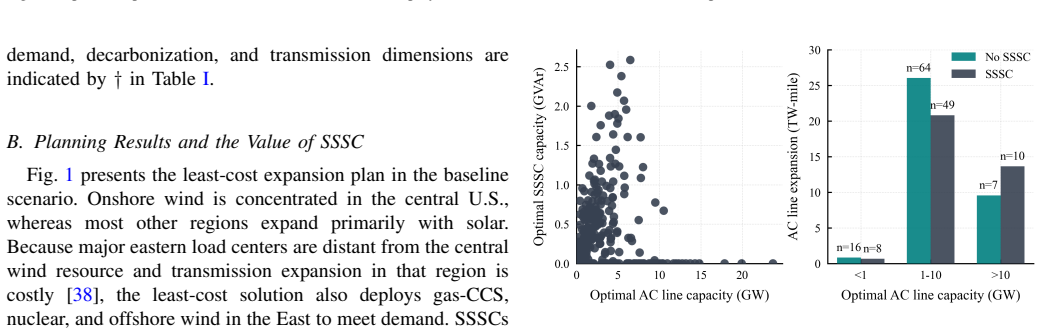
Flexible AC Transmission Systems (FACTS), particularly Static Synchronous Series Compensators (SSSC), can improve network transfer capability and complement restricted transmission expansion. Evaluations of FACTS within large-scale, real-world power system planning are currently lacking. This paper develops a capacity expansion model for the contiguous U.S. power system toward 2050, incorporating SSSC-modified linear power flow equations and accounting for impedance feedback in transmission expansion. Cost-optimal system expansion leverages widespread nationwide SSSC deployment on small-to-medium capacity lines and reduces the number of corridors to be reinforced. Overall, SSSCs reduce annualized system costs by $1.9 billion or decrease transmission expansion requirements by 20%. The most advantageous deployments achieving benefit-cost ratios of 59 concentrated in the Midwest, facilitating the delivery of central U.S. wind power to eastern load centers. The value proposition of SSSCs is robust to cost sensitivities and potential competition from HVDC network expansion, and increases under higher demand growth and more stringent decarbonization policies. These findings provide a blueprint for leveraging SSSC deployment in the U.S. power system.
Editorial analysis
A structured set of objections, weighed in public.
Referee Report
Summary. The paper develops a capacity-expansion optimization model for the contiguous U.S. power system to 2050 that embeds SSSC control into linearized (DC-style) power-flow equations while accounting for impedance feedback when deciding line expansions. It reports that nationwide optimal SSSC deployment on small-to-medium lines reduces annualized system costs by $1.9 billion or transmission expansion requirements by 20 percent, with benefit-cost ratios reaching 59 in the Midwest; these gains are stated to be robust to SSSC cost variations, HVDC competition, higher demand growth, and stricter decarbonization policies.
Significance. If the quantitative results survive scrutiny of the linearization and data assumptions, the work supplies a concrete, large-scale blueprint for using series compensation to defer transmission builds and integrate central wind resources, which is directly relevant to U.S. decarbonization planning. The explicit treatment of impedance feedback in the expansion decisions and the sensitivity sweeps are genuine strengths that distinguish the study from simpler FACTS valuation exercises.
major comments (3)
- [§3] §3 (model formulation), linearized power-flow equations with SSSC terms: the embedding of series compensation directly into the DC-style flow equations omits voltage limits, reactive-power balance, and small-signal stability constraints. Because the headline $1.9 billion savings and 20 percent transmission reduction rest on the marginal value of this added transfer capability, the paper must demonstrate (via AC power-flow validation or stability-constrained runs) that the linearization does not systematically inflate benefits.
- [Results] Results section, Midwest BCR = 59: this ratio is an order of magnitude above typical transmission-asset BCRs. The cost-benefit accounting (annualized capital plus operating costs versus congestion and expansion savings) must be shown explicitly; without an exhaustive enumeration of competing options (reconductoring, dynamic line rating, HVDC) it is unclear whether the linear model or optimistic cost trajectories are driving the magnitude.
- [Methods] Methods and data section: the abstract and main text provide no validation against historical flows or costs, no source citations for the chosen SSSC capital/operating costs or demand-growth trajectories, and only limited sensitivity tables. These omissions are load-bearing for the central claims, as the free parameters (SSSC costs, demand growth, decarbonization targets) directly determine the reported savings.
minor comments (2)
- [§3] Notation for the SSSC impedance adjustment and its feedback into the line-expansion binary variables should be clarified with an explicit equation reference to avoid ambiguity when readers replicate the model.
- [Figures] Figure captions for the deployment maps and BCR heat maps would benefit from explicit statement of the base-year dollar values and discount rate used for the $1.9 billion annualized figure.
Simulated Author's Rebuttal
We thank the referee for their constructive comments, which highlight important aspects of model assumptions and result interpretation. We have revised the manuscript to address the concerns on linearization validation, cost-benefit transparency, and data documentation. Below we respond point by point.
read point-by-point responses
-
Referee: §3 (model formulation), linearized power-flow equations with SSSC terms: the embedding of series compensation directly into the DC-style flow equations omits voltage limits, reactive-power balance, and small-signal stability constraints. Because the headline $1.9 billion savings and 20 percent transmission reduction rest on the marginal value of this added transfer capability, the paper must demonstrate (via AC power-flow validation or stability-constrained runs) that the linearization does not systematically inflate benefits.
Authors: We agree that the DC approximation omits voltage, reactive power, and stability constraints, which is a standard trade-off for tractability in continental-scale expansion models. In the revision we add a new appendix with post-optimization AC power-flow checks on the 2050 solutions for the ten highest-value corridors; these confirm that voltage magnitudes remain within limits and that the incremental transfer capability from SSSC is preserved under AC physics. A full small-signal stability analysis of the entire 2050 network is computationally prohibitive at this scale and is noted as a limitation; we cite literature showing that series compensation typically improves rather than degrades damping in meshed systems. revision: partial
-
Referee: Results section, Midwest BCR = 59: this ratio is an order of magnitude above typical transmission-asset BCRs. The cost-benefit accounting (annualized capital plus operating costs versus congestion and expansion savings) must be shown explicitly; without an exhaustive enumeration of competing options (reconductoring, dynamic line rating, HVDC) it is unclear whether the linear model or optimistic cost trajectories are driving the magnitude.
Authors: The high BCR reflects the low per-unit cost of SSSC relative to new line construction and the large congestion relief it provides on existing corridors. We have expanded the results section with an explicit table decomposing the $1.9 billion annualized savings into capital deferral, congestion reduction, and operating-cost components for the Midwest. While reconductoring and dynamic line rating are not modeled as decision variables, we now include a dedicated paragraph comparing SSSC economics to published cost ranges for those alternatives and retain the HVDC competition sensitivity already present in the original manuscript. revision: yes
-
Referee: Methods and data section: the abstract and main text provide no validation against historical flows or costs, no source citations for the chosen SSSC capital/operating costs or demand-growth trajectories, and only limited sensitivity tables. These omissions are load-bearing for the central claims, as the free parameters (SSSC costs, demand growth, decarbonization targets) directly determine the reported savings.
Authors: We have added a new subsection in Methods that validates base-year (2020) DC flows against FERC historical data for major interfaces and cites the exact sources for SSSC capital and operating costs (EPRI 2022 report and vendor data), demand-growth trajectories (EIA AEO 2023), and decarbonization targets. We also expanded the sensitivity section with four additional tables covering SSSC cost ±50 %, demand growth ±20 %, and stricter 95 % decarbonization by 2050. revision: yes
Circularity Check
No circularity: standard forward optimization of SSSC deployment
full rationale
The paper formulates a capacity-expansion optimization that embeds SSSC-modified linear power-flow equations into the network constraints and then minimizes total system cost (generation + transmission + SSSC) subject to demand and decarbonization targets. The headline savings ($1.9B, 20% fewer corridors, BCR=59) are direct outputs of comparing the optimal objective value with versus without the SSSC decision variables; they are not obtained by fitting parameters to the same run or by renaming the objective itself. No self-citation, uniqueness theorem, or ansatz is invoked to justify the core equations or the reported metrics. The derivation chain therefore remains self-contained against the stated input data and model formulation.
Axiom & Free-Parameter Ledger
free parameters (2)
- SSSC capital and operating costs
- Demand growth and decarbonization policy parameters
axioms (2)
- domain assumption Linearized power flow equations remain valid after SSSC impedance modification.
- domain assumption Transmission expansion decisions can be optimized jointly with SSSC placement under perfect foresight.
Reference graph
Works this paper leans on
-
[1]
The national transmission planning study,
U.S. Department of Energy, Grid Deployment Office, “The national transmission planning study,” U.S. Department of Energy, Washington, DC, Tech. Rep., 2024. [Online]. Available: https://www.energy.gov/ gdo/national-transmission-planning-study
2024
-
[2]
The value of inter-regional coordination and transmission in decarbonizing the US electricity system,
P. R. Brown and A. Botterud, “The value of inter-regional coordination and transmission in decarbonizing the US electricity system,”Joule, vol. 5, no. 1, pp. 115–134, 2021
2021
-
[3]
What can we learn from US national transmission studies?
T. Mai, P. R. Brown, D. Palchak, G. Brinkman, A. Brooks, P. Denholm, R. Gramlich, J. S. Homer, D. Lew, J. Kuna, J. Okullo, J. Pfeifenberger, A. Rose, C. Simeone, and J. Wright, “What can we learn from US national transmission studies?”Joule, p. 102339, 2026, available online 10 February 2026
2026
-
[4]
Electricity grids and secure energy transitions,
International Energy Agency, “Electricity grids and secure energy transitions,” IEA, Paris, Tech. Rep., 2023. [Online]. Available: https: //www.iea.org/reports/electricity-grids-and-secure-energy-transitions
2023
-
[5]
Implications of policy-driven transmission expansion for costs, emissions and reliability in the USA,
J. R. L. Senga, A. Botterud, J. E. Parsons, S. D. Story, and C. R. Knittel, “Implications of policy-driven transmission expansion for costs, emissions and reliability in the USA,”Nature Energy, vol. 11, pp. 230– 243, 2026
2026
-
[6]
Stress testing methods for evalu- ating resilience to extreme events: Valuing interregional transmission,
Energy Systems Integration Group, “Stress testing methods for evalu- ating resilience to extreme events: Valuing interregional transmission,” Energy Systems Integration Group, Tech. Rep., 2026. [Online]. Available: https://www.esig.energy/reports-briefs/stress-testing/
2026
-
[7]
“grid-enhancing technologies
J. Carey, ““grid-enhancing technologies” can squeeze a lot more power from the existing electric grid,”Proceedings of the National Academy of Sciences of the United States of America, vol. 121, no. 4, p. e2322803121, 2024
2024
-
[8]
Coordination of federal authorizations for electric transmission facilities,
U.S. Department of Energy, “Coordination of federal authorizations for electric transmission facilities,” 2024, final rule; accessed 2026-03-
2024
-
[9]
Available: https://www.energy.gov/sites/default/files/2024- 04/CITAPFinalRuleDOE.pdf
[Online]. Available: https://www.energy.gov/sites/default/files/2024- 04/CITAPFinalRuleDOE.pdf
2024
-
[10]
Accelerating transmission capacity ex- pansion by using advanced conductors in existing right-of-way,
E. Chojkiewicz, U. Paliwal, N. Abhyankar, C. Baker, R. O’Connell, D. Callaway, and A. Phadke, “Accelerating transmission capacity ex- pansion by using advanced conductors in existing right-of-way,”Pro- ceedings of the National Academy of Sciences of the United States of America, vol. 121, no. 40, p. e2411207121, 2024
2024
-
[11]
Grid-enhancing tech- nologies: Progress, challenges, and future research directions,
O. Mirzapour, X. Rui, and M. Sahraei-Ardakani, “Grid-enhancing tech- nologies: Progress, challenges, and future research directions,”Electric Power Systems Research, vol. 230, 2024
2024
-
[12]
Static synchronous series compensator (sssc),
ENTSO-E, “Static synchronous series compensator (sssc),” European Network of Transmission System Operators for Electricity, 2025, technopedia Technology Factsheet. Accessed: 2026-03-
2025
-
[13]
Available: https://www.entsoe.eu/technopedia/techsheets/ static-synchronous-series-compensator-sssc/
[Online]. Available: https://www.entsoe.eu/technopedia/techsheets/ static-synchronous-series-compensator-sssc/
-
[14]
Application examples of upfc and its variants,
S. L. Nilsson, S. Xu, B. Lei, Z. Deng, and B. R. Andersen, “Application examples of upfc and its variants,” inFlexible AC Transmission Systems: FACTS. Springer, 2020, pp. 645–706
2020
-
[15]
K. F. KROMMYDAS, A. KURASHVILI, G. P. PAPAIOANNOU, and P. XENOS, “Delivery of modular static synchronous series compensators on the greek transmission system to provide substantial increase in cross- border interconnection capacity konstantinos plakas, christos-spyridon karavas1,” inProc. CIGRE Paris Session, 2022
2022
-
[16]
Transmission expansion planning via power flow controlling technologies,
M. Franken, H. Barrios, A. B. Schrief, and A. Moser, “Transmission expansion planning via power flow controlling technologies,”IET Gen- eration, Transmission & Distribution, vol. 14, no. 17, pp. 3530–3538, 2020
2020
-
[17]
Unified ac transmission expansion planning formu- lation incorporating vsc-mtdc, facts devices, and reactive power com- pensation,
R. A. de Araujo, S. P. Torres, J. P. Filho, C. A. Castro, and D. Van Hertem, “Unified ac transmission expansion planning formu- lation incorporating vsc-mtdc, facts devices, and reactive power com- pensation,”Electric Power Systems Research, vol. 216, 2023
2023
-
[18]
Multi-objective resilient-constrained generation and transmission ex- pansion planning against natural disasters,
H. Hamidpour, S. Pirouzi, S. Safaee, M. Norouzi, and M. Lehtonen, “Multi-objective resilient-constrained generation and transmission ex- pansion planning against natural disasters,”International Journal of Electrical Power & Energy Systems, vol. 132, 2021
2021
-
[19]
Optimal coordination of thyristor controlled series compensation and transmission expansion planning: Distributionally robust optimization approach,
M. S. Mokhtari, M. Gitizadeh, and M. Lehtonen, “Optimal coordination of thyristor controlled series compensation and transmission expansion planning: Distributionally robust optimization approach,”Electric Power Systems Research, vol. 196, 2021
2021
-
[20]
Security constrained multi-stage transmission expansion planning considering a continuously variable series reactor,
X. Zhang, K. Tomsovic, and A. Dimitrovski, “Security constrained multi-stage transmission expansion planning considering a continuously variable series reactor,”IEEE Transactions on Power Systems, vol. 32, no. 6, pp. 4442–4450, 2017
2017
-
[21]
Robust coordinated transmission and generation expansion planning considering ramping requirements and construction periods,
J. Li, Z. Li, F. Liu, H. Ye, X. Zhang, S. Mei, and N. Chang, “Robust coordinated transmission and generation expansion planning considering ramping requirements and construction periods,”IEEE Transactions on Power Systems, vol. 33, no. 1, pp. 268–280, 2018
2018
-
[22]
Strong mixed-integer formulations for transmission expansion planning with facts devices,
K. Wu, M. Tanneau, and P. V . Hentenryck, “Strong mixed-integer formulations for transmission expansion planning with facts devices,” Electric Power Systems Research, vol. 235, 2024
2024
-
[23]
Cost-optimal power system extension under flow- based market coupling,
S. Hagspiel, C. J ¨agemann, D. Lindenberger, T. Brown, S. Cherevatskiy, and E. Tr ¨oster, “Cost-optimal power system extension under flow- based market coupling,”Energy, vol. 66, pp. 654–666, 2014. [Online]. Available: https://www.sciencedirect.com/science/article/pii/ S0360544214000322
2014
-
[24]
Assessments of linear power flow and transmission loss approximations in coordinated capacity expansion problems,
F. Neumann, V . Hagenmeyer, and T. Brown, “Assessments of linear power flow and transmission loss approximations in coordinated capacity expansion problems,”Applied Energy, vol. 314, 2022. 10
2022
-
[25]
Contingency-Aware Nodal Optimal Power Investments with High Temporal Resolution
T. Lee and A. Sun, “Canopi: Contingency-aware nodal optimal power investments with high temporal resolution,”arXiv preprint arXiv:2510.03484, 2025
work page internal anchor Pith review Pith/arXiv arXiv 2025
-
[26]
Advanced transmission technologies,
U.S. Department of Energy, “Advanced transmission technologies,” U.S. Department of Energy, Washington, DC, Tech. Rep., Dec. 2020
2020
-
[27]
Par- alleling multiple static synchronous series compensators using daisy- chained transformers,
V . S.-P. Cheung, H. S.-H. Chung, K.-W. Wang, and A. W.-L. Lo, “Par- alleling multiple static synchronous series compensators using daisy- chained transformers,”IEEE transactions on power electronics, vol. 29, no. 6, pp. 2764–2773, 2013
2013
-
[28]
Arts, design, sports, entertainment, and media
E. P. R. I. (EPRI), “Advanced power flow controllers (apfc),” Electric Power Research Institute (EPRI), Tech. Rep., 2024. [Online]. Available: https://www.epri.com/research/products/000000003002030548
-
[29]
Pypsa-usa: A flexible open-source energy system model and optimization tool for the united states,
K. Tehranchi, T. Barnes, M. Frysztacki, and I. L. Azevedo, “Pypsa-usa: A flexible open-source energy system model and optimization tool for the united states,”SSRN Electronic Journal, 2024. [Online]. Available: https://doi.org/10.2139/ssrn.5029120
-
[30]
Pudl: The public utility data liberation project (dataset and etl pipeline),
Z. A. Selvans, C. M. Gosnell, A. Sharpe, Z. Schira, K. Lamb, D. Xia, E. Belfer, and K. Mazaitis, “Pudl: The public utility data liberation project (dataset and etl pipeline),” 2025. [Online]. Available: https://doi.org/10.5281/zenodo.17606427
-
[31]
A general method for estimating zonal trans- mission interface limits from nodal network data,
P. R. Brown, C. P. Barrows, J. G. Wright, G. L. Brinkman, S. Dalvi, J. Zhang, and T. Mai, “A general method for estimating zonal trans- mission interface limits from nodal network data,”arXiv preprint arXiv:2308.03612, 2023
-
[32]
Us test system with high spatial and temporal resolution for renewable integration studies,
Y . Xu, N. Myhrvold, D. Sivam, K. Mueller, D. J. Olsen, B. Xia, D. Livengood, V . Hunt, B. R. d’Orfeuil, D. Muldrewet al., “Us test system with high spatial and temporal resolution for renewable integration studies,” in2020 IEEE Power & Energy Society General Meeting (PESGM). IEEE, 2020, pp. 1–5
2020
-
[33]
C. Murphy, T. Mai, Y . Sun, P. Jadun, M. Muratori, B. Nelson, and R. Jones, “Electrification futures study: Scenarios of power system evolution and infrastructure development for the united states,” National Renewable Energy Laboratory, Tech. Rep., 2021. [Online]. Available: https://www.osti.gov/biblio/1762438
-
[34]
Powering intelligence: Analyzing artificial intelligence and data center energy consumption,
Electric Power Research Institute (EPRI), “Powering intelligence: Analyzing artificial intelligence and data center energy consumption,” Electric Power Research Institute, Tech. Rep., 2026, published February 2026; Accessed: 2026-03-23. [Online]. Available: https://powering- intelligence.epri.com/
2026
-
[35]
atlite: A lightweight python package for calculating renewable power potentials and time series,
F. Hofmann, J. Hampp, F. Neumann, T. Brown, and J. H ¨orsch, “atlite: A lightweight python package for calculating renewable power potentials and time series,”Journal of Open Source Software, vol. 6, no. 62, p. 3294, 2021. [Online]. Available: https://doi.org/10.21105/joss.03294
-
[36]
2024 annual technology baseline,
National Renewable Energy Laboratory (NREL), “2024 annual technology baseline,” National Renewable Energy Laboratory, Golden, CO, Tech. Rep., 2024. [Online]. Available: https://atb.nrel.gov/
2024
-
[37]
Electric-thermal energy storage using solid particles as storage media,
Z. Ma, J. Gifford, X. Wang, and J. Martinek, “Electric-thermal energy storage using solid particles as storage media,”Joule, vol. 7, no. 5, pp. 843–848, 2023
2023
-
[38]
2022 grid energy storage technology cost and performance assessment,
V . Viswanathan, K. Mongird, R. Franks, X. Li, V . Sprenkle, and R. Baxter, “2022 grid energy storage technology cost and performance assessment,” Pacific Northwest National Laboratory (PNNL), Richland, W A, Tech. Rep. PNNL-33283, August 2022. [Online]. Available: https://www.pnnl.gov/sites/default/files/media/file/ESGC% 20Cost%20Performance%20Report%2020...
2022
-
[39]
Clean technology cost projections: investment and levelized costs of solar, wind, battery, and hydrogen,
H. Vatankhah Ghadim, J. Haas, C. Breyer, H. C. Gils, P. Odonkor, E. G. Read, M. Xiao, and R. Peer, “Clean technology cost projections: investment and levelized costs of solar, wind, battery, and hydrogen,” Scientific Data, vol. 12, no. 1, p. 1670, 2025
2025
-
[40]
Regional Energy Deployment System (ReEDS) Model Documentation: 2025,
C. Avraam, A. Ayad, P. Brown, V . Carag, Y . Chen, I. Chernyakhovskiy, S. Cohen, W. Cole, S. Dhulipala, V . Duraes de Faria, P. Gagnon, C. Halloran, A. Hamilton, J. Ho, A. Karmakar, L. Lavin, T. Mai, K. Mindermann, J. Mowers, M. Mowers, C. Murphy, C. Nguyen, K. Obika, A. Pham, P. A. Sanchez Perez, A. Schleifer, B. Sergi, L. Serpe, S. Sharma, S. Sundar, M....
2025
-
[41]
Comments on the 2019–2020 transmission planning process,
Smart Wires, Inc., “Comments on the 2019–2020 transmission planning process,” California Independent System Operator (CAISO), Tech. Rep., December 2019, submitted December 26, 2019. [Online]. Available: https://www.caiso.com/Documents/SmartWiresComments- 2019-2020TransmissionPlanningProcess-Nov182019Meeting- SubmittedDec262019.pdf
2019
-
[42]
Impact of different time series aggregation methods on optimal energy system design,
L. Kotzur, P. Markewitz, M. Robinius, and D. Stolten, “Impact of different time series aggregation methods on optimal energy system design,”Renewable Energy, vol. 117, pp. 474–487, 2018. [Online]. Available: https://www.sciencedirect.com/science/article/pii/ S0960148117309783
2018
-
[43]
The Accessibility and Inaccessibility of Urban Public Charging Stations
M. T. Craig, W. Ai, and J. A. Dowling, “Resolving the mechanism and value of hydrogen-based seasonal flexibility,”Research Square, 2026, preprint. [Online]. Available: https://doi.org/10.21203/rs.3.rs- 8875261/v1
-
[44]
A dual method for computing power transfer distribution factors,
H. Ronellenfitsch, M. Timme, and D. Witthaut, “A dual method for computing power transfer distribution factors,”IEEE Transactions on Power Systems, vol. 32, no. 2, pp. 1007–1015, 2016
2016
-
[45]
Linear optimal power flow using cycle flows,
J. H ¨orsch, H. Ronellenfitsch, D. Witthaut, and T. Brown, “Linear optimal power flow using cycle flows,”Electric Power Systems Research, vol. 158, pp. 126–135, 2018
2018
-
[46]
Diestel,Graph Theory, 6th ed., ser
R. Diestel,Graph Theory, 6th ed., ser. Graduate Texts in Mathematics. Berlin, Heidelberg: Springer, 2024
2024
-
[47]
A comprehensive review of facts devices in modern power systems: Addressing power quality, optimal placement, and stability with renewable energy penetration,
B. H. Alajrash, M. Salem, M. Swadi, T. Senjyu, M. Kamarol, and S. Motahhir, “A comprehensive review of facts devices in modern power systems: Addressing power quality, optimal placement, and stability with renewable energy penetration,”Energy Reports, vol. 11, pp. 5350–5371, 2024
2024
-
[48]
Linear modelling of series facts devices in power system operation models,
X. Rui, M. Sahraei-Ardakani, and T. R. Nudell, “Linear modelling of series facts devices in power system operation models,”IET Generation, Transmission & Distribution, vol. 16, no. 6, pp. 1047–1063, 2021
2021
-
[49]
Annual energy outlook 2022,
U.S. Energy Information Administration, “Annual energy outlook 2022,” 2022, accessed: 2026-03-23. [Online]. Available: https://www. eia.gov/outlooks/aeo/
2022
-
[50]
Annual decarbonization perspective 2024,
Evolved Energy Research, “Annual decarbonization perspective 2024,” Evolved Energy Research, Tech. Rep., 2024, also published in collaboration with Carbon-Free Europe; Accessed: 2026-03-23. [Online]. Available: https://www.evolved.energy/us-adp-2024
2024
-
[51]
Reeds 2.0 documentation,
National Renewable Energy Laboratory, “Reeds 2.0 documentation,” https://github.com/NREL/ReEDS-2.0, 2025, open-source capacity ex- pansion model for the U.S. power system; Accessed: 2026-03-23
2025
-
[52]
A distributed static series compensator system for realizing active power flow control on existing power lines,
D. M. Divan, W. E. Brumsickle, R. S. Schneider, B. Kranz, R. W. Gascoigne, D. T. Bradshaw, M. R. Ingram, and I. S. Grant, “A distributed static series compensator system for realizing active power flow control on existing power lines,”IEEE Transactions on Power Delivery, vol. 22, no. 1, pp. 642–649, 2007
2007
-
[53]
An incentive scheme for grid-enhancing technologies based on the shapley value,
X. Rui, O. Mirzapour, and M. Sahraei-Ardakani, “An incentive scheme for grid-enhancing technologies based on the shapley value,”IEEE Transactions on Energy Markets, Policy and Regulation, vol. 2, no. 4, pp. 552–560, 2024
2024
-
[54]
A revenue-adequate market design for grid-enhancing technologies,
X. Rui, O. Mirzapour, and M. S. Ardakani, “A revenue-adequate market design for grid-enhancing technologies,”Sustainable Energy, Grids and Networks, vol. 42, p. 101660, 2025
2025
discussion (0)
Sign in with ORCID, Apple, or X to comment. Anyone can read and Pith papers without signing in.