Multi-User XR Offloading via Massive MIMO: A System-Level Analysis using a Real-Life Dataset
Pith reviewed 2026-05-08 17:48 UTC · model grok-4.3
The pith
Massive MIMO allows offloading of SLAM from multiple XR devices while exposing clear trade-offs among latency, localization accuracy, and transmission power.
A machine-rendered reading of the paper's core claim, the machinery that carries it, and where it could break.
Core claim
The authors introduce a system-level framework that combines Massive MIMO channel models with SLAM processing delays to predict latency and localization error for multiple simultaneous XR users, then apply it to a real-life dataset in a parameter sweep; the study finds that Massive MIMO yields lower latency and transmit power than conventional links for moderate user counts but requires explicit balancing against localization error and that a full device power budget remains to be evaluated.
What carries the argument
The system-level analysis framework that couples Massive MIMO uplink models with SLAM execution time and localization error to compute end-to-end performance metrics for multiple XR devices.
If this is right
- For a moderate number of users, Massive MIMO reduces both latency and device transmission power relative to conventional cellular links while keeping localization error within acceptable bounds.
- Increasing the number of base-station antennas improves the latency-power operating point until the per-user rate is constrained by shared resources.
- Localization error grows once the wireless link forces compression or packet loss, creating a hard upper limit on how many users can be supported simultaneously.
- Complete device-level power accounting, including sensing and local processing, is still required before claiming net energy savings.
Where Pith is reading between the lines
- The same framework could be reused to compare offloading of other XR workloads such as rendering or hand tracking.
- Edge servers co-located with the Massive MIMO array would further shrink the propagation and queuing delays that remain after the wireless hop.
- Antenna and power-allocation policies could be tuned in real time using the framework outputs to keep each user inside its latency and accuracy envelope.
- If the localization-error model proves accurate, operators could dimension future XR cells by solving for the maximum user density that meets a target error threshold.
Load-bearing premise
The mathematical models of latency and localization error correctly predict real Massive MIMO link behavior and SLAM accuracy once image or feature data travel over the wireless channel.
What would settle it
An over-the-air experiment that records measured end-to-end latency, localization error, and device transmit power for several XR devices sending SLAM data through a Massive MIMO base station and compares those values directly to the framework predictions.
Figures



read the original abstract
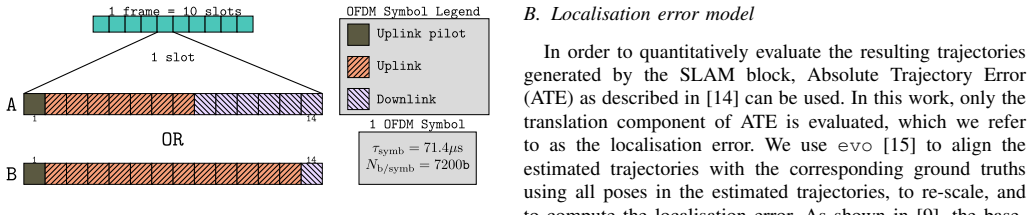
SLAM is one of the biggest bottlenecks of XR devices, which have strict requirements for latency, power consumption, and user satisfaction. A solution that has been proposed and studied to meet the requirements is to offload SLAM to a remote server, which leverages computational hardware but may suffer due to incurred delays and transmission power. In this work, we propose offloading SLAM using Massive MIMO, which is attractive due to lower latencies, transmission power, and a more reliable link for multiple users. A framework for system-level analysis of latency and localisation error in multi-user offloaded XR with Massive MIMO has been proposed, and a case study with varying system-level parameters has been performed with it. The case study showed that there are important trade-offs between latency, localisation error, and device transmission power. We find that Massive MIMO is a promising technology for XR offloading, but that further evaluations including complete device power consumption are needed to get the full picture.
Editorial analysis
A structured set of objections, weighed in public.
Referee Report
Summary. The paper proposes a framework for system-level analysis of latency and localization error in multi-user XR SLAM offloading via Massive MIMO. It performs a case study using a real-life dataset with parameter sweeps over system variables (e.g., number of base-station antennas, simultaneous users, SLAM processing delay), identifies trade-offs among latency, localization error, and device transmission power, and concludes that Massive MIMO is promising for XR offloading while noting the need for further evaluations that include complete device power consumption.
Significance. If the underlying models prove accurate, the work offers practical system-level insights into multi-user XR offloading trade-offs, leveraging a real-life dataset for the SLAM component. This could help guide wireless and computational resource allocation in emerging XR applications, though the lack of end-to-end validation limits immediate applicability.
major comments (1)
- [Framework and Case Study sections] The framework description and case-study parameter sweeps rely on analytic/simulation models for latency and localization error (invoked to generate all reported trade-offs) without any hardware-in-the-loop validation against real Massive MIMO links, over-the-air measurements, or SLAM accuracy under realistic multi-user channel conditions. This is load-bearing for the central claim that Massive MIMO is promising, as the quantitative results and conclusion rest on an untested abstraction.
minor comments (1)
- [Abstract] The abstract provides no equations, error bars, or validation details, making it difficult to assess the strength of the reported trade-offs without the full methods.
Simulated Author's Rebuttal
We thank the referee for the constructive feedback. We address the major comment below, clarifying the scope of our simulation-based study while incorporating additional discussion of model assumptions and limitations in the revised manuscript.
read point-by-point responses
-
Referee: [Framework and Case Study sections] The framework description and case-study parameter sweeps rely on analytic/simulation models for latency and localization error (invoked to generate all reported trade-offs) without any hardware-in-the-loop validation against real Massive MIMO links, over-the-air measurements, or SLAM accuracy under realistic multi-user channel conditions. This is load-bearing for the central claim that Massive MIMO is promising, as the quantitative results and conclusion rest on an untested abstraction.
Authors: We agree that hardware-in-the-loop validation would further strengthen the results. Our manuscript presents a system-level simulation framework that combines established analytic models for Massive MIMO (drawn from the wireless communications literature) with a real-life SLAM dataset for the localization component. The study is explicitly positioned as a simulation-based analysis to identify trade-offs, which is standard for initial system-level evaluations of emerging technologies like XR offloading. The SLAM error model is grounded in real data, while the wireless latency and power models use well-validated abstractions (e.g., from prior Massive MIMO papers). We have added a dedicated subsection in the Discussion to explicitly state the modeling assumptions, their grounding in existing work, and the need for future over-the-air and hardware validation. This does not change the core contribution but directly addresses the concern about untested abstractions. revision: partial
Circularity Check
No significant circularity; framework uses external dataset and standard MIMO models
full rationale
The paper proposes a system-level framework for analyzing latency and localization error in multi-user XR offloading over Massive MIMO, then performs parameter sweeps in a case study using a real-life dataset solely for the SLAM component. No load-bearing step reduces by construction to a self-defined quantity, a fitted parameter renamed as a prediction, or a self-citation chain. The central trade-off results are generated from an analytic/simulation model whose equations are not shown to be equivalent to the outputs by definition, and the manuscript does not invoke uniqueness theorems or ansatzes from prior self-work to force its conclusions. This is the normal case of an independent modeling study.
Axiom & Free-Parameter Ledger
free parameters (3)
- Number of base-station antennas
- Number of simultaneous users
- SLAM processing delay at server
axioms (2)
- domain assumption Massive MIMO channel models and beamforming gains follow standard 3GPP or similar statistical models
- domain assumption Localization error can be modeled as a function of received data rate and packet loss
Reference graph
Works this paper leans on
-
[1]
ILLIXR: An Open Testbed to Enable Extended Reality Systems Research,
M. Huzaifa, R. Desai, S. Grayson, X. Jiang, Y . Jing, J. Lee, F. Lu, Y . Pang, J. Ravichandran, F. Sinclair, B. Tian, H. Yuan, J. Zhang, and S. V . Adve, “ILLIXR: An Open Testbed to Enable Extended Reality Systems Research,”IEEE Micro, vol. 42, no. 4, pp. 97–106, Jul. 2022
work page 2022
-
[2]
RemoteVIO: Offloading Head Tracking in an End-to-End XR System,
Q. Jiang, Y . Pang, W. Sentosa, S. Gao, M. Huzaifa, J. Zhang, J. Perez- Ramirez, D. Das, D. Gonzalez-Aguirre, B. Godfrey, and S. Adve, “RemoteVIO: Offloading Head Tracking in an End-to-End XR System,” inProceedings of the 16th ACM Multimedia Systems Conference, ser. MMSys ’25. New York, NY , USA: Association for Computing Machinery, Mar. 2025, pp. 101–112
work page 2025
-
[3]
Edge-SLAM: Edge-Assisted Visual Simultaneous Localization and Mapping,
A. J. Ben Ali, M. Kouroshli, S. Semenova, Z. S. Hashemifar, S. Y . Ko, and K. Dantu, “Edge-SLAM: Edge-Assisted Visual Simultaneous Localization and Mapping,”ACM Trans. Embed. Comput. Syst., vol. 22, no. 1, pp. 18:1–18:31, Oct. 2022
work page 2022
-
[4]
Orchestrating Joint Offloading and Scheduling for Low- Latency Edge SLAM,
Y . Zhang, Y . Mao, H. Wang, Z. Yu, S. Guo, J. Zhang, L. Wang, and B. Guo, “Orchestrating Joint Offloading and Scheduling for Low- Latency Edge SLAM,”IEEE Transactions on Mobile Computing, vol. 24, no. 8, pp. 6901–6917, Aug. 2025
work page 2025
-
[5]
DynNetSLAM: Dynamic Visual SLAM Network Offloading,
P. Sossalla, J. Hofer, J. Rischke, C. Vielhaus, G. T. Nguyen, M. Reisslein, and F. H. P. Fitzek, “DynNetSLAM: Dynamic Visual SLAM Network Offloading,”IEEE Access, vol. 10, pp. 116 014–116 030, 2022
work page 2022
-
[6]
Robust Collaborative Visual-Inertial SLAM for Mobile Augmented Reality,
X. Pan, G. Huang, Z. Zhang, J. Li, H. Bao, and G. Zhang, “Robust Collaborative Visual-Inertial SLAM for Mobile Augmented Reality,” IEEE Transactions on Visualization and Computer Graphics, vol. 30, no. 11, pp. 7354–7363, Nov. 2024
work page 2024
-
[7]
Noncooperative Cellular Wireless with Unlimited Numbers of Base Station Antennas,
T. L. Marzetta, “Noncooperative Cellular Wireless with Unlimited Numbers of Base Station Antennas,”IEEE Transactions on Wireless Communications, vol. 9, no. 11, pp. 3590–3600, Nov. 2010
work page 2010
-
[8]
Energy and Spectral Efficiency of Very Large Multiuser MIMO Systems,
H. Q. Ngo, E. G. Larsson, and T. L. Marzetta, “Energy and Spectral Efficiency of Very Large Multiuser MIMO Systems,”IEEE Transactions on Communications, vol. 61, no. 4, pp. 1436–1449, Apr. 2013
work page 2013
-
[9]
I. Yaman, G. Tian, E. Tegler, J. Gulin, N. Challa, F. Tufvesson, O. Edfors, K. ˚Astr¨om, S. Malkowsky, and L. Liu, “LuViRA Dataset Validation and Discussion: Comparing Vision, Radio, and Audio Sensors for Indoor Localization,”IEEE Journal of Indoor and Seamless Positioning and Navigation, vol. 2, pp. 240–250, 2024
work page 2024
-
[10]
The World’s First Real-Time Testbed for Massive MIMO: Design, Implementation, and Validation,
S. Malkowsky, J. Vieira, L. Liu, P. Harris, K. Nieman, N. Kundargi, I. C. Wong, F. Tufvesson, V . ¨Owall, and O. Edfors, “The World’s First Real-Time Testbed for Massive MIMO: Design, Implementation, and Validation,”IEEE Access, vol. 5, pp. 9073–9088, 2017
work page 2017
-
[11]
ORB-SLAM3: An Accurate Open-Source Library for Visual, Visual-Inertial and Multi-Map SLAM,
C. Campos, R. Elvira, J. J. G. Rodr ´ıguez, J. M. M. Montiel, and J. D. Tard´os, “ORB-SLAM3: An Accurate Open-Source Library for Visual, Visual-Inertial and Multi-Map SLAM,”IEEE Transactions on Robotics, vol. 37, no. 6, pp. 1874–1890, Dec. 2021
work page 2021
-
[12]
Implementation of Low-Latency Signal Processing and Data Shuffling for TDD Massive MIMO Sys- tems,
S. Malkowsky, J. Vieira, K. Nieman, N. Kundargi, I. Wong, V . ¨Owall, O. Edfors, F. Tufvesson, and L. Liu, “Implementation of Low-Latency Signal Processing and Data Shuffling for TDD Massive MIMO Sys- tems,” in2016 IEEE International Workshop on Signal Processing Systems (SiPS), Oct. 2016, pp. 260–265
work page 2016
-
[13]
Spectrum efficiency and processing latency trade-offs in panel-based lis,
L. Tinnerberg, D. Iancu, O. Edfors, L. Liu, and J. V . Alegr ´ıa, “Spectrum efficiency and processing latency trade-offs in panel-based lis,” 2025. [Online]. Available: https://arxiv.org/abs/2411.19147
-
[14]
A Tutorial on Quantitative Trajectory Evaluation for Visual(-Inertial) Odometry,
Z. Zhang and D. Scaramuzza, “A Tutorial on Quantitative Trajectory Evaluation for Visual(-Inertial) Odometry,” in2018 IEEE/RSJ Interna- tional Conference on Intelligent Robots and Systems (IROS), Oct. 2018, pp. 7244–7251
work page 2018
-
[15]
evo: Python package for the evaluation of odometry and slam
M. Grupp, “evo: Python package for the evaluation of odometry and slam.” https://github.com/MichaelGrupp/evo, 2017
work page 2017
-
[16]
L. Ferreira, S. Malkowsky, P. Persson, S. Karlsson, K. ˚Astr¨om, and L. Liu, “Energy-Efficient Application-Specific Instruction-Set Processor for Feature Extraction in Smart Vision Systems,” in2021 55th Asilomar Conference on Signals, Systems, and Computers, Oct. 2021, pp. 324– 328
work page 2021
discussion (0)
Sign in with ORCID, Apple, or X to comment. Anyone can read and Pith papers without signing in.