Pseudovorticity of 2+1D optical solitons
Pith reviewed 2026-05-07 14:52 UTC · model grok-4.3
The pith
Bright 2+1D optical solitons carry a pseudovorticity dipole, with quadrupoles forming during fusion.
A machine-rendered reading of the paper's core claim, the machinery that carries it, and where it could break.
Core claim
In the hydrodynamic representation of an optical field, pseudovorticity characterizes local rotational structures even without phase singularities or net orbital angular momentum. Detailed phase and amplitude analysis of bright 2+1D photorefractive solitons reveals they carry a pseudovorticity dipole, while quadrupoles emerge in soliton fusion. Geometrical considerations explain the structures, supporting the claim that stable high-dimensional solitons naturally carry a hierarchy of pseudovorticity multipoles encoded in the local perturbed phase and amplitude.
What carries the argument
Pseudovorticity, the local measure of rotational flow in the hydrodynamic representation of the optical field that exists away from phase singularities.
If this is right
- Stable high-dimensional solitons carry a hierarchy of pseudovorticity multipoles.
- These multipoles are encoded in local perturbations of phase and amplitude.
- Soliton fusion converts a dipole into a quadrupole.
- The structures are observable via detailed phase and amplitude measurements.
Where Pith is reading between the lines
- The same pseudovorticity hierarchy may appear in soliton systems outside optics, such as in Bose-Einstein condensates or fluid dynamics.
- Phase-resolved imaging techniques could be adapted to detect these multipoles in other nonlinear wave experiments.
- Stability criteria for higher-dimensional solitons might be refined by including pseudovorticity diagnostics.
Load-bearing premise
The pseudovorticity dipole and higher multipoles are general features of high-dimensional solitons rather than specific to the photorefractive medium or chosen definition.
What would settle it
Absence of a pseudovorticity dipole in numerical simulations of 2+1D bright solitons governed by a different nonlinearity, such as the cubic Kerr model, would falsify the generality claim.
Figures

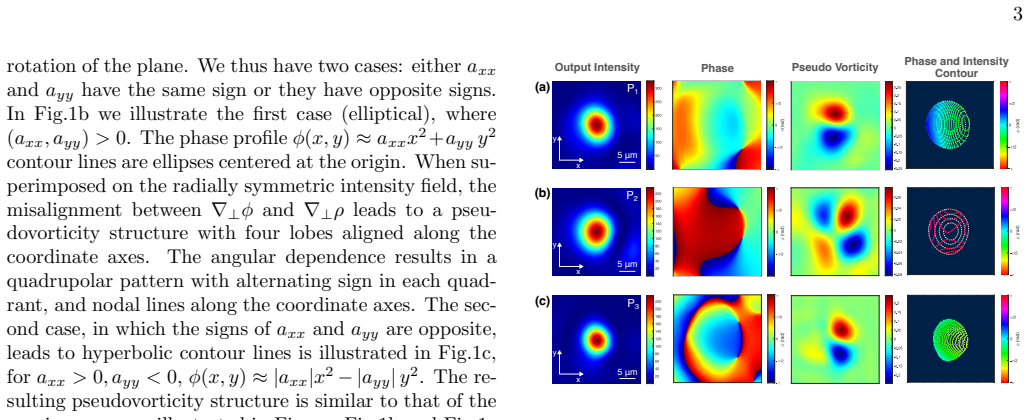


read the original abstract
In the hydrodynamic representation of a quantum fluid or optical field, vorticity vanishes wherever the phase is well defined, and is instead localized at phase singularities, or quantum vortices. Pseudovorticity, by contrast, characterizes local rotational structures, even in regions without singularities or net orbital angular momentum. We study both experimentally and numerically pseudovorticity in photorefractive solitons and show that a detailed phase and amplitude analysis unveils a complex rotational flow dynamic: bright 2+1D solitons are found to carry a pseudovorticity dipole, while quadrupoles emerge in soliton fusion. The phenomenon, also explained using geometrical considerations, suggests a general picture according to which stable high-dimensional solitons naturally carry a hierarchy of pseudovorticity multipoles, encoded in the local perturbed phase and amplitude.
Editorial analysis
A structured set of objections, weighed in public.
Referee Report
Summary. The paper examines pseudovorticity in bright 2+1D optical solitons within photorefractive media, using experimental observations and numerical simulations. It reports that these solitons exhibit a pseudovorticity dipole structure arising from local phase and amplitude perturbations, with quadrupoles forming during soliton fusion events. Through detailed phase-amplitude analysis and geometrical arguments, the work proposes that this indicates a broader hierarchy of pseudovorticity multipoles as a natural feature of stable high-dimensional solitons.
Significance. If the dipole and quadrupole observations are robust and the proposed generality can be substantiated, the result would offer a new lens for interpreting rotational flow structures in optical fields and quantum fluids that persist away from phase singularities. This could inform studies of soliton stability and interactions in higher dimensions, particularly where traditional vorticity vanishes. The work's strength lies in combining direct experimental/numerical evidence with geometric insight, but its impact is tempered by the single-system focus.
major comments (2)
- [Abstract] Abstract: the central claim that the observations 'suggest a general picture according to which stable high-dimensional solitons naturally carry a hierarchy of pseudovorticity multipoles' is load-bearing yet rests solely on photorefractive soliton data and geometry specific to that system. No cross-validation in other nonlinear models (e.g., Kerr or saturable media with different profiles) or parameter-free derivation is presented to establish independence from the chosen medium or pseudovorticity definition.
- [Abstract] Abstract and results sections: the abstract states both experimental and numerical support for the dipole/quadrupole structures, but the provided text lacks explicit details on error bars, data exclusion criteria, discretization effects in numerics, or quantitative measures of pseudovorticity strength, creating moderate evidential gaps that affect claims of generality.
minor comments (2)
- [Introduction] Notation for pseudovorticity should be defined explicitly early in the text with a clear equation, as the distinction from standard vorticity is central but introduced only descriptively in the abstract.
- [Figures] Figure captions and axis labels in experimental/numerical panels would benefit from added scale bars or normalized units to facilitate direct comparison between dipole and quadrupole cases.
Simulated Author's Rebuttal
We thank the referee for the careful reading and constructive comments on our manuscript. We address the major comments point by point below, indicating where revisions will be made to strengthen the presentation while defending the core contributions honestly.
read point-by-point responses
-
Referee: [Abstract] Abstract: the central claim that the observations 'suggest a general picture according to which stable high-dimensional solitons naturally carry a hierarchy of pseudovorticity multipoles' is load-bearing yet rests solely on photorefractive soliton data and geometry specific to that system. No cross-validation in other nonlinear models (e.g., Kerr or saturable media with different profiles) or parameter-free derivation is presented to establish independence from the chosen medium or pseudovorticity definition.
Authors: We thank the referee for this observation. The primary results are the experimental and numerical identification of the pseudovorticity dipole in bright 2+1D photorefractive solitons and the quadrupole formation during fusion, backed by phase-amplitude analysis. The suggestion of a broader hierarchy is presented as a conjecture arising from geometrical considerations of local phase gradients and amplitude perturbations around a stable bright soliton peak. These geometrical features are not tied to the specific photorefractive nonlinearity but follow from the general properties of localized intensity profiles with smooth phase variations in 2+1D. The pseudovorticity definition itself is the standard hydrodynamic one and independent of the medium. We acknowledge the absence of explicit cross-validation or a parameter-free derivation. In the revised manuscript we will rephrase the abstract and discussion to frame the hierarchy as a motivated general picture rather than a firmly established result, and we will expand the geometrical argument to clarify its expected applicability beyond the present system. revision: partial
-
Referee: [Abstract] Abstract and results sections: the abstract states both experimental and numerical support for the dipole/quadrupole structures, but the provided text lacks explicit details on error bars, data exclusion criteria, discretization effects in numerics, or quantitative measures of pseudovorticity strength, creating moderate evidential gaps that affect claims of generality.
Authors: We agree that greater quantitative transparency will improve the manuscript. While some of these elements appear in the methods and supplementary material, they are not sufficiently highlighted in the main text or abstract. In the revision we will add: error bars derived from repeated experimental runs on the pseudovorticity dipole strength; explicit data exclusion criteria (e.g., minimum intensity threshold and phase unwrapping reliability); a brief discussion of numerical discretization (grid resolution and convergence tests); and quantitative measures such as the integrated pseudovorticity magnitude and peak values with uncertainties. These additions will be incorporated into the abstract and results sections to close the noted evidential gaps. revision: yes
Circularity Check
No circularity: observations and geometrical analysis of pseudovorticity are independent of self-referential inputs
full rationale
The paper reports experimental and numerical findings on pseudovorticity dipoles and quadrupoles in photorefractive 2+1D solitons via direct phase-amplitude analysis and geometrical considerations. No load-bearing step reduces by construction to a fitted parameter renamed as prediction, a self-defined quantity, or a self-citation chain that forces the result. The suggestion of a general hierarchy for high-dimensional solitons is presented as an extrapolation from the specific system rather than a theorem derived from prior self-citations or ansatzes. The derivation chain remains self-contained against external benchmarks.
Axiom & Free-Parameter Ledger
axioms (1)
- domain assumption Hydrodynamic representation where vorticity vanishes except at phase singularities while pseudovorticity captures local rotational flow
Reference graph
Works this paper leans on
-
[1]
G. D. Bruce, P. Rodr´ ıguez-Sevilla, and K. Dholakia, Ad- vances in Physics: X6, 1838322 (2021)
2021
-
[2]
Allen, S
L. Allen, S. M. Barnett, and M. J. Padgett, Optical angular momentum (CRC press, 2016)
2016
-
[3]
H. He, M. E. J. Friese, N. R. Heckenberg, and H. Rubinsztein-Dunlop, Phys. Rev. Lett.75, 826 (1995)
1995
-
[4]
M. E. Friese, T. A. Nieminen, N. R. Heckenberg, and H. Rubinsztein-Dunlop, Nature394, 348 (1998)
1998
-
[5]
Forbes, L
A. Forbes, L. Mkhumbuza, and L. Feng, Nat. Rev. Phys. 6, 352 (2024)
2024
-
[6]
D. N. Neshev, T. J. Alexander, E. A. Ostrovskaya, Y. S. Kivshar, H. Martin, I. Makasyuk, and Z. Chen, Phys. Rev. Lett.92, 123903 (2004)
2004
-
[7]
M. V. Berry, J. Opt. A: Pure Appl. Opt.11, 094001 (2009)
2009
-
[8]
Ashkin, Biophys
A. Ashkin, Biophys. J.61, 569 (1992)
1992
-
[9]
Roichman, B
Y. Roichman, B. Sun, Y. Roichman, J. Amato-Grill, and 6 D. G. Grier, Physical review letters100, 013602 (2008)
2008
-
[10]
D. B. Ruffner and D. G. Grier, Physical review letters 108, 173602 (2012)
2012
-
[11]
Toftul, S
I. Toftul, S. Golat, F. J. Rodr´ ıguez-Fortu˜ no, F. Nori, Y. Kivshar, and K. Y. Bliokh, Rev. Mod. Phys.98, 025002 (2026)
2026
-
[12]
Villois, G
A. Villois, G. Krstulovic, D. Proment, and H. Salman, J. Phys. A: Math. Theor.49, 415502 (2016)
2016
-
[13]
Rorai, J
C. Rorai, J. Skipper, R. M. Kerr, and K. R. Sreenivasan, J. Fluid Mech.808, 641 (2016)
2016
-
[14]
Baker-Rasooli, T
M. Baker-Rasooli, T. Aladjidi, N. A. Krause, A. S. Bradley, and Q. Glorieux, Phys. Rev. Lett.134, 233401 (2025)
2025
-
[15]
Dieli, D
L. Dieli, D. Pierangeli, F. Baronio, S. Trillo, and C. Conti, Phys. Rev. Lett.136, 053804 (2026)
2026
-
[16]
Vocke, T
D. Vocke, T. Roger, F. Marino, E. M. Wright, I. Caru- sotto, M. Clerici, and D. Faccio, Optica2, 484 (2015)
2015
-
[17]
Hasegawa, in Optical solitons in fibers (Springer,
A. Hasegawa, in Optical solitons in fibers (Springer,
-
[18]
N. N. Akhmediev and A. Ankiewicz, Solitons, Nonlinear pulses and beams (Chapman & Hall, 1997)
1997
-
[19]
Kibler, J
B. Kibler, J. Fatome, C. Finot, G. Millot, F. Dias, G. Genty, N. Akhmediev, and J. M. Dudley, Nat. Phys. 6, 790 (2010)
2010
-
[20]
J. M. Dudley, G. Genty, and S. Coen, Rev. Mod. Phys. 78, 1135 (2006)
2006
-
[21]
J. M. Dudley, F. Dias, M. Erkintalo, and G. Genty, Nat. Photon.8, 755 (2014)
2014
-
[22]
Z. Chen, M. Segev, and D. N. Christodoulides, Repo. Progr. Phys.75, 086401 (2012)
2012
-
[23]
DelRe, M
E. DelRe, M. Tamburrini, M. Segev, E. Refaeli, and A. J. Agranat, Appl. Phys. Lett.73, 16 (1998)
1998
-
[24]
DelRe, B
E. DelRe, B. Crosignani, and P. Di Porto, in Progress in optics, Vol. 53 (Elsevier, 2009) pp. 153–200
2009
-
[25]
Villois, D
A. Villois, D. Proment, and G. Krstulovic, Phys. Rev. Lett.125, 164501 (2020)
2020
-
[26]
Serafini, L
S. Serafini, L. Galantucci, E. Iseni, T. Bienaim´ e, R. N. Bisset, C. F. Barenghi, F. Dalfovo, G. Lamporesi, and G. Ferrari, Phys. Rev. X7, 021031 (2017)
2017
-
[27]
A. V. Gurevich and A. B. Shvartsburg, Sov. Phys. JETP 31, 1084 (1970)
1970
-
[28]
Falsi, A
L. Falsi, A. Villois, F. Coppini, A. J. Agranat, E. DelRe, and S. Trillo, Phys. Rev. Lett.133, 183804 (2024)
2024
-
[29]
V. E. Zakharov and V. S. Synakh, Sov. Phys. JETP41, 465 (1976)
1976
-
[30]
LeMesurier, G
B. LeMesurier, G. Papanicolaou, C. Sulem, and P. Sulem, Physica D31, 78 (1988)
1988
-
[31]
Fibich, The nonlinear Schr¨ odinger Equation (Springer, Berlin, 2015)
G. Fibich, The nonlinear Schr¨ odinger Equation (Springer, Berlin, 2015)
2015
-
[32]
J. E. Bjorkholm and A. A. Ashkin, Phys. Rev. Lett.32, 129 (1974)
1974
-
[33]
E. L. Falc˜ ao Filho, C. B. de Ara´ ujo, G. Boudebs, H. Leblond, and V. Skarka, Phys. Rev. Lett.110, 013901 (2013)
2013
-
[34]
Cuche, P
E. Cuche, P. Marquet, and C. Depeursinge, Appl. Opt. 39, 4070 (2000)
2000
-
[35]
F. Xin, M. Flammini, F. Di Mei, L. Falsi, D. Pierangeli, A. J. Agranat, and E. DelRe, Phys. Rev. A100, 043816 (2019)
2019
-
[36]
F. Xin, F. Di Mei, L. Falsi, D. Pierangeli, C. Conti, A. J. Agranat, and E. DelRe, Phys. Rev. Lett.127, 133901 (2021)
2021
-
[37]
F. Xin, L. Falsi, D. Pierangeli, F. Fusella, G. Perepelitsa, Y. Garcia, A. J. Agranat, and E. DelRe, Phys. Rev. Lett. 129, 043901 (2022)
2022
-
[38]
DelRe, A
E. DelRe, A. D’Ercole, and E. Palange, Phys. Rev. E71, 036610 (2005)
2005
-
[39]
Coppini and P
F. Coppini and P. M. Santini, Eur. Phys. J. Plus141, 99 (2026). END MA TTER Soliton solutions of Eq. (5) can be sought in the form ψ(x, y, z;λ) =u(r)e iλ2z, r= p x2 +y 2 (6) where the family of shape-invariant, radially-symmetric and topologically neutral (flat-phase) profilesu(r) are parametrised by the nonlinear shiftλ 2, and can be nu- merically found ...
2026
-
[39]
Coppini and P
F. Coppini and P. M. Santini, Eur. Phys. J. Plus141, 99 (2026). END MA TTER Soliton solutions of Eq. (5) can be sought in the form ψ(x, y, z;λ) =u(r)e iλ2z, r= p x2 +y 2 (6) where the family of shape-invariant, radially-symmetric and topologically neutral (flat-phase) profilesu(r) are parametrised by the nonlinear shiftλ 2, and can be nu- merically found ...
2026
discussion (0)
Sign in with ORCID, Apple, or X to comment. Anyone can read and Pith papers without signing in.