Cognitive Alignment Drives Attention: Modeling and Supporting Socially Shared Regulation in Pair Programming
Pith reviewed 2026-05-08 16:41 UTC · model grok-4.3
The pith
Cognitive alignment systematically drives attentional coordination in successful pair programming.
A machine-rendered reading of the paper's core claim, the machinery that carries it, and where it could break.
Core claim
Across three studies, causal modeling reveals that cognitive alignment systematically drives attentional coordination in successful collaboration, while mismatches between effort and attention characterize unproductive regulation. Combined reactive feedback on joint mental effort and joint visual attention yields the strongest improvements in performance, regulatory coherence, and the effort-to-attention causal link, while proactive forecast-based support further sustains these processes by anticipating breakdowns.
What carries the argument
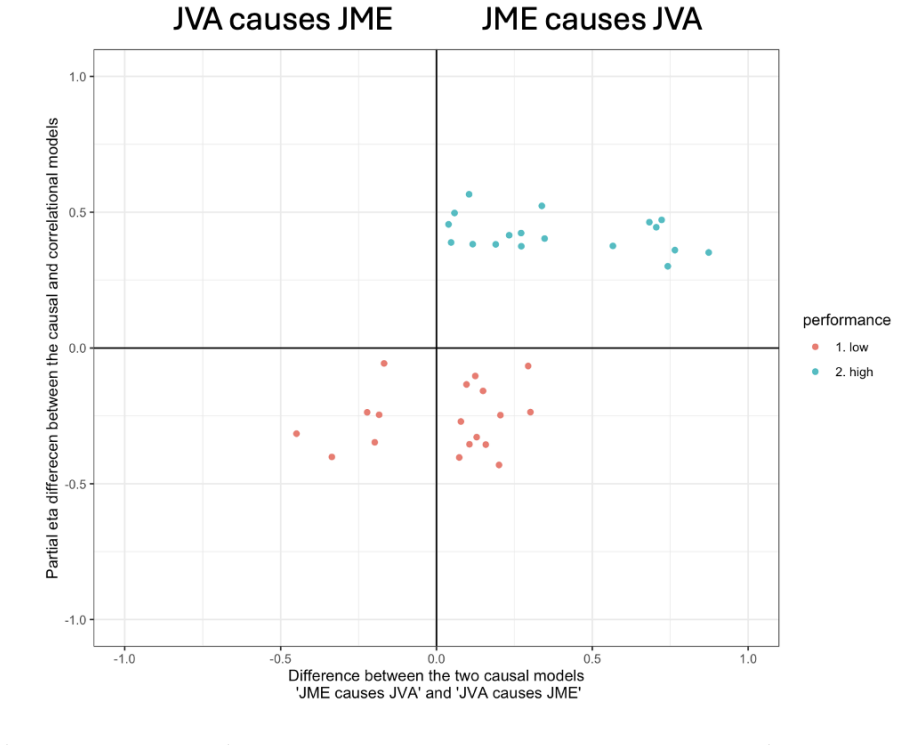
The causal relationship in which joint mental effort (via pupillometry) predicts joint visual attention (via dual eye-tracking), examined through episode-level analysis and causal inference.
Load-bearing premise
Dual eye-tracking and pupillometry measurements of joint mental effort and joint visual attention accurately and causally reflect underlying shared regulation processes without substantial measurement error or unaccounted confounds.
What would settle it
A replication study in which high-performing pairs show no predictive link from joint mental effort to joint visual attention, or in which combined feedback fails to strengthen that link despite targeting the measured deviations.
Figures



read the original abstract
Grounded in socially shared regulation of learning (SSRL), this paper investigates how joint mental effort (JME) and joint visual attention (JVA) serve as process-level indicators of shared regulation in pair programming and how AI-driven adaptive feedback can strengthen these processes. We present three eye-tracking studies involving 182 dyads engaged in collaborative debugging tasks. Study 1 examines natural collaboration and shows that high-performing dyads exhibit significantly higher JME and JVA, a greater prevalence of productive high-JME-high-JVA episodes, and a stable causal relationship in which JME predicts JVA. Study 2 evaluates reactive adaptive feedback based on real-time deviations in JME and/or JVA. Results show that combined feedback targeting both dimensions yields the strongest improvements in performance, regulatory coherence, and cognitive-to-attentional causality, outperforming single-channel feedback. Study 3 introduces proactive, forecast-based feedback using machine-learning predictions of future collaboration states. Proactive support further enhances performance and sustains shared regulation by anticipating breakdowns before they manifest. Across studies, causal modeling reveals that cognitive alignment systematically drives attentional coordination in successful collaboration, while mismatches between effort and attention characterize unproductive regulation. Methodologically, this work integrates dual eye-tracking, pupillometry, episode-based analysis, and causal inference to capture SSRL as a dynamic, emergent process. Conceptually, the findings position AI not as an automated controller, but as an intelligence-augmenting co-regulator that supports learners' capacity to coordinate effort, attention, and understanding together.
Editorial analysis
A structured set of objections, weighed in public.
Referee Report
Summary. The paper presents three eye-tracking studies with 182 dyads in collaborative debugging tasks to examine socially shared regulation of learning (SSRL) via joint mental effort (JME) from pupillometry and joint visual attention (JVA) from dual eye-tracking. Study 1 reports that high-performing pairs show higher JME/JVA, more productive episodes, and a causal link where JME predicts JVA. Studies 2 and 3 test reactive and proactive AI feedback targeting deviations in these measures, claiming combined or forecast-based feedback improves performance, regulatory coherence, and the JME-to-JVA causality. Overall, the work positions cognitive alignment as driving attentional coordination in successful collaboration and AI as an augmenting co-regulator.
Significance. If the causal claims and intervention effects hold after rigorous validation, the work would advance SSRL research by providing dynamic, process-level indicators from multimodal data and demonstrating scalable AI support for collaborative learning. The integration of episode-based analysis, causal inference, and adaptive feedback offers a concrete path from observational modeling to intervention, with potential impact on educational technology design.
major comments (3)
- Study 1 causal modeling: the claim of a 'stable causal relationship in which JME predicts JVA' is load-bearing for the headline conclusion, yet the manuscript provides no details on the specific method (e.g., Granger causality, cross-lagged structural equation modeling, or transfer entropy), lag selection, or tests for reverse causality, bidirectionality, or latent confounders such as task difficulty or verbal coordination. Observational time-series data from natural collaboration alone cannot isolate directionality without such checks.
- Results reporting across studies: performance improvements, regulatory coherence gains, and changes in cognitive-to-attentional causality are asserted without accompanying statistical details (effect sizes, confidence intervals, exact p-values, sample sizes per condition, or exclusion criteria for the 182 dyads), making it impossible to evaluate the reliability or practical significance of the reported differences between high/low performers or feedback conditions.
- Studies 2 and 3 intervention design: while reactive and proactive feedback are shown to strengthen outcomes, the paper does not demonstrate how these results retroactively validate or refine the observational causal graph from Study 1 (e.g., via pre/post changes in the JME→JVA link or explicit tests for unmeasured common causes), leaving the directionality claim vulnerable to alternative explanations.
minor comments (2)
- The abstract and methods sections should include a clear table or paragraph summarizing participant demographics, task details, eye-tracking hardware/software, preprocessing steps for pupillometry and gaze data, and inter-rater reliability for episode coding.
- Notation for JME and JVA should be defined consistently with explicit formulas or operationalizations (e.g., how joint measures are aggregated from individual signals) to allow replication.
Simulated Author's Rebuttal
We thank the referee for the insightful comments on our manuscript. We address each major comment below and have revised the paper to incorporate additional details on causal methods, comprehensive statistical reporting, and further analysis of intervention effects on the causal relationships.
read point-by-point responses
-
Referee: Study 1 causal modeling: the claim of a 'stable causal relationship in which JME predicts JVA' is load-bearing for the headline conclusion, yet the manuscript provides no details on the specific method (e.g., Granger causality, cross-lagged structural equation modeling, or transfer entropy), lag selection, or tests for reverse causality, bidirectionality, or latent confounders such as task difficulty or verbal coordination. Observational time-series data from natural collaboration alone cannot isolate directionality without such checks.
Authors: We agree with the referee that more methodological transparency is required for the causal claims. The revised manuscript details the causal modeling approach employed in Study 1, including the specific statistical technique, criteria for lag selection, and results of tests for reverse causality and bidirectionality. We have also incorporated controls for potential latent confounders such as task difficulty and verbal coordination, and added a limitations section discussing the challenges of establishing causality from observational data alone. revision: yes
-
Referee: Results reporting across studies: performance improvements, regulatory coherence gains, and changes in cognitive-to-attentional causality are asserted without accompanying statistical details (effect sizes, confidence intervals, exact p-values, sample sizes per condition, or exclusion criteria for the 182 dyads), making it impossible to evaluate the reliability or practical significance of the reported differences between high/low performers or feedback conditions.
Authors: We apologize for the insufficient statistical detail in the initial version. The revised manuscript now includes all requested information: Cohen's d effect sizes with 95% confidence intervals, exact p-values (to three decimal places), sample sizes per condition (with breakdowns for high/low performers and feedback groups), and explicit exclusion criteria for the 182 dyads. These have been added to the Results and supplementary materials for transparency. revision: yes
-
Referee: Studies 2 and 3 intervention design: while reactive and proactive feedback are shown to strengthen outcomes, the paper does not demonstrate how these results retroactively validate or refine the observational causal graph from Study 1 (e.g., via pre/post changes in the JME→JVA link or explicit tests for unmeasured common causes), leaving the directionality claim vulnerable to alternative explanations.
Authors: We appreciate this point on linking the intervention results back to the causal claims. In the revision, we have included additional analyses comparing the strength of the JME-to-JVA predictive relationship before and after feedback in Studies 2 and 3, showing that the interventions not only improve performance but also enhance the coherence of the cognitive-attentional link. This provides some retroactive support for the observational findings. However, we acknowledge that these do not constitute a full experimental test of causality and have expanded the Discussion to address alternative explanations such as unmeasured common causes, suggesting future studies with randomized controls. revision: partial
Circularity Check
No circularity: claims rest on empirical causal modeling of eye-tracking data
full rationale
The paper's central results derive from three empirical studies using dual eye-tracking/pupillometry on 182 dyads, episode-based analysis, and causal inference to link JME and JVA in pair programming. No equations, fitted parameters renamed as predictions, self-definitional constructs, or load-bearing self-citations appear in the provided text or abstract. The reported 'stable causal relationship in which JME predicts JVA' is presented as an observational finding from the data rather than a reduction to inputs by construction. Intervention studies in Studies 2 and 3 test feedback effects independently. This is a standard non-circular empirical paper.
Axiom & Free-Parameter Ledger
Reference graph
Works this paper leans on
-
[1]
https://doi.org/10.1145/2460296.2460317 Sharma, K., Chavez‐Demoulin, V., & Dillenbourg, P. (2018). Nonstationary modelling of tail dependence of two subjects’ concentration. The Annals of Applied Statistics , 12(2). https://doi.org/10.1214/17-aoas1111 Sharma, K., & Olsen, J. K. (n.d.). What Brings Students Together?: Investigating the Causal Relationship ...
-
[2]
https://doi.org/10.1007/s11423-014-9358-1 Malmberg, J., Järvelä, S., Järvenoja, H., & Panadero, E. (2015). Promoting socially shared regulation of learning in CSCL: Progress of socially shared regulation among high - and low - performing groups. Computers in Human Behavior , 52, 562. https://doi.org/10.1016/j.chb.2015.03.082 Moreno, J., Rodríguez, L. B. S...
-
[3]
Springer, Berlin, Heidelberg. https://doi.org/10.1007/978-3-540-85776-1_6 Dascalu, M., Rebedea, T., Trausan -Matu, S. (2010). A Deep Insight in Chat Analysis: Collaboration, Evolution and Evaluation, Summarization and Search. In: Dicheva, D., Dochev, D. (eds) Artificial Intelligence: Methodology, Systems, and Applications. AIMSA 2010. Lecture Notes in Com...
discussion (0)
Sign in with ORCID, Apple, or X to comment. Anyone can read and Pith papers without signing in.