Hamiltonian Interface Dynamics for Reduced-Order Optimization of Incompressible Mixing
Pith reviewed 2026-05-08 15:52 UTC · model grok-4.3
The pith
Maximizing advected interface length in reduced Hamiltonian systems produces near-exponential mixing rates for incompressible flows.
A machine-rendered reading of the paper's core claim, the machinery that carries it, and where it could break.
Core claim
By optimizing time-dependent Hamiltonians to maximize interface length, the method generates near-exponential stretching of material interfaces and substantially faster decay of the H^{-1} mix-norm than the polynomial decay seen in stationary flows, and outperforms a matched Eulerian Sobolev-norm optimizer on a common solver while lowering cost.
What carries the argument
The finite-dimensional Hamiltonian control problem obtained by parametrizing stream functions and maximizing the length of advected interfaces.
If this is right
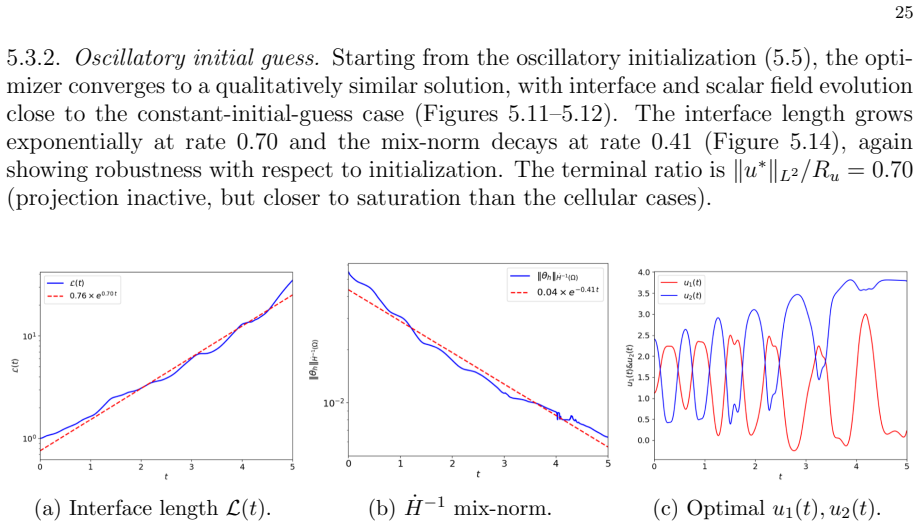
- Time-dependent optimized Hamiltonians produce near-exponential interface stretching.
- Decay of the H^{-1} mix-norm is substantially faster than for stationary flows.
- Interface-based controls yield faster H^{-1} decay than Eulerian Sobolev-norm optimization under matched conditions.
- Computational cost is substantially reduced compared to full transport PDE optimization.
- Interface length serves as an effective but not fully faithful proxy for mixing when the control basis is enlarged.
Where Pith is reading between the lines
- The algebraic consistency of the discrete adjoint with the fully discrete objective derivative enables reliable use of gradient-based methods in similar reduced-order flow control problems.
- This reduced interface approach might extend to other mixing or transport optimization tasks where full state PDE solves are prohibitive.
- Further work could test whether the proxy limitation persists in three-dimensional or turbulent regimes.
- The observation that basis enrichment improves the proxy without proportional mixing gains suggests a need for hybrid objectives combining interface length with other measures.
Load-bearing premise
Maximizing the length of advected material interfaces serves as a reliable proxy for true mixing measured by H^{-1} norm decay, even as the control basis grows.
What would settle it
A numerical experiment in which a control that maximizes interface length shows no proportional improvement in H^{-1} decay compared to one that does not, or identification of a flow control achieving better mixing without maximizing interface length.
Figures







read the original abstract
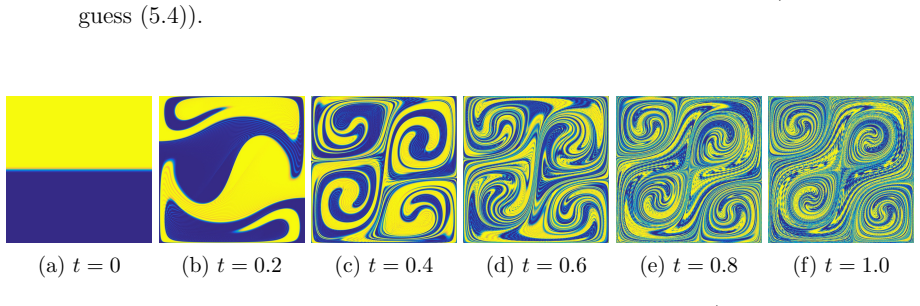
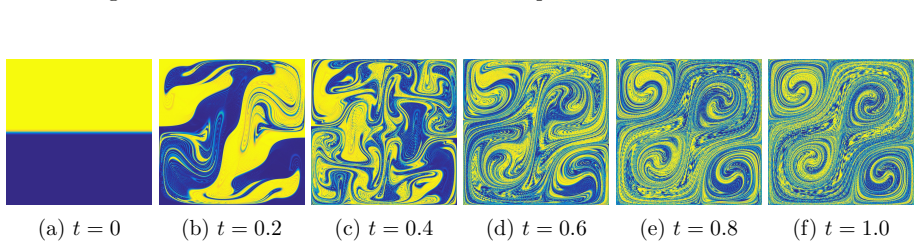
We develop a reduced-order framework for optimizing mixing in two-dimensional incompressible flows. Instead of optimizing the full transport PDE, the method maximizes the length of advected material interfaces, leading to a finite-dimensional Hamiltonian control problem based on parametrized stream functions. We derive the continuous adjoint equations and reduced gradients, and discretize the forward and adjoint dynamics with the implicit midpoint rule. The resulting discrete adjoint is algebraically consistent with the derivative of the fully discrete objective, up to the tolerance of the nonlinear midpoint solves. The approach applies to bounded two-dimensional domains with smooth finite-dimensional stream-function parametrizations. Numerical experiments on cellular-flow and Doswell frontogenesis benchmarks show that the optimized time-dependent Hamiltonians generate near-exponential interface stretching and substantially faster decay of the $\dot{H}^{-1}$ mix-norm, in contrast with the polynomial behavior observed for stationary flows. When evaluated on a common reference transport solver, the interface-based controls produce faster $\dot{H}^{-1}$ decay than a Eulerian Sobolev-norm optimizer under a matched setup, while substantially reducing computational cost. We also identify a limitation of the reduced model: increasing the control basis may further improve the interface-length objective without yielding proportional gains in $\dot{H}^{-1}$ mixing, confirming that interface length is an effective but not fully faithful proxy for mixing in geometrically complex regimes.
Editorial analysis
A structured set of objections, weighed in public.
Referee Report
Summary. The manuscript develops a reduced-order optimization method for incompressible mixing in 2D flows by maximizing the length of advected interfaces through a Hamiltonian control problem with parametrized stream functions. Continuous adjoints are derived and discretized consistently using the implicit midpoint rule. Numerical results on cellular flow and Doswell frontogenesis show that time-dependent optimized Hamiltonians yield near-exponential stretching and faster H^{-1} mix-norm decay than stationary flows or a matched Eulerian optimizer, at reduced cost, while noting that interface length is an effective but imperfect proxy for mixing.
Significance. If the results hold, this provides a promising reduced-order approach for mixing control with demonstrated computational advantages and algebraic consistency in discretization. The explicit discussion of the proxy limitation adds credibility. The work contributes to numerical methods for PDE-constrained optimization in fluid dynamics by avoiding full transport solves.
minor comments (3)
- The notation for the mix-norm (denoted with a dot in the abstract) should be defined explicitly upon first use in the introduction or methods section to aid readers from outside the specific mixing literature.
- In the numerical experiments section, the precise parameter values and tolerances for the nonlinear midpoint solves should be reported to allow assessment of how closely the algebraic consistency is achieved in practice.
- Figure captions would benefit from explicitly listing the quantities plotted (e.g., interface length vs. time, H^{-1} norm decay) and noting any shared reference solver details for the cross-method comparisons.
Simulated Author's Rebuttal
We thank the referee for their positive summary of the manuscript, recognition of the algebraic consistency in the discretization, computational advantages, and the explicit discussion of the interface-length proxy limitation. We are pleased with the recommendation to accept.
Circularity Check
No significant circularity; derivation is self-contained
full rationale
The paper starts from the incompressible transport PDE and an interface-length objective, derives the continuous adjoint system and reduced gradients in the standard way, then discretizes both forward and adjoint dynamics with the implicit midpoint rule while proving algebraic consistency of the discrete adjoint (up to nonlinear-solve tolerance). The central performance claims are established by direct numerical evaluation on reference transport solvers for cellular-flow and Doswell benchmarks; the authors explicitly record that further enrichment of the control basis improves the proxy without proportional gains in the H^{-1} norm, treating this as an observed limitation rather than a hidden equivalence. No step reduces a claimed result to a fitted parameter renamed as prediction, to a self-citation chain, or to a definitional tautology.
Axiom & Free-Parameter Ledger
free parameters (1)
- dimension of stream-function control basis
axioms (2)
- domain assumption The flow remains incompressible and the domain is bounded with smooth boundary
- standard math The implicit midpoint rule preserves the algebraic consistency between discrete adjoint and objective derivative up to nonlinear solver tolerance
Reference graph
Works this paper leans on
-
[1]
G. Alberti, G. Crippa, and A. L. Mazzucato. Exponential self-similar mixing by incompressible flows. J. Amer. Math. Soc., 32(2):445–490, 2019
work page 2019
- [2]
-
[3]
V. Caselles, R. Kimmel, and G. Sapiro. Geodesic active contours.International Journal of Computer Vision, 22(1):61–79, Feb 1997
work page 1997
-
[4]
M. Coti Zelati, G. Crippa, G. Iyer, and A. L. Mazzucato. Mixing in incompressible flows: transport, dissipation, and their interplay.Notices Amer. Math. Soc., 71(5):593–604, 2024. 29
work page 2024
-
[5]
G. Crippa and C. Schulze. Cellular mixing with bounded palenstrophy.Math. Models Methods Appl. Sci., 27(12):2297–2320, 2017
work page 2017
-
[6]
D. D’Alessandro, M. Dahleh, and I. Mezi´ c. Control of mixing in fluid flow: a maximum entropy approach.IEEE Trans. Automat. Control, 44(10):1852–1863, 1999
work page 1999
-
[7]
C. A. Doswell. A kinematic analysis of frontogenesis associated with a nondivergent vortex.Journal of Atmospheric Sciences, 41(7):1242 – 1248, 1984
work page 1984
-
[8]
A. Fannjiang, A. Kiselev, and L. Ryzhik. Quenching of reaction by cellular flows.Geom. Funct. Anal., 16(1):40–69, 2006
work page 2006
- [9]
- [10]
-
[11]
Hartman.Ordinary differential equations, volume 38 ofClassics in Applied Mathematics
P. Hartman.Ordinary differential equations, volume 38 ofClassics in Applied Mathematics. Society for Industrial and Applied Mathematics (SIAM), Philadelphia, PA, 2002. Corrected reprint of the second (1982) edition [Birkh¨ auser, Boston, MA; MR0658490 (83e:34002)], With a foreword by Peter Bates
work page 2002
- [12]
- [13]
- [14]
-
[15]
P. Mattila.Geometry of sets and measures in Euclidean spaces, volume 44 ofCambridge Studies in Advanced Mathematics. Cambridge University Press, Cambridge, 1995. Fractals and rectifiability
work page 1995
-
[16]
S. Osher and J. A. Sethian. Fronts propagating with curvature-dependent speed: algorithms based on Hamilton-Jacobi formulations.J. Comput. Phys., 79(1):12–49, 1988
work page 1988
-
[17]
J.-L. Thiffeault. Using multiscale norms to quantify mixing and transport.Nonlinearity, 25(2):R1– R44, 2012
work page 2012
- [18]
- [19]
discussion (0)
Sign in with ORCID, Apple, or X to comment. Anyone can read and Pith papers without signing in.