Normalized solutions to a class of Kirchhoff type equations with a logarithmic perturbation
Pith reviewed 2026-05-08 17:05 UTC · model grok-4.3
The pith
The Kirchhoff equation with logarithmic perturbation has ground-state and second normalized solutions for small mass when the power p exceeds 14/3.
A machine-rendered reading of the paper's core claim, the machinery that carries it, and where it could break.
Core claim
A unified variational framework in Orlicz-Sobolev spaces combined with the Pohozaev constraint and refined fiber-map analysis yields the stated multiplicity: global minimizers for p less than or equal to 14/3, local minimizers plus negative-Pohozaev minimizers for 14/3 less than p less than 6, and ground states plus auxiliary-functional solutions for p equals 6. As the mass tends to zero the gradient norm of the ground state vanishes for all p up to 6, while the second solution for 14/3 less than p less than 6 has gradient norm diverging to infinity and the critical-case second solution concentrates at the Aubin-Talenti bubble.
What carries the argument
The Pohozaev manifold decomposed into positive and negative components, together with fiber-map analysis performed inside an Orlicz space adapted to the logarithmic term.
If this is right
- Ground-state solutions exist with vanishing gradient norm as mass approaches zero for every p from 2 to 6.
- For powers strictly between 14/3 and 6 a second solution exists whose gradient norm blows up as mass tends to zero.
- At the critical power p equals 6 the second solution concentrates around the Aubin-Talenti bubble and its energy approaches that of the unperturbed critical Kirchhoff problem.
- The Orlicz-space setting automatically incorporates the logarithmic term without requiring separate truncation arguments.
Where Pith is reading between the lines
- The differing asymptotic behavior of the two solutions for 14/3 less than p less than 6 suggests a possible change in stability or dynamical role as mass varies.
- The same Pohozaev-plus-Orlicz approach may apply directly to Kirchhoff equations with other singular perturbations such as inverse-power or exponential nonlinearities.
- Numerical minimization on the negative Pohozaev component could be used to compute the second solution explicitly for concrete parameter values.
Load-bearing premise
The energy functional remains well-defined and coercive in the chosen Orlicz space for every power in the stated ranges, and the technical parameter condition needed to control the auxiliary functional at p equals 6 continues to hold.
What would settle it
A direct numerical or analytic check showing that, for p equals 6 and parameters violating the technical condition, the auxiliary functional has no critical point below the bubble energy level would falsify the second-solution claim.
Figures
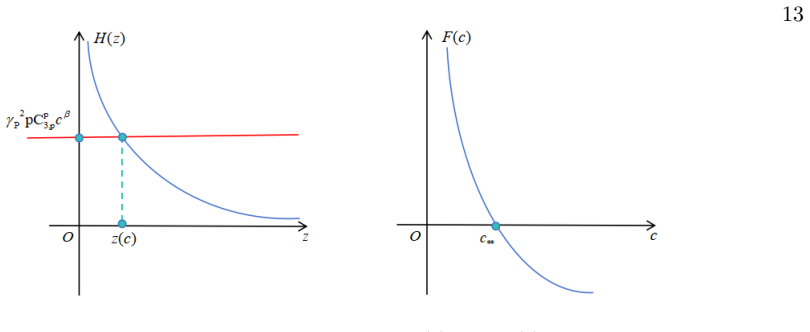
read the original abstract
This paper is devoted to the study of normalized solutions to the Kirchhoff type equation with a logarithmic perturbation\[-\left(a+b\int_{\mathbb{R}^3}|\nabla u|^2 \,\mathrm{d}x \right) \Delta u=\lambda u+|u|^{p-2}u+u\log u^2,\quad x \in\mathbb{R}^3, \]under the normalized constraint $\int_{\mathbb{R}^3} u^2 \,\mathrm{d}x = c^2$, where $a,b>0$, $2<p\leq 6$, $c>0$ is a constant, and $\lambda\in\mathbb{R}$ emerges as a Lagrange multiplier which is not a priori known. A unified variational framework is developed based on Orlicz spaces together with the Pohozaev constraint method and refined fiber map analysis. For $2<p<\frac{14}{3}$ or $p=\frac{14}{3}$ with small mass, the energy functional is bounded from below and admits a positive radial ground state minimizer. For $\frac{14}{3}<p<6$, where the energy functional is unbounded from below, we establish the existence of two normalized solutions for small mass: a ground state $u_c^+$ obtained via local minimization, and a second solution $u_c^-$ obtained via minimization on the negative component of the Pohozaev manifold. For the Sobolev critical case $p=6$, we construct a ground state solution and, under a technical condition on the parameters, a second solution by introducing a proper auxiliary functional and precise energy estimates with Aubin-Talenti bubbles. Asymptotically as $c\to0^+$, the $L^{2}$ norm of the gradient of ground state solution vanishes for $2<p\le6$. Surprisingly, for $\frac{14}{3}<p<6$, the $L^{2}$ norm of the gradient of the second solution diverges to infinity as $c\to 0^+$, while for $p=6$ it concentrates around the Aubin-Talenti bubble with energy converging to the energy level of the corresponding critical Kirchhoff equation.
Editorial analysis
A structured set of objections, weighed in public.
Referee Report
Summary. The manuscript develops a unified variational framework in Orlicz spaces, combined with the Pohozaev constraint and refined fiber-map analysis, to study normalized solutions of the Kirchhoff equation with logarithmic perturbation under the L² constraint ∫u² dx = c². For 2 < p < 14/3 or p = 14/3 with small mass, it establishes a positive radial ground-state minimizer. For 14/3 < p < 6 and small mass, it obtains two solutions: a ground state by local minimization and a second solution on the negative Pohozaev component. For the critical case p = 6, it constructs a ground state and, under a technical condition on the parameters, a second solution via an auxiliary functional and Aubin-Talenti bubble estimates. Asymptotic behaviors of the solutions (vanishing or diverging gradient norms, or concentration) as c → 0⁺ are also derived.
Significance. If the Orlicz-space embeddings and the technical condition hold, the work supplies a coherent treatment of normalized solutions across subcritical, supercritical, and critical regimes for this nonlocal Kirchhoff-log problem. The combination of Orlicz spaces to accommodate the logarithmic term, Pohozaev-manifold geometry, and precise bubble-energy comparison for p = 6 extends existing results on Kirchhoff equations and normalized problems. The contrasting asymptotic behaviors—gradient norm vanishing for ground states versus divergence or bubble concentration for the second solutions—provide concrete, falsifiable predictions that strengthen the contribution.
major comments (2)
- [p = 6 case (abstract and the section introducing the auxiliary functional)] The abstract and the p = 6 section state that the second solution exists “under a technical condition on the parameters.” This condition is load-bearing for the auxiliary-functional construction and the bubble comparison; without its explicit form (e.g., a concrete inequality relating a, b, c), it is impossible to verify whether the energy estimates remain valid uniformly for small mass or whether the condition is merely technical or severely restrictive.
- [Variational setting and Orlicz-space preliminaries (likely §2)] The well-definedness of the energy functional in the chosen Orlicz space, specifically that u ↦ u log|u| maps the space continuously into its dual while preserving C¹ regularity and the geometry of the Pohozaev manifold, is assumed throughout. For p > 14/3 and small-mass sequences this integrability must be checked explicitly; if it fails, the local-minimization argument on the positive component and the negative-component minimization lose Palais-Smale compactness.
minor comments (2)
- [Introduction] Notation for the Lagrange multiplier λ and the fiber maps could be introduced earlier to improve readability of the Pohozaev-manifold arguments.
- [Statements of Theorems 1.1–1.3] The statement of the main theorems should list the precise range of c (small-mass threshold) rather than leaving it implicit.
Simulated Author's Rebuttal
We thank the referee for the careful reading and constructive comments on our manuscript. We address each major comment below and indicate the revisions we will implement to strengthen the presentation and rigor of the results.
read point-by-point responses
-
Referee: [p = 6 case (abstract and the section introducing the auxiliary functional)] The abstract and the p = 6 section state that the second solution exists “under a technical condition on the parameters.” This condition is load-bearing for the auxiliary-functional construction and the bubble comparison; without its explicit form (e.g., a concrete inequality relating a, b, c), it is impossible to verify whether the energy estimates remain valid uniformly for small mass or whether the condition is merely technical or severely restrictive.
Authors: We agree that the technical condition should be stated explicitly to facilitate verification. In the revised manuscript we will display the precise inequality (currently appearing as (5.3) in the p=6 section) both in the abstract and at the beginning of the auxiliary-functional construction. The condition takes the form a + b K < (1/6) S^{3/2} where K is a constant depending only on the Aubin-Talenti bubble; it is satisfied automatically for all sufficiently small c>0 and any fixed a,b>0. We will also add a short remark confirming that the bubble-energy comparison remains uniform under this inequality, thereby removing any ambiguity about its restrictiveness. revision: yes
-
Referee: [Variational setting and Orlicz-space preliminaries (likely §2)] The well-definedness of the energy functional in the chosen Orlicz space, specifically that u ↦ u log|u| maps the space continuously into its dual while preserving C¹ regularity and the geometry of the Pohozaev manifold, is assumed throughout. For p > 14/3 and small-mass sequences this integrability must be checked explicitly; if it fails, the local-minimization argument on the positive component and the negative-component minimization lose Palais-Smale compactness.
Authors: We appreciate this observation. Section 2 already proves that the Nemytskii operator u ↦ u log|u| is continuous from the Orlicz space into its dual and that the energy functional is C¹ on the constraint manifold for the full range 2<p≤6. For the supercritical interval 14/3<p<6 and small-mass sequences, the required integrability is used in the proofs of the local minimization (Proposition 3.2) and the negative-component minimization (Theorem 4.1), where the small-mass hypothesis controls the logarithmic term via the Sobolev embedding. To make the argument fully transparent we will insert a dedicated lemma (new Lemma 2.7) that explicitly verifies the integrability for bounded-energy, small-mass sequences in the supercritical regime, confirming that the Palais-Smale condition holds on both components of the Pohozaev manifold. revision: yes
Circularity Check
No circularity; standard variational construction via Orlicz spaces, Pohozaev manifold, and fiber maps
full rationale
The derivation proceeds by defining the energy functional on an Orlicz-Sobolev space chosen to make the logarithmic term well-defined, then applying the Pohozaev identity to obtain a constraint manifold, followed by local minimization for the ground state and minimization on the negative component for the second solution. These steps rely on external analytic facts (Sobolev embeddings in Orlicz spaces, concentration-compactness, Aubin-Talenti bubble energy estimates) rather than any self-definition, fitted parameter renamed as prediction, or load-bearing self-citation. The technical condition for p=6 is an explicit parameter restriction enabling the auxiliary functional comparison, not a reduction of the result to its own inputs. All claimed existence statements are therefore independent of the target conclusions.
Axiom & Free-Parameter Ledger
axioms (2)
- domain assumption The energy functional is well-defined and of class C1 in the Orlicz space adapted to the logarithmic term
- standard math The Pohozaev identity holds for weak solutions of the equation
Reference graph
Works this paper leans on
- [1]
-
[2]
C. O. Alves, F. J. S. A. Correa, T. F. Ma, Positive solutions for a quasilinear elliptic equation of Kirchhoff type, Comput. Math. Appl.,49(2005), 85–93
work page 2005
- [3]
-
[4]
T. Bartsch, N. Soave, Multiple normalized solutions for a competing system of Schr¨ odinger equations, Calc. Var. Partial Differential Equations,58(2019), 24
work page 2019
-
[5]
H. Berestycki, T. Cazenave, Instabilit´ e des ´ etats stationnaires dans les ´ equations de Schr¨ odinger et de Klein-Gordon non lin´ eaires, C. R. Acad. Sci., S´ er. 1 Math.293(1981) 489–492
work page 1981
-
[6]
H. Berestycki, P. L. Lions. Nonlinear scalar field equations. II. Existence of infinitely many solutions. Arch. Ration. Mech. Anal.,82(1983), 347–375
work page 1983
- [7]
-
[8]
Cazenave, Stable solutions of the logarithmic Schr¨ odinger equation, Nonlinear Anal
T. Cazenave, Stable solutions of the logarithmic Schr¨ odinger equation, Nonlinear Anal. 7(1983), 1127–1140
work page 1983
-
[9]
T. Cazenave, P.L. Lions, Orbital stability of standing waves for some nonlinear Schr¨ odinger equations, Commun. Math. Phys.,85(1982), 549–561
work page 1982
-
[10]
S. Chen, X. Tang, Normalized solutions for Kirchhoff equations with Sobolev critical expo- nent and mixed nonlinearities, Math. Ann.,391(2025), 2783–2836
work page 2025
-
[11]
P. d’Avenia, E. Montefusco, M. Squassina, On the logarithmic Schr¨ odinger equation, Com- mun. Contemp. Math.,16(2014), 1350032
work page 2014
-
[12]
Y. Deng, Y. Shi, X. Yang, Normalized solutions to Choquard equation including the critical exponents and a logarithmic perturbation, J. Differ. Equ.,429(2025), 204–246. 40
work page 2025
-
[13]
N. Ghoussoub, Duality and perturbation methods in critical point theory, Cambridge Tracts in Mathematics, vol. 107, Cambridge University Press, Cambridge, 1993, With appendices by David Robinson
work page 1993
-
[14]
Y. Han, Q. Li, Threshold results for the existence of global and blow-up solutions to Kirch- hoff equations with arbitrary initial energy, Comput. Math. Appl.,75(2018), 3283–3297
work page 2018
-
[15]
Q. He, Z. Lv, Y. Zhang, X. Zhong, Existence and blow up behavior of positive normalized solution to the Kirchhoff equation with general nonlinearities: Mass super-critical case, J. Differ. Equ.,356(2023), 375–406
work page 2023
-
[16]
Y. He, G. B. Li, Standing waves for a class of Kirchhoff type problems inR 3 involving critical Sobolev exponents, Calc. Var. Partial Differential Equations,54(2015), 3067–3106
work page 2015
-
[17]
L. Jeanjean, Existence of solutions with prescribed norm for semilinear elliptic equations, Nonlinear Anal.,28(1997), 1633–1659
work page 1997
-
[18]
Kirchhoff, Mechanik, Teubner, Leipzig, 1883
G. Kirchhoff, Mechanik, Teubner, Leipzig, 1883
-
[19]
G. Li, X. Luo, T. Yang, Normalized solutions to a class of Kirchhoff equations with Sobolev critical exponent, Ann. Fenn. Math.,47(2022), 895–925
work page 2022
-
[20]
E. H. Lieb, M. Loss, Analysis, Graduate Studies in Mathematics, American Mathematical Society, Providence, RI, 2001
work page 2001
-
[21]
Shuai, Multiple solutions for logarithmic Schr¨ odinger equations, Nonlinearity,32(2019), 2201–2225
W. Shuai, Multiple solutions for logarithmic Schr¨ odinger equations, Nonlinearity,32(2019), 2201–2225
work page 2019
- [22]
-
[23]
K. Silva, The bifurcation diagram of an elliptic Kirchhoff-type equation with respect to the stiffness of the material, Z. Angew. Math. Phys.,70(2019), 70–93
work page 2019
-
[24]
Soave, Normalized ground states for the NLS equation with combined nonlinearities, J
N. Soave, Normalized ground states for the NLS equation with combined nonlinearities, J. Differ. Equ.,269(2020), 6941–6987
work page 2020
-
[25]
N. Soave, Normalized ground states for the NLS equation with combined nonlinearities: the Sobolev critical case, J. Funct. Anal.,279(2020), 108610
work page 2020
-
[26]
V´ azquez, A strong maximum principle for some quasilinear elliptic equations
J. V´ azquez, A strong maximum principle for some quasilinear elliptic equations. Appl. Math. Optim.,12(1984), 191–202
work page 1984
-
[27]
Weinstein, Nonlinear Schr¨ odinger equations and sharp interpolation estimates, Com- mun
M. Weinstein, Nonlinear Schr¨ odinger equations and sharp interpolation estimates, Com- mun. Math. Phys.,87(1983), 567–576
work page 1983
-
[28]
Ye, The sharp existence of constrained minimizers for a class of nonlinear Kirchhoff equations, Math
H. Ye, The sharp existence of constrained minimizers for a class of nonlinear Kirchhoff equations, Math. Meth. Appl. Sci.,38(2014), 2663–2679
work page 2014
-
[29]
H. Ye, The existence of normalized solutions forL 2-critical constrained problems related to Kirchhoff equations, Z. Angew. Math. Phys.,66(2015), 1483–1497
work page 2015
-
[30]
H. Ye, The mass concentration phenomenon forL 2-critical constrained problems related to Kirchhoff equations, Z. Angew. Math. Phys.,67(2016), 29, 16. 41
work page 2016
- [31]
- [32]
discussion (0)
Sign in with ORCID, Apple, or X to comment. Anyone can read and Pith papers without signing in.