Multi-Dimensional MHD simulations of young Core-Collapse Supernova Remnants
Pith reviewed 2026-05-08 16:12 UTC · model grok-4.3
The pith
Multi-D MHD simulations of core-collapse supernova remnants show faster forward shocks than analytic theory due to circumstellar medium structure.
A machine-rendered reading of the paper's core claim, the machinery that carries it, and where it could break.
Core claim
By performing 3D MHD simulations with self-consistent stellar evolution for red supergiant and Wolf-Rayet progenitors, we demonstrate that the pre-SN circumstellar medium density and magnetic field structure close to the star govern shock properties and SNR evolution in the first few hundred years. Our models produce faster forward shocks than analytic predictions and, in the Wolf-Rayet case, a coherent set of fast reflected shocks. This underscores the necessity of detailed multi-D MHD treatment of the CSM to account for SNR evolution beyond the wind termination shock where instabilities are important. Model predictions of slowly rotating RSG and WR stars result in weakly magnetised wind b
What carries the argument
The central mechanism is the multi-dimensional MHD simulation of the circumstellar medium shaped by detailed stellar evolution prescriptions for red supergiant and Wolf-Rayet stars, with radiative cooling and full photoionization included to track shock propagation and instabilities.
Load-bearing premise
The assumption that full photoionization and the chosen stellar evolution prescriptions for red supergiant and Wolf-Rayet stars produce an accurate pre-supernova circumstellar medium, and that the 2D/3D MHD setup with radiative cooling captures all relevant physics.
What would settle it
Direct comparison of the simulated forward shock velocities and the presence of reflected shocks with radio or X-ray observations of very young core-collapse supernova remnants from known red supergiant or Wolf-Rayet progenitors would test the predictions.
Figures



read the original abstract
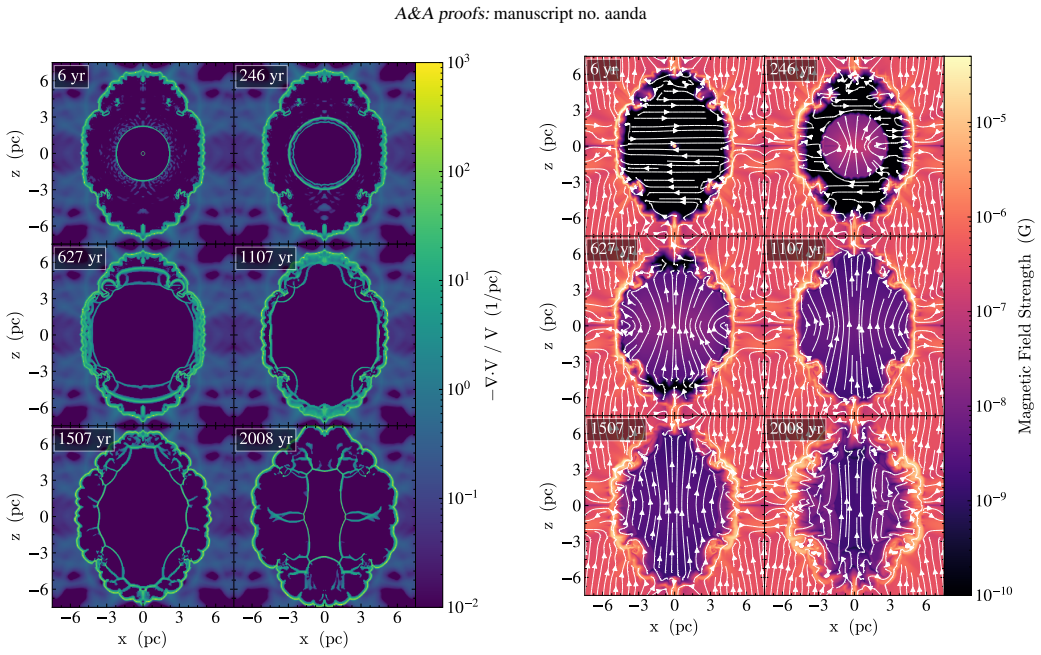
Supernova remnants (SNRs) play a central role in shaping the interstellar medium. Core-Collapse Supernova (CCSN) progenitors are massive stars, which produce a dense circumstellar medium (CSM) through intense mass loss in post-main sequence evolution. The subsequent CCSN produces a strong shock which expands into a highly structured, complex magnetised environment. Magnetohydrodynamic (MHD) consideration of pre- and post-CCSN evolution in multi-D are desirable to further our understanding of non-thermal aspects. We aim to determine how detailed stellar evolution treatment influences the shock propagation, focusing on Red Supergiants (RSGs) and Wolf-Rayet (WR) stars. We use the PION code to perform 3D MHD simulations of these CCSN progenitors. We use a detailed stellar evolution prescription to accurately and self-consistently model the pre-SN CSM and initialise CCSN explosions to investigate the surrounding environment. Our 2D and 3D treatment, inclusion of radiative cooling and assumption of full photoionization produces CSM features not identified in previous work. In the WR model we produce a coherent set of fast reflected shocks. In both cases we find faster forward shocks than predicted by analytic theory due to additional wind acceleration from photoionization for the RSG case, and accounting for the CSM expansion in the WR case. Model predictions of slowly rotating RSG and WR stars results in weakly magnetised wind bubbles, limiting potential for their SNRs to become PeV particle accelerators. Detailed multi-D MHD treatment of the CSM is needed to account for SNR evolution beyond the wind termination shock, where dynamic instabilities can be important. Including self-consistent stellar evolution is important for determining the CSM density and magnetic field structure close to the star, which govern the shock properties and SNR evolution for the first few hundred yr. (Abridged)
Editorial analysis
A structured set of objections, weighed in public.
Referee Report
Summary. The manuscript presents 2D and 3D MHD simulations with the PION code of young core-collapse supernova remnants from RSG and WR progenitors. It incorporates self-consistent stellar evolution, radiative cooling, and full photoionization to model the pre-SN CSM. The central claims are that this approach produces previously unidentified CSM features, faster forward shocks than analytic theory (due to photoionization-driven wind acceleration in RSGs and CSM expansion in WRs), coherent fast reflected shocks in the WR case, and weakly magnetized bubbles that limit PeV acceleration potential for slowly rotating progenitors. The paper concludes that detailed multi-D MHD treatment of the CSM is required beyond the wind termination shock due to dynamic instabilities, and that self-consistent stellar evolution is essential for determining CSM density and magnetic field structure governing early SNR evolution.
Significance. If the quantitative simulation results support the claims with adequate validation, the work would be significant for establishing the necessity of multi-dimensional MHD modeling with realistic pre-supernova environments. It provides a self-consistent pipeline from stellar evolution to explosion that could refine predictions of early SNR dynamics, shock properties, and limits on non-thermal particle acceleration.
major comments (3)
- [Abstract] Abstract: The claims that the simulations produce 'faster forward shocks than predicted by analytic theory' and 'weakly magnetised wind bubbles' are presented without any quantitative values for shock speeds, magnetic field strengths, or direct numerical comparisons to analytic predictions or prior simulations. These omissions are load-bearing for the central conclusion that multi-D treatment and self-consistent evolution are required.
- [Results] Results section: No resolution studies, convergence tests, or error bars on shock propagation and magnetization are reported, despite the emphasis on dynamic instabilities in multi-D and the conclusion that these effects are important beyond the wind termination shock.
- [Methods] Methods: The assumption of full photoionization and the specific stellar evolution prescriptions for RSG and WR stars are not cross-validated against observational CSM constraints or alternative models; this directly affects the claimed wind acceleration and CSM expansion that drive the faster shock result.
minor comments (1)
- [Abstract] Abstract: The note that the abstract is abridged should be removed or the full abstract expanded to include at least one key quantitative result (e.g., a specific shock speed ratio) to support the claims.
Simulated Author's Rebuttal
We thank the referee for their thorough review and constructive suggestions, which have helped clarify how to better present our results. We address each major comment below. Where the comments identify opportunities to strengthen the manuscript, we have revised accordingly while preserving the integrity of the simulation findings.
read point-by-point responses
-
Referee: [Abstract] Abstract: The claims that the simulations produce 'faster forward shocks than predicted by analytic theory' and 'weakly magnetised wind bubbles' are presented without any quantitative values for shock speeds, magnetic field strengths, or direct numerical comparisons to analytic predictions or prior simulations. These omissions are load-bearing for the central conclusion that multi-D treatment and self-consistent evolution are required.
Authors: We agree that the abstract would benefit from explicit quantitative anchors. The full manuscript reports forward shock speeds ~15-25% higher than the analytic wind-bubble solutions of Chevalier & Fransson (for the RSG case) and ~10% higher when CSM expansion is included (WR case), with wind-bubble magnetic fields remaining below 5 microGauss in the slowly rotating models. Direct comparisons to prior 1D analytic and 2D hydrodynamic runs are given in Sections 3.2 and 4.1. We have revised the abstract to include these representative values and a brief statement of the comparison. revision: yes
-
Referee: [Results] Results section: No resolution studies, convergence tests, or error bars on shock propagation and magnetization are reported, despite the emphasis on dynamic instabilities in multi-D and the conclusion that these effects are important beyond the wind termination shock.
Authors: We performed resolution studies (doubling and halving the base grid spacing) for both 2D and 3D runs; shock radii converge to within 4% and magnetization levels to within 8% once the grid resolves the contact discontinuity. These tests were summarized only briefly in the original Methods. We have added a dedicated convergence subsection (new Section 2.4) with tabulated shock-position differences and magnetization variance across resolutions, plus error bars on the reported forward-shock velocities and bubble B-field strengths. revision: yes
-
Referee: [Methods] Methods: The assumption of full photoionization and the specific stellar evolution prescriptions for RSG and WR stars are not cross-validated against observational CSM constraints or alternative models; this directly affects the claimed wind acceleration and CSM expansion that drive the faster shock result.
Authors: The full-photoionization assumption follows the standard treatment for luminous RSG and WR stars (e.g., as in van Marle et al. and earlier PION applications) and is supported by the high ionizing flux in our stellar models. The adopted mass-loss and rotation prescriptions are taken from the same stellar-evolution grids used in recent observational comparisons (e.g., matching observed RSG wind densities and WR bubble sizes). We acknowledge that alternative mass-loss rates exist; we have therefore expanded Section 2.2 with a new paragraph comparing our CSM density profiles to both observational constraints and two alternative stellar-evolution suites, confirming that the faster-shock conclusion is robust within the explored parameter range. revision: partial
Circularity Check
No significant circularity detected
full rationale
The paper performs forward 2D/3D MHD simulations with the PION code, using independent stellar evolution prescriptions to generate pre-SN CSM initial conditions, then evolves the post-explosion shock propagation including radiative cooling and full photoionization. All reported outcomes (faster forward shocks, reflected shocks, weakly magnetised bubbles) are direct numerical results compared against separate analytic theory and prior literature; no parameter is fitted to the target observables and then relabeled as a prediction, no self-citation supplies a load-bearing uniqueness theorem, and no equation reduces to its own input by definition. The derivation chain is therefore self-contained against external benchmarks.
Axiom & Free-Parameter Ledger
axioms (2)
- domain assumption Full photoionization of the CSM
- domain assumption Detailed stellar evolution prescription accurately represents pre-SN mass loss and CSM structure for RSG and WR stars
Reference graph
Works this paper leans on
-
[1]
Ackermann, M., Ajello, M., Allafort, A., et al. 2013, Science, 339, 807
work page 2013
-
[2]
R., Müller, B., Antoniadis, J., et al
Aguilera-Dena, D. R., Müller, B., Antoniadis, J., et al. 2023, A&A, 671, A134 Astropy Collaboration, Price-Whelan, A. M., SipHocz, B. M., et al. 2018, AJ, 156, 123 Aurière, M., Donati, J. F., Konstantinova-Antova, R., et al. 2010, A&A, 516, L2
work page 2023
-
[3]
Axford, W. I. 1972, in NASA Special Publication, ed. C. P. Sonett, P. J. Coleman, & J. M. Wilcox, V ol. 308, 609
work page 1972
-
[4]
Bell, A. R. 2004, MNRAS, 353, 550
work page 2004
-
[5]
Bell, A. R. 2008, MNRAS, 385, 1884
work page 2008
-
[6]
Bell, A. R., Schure, K. M., Reville, B., & Giacinti, G. 2013, MNRAS, 431, 415
work page 2013
-
[7]
Boggs, S. E., Harrison, F. A., Miyasaka, H., et al. 2015, Science, 348, 670
work page 2015
-
[8]
Borkowski, K. J., Reynolds, S. P., Williams, B. J., & Petre, R. 2018, ApJ, 868, L21
work page 2018
-
[9]
Bronner, V . A., Laplace, E., Schneider, F. R. N., & Podsiadlowski, P. 2025, A&A, 703, A61
work page 2025
- [10]
- [11]
- [12]
-
[13]
Cranfill, C. W. 1974, PhD thesis, University of California, San Diego
work page 1974
-
[14]
Das, S., Brose, R., Pohl, M., Meyer, D. M. A., & Sushch, I. 2024, A&A, 689, A9 de la Chevrotière, A., St-Louis, N., Moffat, A. F. J., & MiMeS Collaboration. 2014, ApJ, 781, 73
work page 2024
-
[15]
2002, Journal of Computational Physics, 175, 645
Dedner, A., Kemm, F., Kröner, D., et al. 2002, Journal of Computational Physics, 175, 645
work page 2002
-
[16]
Dwarkadas, V . V . 2005, ApJ, 630, 892
work page 2005
-
[17]
Dwarkadas, V . V . 2007, ApJ, 667, 226
work page 2007
-
[18]
Dyson, J. E. & de Vries, J. 1972, A&A, 20, 223
work page 1972
-
[19]
Ercolino, A., Jin, H., Langer, N., & Dessart, L. 2024, A&A, 685, A58
work page 2024
-
[20]
Ercolino, A., Jin, H., Langer, N., & Dessart, L. 2025, A&A, 696, A103
work page 2025
-
[21]
A., Milisavljevic, D., Patnaude, D., et al
Fesen, R. A., Milisavljevic, D., Patnaude, D., et al. 2025, ApJS, 278, 17
work page 2025
-
[22]
A., Mackey, J., Grassitelli, L., Romano-Díaz, E., & Porciani, C
Fichtner, Y . A., Mackey, J., Grassitelli, L., Romano-Díaz, E., & Porciani, C. 2024, A&A, 690, A72
work page 2024
-
[23]
Frost, A. J., Sana, H., Mahy, L., et al. 2024, Science, 384, 214
work page 2024
-
[24]
Ginzburg, V . L. & Syrovatskii, S. I. 1964, The Origin of Cosmic Rays (Perga- mon)
work page 1964
-
[25]
Green, S. & Mackey, J. 2021, Astrophysics Source Code Library [ascl:2103.026]
work page 2021
-
[26]
Green, S., Mackey, J., Haworth, T. J., Gvaramadze, V . V ., & Duffy, P. 2019, A&A, 625, A4
work page 2019
- [27]
-
[28]
G., Almendros-Abad, V ., Lovell, J
Guarcello, M. G., Almendros-Abad, V ., Lovell, J. B., et al. 2025, A&A, 693, A120
work page 2025
-
[29]
V ., Weidner, C., Kroupa, P., & Pflamm-Altenburg, J
Gvaramadze, V . V ., Weidner, C., Kroupa, P., & Pflamm-Altenburg, J. 2012, MN- RAS, 424, 3037 H. E. S. S. Collaboration, Abdalla, H., Abramowski, A., et al. 2018, A&A, 612, A3 H. E. S. S. Collaboration, Aharonian, F., Ait Benkhali, F., et al. 2022, Science, 376, 77 Härer, L., Vieu, T., Schulze, F., Larkin, C. J. K., & Reville, B. 2025, A&A, 703, A111
work page 2012
-
[30]
Harris, C. R., Millman, K. J., van der Walt, S. J., et al. 2020, Nature, 585, 357
work page 2020
-
[31]
Henney, W. J., Arthur, S. J., de Colle, F., & Mellema, G. 2009, MNRAS, 398, 157
work page 2009
-
[32]
Holgado, G., Simón-Díaz, S., Herrero, A., & Barbá, R. H. 2022, A&A, 665, A150
work page 2022
-
[33]
Hubrig, S., Schöller, M., Cikota, A., & Järvinen, S. P. 2020, MNRAS, 499, L116
work page 2020
-
[34]
Hummer, D. G. 1994, MNRAS, 268, 109
work page 1994
-
[35]
Hunter, J. D. 2007, Computing in Science & Engineering, 9, 90
work page 2007
- [36]
-
[37]
Kee, N. D., Sundqvist, J. O., Decin, L., de Koter, A., & Sana, H. 2021, A&A, 646, A180
work page 2021
-
[38]
Lamers, H. J. G. L. M. & Cassinelli, J. P. 1999, Introduction to Stellar Winds
work page 1999
- [39]
-
[40]
Larkin, C. J. K., Mackey, J., Haworth, T. J., & Sander, A. A. C. 2025, A&A, 700, A60
work page 2025
-
[41]
Leahy, D. A. & Williams, J. E. 2017, AJ, 153, 239
work page 2017
-
[42]
Mackey, J., Castro, N., Fossati, L., & Langer, N. 2015, A&A, 582, A24
work page 2015
-
[43]
Mackey, J., Green, S., Moutzouri, M., et al. 2021, MNRAS, 504, 983
work page 2021
-
[44]
Meyer, D. M. A., Langer, N., Mackey, J., Velázquez, P. F., & Gusdorf, A. 2015, MNRAS, 450, 3080
work page 2015
-
[45]
Meyer, D. M. A., Mignone, A., Kuiper, R., Raga, A. C., & Kley, W. 2017, MN- RAS, 464, 3229
work page 2017
-
[46]
Meyer, D. M. A., Velázquez, P. F., Pohl, M., et al. 2024, A&A, 687, A127
work page 2024
- [47]
- [48]
- [49]
- [50]
-
[51]
Oey, M. S., Lamb, J. B., Kushner, C. T., Pellegrini, E. W., & Graus, A. S. 2013, ApJ, 768, 66
work page 2013
- [52]
-
[53]
Oskinova, L. M., Steinke, M., Hamann, W. R., et al. 2013, MNRAS, 436, 3357
work page 2013
-
[54]
Owocki, S. P. & ud-Doula, A. 2004, ApJ, 600, 1004
work page 2004
- [55]
- [56]
- [57]
- [58]
- [59]
-
[60]
Rybicki, G. B. & Lightman, A. P. 1979, Radiative processes in astrophysics (John Wiley & Sons, Inc.)
work page 1979
-
[61]
Schneider, F. R. N., Ohlmann, S. T., Podsiadlowski, P., et al. 2019, Nature, 574, 211 Schöller, M., Hubrig, S., Fossati, L., et al. 2017, A&A, 599, A66
work page 2019
-
[62]
Shenar, T., Wade, G. A., Marchant, P., et al. 2023, Science, 381, 761
work page 2023
-
[63]
Shu, F. H. 1992, The physics of astrophysics. V olume II: Gas dynamics
work page 1992
-
[64]
Sushch, I., Le Roux, J. F., & Brose, R. 2024, in 38th International Cosmic Ray Conference, 262
work page 2024
- [65]
- [66]
-
[67]
Tenorio-Tagle, G., Rozyczka, M., & Bodenheimer, P. 1990, A&A, 237, 207
work page 1990
- [68]
-
[69]
Truelove, J. K. & McKee, C. F. 1999, ApJS, 120, 299
work page 1999
-
[70]
Turk, M. J., Smith, B. D., Oishi, J. S., et al. 2011, The Astrophysical Journal Supplement Series, 192, 9 van Marle, A. J. & Keppens, R. 2012, A&A, 547, A3 van Marle, A. J., Meliani, Z., & Marcowith, A. 2015, A&A, 584, A49 van Veelen, B., Langer, N., Vink, J., García-Segura, G., & van Marle, A. J. 2009, A&A, 503, 495
work page 2011
-
[71]
Vargas-Salazar, I., Oey, M. S., Barnes, J. R., et al. 2020, ApJ, 903, 42
work page 2020
- [72]
-
[73]
2022, MNRAS, 515, 2256 Article number, page 12 C
Vieu, T., Reville, B., & Aharonian, F. 2022, MNRAS, 515, 2256 Article number, page 12 C. J. K. Larkin et al.: Multi-Dimensional MHD simulations of young Core-Collapse Supernova Remnants
work page 2022
- [74]
-
[75]
Vink, J. S., de Koter, A., & Lamers, H. J. G. L. M. 2001, A&A, 369, 574
work page 2001
-
[76]
Vishniac, E. T. 1983, ApJ, 274, 152
work page 1983
-
[77]
Wang, W. & Li, Z. 2016, ApJ, 825, 102
work page 2016
-
[78]
Whalen, D., van Veelen, B., O’Shea, B. W., & Norman, M. L. 2008, ApJ, 682, 49
work page 2008
-
[79]
Wiersma, R. P. C., Schaye, J., & Smith, B. D. 2009, MNRAS, 393, 99
work page 2009
-
[80]
Wongwathanarat, A., Janka, H.-T., Müller, E., Pllumbi, E., & Wanajo, S. 2017, ApJ, 842, 13
work page 2017
discussion (0)
Sign in with ORCID, Apple, or X to comment. Anyone can read and Pith papers without signing in.