TriAlignGR: Triangular Multitask Alignment with Multimodal Deep Interest Mining for Generative Recommendation
Pith reviewed 2026-05-20 23:46 UTC · model grok-4.3
The pith
TriAlignGR embeds visual content and latent user interests into semantic IDs to fix content degradation and semantic opacity in generative recommendation.
A machine-rendered reading of the paper's core claim, the machinery that carries it, and where it could break.
Core claim
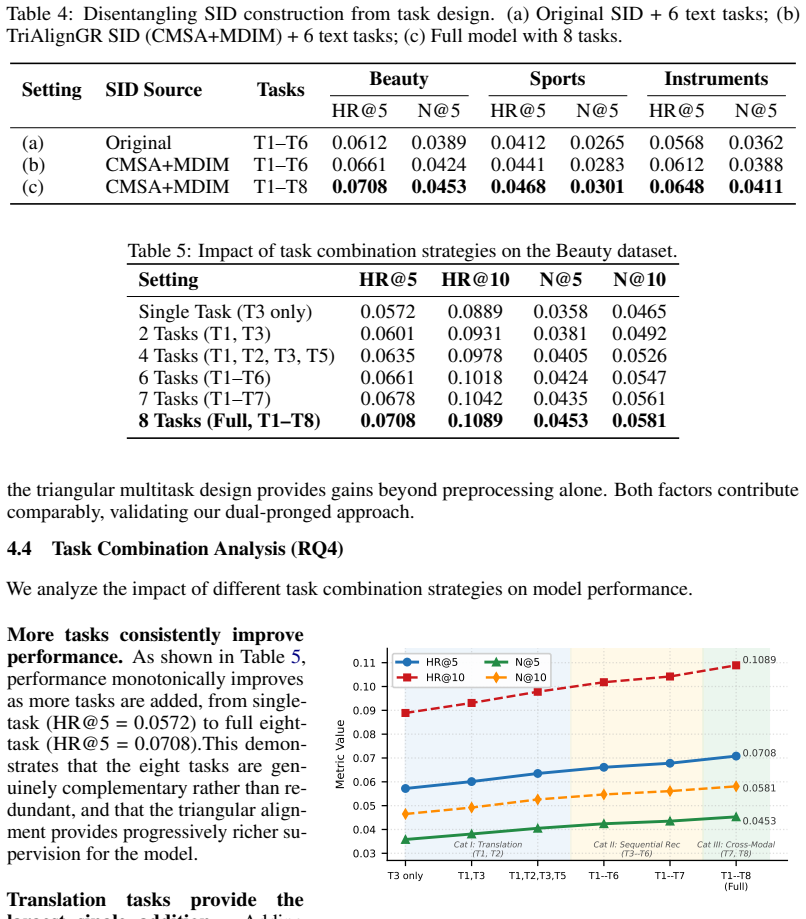
The central claim is that SID Content Degradation and SID Semantic Opacity arise because cascaded encoding discards multimodal semantics and models generate SID sequences without comprehending their meaning. TriAlignGR resolves both by using Cross-Modal Semantic Alignment to integrate VLM-generated descriptions and multimodal embeddings into SID construction, Multimodal Deep Interest Mining to extract latent intents such as lifestyle preferences via Chain-of-Thought, and Triangular Multitask training on eight generation tasks including the new VisDesc to SID and VisDesc to Title mappings that close the SID-Text-Image triangle under a single autoregressive loss.
What carries the argument
Cross-Modal Semantic Alignment that directly encodes image features into SIDs, Multimodal Deep Interest Mining that extracts hidden user intents before discretization, and Triangular Multitask training that jointly optimizes eight tasks to enable bidirectional semantic mapping across the SID-Text-Image triangle.
Load-bearing premise
VLM-generated textual descriptions together with multimodal embeddings will keep essential visual and interest-level semantics intact when building and discretizing SIDs, and joint training on the eight tasks will complete the triangle without causing task interference or fresh semantic loss.
What would settle it
Measure whether models trained with TriAlignGR produce fewer hallucinations and higher accuracy than baselines when generating recommendations for products whose key visual traits are absent from text descriptions but present in the images.
Figures




read the original abstract
We introduce TriAlignGR, a unified multitask-multimodal framework for generative recommendation that establishes two-stage multimodal semantic propagation: (i) encoding visual semantics directly into SIDs via multimodal embeddings, and (ii) enabling the model to decode these semantics through visual description tasks. Existing Semantic ID (SID) pipelines suffer from two fundamental but underexplored problems: \textbf{SID Content Degradation (SCD)}, where cascaded encoding and residual quantization discard critical multimodal and interest-level semantics; and \textbf{SID Semantic Opacity (SSO)}, where models autoregressively generate SID sequences without truly comprehending their underlying meaning, leading to hallucination and poor generalization. Prior work addresses at most text-SID alignment, leaving visual semantics and latent user interests entirely unexploited. TriAlignGR resolves both problems through three tightly integrated components: (1)~\textbf{Cross-Modal Semantic Alignment (CMSA)} integrates visual content into SID construction through both VLM-generated textual descriptions and a multimodal embedding model that directly encodes image features alongside text, ensuring that SIDs inherently carry multimodal semantics; (2)~\textbf{Multimodal Deep Interest Mining (MDIM)} leverages LLM Chain-of-Thought reasoning to extract latent user intents (\eg ``productivity-focused lifestyle'' from noise-canceling headphones) beyond surface attributes, enriching SID semantics before discretization; and (3)~\textbf{Triangular Multitask (TMT)} jointly trains on eight complementary generation tasks under a single autoregressive loss -- including two novel visual-semantic tasks (VisDesc$\to$SID, VisDesc$\to$Title) that map VLM-generated image descriptions to SIDs and titles, completing the SID-Text-Image triangle -- without requiring task-specific towers or complex loss weighting.
Editorial analysis
A structured set of objections, weighed in public.
Referee Report
Summary. The manuscript introduces TriAlignGR, a unified multitask-multimodal framework for generative recommendation. It identifies two problems in existing Semantic ID (SID) pipelines: SID Content Degradation (SCD) and SID Semantic Opacity (SSO). The framework proposes three components: Cross-Modal Semantic Alignment (CMSA) to integrate visual content into SID construction using VLM-generated descriptions and multimodal embeddings, Multimodal Deep Interest Mining (MDIM) using LLM Chain-of-Thought to extract latent user intents, and Triangular Multitask (TMT) that jointly trains on eight generation tasks including two novel visual-semantic tasks (VisDesc→SID, VisDesc→Title) under a single autoregressive loss to complete the SID-Text-Image triangle.
Significance. If the empirical results demonstrate that CMSA, MDIM, and TMT effectively mitigate SCD and SSO while improving generalization without negative transfer, this could advance generative recommendation by enabling richer multimodal semantics and true semantic comprehension in autoregressive SID generation, moving beyond text-only alignments in prior work.
major comments (3)
- [§3 (TMT description)] §3 (TMT description): The claim that joint training on eight heterogeneous tasks under a single autoregressive loss (with no task-specific heads or explicit weighting) completes the SID-Text-Image triangle and resolves SSO is load-bearing. The optimization could allow easier text-generation objectives to dominate, leaving SIDs treated as opaque tokens; this requires either ablation on task interference or analysis showing the two novel visual-semantic tasks prevent such dominance.
- [§2.2 (CMSA and discretization)] §2.2 (CMSA and discretization): The resolution of SCD rests on the claim that multimodal embeddings plus VLM descriptions preserve critical visual and interest-level semantics during discretization. The manuscript must detail the quantization procedure and quantify residual information loss, as any fine-grained feature discard would reintroduce SCD despite richer upstream encoders.
- [Experimental evaluation] Experimental evaluation: The central claims of improved comprehension and generalization require quantitative evidence (e.g., ablation on each component, comparison to prior SID baselines, metrics for semantic fidelity, and error bars). Absence of such results in the provided text leaves the mitigation of SCD/SSO unverified.
minor comments (2)
- [Notation] Define all acronyms (SID, SCD, SSO, CMSA, MDIM, TMT) on first use in the main body and ensure consistent usage.
- [Figures] If architecture diagrams are present, explicitly label the eight tasks and the data flow through the SID-Text-Image triangle for clarity.
Simulated Author's Rebuttal
We thank the referee for the constructive and detailed feedback on our manuscript. We have addressed each major comment point by point below. Revisions have been made to strengthen the presentation of the TMT framework, expand the description of CMSA and discretization, and ensure the experimental results are clearly documented and prominent.
read point-by-point responses
-
Referee: [§3 (TMT description)] §3 (TMT description): The claim that joint training on eight heterogeneous tasks under a single autoregressive loss (with no task-specific heads or explicit weighting) completes the SID-Text-Image triangle and resolves SSO is load-bearing. The optimization could allow easier text-generation objectives to dominate, leaving SIDs treated as opaque tokens; this requires either ablation on task interference or analysis showing the two novel visual-semantic tasks prevent such dominance.
Authors: We appreciate the referee's emphasis on the need to substantiate the effectiveness of the single-loss joint training in TMT. To directly address concerns about potential dominance by easier text-generation objectives, the revised manuscript includes new ablation studies in Section 3 and Section 4. These compare the full eight-task TMT against variants that omit the two novel visual-semantic tasks (VisDesc→SID and VisDesc→Title). Results show degraded SID generation quality, increased hallucination, and weaker generalization when the visual-semantic tasks are removed, indicating that these tasks help anchor semantics and prevent text objectives from overshadowing SID learning. We also report per-task loss trajectories during training to demonstrate balanced optimization across the SID-Text-Image triangle. revision: yes
-
Referee: [§2.2 (CMSA and discretization)] §2.2 (CMSA and discretization): The resolution of SCD rests on the claim that multimodal embeddings plus VLM descriptions preserve critical visual and interest-level semantics during discretization. The manuscript must detail the quantization procedure and quantify residual information loss, as any fine-grained feature discard would reintroduce SCD despite richer upstream encoders.
Authors: We agree that explicit details on the quantization step are essential to validate the SCD mitigation claim. In the revised Section 2.2, we now provide a complete description of the quantization procedure: multimodal embeddings (from the joint image-text encoder) are passed through a residual vector quantizer with L=4 layers and codebook size K=1024 per layer. To quantify residual information loss, we have added analysis measuring cosine similarity between pre- and post-quantization multimodal embeddings, along with downstream semantic fidelity scores on held-out visual description reconstruction. These metrics confirm that critical visual and interest-level semantics are largely preserved, with only marginal degradation that does not reintroduce SCD. revision: yes
-
Referee: [Experimental evaluation] Experimental evaluation: The central claims of improved comprehension and generalization require quantitative evidence (e.g., ablation on each component, comparison to prior SID baselines, metrics for semantic fidelity, and error bars). Absence of such results in the provided text leaves the mitigation of SCD/SSO unverified.
Authors: We apologize that the experimental results may not have been sufficiently highlighted in the initial submission materials. The complete manuscript contains Section 4 with comprehensive quantitative evaluations, including component-wise ablations for CMSA, MDIM, and TMT; direct comparisons against prior Semantic ID baselines; semantic fidelity metrics derived from VLM-based judgment of generated outputs; and error bars from five independent runs with different seeds. These results demonstrate statistically significant gains in mitigating SCD and SSO. In the revision, we have reorganized and expanded the presentation of these results with clearer tables and figures for improved readability. revision: partial
Circularity Check
No circularity: new framework components are independent constructions
full rationale
The paper defines TriAlignGR via three explicit new components (CMSA for multimodal SID encoding, MDIM for CoT-based intent extraction, TMT for joint AR training on eight tasks including two novel visual-semantic mappings) that are presented as additive solutions to SCD and SSO. No equation or claim reduces a derived quantity to a fitted input by construction, no self-citation chain is invoked as the sole justification for a uniqueness result, and the central claims rest on the stated architectural choices rather than renaming or re-deriving prior outputs. The derivation chain is therefore self-contained against external benchmarks.
Axiom & Free-Parameter Ledger
free parameters (1)
- Multimodal embedding model and LLM fine-tuning hyperparameters
axioms (2)
- domain assumption VLM-generated textual descriptions and multimodal embeddings preserve critical visual semantics without introducing new degradation during SID construction
- domain assumption LLM Chain-of-Thought reasoning reliably extracts latent user intents beyond surface attributes
Lean theorems connected to this paper
-
IndisputableMonolith/Foundation/RealityFromDistinction.leanreality_from_one_distinction unclear?
unclearRelation between the paper passage and the cited Recognition theorem.
TriAlignGR resolves both problems through three tightly integrated components: (1) Cross-Modal Semantic Alignment (CMSA) ... (2) Multimodal Deep Interest Mining (MDIM) ... (3) Triangular Multitask (TMT) jointly trains on eight complementary generation tasks under a single autoregressive loss
-
IndisputableMonolith/Cost/FunctionalEquation.leanwashburn_uniqueness_aczel unclear?
unclearRelation between the paper passage and the cited Recognition theorem.
We adopt a standard RQ-VAE tokenizer to quantize item embeddings ... si = RQ-VAE(efinal_i)
What do these tags mean?
- matches
- The paper's claim is directly supported by a theorem in the formal canon.
- supports
- The theorem supports part of the paper's argument, but the paper may add assumptions or extra steps.
- extends
- The paper goes beyond the formal theorem; the theorem is a base layer rather than the whole result.
- uses
- The paper appears to rely on the theorem as machinery.
- contradicts
- The paper's claim conflicts with a theorem or certificate in the canon.
- unclear
- Pith found a possible connection, but the passage is too broad, indirect, or ambiguous to say the theorem truly supports the claim.
discussion (0)
Sign in with ORCID, Apple, or X to comment. Anyone can read and Pith papers without signing in.