Shape of Direct-Method Mass-Metallicity Relation with JWST: Fast-Track Nitrogen and Helium Enrichment
Pith reviewed 2026-05-08 15:52 UTC · model grok-4.3
The pith
Auroral-line selection biases the low-mass high-redshift mass-metallicity relation traced by JWST toward lower metallicities.
A machine-rendered reading of the paper's core claim, the machinery that carries it, and where it could break.
Core claim
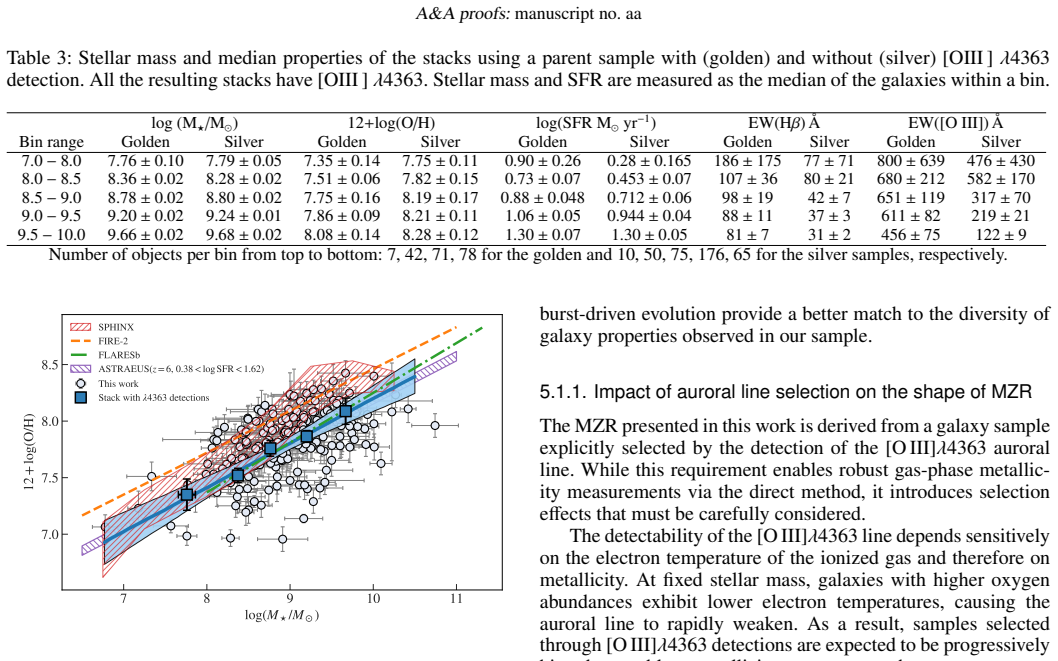
Using a homogeneous sample of 286 galaxies with [O III] λ4363 detections, the direct-method mass-metallicity relation has a linear slope γ = 0.38 ± 0.09 across log(M*/M⊙) = 6.77-10.5. Stacked spectra of non-detections produce a relation of similar slope but with metallicities higher by 0.2-0.3 dex at fixed mass; these non-detections also exhibit lower SFRs, smaller equivalent widths, and smaller offsets from the fundamental metallicity relation, while several stacked bins show enhanced N/O and He/H ratios.
What carries the argument
The direct Te method applied to [O III] λ4363 auroral-line detections for electron temperature and oxygen abundance, combined with spectral stacking of non-detections to extend coverage.
Load-bearing premise
That the stacked spectra of galaxies without individual auroral-line detections provide an unbiased representation of the underlying population at fixed stellar mass, without residual selection or aperture effects.
What would settle it
A complete, auroral-line-independent metallicity survey of the same low-mass high-redshift population, or deeper observations that detect the auroral line across a representative range of star-formation rates, would show whether the 0.2-0.3 dex metallicity offset disappears.
Figures




read the original abstract
We investigate the mass-metallicity relation (MZR) from z=1 to z=9 using electron-temperature-based gas-phase metallicities and examine how auroral-line selection, star-formation history, and secondary abundances affect its interpretation in the early Universe. We compile a homogeneous sample of 286 star-forming galaxies observed with JWST/NIRSpec medium resolution spectroscopy, selected through detections of the [O\,III]\,$\lambda$4363 auroral line from the public DAWN JWST Archive (DJA). We derive electron densities, temperatures, and oxygen abundances using the direct $T_e$ method, along with relative N/O and He/H abundances. Stellar masses are obtained via SED fitting and star-formation rates from reddening-corrected Balmer emission lines. To quantify auroral-line selection biases, we additionally stack galaxy spectra with and without auroral-line detections, extending the MZR into regimes inaccessible to individual measurements. The auroral-line-detected sample spans log(M*/Msun)=6.77-10.5 and 12+log(O/H)=6.9-8.4. A linear fit gives an MZR slope of $\gamma$=0.38 $\pm$ 0.09. Stacked galaxies without individual $\lambda$4363 detections define a relation with a similar slope but metallicities higher by ~0.2-0.3 dex at fixed stellar mass. Auroral-line detections also show higher SFRs, larger equivalent widths, and larger offsets from the fundamental metallicity relation, whereas non-detections appear more chemically evolved and closer to it. Several stacked bins also show enhanced N/O and He/H ratios. These results indicate that the low-mass high-redshift MZR traced by JWST is shaped by both recent star-formation history and auroral-line selection effects. Auroral lines preferentially identify high-EW, high-sSFR galaxies in the low-metallicity envelope, whereas non-detections reveal a more enriched sequence closer to the metallicity expected from the FMR.
Editorial analysis
A structured set of objections, weighed in public.
Referee Report
Summary. The manuscript investigates the shape of the direct-method mass-metallicity relation (MZR) at high redshifts (z=1-9) using JWST/NIRSpec spectroscopy. Using a sample of 286 star-forming galaxies with [O III] λ4363 auroral line detections from the DAWN JWST Archive, the authors derive oxygen abundances via the electron temperature method and fit a linear MZR with slope γ = 0.38 ± 0.09. They additionally stack spectra of galaxies without individual auroral detections to extend the relation, finding that these stacks exhibit metallicities 0.2-0.3 dex higher at fixed stellar mass, closer to the fundamental metallicity relation (FMR). The paper argues that auroral-line selection effects preferentially select high specific star-formation rate (sSFR), high equivalent width galaxies in the low-metallicity envelope, while non-detections trace a more chemically evolved population.
Significance. If the stacking procedure is shown to be unbiased, this work would be significant for understanding selection biases in high-redshift metallicity measurements and the interplay between star-formation history and chemical enrichment. The homogeneous analysis of public JWST data, use of direct Te method, and inclusion of N/O and He/H ratios are strengths. The reported offset from the FMR for auroral-detected galaxies provides a testable prediction for future observations. However, the central interpretation hinges on the validity of the stacked spectra as representative of the parent population.
major comments (2)
- The assertion that stacked spectra of non-detections provide an unbiased proxy for the underlying population at fixed stellar mass is load-bearing for the claim of a 0.2-0.3 dex offset. The manuscript should include quantitative tests, such as matching detected and non-detected samples on stellar mass and redshift, and comparing their exposure time distributions, slit loss corrections, or equivalent width distributions to rule out residual observational biases.
- Details on error propagation for electron densities, temperatures, and ionization corrections into the final abundances and MZR fit (including the reported slope of 0.38±0.09) are insufficiently described. This affects assessment of whether the offset between the auroral-detected sample and the stacked non-detections is statistically significant.
minor comments (1)
- The abstract states that 'several stacked bins also show enhanced N/O and He/H ratios' without quantifying the enhancement or its significance; this should be specified with reference to the relevant table or figure.
Simulated Author's Rebuttal
We thank the referee for their constructive and insightful comments, which help clarify key aspects of our analysis on selection biases and error handling in the direct-method MZR. We address each major comment below and will revise the manuscript to incorporate the suggested improvements.
read point-by-point responses
-
Referee: The assertion that stacked spectra of non-detections provide an unbiased proxy for the underlying population at fixed stellar mass is load-bearing for the claim of a 0.2-0.3 dex offset. The manuscript should include quantitative tests, such as matching detected and non-detected samples on stellar mass and redshift, and comparing their exposure time distributions, slit loss corrections, or equivalent width distributions to rule out residual observational biases.
Authors: We agree that quantitative validation of the stacking procedure is essential to support the claimed offset and the interpretation of auroral-line selection effects. In the revised manuscript, we will add a new subsection detailing these tests: we will construct mass- and redshift-matched subsamples of detected and non-detected galaxies, compare their exposure time, slit-loss correction, and equivalent-width distributions using Kolmogorov-Smirnov tests, and perform additional stacking experiments on observationally similar subsets. These results will be presented alongside the existing MZR comparison to demonstrate that the 0.2-0.3 dex metallicity offset is not driven by residual observational biases. revision: yes
-
Referee: Details on error propagation for electron densities, temperatures, and ionization corrections into the final abundances and MZR fit (including the reported slope of 0.38±0.09) are insufficiently described. This affects assessment of whether the offset between the auroral-detected sample and the stacked non-detections is statistically significant.
Authors: We acknowledge that the current Methods section provides insufficient detail on error propagation. In the revision, we will expand this section to describe the full propagation chain: uncertainties in n_e (from [S II] doublet ratios), T_e (from [O III] auroral-to-nebular ratios), and ionization correction factors will be propagated via Monte Carlo resampling (drawing 10,000 realizations from the posterior distributions of each quantity) into the final 12+log(O/H) values. We will also report bootstrap or MCMC uncertainties on the MZR slope (γ = 0.38 ± 0.09) and intercept, and include a statistical assessment (likelihood-ratio test or χ² comparison) of the significance of the offset between the auroral-detected points and the stacked non-detections. revision: yes
Circularity Check
No significant circularity; results are direct empirical measurements from archival data and standard methods.
full rationale
The paper selects a sample of 286 galaxies from the public DJA archive based on [OIII] λ4363 detections, derives Te-based abundances and stellar masses via standard SED fitting and emission-line methods, performs a linear fit to obtain the MZR slope, and stacks non-detected spectra for comparison. These steps produce measured quantities (slope γ=0.38±0.09, ~0.2-0.3 dex offset) without any self-definitional reduction, fitted parameter renamed as prediction, or load-bearing self-citation chain. The central claim follows from the data processing and stacking procedure itself rather than tautological redefinition of inputs. Minor self-citation (if present) is not load-bearing for the reported relations.
Axiom & Free-Parameter Ledger
free parameters (1)
- MZR linear slope
axioms (2)
- domain assumption Direct Te method yields accurate gas-phase oxygen abundances when auroral lines are detected
- domain assumption Stacked spectra without individual detections represent the average properties of the parent population at fixed mass
Reference graph
Works this paper leans on
-
[1]
Andrews, B. H. & Martini, P. 2013, ApJ, 765, 140 Arellano-Córdova, K. Z., Berg, D. A., Mingozzi, M., et al. 2025, MNRAS, 544, 1588
work page 2013
- [2]
-
[3]
Belfiore, F., Maiolino, R., Tremonti, C., et al. 2017, MNRAS, 469, 151
work page 2017
- [4]
-
[5]
Berg, D. A., Skillman, E. D., Marble, A. R., et al. 2012, ApJ, 754, 98
work page 2012
-
[6]
2026, The k-MENDEL sample of local analogs to reionization galaxies
Bonatto, L., Amorín, R., Giménez-Alcázar, A., et al. 2026, The k-MENDEL sample of local analogs to reionization galaxies. Spectral identification of EELGs and properties of green peas in DESI
work page 2026
-
[7]
Boquien, M., Burgarella, D., Roehlly, Y ., et al. 2019, A&A, 622, A103
work page 2019
-
[8]
Brinchmann, J., Pettini, M., & Charlot, S. 2008, MNRAS, 385, 769
work page 2008
-
[9]
Bruzual, G. & Charlot, S. 2003, MNRAS, 344, 1000 Calabrò, A., Amorín, R., Fontana, A., et al. 2017, A&A, 601, A95 Calabrò, A., Pentericci, L., Santini, P., et al. 2024, A&A, 690, A290
work page 2003
- [10]
-
[11]
J., Carreira, C., Simmonds, C., et al
Cameron, A. J., Carreira, C., Simmonds, C., et al. 2026, arXiv e-prints, arXiv:2601.15964
-
[12]
Cameron, A. J., Katz, H., Rey, M. P., & Saxena, A. 2023, MNRAS, 523, 3516
work page 2023
-
[13]
1986, Monthly Notices of the Royal Astronomical Society, 223, 811
Campbell, A., Terlevich, R., & Melnick, J. 1986, Monthly Notices of the Royal Astronomical Society, 223, 811
work page 1986
- [14]
-
[15]
Carnall, A. C., Cullen, F., McLure, R. J., et al. 2024, MNRAS, 534, 325
work page 2024
-
[16]
Castellano, M., Napolitano, L., Fontana, A., et al. 2024, ApJ, 972, 143
work page 2024
- [17]
- [18]
- [19]
-
[20]
Chisholm, J., Berg, D. A., Endsley, R., et al. 2024, MNRAS, 534, 2633
work page 2024
-
[21]
Christensen, L., Jakobsen, P., Willott, C., et al. 2023, A&A, 680, A82
work page 2023
-
[22]
L., Aird, J., Reddy, N., et al
Coil, A. L., Aird, J., Reddy, N., et al. 2015, ApJ, 801, 35
work page 2015
-
[23]
Cresci, G., Mannucci, F., Sommariva, V ., et al. 2012, MNRAS, 421, 262
work page 2012
-
[24]
R., Hutter, A., Dayal, P., et al
Cueto, E. R., Hutter, A., Dayal, P., et al. 2024, A&A, 686, A138
work page 2024
-
[25]
Curti, M., Maiolino, R., Cirasuolo, M., et al. 2020, MNRAS, 492, 821
work page 2020
-
[26]
2024, A&A, 684, A75 Davé, R., Oppenheimer, B
Curti, M., Maiolino, R., Curtis-Lake, E., et al. 2024, A&A, 684, A75 Davé, R., Oppenheimer, B. D., & Finlator, K. 2011, MNRAS, 415, 11 de Graaff, A., Brammer, G., Weibel, A., et al. 2025, A&A, 697, A189 D’Eugenio, F., Cameron, A. J., Scholtz, J., et al. 2025, ApJS, 277, 4 Duarte Puertas, S., Vilchez, J. M., Iglesias-Páramo, J., et al. 2022, A&A, 666, A186
work page 2024
-
[27]
Nitrogen enhancement of GN-z11 by metal pollution from supermassive stars
Ebihara, S., Fujii, M. S., Saitoh, T. R., et al. 2026, arXiv e-prints, arXiv:2601.04344
work page internal anchor Pith review Pith/arXiv arXiv 2026
-
[28]
Eisenstein, D. J., Johnson, B. D., Robertson, B., et al. 2025, ApJS, 281, 50
work page 2025
- [29]
-
[30]
L., Fujimoto, S., Tsujita, A., et al
Faisst, A. L., Fujimoto, S., Tsujita, A., et al. 2025, arXiv e-prints, arXiv:2510.16111
-
[31]
Ferland, G. J., Porter, R. L., van Hoof, P. A. M., et al. 2013, Rev. Mexicana Astron. Astrofis., 49, 137 Fernández, V ., Amorín, R., Firpo, V ., & Morisset, C. 2024, A&A, 688, A69 Fernández, V ., Terlevich, E., Díaz, A. I., Terlevich, R., & Rosales-Ortega, F. F. 2018, MNRAS, 478, 5301
work page 2013
-
[32]
M., Meléndez, M., Kraemer, S., et al
Feuillet, L. M., Meléndez, M., Kraemer, S., et al. 2024, ApJ, 962, 104
work page 2024
-
[33]
Finkelstein, S. L., Bagley, M. B., Arrabal Haro, P., et al. 2022, ApJ, 940, L55
work page 2022
-
[34]
Finkelstein, S. L., Bagley, M. B., Ferguson, H. C., et al. 2023, ApJ, 946, L13
work page 2023
-
[35]
Foreman-Mackey, D., Hogg, D. W., Lang, D., & Goodman, J. 2013, PASP, 125, 306
work page 2013
-
[36]
L., Pascale, M., Pierel, J., et al
Frye, B. L., Pascale, M., Pierel, J., et al. 2024, ApJ, 961, 171 Hägele, G. F., Pérez-Montero, E., Díaz, Á. I., Terlevich, E., & Terlevich, R. 2006, MNRAS, 372, 293
work page 2024
-
[37]
E., Watson, D., Brammer, G., et al
Heintz, K. E., Watson, D., Brammer, G., et al. 2024, Science, 384, 890
work page 2024
-
[38]
L., Finlator, K., & Dressler, A
Henry, A., Martin, C. L., Finlator, K., & Dressler, A. 2013, ApJ, 769, 148
work page 2013
-
[39]
F., Wetzel, A., Kereš, D., et al
Hopkins, P. F., Wetzel, A., Kereš, D., et al. 2018, MNRAS, 480, 800
work page 2018
-
[40]
Ito, K., Valentino, F., Brammer, G., et al. 2025, arXiv e-prints, arXiv:2506.22642
-
[41]
I., Stasi´nska, G., Meynet, G., Guseva, N
Izotov, Y . I., Stasi´nska, G., Meynet, G., Guseva, N. G., & Thuan, T. X. 2006, A&A, 448, 955
work page 2006
-
[42]
Izotov, Y . I. & Thuan, T. X. 2004, ApJ, 602, 200
work page 2004
-
[43]
Ji, X., Belokurov, V ., Maiolino, R., et al. 2026, MNRAS, 545, staf2110
work page 2026
- [44]
-
[45]
2023, The Open Journal of Astrophysics, 6, 44
Katz, H., Rosdahl, J., Kimm, T., et al. 2023, The Open Journal of Astrophysics, 6, 44
work page 2023
-
[46]
Kauffmann, G., Heckman, T. M., Tremonti, C., et al. 2003, MNRAS, 346, 1055
work page 2003
-
[47]
Kewley, L. J., Dopita, M. A., Sutherland, R. S., Heisler, C. A., & Trevena, J. 2001, ApJ, 556, 121
work page 2001
-
[48]
Kewley, L. J. & Ellison, S. L. 2008, ApJ, 681, 1183
work page 2008
-
[49]
Khostovan, A. A., Sanders, R. L., Shapley, A. E., et al. 2025, arXiv e-prints, arXiv:2512.16989
-
[50]
Kobayashi, C. & Ferrara, A. 2024, ApJ, 962, L6 Korhonen Cuestas, N. A., Strom, A. L., Miller, T. B., et al. 2025, ApJ, 984, 188
work page 2024
-
[51]
Kotiwale, G., Matthee, J., Kashino, D., et al. 2026, A&A, 706, A165
work page 2026
- [52]
-
[53]
Kunth, D. & Sargent, W. L. W. 1983, ApJ, 273, 81 Lara-López, M. A., Cepa, J., Bongiovanni, A., et al. 2010, A&A, 521, L53
work page 1983
-
[54]
Laseter, I. H., Maseda, M. V ., Bunker, A. J., et al. 2025, arXiv e-prints, arXiv:2510.15024
-
[55]
F., Serrano, A., & Torres-Peimbert, S
Lequeux, J., Peimbert, M., Rayo, J. F., Serrano, A., & Torres-Peimbert, S. 1979, A&A, 80, 155
work page 1979
- [56]
-
[57]
Lilly, S. J., Carollo, C. M., Pipino, A., Renzini, A., & Peng, Y . 2013, ApJ, 772, 119
work page 2013
-
[58]
Lovell, C. C., Vijayan, A. P., Thomas, P. A., et al. 2021, MNRAS, 500, 2127
work page 2021
-
[59]
Luridiana, V ., Morisset, C., & Shaw, R. A. 2015, A&A, 573, A42
work page 2015
- [60]
- [61]
- [62]
-
[63]
Maiolino, R., Scholtz, J., Witstok, J., et al. 2024, Nature, 627, 59
work page 2024
-
[64]
Mannucci, F., Cresci, G., Maiolino, R., Marconi, A., & Gnerucci, A. 2010, MN- RAS, 408, 2115
work page 2010
-
[65]
Marszewski, A., Faucher-Giguère, C.-A., Feldmann, R., & Sun, G. 2025, ApJ, 991, L4
work page 2025
-
[66]
Marszewski, A., Sun, G., Faucher-Giguère, C.-A., Hayward, C. C., & Feldmann, R. 2024, ApJ, 967, L41
work page 2024
-
[67]
Mascia, S., Roberts-Borsani, G., Treu, T., et al. 2024, A&A, 690, A2
work page 2024
-
[68]
V ., Lewis, Z., Matthee, J., et al
Maseda, M. V ., Lewis, Z., Matthee, J., et al. 2023, ApJ, 956, 11
work page 2023
- [69]
- [70]
-
[71]
Mazzolari, G., Übler, H., Maiolino, R., et al. 2024, A&A, 691, A345
work page 2024
-
[72]
2025, arXiv e-prints, arXiv:2507.08787
McClymont, W., Tacchella, S., Smith, A., et al. 2026, MN- RAS[arXiv:2507.08787] Méndez-Delgado, J. E., Esteban, C., García-Rojas, J., et al. 2023, MNRAS, 523, 2952 Méndez-Delgado, J. E., Esteban, C., García-Rojas, J., Arellano-Córdova, K. Z., & Valerdi, M. 2020, MNRAS, 496, 2726 Mollá, M. & Terlevich, R. 2012, MNRAS, 425, 1696
-
[73]
Morishita, T., Stiavelli, M., Chary, R.-R., et al. 2024, ApJ, 963, 9
work page 2024
-
[74]
Moustakas, J., Kennicutt, Jr., R. C., Tremonti, C. A., et al. 2010, ApJS, 190, 233
work page 2010
-
[75]
L., Kereš, D., Faucher-Giguère, C.-A., et al
Muratov, A. L., Kereš, D., Faucher-Giguère, C.-A., et al. 2015, MNRAS, 454, 2691
work page 2015
-
[76]
2025, arXiv e-prints, arXiv:2506.11846, doi: 10.48550/arXiv.2506.11846
Nakajima, K., Ouchi, M., Harikane, Y ., et al. 2025, arXiv e-prints, arXiv:2506.11846
- [77]
- [78]
-
[79]
Nicholls, D. C., Sutherland, R. S., Dopita, M. A., Kewley, L. J., & Groves, B. A. 2017, MNRAS, 466, 4403
work page 2017
-
[80]
Onodera, M., Carollo, C. M., Lilly, S., et al. 2016, ApJ, 822, 42
work page 2016
discussion (0)
Sign in with ORCID, Apple, or X to comment. Anyone can read and Pith papers without signing in.