Significant heat transfer enhancement via polymer additives in two-dimensional sheared convection
Pith reviewed 2026-05-08 05:09 UTC · model grok-4.3
The pith
Polymer additives can increase heat transfer by up to 1100% in two-dimensional sheared convection through hook-like stress structures.
A machine-rendered reading of the paper's core claim, the machinery that carries it, and where it could break.
Core claim
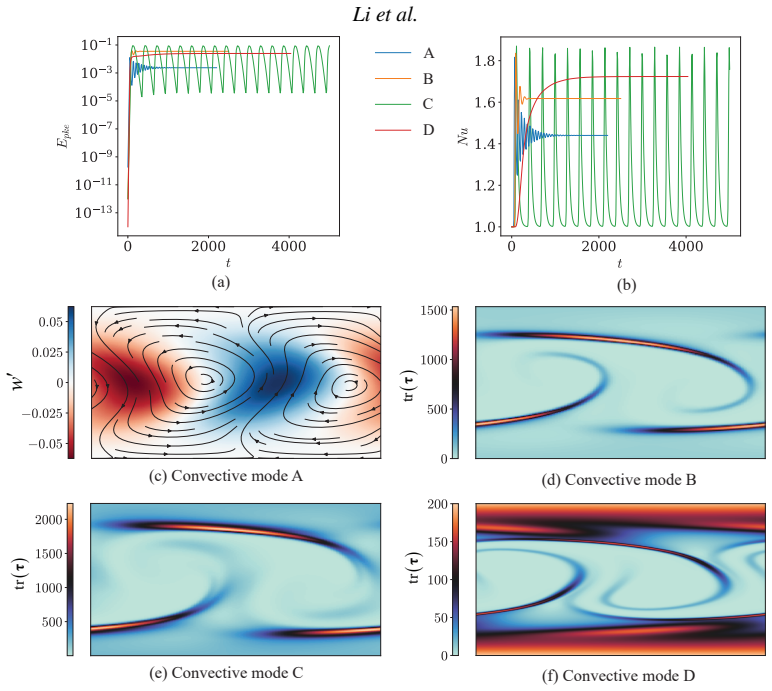
In two-dimensional thermally-stratified Poiseuille flow, polymers enhance the heat flux of the buoyancy-driven convective mode by up to 1100%. The resulting nonlinear states take the form of periodic orbits or travelling waves dominated by hook-like polymer-stress structures. Unattached hooks reduce streamwise velocity and promote wall-normal motion, while wall-attached hooks reorganize the flow into strong counter-rotating rolls. These states are sustained synergistically by polymer stresses and buoyancy, as confirmed by perturbation kinetic energy budgets. Wall-attached configurations allow rapid thermal equilibration at the expense of high hydraulic resistance, whereas unattached hooks in
What carries the argument
Hook-like polymer-stress structures that attach to walls or remain unattached, reorganizing the flow into rolls or acting as speed bumps to promote mixing while being sustained by the synergy of elasticity and buoyancy.
If this is right
- Wall-attached hooks enable rapid thermal equilibration but impose a large hydraulic penalty, making them suitable for process streams needing fast temperature adjustment.
- Unattached hooks provide a more thermally efficient regime for heat-transport applications.
- The centre mode develops into a nonlinear arrowhead state yielding only about 0.03% heat transfer increase over the conductive state.
- Perturbation kinetic energy budgets show that polymer stresses and buoyancy sustain the enhanced states in a synergistic manner.
Where Pith is reading between the lines
- If comparable hook structures emerge in three-dimensional flows, the same enhancement mechanism could apply to practical cooling systems.
- The contrast between attached and unattached regimes offers a way to tune polymer solutions for either quick thermal response or steady efficient transport.
- This elasto-buoyant reorganization may appear in other stratified or sheared viscoelastic flows when similar stress concentrations form.
Load-bearing premise
The two-dimensional geometry and chosen viscoelastic constitutive model accurately represent the dynamics of real three-dimensional polymer solutions at the simulated Reynolds numbers.
What would settle it
A three-dimensional simulation or laboratory experiment that fails to produce hook-like polymer stress structures or achieves less than 100% heat flux increase would falsify the reported extreme enhancement for the convective mode.
Figures




read the original abstract
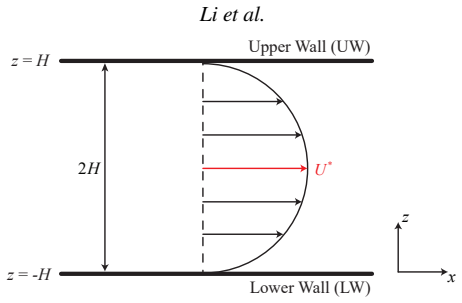
Heat dissipation is critical in modern engineering systems. Polymer additives offer a potential route to improve fluid-based cooling. Here, we study elasticity-enhanced heat transfer in two-dimensional, thermally-stratified Poiseuille flow. At Reynolds numbers, $Re$, $\lesssim 1000$, we observe two types of linearly unstable modes: the recently identified elasticity-induced centre mode (Khalid et al., J. Fluid Mech. 915, 2021) and the classical buoyancy-driven convective mode (Kelly, Adv. Appl. Mech. 31, 35-112, 1994). Direct numerical simulations show that the centre mode develops into a nonlinear `arrowhead' state but yields negligible heat transfer enhancement (typically $\approx 0.03\%$ increase compared to the conductive state). By contrast, polymers can enhance the heat flux associated with the convective mode by up to $1100\%$. The nonlinear convective-mode states take the form of either periodic orbits or travelling waves, and are dominated by hook-like polymer-stress structures that can attach to the walls. The unattached hooks act as `speed bumps' that reduced streamwise velocity and promote wall-normal motion, whereas wall-attached hooks form effective `polymer walls', reorganising the flow into strong counter-rotating rolls and triggering the extreme-enhancement regime. The elasto-buoyant nature of these states is confirmed by perturbation kinetic energy budgets, which show that polymer and buoyancy sustain the states synergistically. The wall-attached hooks enable rapid thermal equilibration but impose a large hydraulic penalty, making them suitable for process streams requiring fast temperature adjustment. Unattached hooks provide a more thermally efficient regime for heat-transport applications. These results highlight the potential of elastic fluids for future heat transfer enhancement technologies.
Editorial analysis
A structured set of objections, weighed in public.
Referee Report
Summary. The manuscript reports direct numerical simulations of two-dimensional viscoelastic Poiseuille flow with thermal stratification at Re ≲ 1000. It identifies two linearly unstable modes: an elasticity-induced centre mode that saturates into an 'arrowhead' state with negligible heat-transfer enhancement (≈0.03% over the conductive state) and a buoyancy-driven convective mode whose heat flux can be increased by up to 1100% through the formation of hook-like polymer-stress structures. Wall-attached hooks reorganize the flow into strong counter-rotating rolls while unattached hooks act as speed bumps; both regimes are sustained synergistically by polymer work and buoyancy, as shown by perturbation kinetic-energy budgets. The work distinguishes thermally efficient (unattached) from rapid-equilibration (attached) regimes and highlights potential engineering applications.
Significance. If the reported 2D mechanisms are robust, the work establishes a clear route to substantial heat-transfer enhancement via polymer additives in sheared convection, with the 1100% figure and the elasto-buoyant budgets providing quantitative, mechanistic support. The explicit separation of centre-mode versus convective-mode responses and the identification of hook structures constitute a strength of the DNS-plus-budget analysis.
major comments (2)
- [§4.2] §4.2 (convective-mode states): the 1100% heat-flux enhancement is stated without an explicit baseline (Newtonian convective state at identical Re, or conductive state) or the precise (Re, Wi, β) combination at which the maximum occurs; because this number is the headline quantitative claim, the parameter values and baseline definition must be stated unambiguously.
- [§5] §5 (perturbation kinetic-energy budgets): the budgets are used to assert synergistic elasto-buoyant sustenance, yet the text does not report the time-averaged fractional contributions of the polymer-stress work term versus the buoyancy term for the attached-hook versus unattached-hook regimes; without these fractions the synergy claim remains qualitative.
minor comments (3)
- [Abstract and §3] The abstract and §3 should list the Weissenberg numbers and polymer viscosity ratios at which the 1100% and 0.03% figures are obtained.
- [Figure captions] Figure captions for the hook-structure visualizations should indicate whether the snapshots are instantaneous or phase-averaged and should include the corresponding Nusselt number.
- [Methods] The manuscript should state the constitutive model (Oldroyd-B, FENE-P, etc.) and the value of the polymer viscosity ratio β in the methods section.
Simulated Author's Rebuttal
We thank the referee for the careful reading of our manuscript and the positive recommendation for minor revision. We address each major comment below and will revise the manuscript accordingly to improve clarity and quantitative support.
read point-by-point responses
-
Referee: [§4.2] §4.2 (convective-mode states): the 1100% heat-flux enhancement is stated without an explicit baseline (Newtonian convective state at identical Re, or conductive state) or the precise (Re, Wi, β) combination at which the maximum occurs; because this number is the headline quantitative claim, the parameter values and baseline definition must be stated unambiguously.
Authors: We agree that the baseline and specific parameters must be stated unambiguously for the headline 1100% claim. In the revised manuscript we will explicitly define the enhancement relative to the Newtonian convective state at identical Re and report the precise (Re, Wi, β) values at which the maximum occurs. revision: yes
-
Referee: [§5] §5 (perturbation kinetic-energy budgets): the budgets are used to assert synergistic elasto-buoyant sustenance, yet the text does not report the time-averaged fractional contributions of the polymer-stress work term versus the buoyancy term for the attached-hook versus unattached-hook regimes; without these fractions the synergy claim remains qualitative.
Authors: We accept that reporting the time-averaged fractional contributions would strengthen the quantitative basis for the synergistic elasto-buoyant sustenance. In the revised manuscript we will add these fractions for both the attached-hook and unattached-hook regimes. revision: yes
Circularity Check
No circularity: results are direct outputs of DNS on the governing equations
full rationale
The paper reports heat-transfer enhancement observed in direct numerical simulations of the 2D viscoelastic equations (Oldroyd-B or equivalent constitutive model) at given Re, Wi and polymer viscosity ratio. The 1100% figure and the hook-structure mechanism are computed quantities, not fitted parameters renamed as predictions. The centre-mode reference is to external prior work (Khalid et al. 2021) and does not form a self-citation chain that reduces the central claim to an input. Kinetic-energy budgets are post-processed from the simulated fields. No step in the reported chain reduces by construction to its own inputs.
Axiom & Free-Parameter Ledger
free parameters (2)
- Reynolds number
- Elasticity parameter (Weissenberg number)
axioms (2)
- domain assumption The polymer solution obeys a standard viscoelastic constitutive equation such as Oldroyd-B
- domain assumption Two-dimensional flow captures the essential heat-transfer physics
Reference graph
Works this paper leans on
-
[1]
Kerswell, R. R. and Page, J. , title =. J. Fluid Mech. , volume =. 2024 , doi =
work page 2024
-
[2]
Khalid, M. and Chaudhary, I. and Garg, P. and Shankar, V. and Subramanian, G. , title =. J. Fluid Mech. , volume =. 2021 , doi =
work page 2021
-
[3]
Gage, K. S. and Reid, W. H. , title =. J. Fluid Mech. , volume =. 1968 , doi =
work page 1968
-
[4]
Sureshkumar, R. and Beris, A. N. , title =. J. Non-Newtonian Fluid Mech. , volume =. 1995 , doi =
work page 1995
-
[5]
Howard, L. N. , title =. J. Fluid Mech. , volume =. 1962 , doi =
work page 1962
-
[6]
Kelly, R. E. , title =. Advances in Applied Mechanics , editor =. 1994 , doi =
work page 1994
- [7]
-
[8]
Yao, Z.-Z. and Lu, C.-L. and Zhou, C.-T. and Luo, K. and Yi, H.-L. and Tan, H.-P. , title =. Intl J. Heat Fluid Flow , volume =. 2024 , doi =
work page 2024
-
[9]
Burns, K. J. and Vasil, G. M. and Oishi, J. S. and Lecoanet, D. and Brown, B. P. , title =. Phys. Rev. Research , volume =. 2020 , doi =
work page 2020
-
[10]
Dubief, Y. and Page, J. and Kerswell, R. R. and Terrapon, V. E. and Steinberg, V. , title =. Phys. Rev. Fluids , volume =. 2022 , doi =
work page 2022
-
[11]
Purnode, B. and Legat, V. , title =. J. Non-Newtonian Fluid Mech. , volume =. 1996 , doi =
work page 1996
-
[12]
Dong, M. and Wan, D. , title =. 2025 , archiveprefix =. doi:10.48550/arXiv.2508.09635 , url =. 2508.09635 , primaryclass =
-
[13]
Beneitez, M. and Page, J. and Kerswell, R. R. , title =. Phys. Rev. Fluids , volume =. 2023 , doi =
work page 2023
- [14]
-
[15]
Zhang, Z. and Wang, X. and Yan, Y. , title =. e-Prime , volume =. 2021 , doi =
work page 2021
-
[16]
Konovalov, D. and Tolstorebrov, I. and Eikevik, T. M. and Kobalava, H. and Radchenko, M. and Hafner, A. and Radchenko, A. , title =. Energies , volume =. 2023 , doi =
work page 2023
-
[17]
Parizad Benam, B. and Sadaghiani, A. K. and Ya. Review on high heat flux flow boiling of refrigerants and water for electronics cooling , journal =. 2021 , doi =
work page 2021
-
[18]
Hirata, S. C. and Alves, L. S. de B. and Delenda, N. and Ouarzazi, M. N. , title =. J. Fluid Mech. , volume =. 2015 , doi =
work page 2015
-
[19]
Roy, T. and Taylor, D. and Poulikakos, D. , title =. Intl J. Heat Mass Transfer , volume =. 2024 , doi =
work page 2024
-
[20]
Schmid, P. J. and Henningson, D. S. , title =. 2001 , doi =
work page 2001
- [21]
-
[22]
Groisman, A. and Steinberg, V. , title =. Nature , volume =. 2000 , doi =
work page 2000
-
[23]
Pope, S. B. , title =
-
[24]
Page, J. and Dubief, Y. and Kerswell, R. R. , title =. Phys. Rev. Lett. , volume =. 2020 , doi =
work page 2020
-
[25]
Wu, Z. and Wang, Z. , title =. The Innovation Energy , volume =. 2025 , doi =
work page 2025
-
[26]
Abed, W. M. and Whalley, R. D. and Dennis, D. J. C. and Poole, R. J. , title =. J. Non-Newtonian Fluid Mech. , volume =. 2016 , doi =
work page 2016
-
[27]
Whalley, R. D. and Abed, W. M. and Dennis, D. J. C. and Poole, R. J. , title =. Theor. Appl. Mech. Lett. , volume =. 2015 , doi =
work page 2015
-
[28]
Li, D.-Y. and Zhang, H. and Cheng, J.-P. and Li, X.-B. and Li, F.-C. and Qian, S. and Joo, S. W. , title =. Microfluid. Nanofluid. , volume =. 2017 , doi =
work page 2017
-
[29]
Yang, H. and Yao, G. and Wen, D. , title =. Exp. Thermal Fluid Sci. , volume =. 2020 , doi =
work page 2020
-
[30]
Traore, B. and Castelain, C. and Burghelea, T. , title =. J. Non-Newtonian Fluid Mech. , volume =. 2015 , doi =
work page 2015
-
[31]
Garg, H. and Wang, L. , title =. Intl J. Thermofluids , volume =. 2024 , doi =
work page 2024
-
[32]
Chauhan, A. and Sasmal, C. , title =. Phys. Rev. Fluids , volume =. 2024 , doi =
work page 2024
-
[33]
Cai, W. and Wei, T. and Tang, X. and Liu, Y. and Li, B. and Li, F. , title =. Exp. Thermal Fluid Sci. , volume =. 2019 , doi =
work page 2019
-
[34]
Wang, Y. and Cheng, J.-P. and Zhang, H.-N. and Zheng, X. and Cai, W.-H. and Siginer, D. A. , title =. Phys. Fluids , volume =. 2023 , doi =
work page 2023
-
[35]
Xu, C. and Zhang, C. and Brandt, L. and Song, J. and Shishkina, O. , title =. J. Fluid Mech. , volume =. 2025 , doi =
work page 2025
-
[36]
Sharma, C. S. and Tiwari, M. K. and Zimmermann, S. and Brunschwiler, T. and Schlottig, G. and Michel, B. and Poulikakos, D. , title =. Appl. Energy , volume =. 2015 , doi =
work page 2015
-
[37]
Khalili, Z. and Sheikholeslami, M. and Momayez, L. , title =. Sci. Rep. , volume =. 2023 , doi =
work page 2023
- [38]
-
[39]
Taher, R. and Abid, C. , title =. Heat Mass Transfer , volume =. 2018 , doi =
work page 2018
-
[40]
Taher, R. and Ahmed, M. M. and Haddad, Z. and Abid, C. , title =. Intl J. Heat Mass Transfer , volume =. 2021 , doi =
work page 2021
-
[41]
Zhang, L. and Huang, Y. and Peng, L. and Li, Y.-R. , title =. Case Stud. Thermal Engng , volume =. 2023 , doi =
work page 2023
-
[42]
Zhu, Y.-Z. and Zhang, L. and Wu, C.-M. and Li, Y.-R. , title =. Appl. Thermal Engng , volume =. 2025 , doi =
work page 2025
- [43]
-
[44]
Yan, R. and Gao, C. and Zheng, Y. and Wu, B. and Zheng, H. and Ding, T. , title =. Intl Commun. Heat Mass Transfer , volume =. 2026 , doi =
work page 2026
- [45]
-
[46]
Kamboj, A. and Patne, R. and Narayana, P. A. L. and Sahu, K. C. , title =. Chem. Engng Sci. , volume =. 2025 , doi =
work page 2025
-
[47]
Zhang, M. and Lashgari, I. and Zaki, T. A. and Brandt, L. , title =. J. Fluid Mech. , volume =. 2013 , doi =
work page 2013
-
[48]
Dubief, Y. and Terrapon, V. E. and Hof, B. , title =. Annu. Rev. Fluid Mech. , volume =. 2023 , doi =
work page 2023
- [49]
-
[50]
Miles, J. W. , title =. J. Fluid Mech. , volume =. 1961 , doi =
work page 1961
-
[51]
Howard, L. N. , title =. J. Fluid Mech. , volume =. 1961 , doi =
work page 1961
-
[52]
Lewy, T. A. and Kerswell, R. R. , title =. 2025 , archiveprefix =. 2509.26168 , primaryclass =
work page internal anchor Pith review Pith/arXiv arXiv 2025
-
[53]
Maradiya, C. and Vadher, J. and Agarwal, R. , title =. Beni-Suef Univ. J. Basic Appl. Sci. , volume =. 2018 , doi =
work page 2018
-
[54]
Manglik, R. M. , title =. Heat Transfer Handbook , publisher =
-
[55]
Ali, N. and Javed, M. A. , title =. Intl J. Heat Mass Transfer , volume =. 2016 , doi =
work page 2016
-
[56]
Khan, Z. and Shah, R. A. and Islam, S. and Jan, H. and Jan, B. and Rasheed, H.-U. and Khan, A. , title =. Coatings , volume =. 2017 , doi =
work page 2017
-
[57]
Lin, Y. and Kerswell, R. R. , title =. Geophys. Astrophys. Fluid Dyn. , volume =. 2025 , doi =
work page 2025
-
[58]
Takahashi, M. and Fujinuma, H. and Tsukuii, J. and Inoue, A. , title =. J. Nucl. Sci. Technol. , volume =. 1992 , doi =
work page 1992
-
[59]
Dubief, Y. and Terrapon, V. E. , title =. Phys. Fluids , volume =. 2020 , doi =
work page 2020
discussion (0)
Sign in with ORCID, Apple, or X to comment. Anyone can read and Pith papers without signing in.