Vortex ring formation from the interaction of a cavitation bubble with a confined air bubble: experiments and a timing criterion
Pith reviewed 2026-05-11 03:13 UTC · model grok-4.3
The pith
A dimensionless timing parameter distinguishes when vortex rings form from cavitation and confined air bubble interactions.
A machine-rendered reading of the paper's core claim, the machinery that carries it, and where it could break.
Core claim
The central claim is that the dimensionless timing parameter Π = (h + R_max) / (U_lc · t_cav/2) separates the observed regimes, with vortex ring formation occurring precisely when 1 ≲ Π ≲ 1.5; this is established by high-speed imaging across stand-off and fill-fraction values together with one-dimensional predictions of liquid-column impact location and speed U_lc.
What carries the argument
The dimensionless timing parameter Π that compares the liquid-column travel time to the cavitation-bubble collapse half-period.
If this is right
- Rings form only for small stand-off distances and low air fill fractions when the liquid column impacts during collapse.
- Large stand-off distances produce late impacts that do not form rings.
- Large air fill fractions allow the air bubble to bypass the column and impact directly, producing no ring.
- Any formed ring starts at 5 m/s, slows quadratically, and breaks up via azimuthal instabilities near Re = 4500.
Where Pith is reading between the lines
- The timing-based separation implies that ring formation is governed more by global timing than by local three-dimensional vorticity details.
- The reported quadratic deceleration and Re-based breakup could serve as a benchmark for simple drag models of such rings in confined geometries.
- The same Π construction might be tested in other confined multiphase setups to see whether the 1–1.5 window holds when viscosity or wall effects are stronger.
Load-bearing premise
The one-dimensional Rayleigh-Plesset and isentropic models accurately predict liquid-column impact location and speed without corrections for three-dimensional flow, wall effects, or viscosity.
What would settle it
Measure the actual liquid-column speed and impact timing in the confined geometry and check whether rings appear only inside the predicted Π window or appear outside it.
Figures




read the original abstract
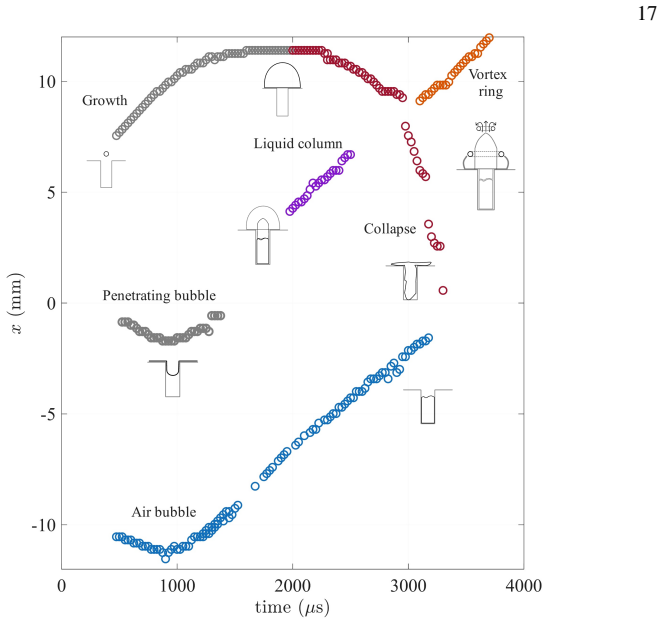
We study vortex ring formation arising from the interaction between a cavitation bubble and a confined air bubble in a cylindrical blind hole, using high-speed shadowgraphy imaging. As the cavitation bubble grows above the hole, it drives a downward flow that compresses the air bubble at the base. The air bubble subsequently expands, expelling the overlying liquid column upward as a coherent slug; impact of this slug on the far boundary of the collapsing cavitation bubble produces a vortex ring. Parametric experiments across the dimensionless stand-off distance $\mathcal{H} = h/R_{\max}$ and the air bubble fill fraction $\mathcal{B} = (d_\text{hole} - d_\text{top})/d_\text{hole}$ identify three regimes: (i) liquid column impact during collapse, producing a vortex ring ($\mathcal{H} \lesssim 0.5$, $\mathcal{B} \lesssim 0.5$); (ii) late impact near the end of collapse (large $\mathcal{H}$); and (iii) direct air bubble impact after bypassing the liquid column (large $\mathcal{B}$), with neither (ii) nor (iii) producing a ring. Two one-dimensional models, based on the Rayleigh-Plesset equation and isentropic air bubble expansion, predict the liquid column impact location and its speed $U_\text{lc}$, respectively. A dimensionless timing parameter $\Pi = (h + R_{\max}) / (U_\text{lc} \cdot t_\text{cav}/2)$, comparing the liquid column travel time to the cavitation collapse half-period, distinguishes the three regimes: ring formation occurs for $1 \lesssim \Pi \lesssim 1.5$. The ring propagates from the hole at an initial speed of $5$ m/s, decelerating quadratically, and breaks apart via azimuthal instabilities at $Re \approx 4500$.
Editorial analysis
A structured set of objections, weighed in public.
Referee Report
Summary. The manuscript uses high-speed shadowgraphy to examine vortex ring formation from the interaction of a cavitation bubble with a confined air bubble in a cylindrical blind hole. Parametric experiments in dimensionless stand-off distance H = h/R_max and air-bubble fill fraction B identify three regimes: liquid-column impact during collapse (producing a ring for H ≲ 0.5, B ≲ 0.5), late impact, and direct air-bubble impact. One-dimensional Rayleigh-Plesset and isentropic-expansion models predict liquid-column impact location and speed U_lc; the resulting dimensionless timing parameter Π = (h + R_max)/(U_lc · t_cav/2) separates the regimes, with rings forming only for 1 ≲ Π ≲ 1.5. Ring propagation speed and breakup at Re ≈ 4500 are also reported.
Significance. If the timing criterion holds, the work supplies a compact, experimentally grounded predictor for vortex-ring generation in confined bubble interactions that builds directly on standard bubble-dynamics equations without ad-hoc fitting. The experimental regime classification is independent of the models, and the use of established Rayleigh-Plesset and isentropic formulations is a clear strength. The result is relevant to cavitation-driven flows, vortex dynamics, and confined multiphase systems.
major comments (1)
- [Modeling section (one-dimensional models for U_lc)] The timing parameter Π is computed from U_lc obtained via the one-dimensional isentropic model for air-bubble expansion (described after the experimental methods). No direct experimental measurement or validation of the predicted liquid-column speed is presented for the confined cylindrical geometry; wall shear, possible 3D recirculation, and viscous boundary layers omitted from the model could systematically shift actual arrival time and speed, thereby affecting the precise boundaries of the 1 ≲ Π ≲ 1.5 interval even if the experimental regime classification remains correct.
minor comments (1)
- [Abstract] The abstract states that the ring breaks apart at Re ≈ 4500 but does not indicate how the Reynolds number is defined or which characteristic length and viscosity are used.
Simulated Author's Rebuttal
We thank the referee for the positive assessment of our work and the recommendation for minor revision. We address the single major comment below.
read point-by-point responses
-
Referee: [Modeling section (one-dimensional models for U_lc)] The timing parameter Π is computed from U_lc obtained via the one-dimensional isentropic model for air-bubble expansion (described after the experimental methods). No direct experimental measurement or validation of the predicted liquid-column speed is presented for the confined cylindrical geometry; wall shear, possible 3D recirculation, and viscous boundary layers omitted from the model could systematically shift actual arrival time and speed, thereby affecting the precise boundaries of the 1 ≲ Π ≲ 1.5 interval even if the experimental regime classification remains correct.
Authors: We agree that the one-dimensional isentropic model for air-bubble expansion omits wall shear, three-dimensional recirculation, and viscous boundary layers in the confined cylindrical geometry, and that no direct experimental measurement of the liquid-column speed U_lc is presented. The three flow regimes are identified experimentally from high-speed shadowgraphy and are therefore independent of the model. The timing parameter Π is offered as a simple predictor constructed from the established Rayleigh-Plesset equation and isentropic expansion; in the reported parametric data this predictor correctly delineates the interval in which vortex rings form. We will add a concise paragraph in the modeling section that states the model assumptions, acknowledges the neglected effects, and notes that the precise numerical limits of the Π interval carry some uncertainty as a result. revision: partial
Circularity Check
No circularity: models are standard and unfitted; regime separation is an independent empirical correlation
full rationale
The experimental regimes are classified directly from high-speed imaging using the geometric parameters H and B, without reference to the timing parameter. The Rayleigh-Plesset and isentropic models are the standard formulations with no parameters adjusted to the vortex-ring observations or to the target Π values; they supply U_lc and impact location as forward predictions from bubble dynamics alone. Π is then computed for each experimental case and observed to cluster the ring-forming cases in a narrow band. This is a post-hoc correlation between an independent model output and independent experimental labels, not a self-definition, fitted prediction, or self-citation chain. The derivation chain remains self-contained against external benchmarks.
Axiom & Free-Parameter Ledger
axioms (2)
- standard math Rayleigh-Plesset equation governs the dynamics of the cavitation bubble
- domain assumption Air bubble expansion is isentropic
Lean theorems connected to this paper
-
IndisputableMonolith/Cost/FunctionalEquation.leanwashburn_uniqueness_aczel unclear?
unclearRelation between the paper passage and the cited Recognition theorem.
Two one-dimensional models, based on the Rayleigh–Plesset equation and isentropic air bubble expansion, predict the liquid column impact location and its speed U_lc, respectively. A dimensionless timing parameter Π = (h + R_max)/(U_lc · t_cav/2) ... distinguishes the three regimes: ring formation occurs for 1 ≲ Π ≲ 1.5.
-
IndisputableMonolith/Foundation/RealityFromDistinction.leanreality_from_one_distinction unclear?
unclearRelation between the paper passage and the cited Recognition theorem.
The growth of the cavitation bubble is described using the Rayleigh–Plesset model ... p_B = P_o (R_o / R)^{3k}
What do these tags mean?
- matches
- The paper's claim is directly supported by a theorem in the formal canon.
- supports
- The theorem supports part of the paper's argument, but the paper may add assumptions or extra steps.
- extends
- The paper goes beyond the formal theorem; the theorem is a base layer rather than the whole result.
- uses
- The paper appears to rely on the theorem as machinery.
- contradicts
- The paper's claim conflicts with a theorem or certificate in the canon.
- unclear
- Pith found a possible connection, but the passage is too broad, indirect, or ambiguous to say the theorem truly supports the claim.
Reference graph
Works this paper leans on
-
[1]
Scientific Papers on Mechanical and Physical Subject , volume=
Experiments showing the boiling of water in an open tube at ordinary temperatures , author=. Scientific Papers on Mechanical and Physical Subject , volume=. 1894 , publisher=
-
[2]
On the pressure developed in a liquid during the collapse of a spherical cavity , author=
VIII. On the pressure developed in a liquid during the collapse of a spherical cavity , author=. The London, Edinburgh, and Dublin Philosophical Magazine and Journal of Science , volume=. 1917 , publisher=
work page 1917
-
[3]
Philosophical Transactions for the Royal Society of London
The collapse of cavitation bubbles and the pressures thereby produced against solid boundaries , author=. Philosophical Transactions for the Royal Society of London. Series A, Mathematical and Physical Sciences , pages=. 1966 , publisher=
work page 1966
-
[4]
Comptes Rendus Physique , volume=
Cavitation in water: a review , author=. Comptes Rendus Physique , volume=. 2006 , publisher=
work page 2006
- [5]
-
[6]
Journal of Fluid Mechanics , volume=
Experimental investigations of cavitation-bubble collapse in the neighbourhood of a solid boundary , author=. Journal of Fluid Mechanics , volume=. 1975 , publisher=
work page 1975
-
[7]
Journal of Fluid Mechanics , volume=
The final stage of the collapse of a cavitation bubble near a rigid wall , author=. Journal of Fluid Mechanics , volume=. 1993 , publisher=
work page 1993
-
[8]
Journal of Fluid Mechanics , volume=
Growth and collapse of a vapour cavity near a free surface , author=. Journal of Fluid Mechanics , volume=. 1981 , publisher=
work page 1981
-
[9]
Annual review of fluid mechanics , volume=
Cavitation bubbles near boundaries , author=. Annual review of fluid mechanics , volume=. 1987 , publisher=
work page 1987
-
[10]
Journal of Applied Physics , volume=
Interaction of cavitation bubbles with a free surface , author=. Journal of Applied Physics , volume=. 2001 , publisher=
work page 2001
-
[11]
Journal of Fluid Mechanics , volume=
Collapse of an initially spherical vapour cavity in the neighbourhood of a solid boundary , author=. Journal of Fluid Mechanics , volume=. 1971 , publisher=
work page 1971
-
[12]
Journal of Physics: Conference Series , volume=
Laser diagnostics for characterization of sprays formed by a collapsing non-equilibrium bubble , author=. Journal of Physics: Conference Series , volume=. 2015 , organization=
work page 2015
-
[13]
Physical Review Fluids , volume=
Flow fields and vortex dynamics of bubbles collapsing near a solid boundary , author=. Physical Review Fluids , volume=. 2017 , publisher=
work page 2017
-
[14]
Advances in science and technology , volume=
Vortex rings in bio-inspired and biological jet propulsion , author=. Advances in science and technology , volume=. 2009 , publisher=
work page 2009
-
[15]
Entrapment and interaction of an air bubble with an oscillating cavitation bubble , author=. Physics of Fluids , volume=. 2018 , publisher=
work page 2018
-
[16]
Ultrasonics Sonochemistry , keywords =
Kauer, Markus and Belova-Magri, Valentina and Cair. Ultrasonics Sonochemistry , keywords =. doi:10.1016/j.ultsonch.2018.04.015 , issn =
-
[17]
Physical Review Fluids , number =
Reuter, Fabian and Gonzalez-Avila, Silvestre Roberto and Mettin, Robert and Ohl, Claus Dieter , doi =. Physical Review Fluids , number =
-
[18]
Journal of Hydrodynamics , keywords =
Bai, Li Xin and Xu, Wei Lin and Li, Chao and Gao, Yan Dong , doi =. Journal of Hydrodynamics , keywords =
-
[19]
and Klaseboer, Evert and Khoo, Boo Cheong and Ohl, Claus Dieter , doi =
Karri, Badarinath and Avila, Silvestre Roberto Gonzalez and Loke, Yee Chong and O'Shea, Sean J. and Klaseboer, Evert and Khoo, Boo Cheong and Ohl, Claus Dieter , doi =. Physical Review E - Statistical, Nonlinear, and Soft Matter Physics , title =
-
[20]
Goh, B. H.T. and Oh, Y. D.A. and Klaseboer, E. and Ohl, S. W. and Khoo, B. C. , doi =. Review of Scientific Instruments , number =
-
[21]
doi:10.1017/jfm.2015.33 , file =
Journal of Fluid Mechanics , keywords =. doi:10.1017/jfm.2015.33 , file =
-
[22]
Krueger, Paul S. and Moslemi, Ali A. and Nichols, J. Tyler and Bartol, Ian K. and Stewart, William J. , doi =. CIMTEC 2008 - Proceedings of the 3rd International Conference on Smart Materials, Structures and Systems - Mining Smartness from Nature , keywords =
work page 2008
-
[23]
Zhang, S. and Wang, S. P. and Zhang, A. M. , doi =. Physics of Fluids , number =
-
[24]
and Klaseboer, Evert and Ohl, Siew Wan and Khoo, Boo Cheong , doi =
Karri, Badarinath and Pillai, Kiran S. and Klaseboer, Evert and Ohl, Siew Wan and Khoo, Boo Cheong , doi =. Sensors and Actuators, A: Physical , keywords =
-
[25]
Klaseboer, E. and Hung, K. C. and Wang, C. and Wang, C. W. and Khoo, B. C. and Boyce, P. and Debono, S. and Charlier, Herve , doi =. Journal of Fluid Mechanics , pages =
-
[26]
and Khoo, Boo Cheong and Szeri, Andrew J
Klaseboer, Evert and Fong, Siew Wan and Turangan, Cary K. and Khoo, Boo Cheong and Szeri, Andrew J. and Calvisi, Michael L. and Sankin, Georgy N. and Zhong, Pei , doi =. Journal of Fluid Mechanics , pages =
-
[27]
Tomita, Y. and Robinson, P. B. and Tong, R. P. and Blake, J. R. , doi =. Journal of Fluid Mechanics , pages =
-
[28]
Kannan, Y. S. and Balusamy, Saravanan and Karri, Badarinath and Sahu, Kirti Chandra , doi =. Experimental Thermal and Fluid Science , number =
-
[29]
Sensors and Actuators, A: Physical , keywords =
Lew, Kelly Siew Fong and Klaseboer, Evert and Khoo, Boo Cheong , doi =. Sensors and Actuators, A: Physical , keywords =
-
[30]
Khoo, B.C. and Klaseboer, E. and Hung, K.C. , doi =. Sensors and Actuators A: Physical , keywords =
-
[31]
Journal of Applied Physics , number =
Pain, Agn. Journal of Applied Physics , number =. doi:10.1063/1.3692749 , file =
-
[32]
Goh, B. H.T. and Ohl, S. W. and Klaseboer, E. and Khoo, B. C. , doi =. Physics of Fluids , number =
-
[33]
Physical Review E - Statistical, Nonlinear, and Soft Matter Physics , number =
Karri, Badarinath and Ohl, Siew Wan and Klaseboer, Evert and Ohl, Claus Dieter and Khoo, Boo Cheong , doi =. Physical Review E - Statistical, Nonlinear, and Soft Matter Physics , number =
-
[34]
Coussios, Constantin C. and Roy, Ronald A. , doi =. Annual Review of Fluid Mechanics , keywords =
-
[35]
Ultrasonics Sonochemistry , keywords =
Yusof, Nor Saadah Mohd and Babgi, Bandar and Alghamdi, Yousef and Aksu, Mecit and Madhavan, Jagannathan and Ashokkumar, Muthupandian , doi =. Ultrasonics Sonochemistry , keywords =
-
[36]
Review of Scientific Instruments , volume=
A low-voltage spark-discharge method for generation of consistent oscillating bubbles , author=. Review of Scientific Instruments , volume=. 2013 , publisher=
work page 2013
-
[37]
Journal of Environmental Health Science and Engineering , volume=
A critical review of the current technologies in wastewater treatment plants by using hydrodynamic cavitation process: principles and applications , author=. Journal of Environmental Health Science and Engineering , volume=. 2020 , publisher=
work page 2020
-
[38]
Journal of Fluid Mechanics , volume=
Cinematographic observation of the collapse and rebound of a laser-produced cavitation bubble near a wall , author=. Journal of Fluid Mechanics , volume=. 2003 , publisher=
work page 2003
-
[39]
Journal of Fluids Engineering , year=
Interaction between an oscillating bubble and a free surface , author=. Journal of Fluids Engineering , year=
-
[40]
Australasian Conference on Hydraulics and Fluid Mechanics (7th: 1980: Brisbane, Qld.) , pages=
Growth and collapse of cavitation bubbles near flexible boundaries , author=. Australasian Conference on Hydraulics and Fluid Mechanics (7th: 1980: Brisbane, Qld.) , pages=. 1980 , organization=
work page 1980
-
[41]
Journal of Fluid Mechanics , volume=
The structure and stability of vortex rings , author=. Journal of Fluid Mechanics , volume=. 1972 , publisher=
work page 1972
-
[42]
Journal of Fluid Mechanics , volume=
Single cavitation bubble dynamics in a stagnation flow , author=. Journal of Fluid Mechanics , volume=. 2024 , publisher=
work page 2024
-
[43]
Robust cavitation-based pumping into a capillary , author=. Physics of Fluids , volume=. 2024 , publisher=
work page 2024
-
[44]
Physical review letters , volume=
Particle motion induced by bubble cavitation , author=. Physical review letters , volume=. 2015 , publisher=
work page 2015
-
[45]
Journal of applied physics , volume=
Collapse of multiple gas bubbles by a shock wave and induced impulsive pressure , author=. Journal of applied physics , volume=. 1984 , publisher=
work page 1984
-
[46]
Journal of Fluid Mechanics , volume=
Mechanisms of impulsive pressure generation and damage pit formation by bubble collapse , author=. Journal of Fluid Mechanics , volume=. 1986 , publisher=
work page 1986
-
[47]
Journal of Fluid Mechanics , volume=
Optical and acoustic investigations of the dynamics of laser-produced cavitation bubbles near a solid boundary , author=. Journal of Fluid Mechanics , volume=. 1989 , publisher=
work page 1989
-
[48]
Journal of Fluid Mechanics , volume=
Cavitation bubble dynamics in a liquid gap of variable height , author=. Journal of Fluid Mechanics , volume=. 2011 , publisher=
work page 2011
-
[49]
Interaction of particles with a cavitation bubble near a solid wall , author=. Physics of Fluids , volume=. 2018 , publisher=
work page 2018
-
[50]
Journal of Fluid Mechanics , volume=
Dynamics of laser-induced cavitation bubbles near an elastic boundary , author=. Journal of Fluid Mechanics , volume=. 2001 , publisher=
work page 2001
-
[51]
Annual Review of Fluid Mechanics , volume=
Cavitation in fluid machinery and hydraulic structures , author=. Annual Review of Fluid Mechanics , volume=. 1981 , publisher=
work page 1981
-
[52]
Fundamentals, biomedical applications and future potential of micro-scale cavitation-a review , author=. Lab on a Chip , volume=. 2022 , publisher=
work page 2022
-
[53]
Journal of fluid mechanics , volume=
Cavitation erosion by single laser-produced bubbles , author=. Journal of fluid mechanics , volume=. 1998 , publisher=
work page 1998
- [54]
-
[55]
Proceedings of the First US National Congress on Applied Mechanics , pages=
The collapse or growth of a spherical bubble or cavity in a viscous fluid , author=. Proceedings of the First US National Congress on Applied Mechanics , pages=. 1952 , organization=
work page 1952
discussion (0)
Sign in with ORCID, Apple, or X to comment. Anyone can read and Pith papers without signing in.