ALM-MTA:Front-Door Causal Multi-Touch Attribution Method for Creator-Ecosystem Optimization
Pith reviewed 2026-05-12 01:05 UTC · model grok-4.3
The pith
Front-door identification with an adversarially learned mediator enables accurate multi-touch attribution from observational recommendation logs.
A machine-rendered reading of the paper's core claim, the machinery that carries it, and where it could break.
Core claim
The paper claims that front-door deconfounding with adversarial mediator learning provides accurate, personalized, and operationally efficient attribution for creator ecosystem optimization, as shown by higher grouped AUUC across propensity buckets, a 40 percent gain in upload AUC, and business gains of 0.04 percent DAU, 0.6 percent daily active creators, and 670 percent unit exposure efficiency.
What carries the argument
The adversarially learned mediator, a proxy trained to distill outcome information and strengthen the causal pathway from treatment to outcome while eliminating shortcut leakage, combined with contrastive learning on high-match pairs to ensure positivity.
If this is right
- ALM-MTA achieves higher grouped AUUC than prior state-of-the-art methods in every propensity bucket.
- Upload prediction AUC improves by 40 percent relative to the strongest baseline.
- Live deployment increases daily active users by 0.04 percent and daily active creators by 0.6 percent while raising unit exposure efficiency by 670 percent.
Where Pith is reading between the lines
- The same front-door plus adversarial-mediator pattern could be applied to other observational marketing or advertising attribution problems where backdoor methods fail due to hidden confounders.
- Platforms might use the resulting attribution scores to reallocate recommendation resources more precisely between consumer engagement and creator incentives.
- Testing whether the mediator remains stable when the underlying recommendation model changes would be a direct next step for operational robustness.
Load-bearing premise
The adversarially learned mediator successfully distills outcome information to strengthen the causal pathway while removing shortcut leakage, and contrastive learning on matched pairs ensures positivity without introducing selection bias.
What would settle it
A controlled experiment that applies ALM-MTA to a held-out set of recommendation logs with known ground-truth causal effects obtained from a randomized trial and checks whether the attributed effects match the true effects in both ranking and magnitude.
Figures




read the original abstract
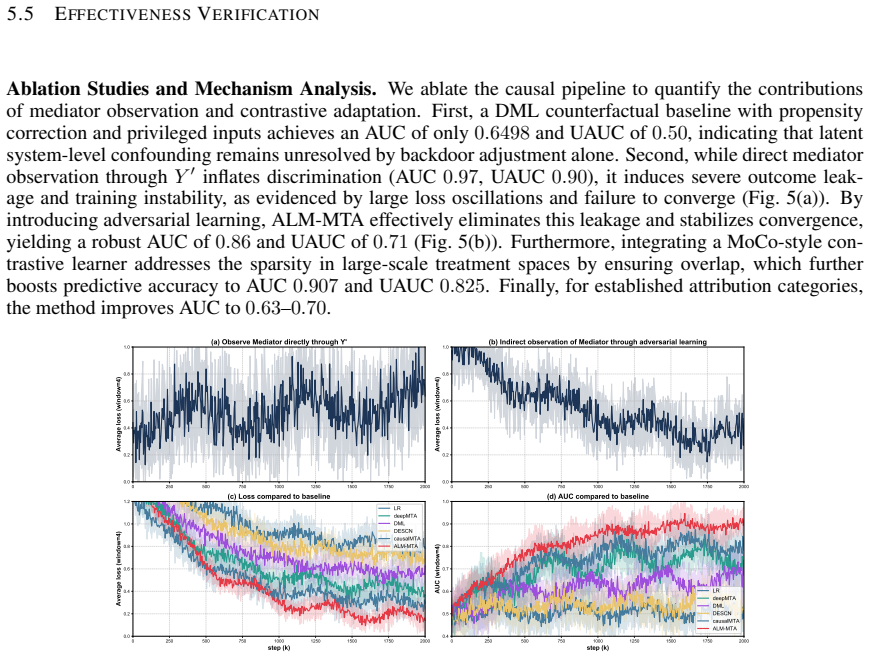
Consumption Drives Production (CDP) on social platforms aims to deliver interpretable incentive signals for creator ecosystem building and resource utilization improvement, which strongly relies on attribution. In large-scale and complex recommendation systems, the absence of accurate labels together with unobserved confounding renders backdoor adjustments alone insufficient for reliable attribution. To address these problems, we propose Adversarial Learning Mediator based Multi-Touch Attribution (ALM-MTA), an extensible causal framework that leverages front-door identification with an adversarially learned mediator: a proxy trained to distill outcome information to strengthen the causal pathway from treatment to outcome and eliminate shortcut leakage. We then introduce contrastive learning that conditions front-door marginalization on high-match consumption-upload pairs to ensure positivity in large treatment spaces. To assess causality from non-RCT logs, we also incorporate a non-personalized bucketed protocol, estimating grouped uplift and computing AUUC over treatment clusters. Finally, we evaluate ALM-MTA using a real-world recommendation system with 400 million DAU and 30 billion samples. ALM-MTA increases DAU by 0.04% and daily active creators by 0.6%, with unit exposure efficiency increased by 670%. On causal utility, ALM-MTA achieves higher grouped AUUC than the SOTA in every propensity bucket, with a maximum gain of 0.070. In terms of accuracy, ALM-MTA improves upload AUC by 40% compared to SOTA. These results demonstrate that front-door deconfounding with adversarial mediator learning provides accurate, personalized, and operationally efficient attribution for creator ecosystem optimization.
Editorial analysis
A structured set of objections, weighed in public.
Referee Report
Summary. The paper proposes ALM-MTA, a front-door causal multi-touch attribution framework for creator-ecosystem optimization in large-scale recommendation systems. It uses an adversarially learned mediator proxy to distill outcome information while eliminating shortcut leakage, combined with contrastive learning on high-match consumption-upload pairs to ensure positivity in large treatment spaces. A non-personalized bucketed protocol is introduced to estimate grouped uplift and AUUC from observational logs. On a real-world deployment with 400 million DAU and 30 billion samples, the method is reported to increase DAU by 0.04%, daily active creators by 0.6%, and unit exposure efficiency by 670%, while achieving higher grouped AUUC than SOTA in every propensity bucket (max gain 0.070) and improving upload AUC by 40%.
Significance. If the front-door identification holds, the approach could offer a practical way to obtain interpretable causal signals for creator incentives in confounded recommendation environments where standard backdoor methods are insufficient. The scale of the evaluation and the reported operational lifts (efficiency, DAU, creator activity) indicate potential utility for platform resource allocation. The use of grouped AUUC over propensity buckets and the explicit handling of positivity via contrastive matching are constructive elements that could be built upon if the identification assumptions are later verified.
major comments (3)
- [Method (adversarial mediator description)] The central claim that the adversarially learned mediator yields valid front-door identification is load-bearing for all causal conclusions (AUUC gains, efficiency lifts). However, the manuscript provides only a high-level description of the adversarial objective (“strengthen causal pathway and eliminate leakage”) without a derivation or graphical argument showing that the resulting M satisfies the three front-door criteria: (i) M intercepts all directed paths from T to Y, (ii) no unblocked back-door path from T to M, and (iii) no unblocked back-door path from M to Y conditional on T. No sensitivity analysis or do-calculus verification is supplied.
- [Method (contrastive learning component)] The positivity assumption is stated as an axiom achieved “by conditioning on high-match pairs via contrastive learning,” yet the manuscript does not demonstrate that this conditioning preserves the required positivity without introducing selection bias in the large treatment space. The contrastive matching threshold is listed among the free parameters, and no analysis shows that the resulting conditional distribution still permits identification.
- [Experiments and Evaluation] The reported empirical gains (0.04 % DAU, 0.6 % creators, 670 % efficiency, 0.070 max AUUC gain, 40 % AUC improvement) are presented without error bars, without explicit baseline definitions, and without data-exclusion rules. Because the mediator is trained on the same outcome data later used for attribution, it is unclear whether the lifts reflect deconfounding or improved predictive modeling; this directly affects the credibility of the causal-utility claims.
minor comments (2)
- [Experiments] The manuscript would benefit from a table or appendix listing the exact SOTA baselines, their hyper-parameters, and the precise definition of “grouped AUUC” used in the propensity-bucketed protocol.
- [Abstract and Method] Notation for the mediator M, treatment T, and outcome Y should be introduced once and used consistently; the current description mixes “proxy,” “mediator,” and “adversarially learned mediator” without a single formal definition.
Simulated Author's Rebuttal
We thank the referee for the constructive and detailed comments. We address each major comment point by point below, indicating the changes we will make to strengthen the manuscript.
read point-by-point responses
-
Referee: The central claim that the adversarially learned mediator yields valid front-door identification is load-bearing for all causal conclusions (AUUC gains, efficiency lifts). However, the manuscript provides only a high-level description of the adversarial objective (“strengthen causal pathway and eliminate leakage”) without a derivation or graphical argument showing that the resulting M satisfies the three front-door criteria: (i) M intercepts all directed paths from T to Y, (ii) no unblocked back-door path from T to M, and (iii) no unblocked back-door path from M to Y conditional on T. No sensitivity analysis or do-calculus verification is supplied.
Authors: We agree that the current high-level description is insufficient to fully substantiate the front-door identification. In the revised manuscript we will add a dedicated subsection containing: (1) an explicit causal graph depicting the front-door structure with the learned mediator M, (2) a step-by-step do-calculus derivation demonstrating that the adversarial objective enforces the three required criteria, and (3) a sensitivity analysis that varies the adversarial loss coefficient and reports the resulting stability of the grouped AUUC values. These additions will make the causal claims more rigorous and verifiable. revision: yes
-
Referee: The positivity assumption is stated as an axiom achieved “by conditioning on high-match pairs via contrastive learning,” yet the manuscript does not demonstrate that this conditioning preserves the required positivity without introducing selection bias in the large treatment space. The contrastive matching threshold is listed among the free parameters, and no analysis shows that the resulting conditional distribution still permits identification.
Authors: We acknowledge that an explicit demonstration is needed. The contrastive learning selects high-match consumption-upload pairs to guarantee overlap in the conditional treatment space. In the revision we will insert a formal argument showing that, under the front-door assumptions, this conditioning preserves positivity without introducing selection bias, because the matching variable is observed consumption that is d-separated from the unobserved confounders given the treatment. We will also report AUUC and uplift results across a range of matching thresholds to demonstrate empirical robustness. revision: yes
-
Referee: The reported empirical gains (0.04 % DAU, 0.6 % creators, 670 % efficiency, 0.070 max AUUC gain, 40 % AUC improvement) are presented without error bars, without explicit baseline definitions, and without data-exclusion rules. Because the mediator is trained on the same outcome data later used for attribution, it is unclear whether the lifts reflect deconfounding or improved predictive modeling; this directly affects the credibility of the causal-utility claims.
Authors: We will revise the Experiments section to explicitly define all baselines, state the data-exclusion rules (minimum activity thresholds and log-validity filters), and add error bars or bootstrap confidence intervals for the reported metrics where the underlying logs permit. Regarding the mediator training concern: the adversarial objective is constructed to isolate the causal pathway by penalizing shortcut leakage, and the grouped AUUC metric specifically evaluates causal ranking quality rather than predictive accuracy. The observed operational lifts in DAU and creator activity provide additional corroboration. We will add a clarifying paragraph on this distinction. revision: partial
Circularity Check
No significant circularity in the derivation chain
full rationale
The paper proposes ALM-MTA as an extensible causal framework that applies front-door identification via an adversarially learned mediator plus contrastive learning, then reports empirical lifts (0.04% DAU, 0.6% creators, 670% efficiency, 0.070 AUUC gain) from a real-world deployment on 400M DAU logs using a non-personalized bucketed protocol. No equations, fitted parameters, or self-citations are exhibited that reduce the reported causal utility or accuracy metrics to the training inputs by construction. The mediator is described as distilling outcome information, but the performance numbers are measured outcomes of the deployed system rather than predictions forced by the fit itself. The derivation therefore remains self-contained against external benchmarks and does not match any of the enumerated circularity patterns.
Axiom & Free-Parameter Ledger
free parameters (2)
- adversarial training hyperparameters
- contrastive matching threshold
axioms (2)
- domain assumption Front-door identification assumptions hold: no direct effect of treatment on outcome except through the mediator, and the mediator captures all relevant confounding paths.
- ad hoc to paper Positivity is achieved by conditioning on high-match pairs via contrastive learning.
invented entities (1)
-
Adversarially learned mediator proxy
no independent evidence
discussion (0)
Sign in with ORCID, Apple, or X to comment. Anyone can read and Pith papers without signing in.